
The most disciplined I have ever played was three players from the money in a Friday tournament, everyone folding like the cards were on fire. I had a middle stack and open-folded ace-jack twice — hands I'd raise every time in a cash game. Two orbits later the short stack busted, I limped into the min-cash… and finished 14th for a payout barely above my buy-in. I "survived" my way out of any real money. That's the bubble in one story: play it too scared and you lock up peanuts; play it right and it's where tournaments are actually won.
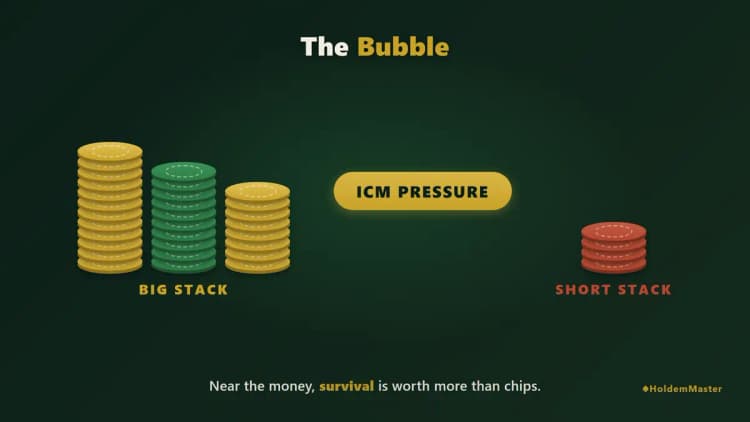
On the bubble, one more bust-out pays everyone else — so for a few critical hands, staying alive is worth more than the chips you could win. That single fact flips normal poker on its head, and almost everyone gets it wrong in the same two ways: the big stacks don't attack enough, and the medium stacks call far too much. This guide is the stack-by-stack playbook — what to do with a big, medium, or short stack, across the three different bubbles you'll face.
If you want the math behind why chips stop equaling money here, that's  ICM — this guide is where that theory turns into folds and shoves at the
  tournament table.
The bubble in one glance
What Is the Bubble in Poker? (And "On the Bubble")
The bubble is the spot right before the money — the point where one more elimination puts everyone still in their seat into the paid places. If a tournament pays the top 27, the bubble is reached with 28 players left: bust now and you get nothing; survive one more elimination and you're guaranteed a cash.
A few terms you'll hear:
- •On the bubble — the tournament is one (or a few) eliminations away from the money. Play slows to a crawl.
- •Bubble boy — the unlucky player who busts one spot short of the money and wins nothing. Nobody wants the title.
- •Stone bubble (or hard bubble) — the single elimination that bursts the bubble and pays everyone left. When it's a true stone bubble, all remaining players are guaranteed money the instant one player busts.
Why the Bubble Changes Everything: ICM in One Paragraph
Because tournament chips aren't money — you only win one first prize, so the chips protecting a guaranteed cash are worth more than the chips reaching for more. This is the Independent Chip Model, and near a pay jump it means the risk of busting outweighs the reward of winning a coin flip. A call that's break-even in chips can be a losing play in real dollars.
You don't need to run the math live — that's what our ICM calculator is for, and the full breakdown lives in the ICM guide. What matters at the table is the consequence: calls get much tighter, but shoves stay wide, because winning without a showdown (fold equity) is worth more than ever when everyone else is playing scared. Remember one line: tighten your calls before you tighten your shoves.
The 3 Bubbles You'll Face: Money vs Final-Table vs Satellite
Not all bubbles are equal — the money bubble, the final-table bubble, and the satellite bubble reward completely different strategies. Mixing them up is one of the most expensive mistakes in tournament poker.
- •Money bubble — the jump from nothing to a min-cash. Survival premium is high, but the min-cash is small, so you still want to accumulate for the top prizes. Apply pressure, don't just hide.
- •Final-table bubble — one spot from the final table. ICM pressure here is usually the most extreme in the entire tournament because the biggest prizes are now in play. Short stacks have the most to gain from a deep run; a big stack 9-handed is arguably the best seat in the whole event.
- •Satellite bubble — the odd one out. In a multi-seat satellite every qualifying seat pays exactly the same. Once your stack is big enough to be safe, extra chips are worth nothing — so the correct play becomes almost the opposite of a normal bubble (more on the "fold aces" rule below).
How to Play a BIG Stack on the Bubble
Attack relentlessly — you have the lowest risk premium at the table and everyone else has to respect your chips. The big stack is the single biggest beneficiary of the bubble. You can bust anyone; no one can bust you. So put the pressure on:
- •Open wide and 3-bet light, especially against the medium stacks to your right who can't call without risking their tournament.
- •Target medium stacks, not the shortest stacks. This is the key nuance: short stacks are more willing to call you (they have less to lose), and doubling one up is a disaster. Bully the players who are most afraid of busting — the mediums.
- •Don't get carried away. Applying pressure means stealing and folding to resistance, not spewing your stack into calls. If a tight medium stack finally shoves, respect it.
How to Play a MEDIUM Stack on the Bubble
The medium stack is the most trapped seat at the table — and this is the fact almost every article gets wrong. People assume the short stack feels the most pressure. By the actual math (bubble factor), it's the medium stack that's most constrained: big enough to have real prize equity to lose, not short enough to justify gambling.
Your playbook:
- •Tighten your calling range harder than anyone. You have the most to lose by calling off and busting. Fold hands you'd happily call with in a cash game — even hands as strong as some pairs and big aces against a bigger stack's shove.
- •Keep stealing from the stacks below you. Trapped on calls doesn't mean passive. Open and pressure the shorter stacks; just avoid tangling with the big stacks on your left.
- •Ladder awareness, not fear. You're navigating to the money, but don't fold your way to a short stack and blind out — that's trading one trap for a worse one.
How to Play a SHORT Stack on the Bubble
Move all-in or fold — never limp or call off — and use the fact that your bubble factor is actually lower than the medium stack's. Because you're already likely to bust, doubling up helps you a lot, so you're freer to gamble than the trapped middle stacks. But you gamble by being the one who shoves, not the one who calls — the full  short-stack push/fold playbook covers the mechanics:
- •Shove or fold. First-in aggression keeps your fold equity, which is your most valuable weapon. Open-limping or flat-calling with a short stack throws that away.
- •Wait if there are shorter stacks than you. If two players are shorter, you can fold marginal hands and let them bust first — laddering up for free. If you're the shortest, you can't afford to wait; find a spot and shove before you blind out.
- •Don't tighten into oblivion. Folding down to two big blinds "to survive" is how you become the bubble boy anyway. Pick a reasonable shoving range and commit.
Bubble Factor & Risk Premium: The Number That Tells You When to Fold
"Bubble factor" measures how much more losing your stack costs you than winning the same pot helps — and it converts directly into the extra equity you need to make a call. A bubble factor of 1.0 means chips and money move together (early in a tournament). A bubble factor of 1.5 means busting hurts 1.5× as much as winning helps, so you need a much bigger edge to get your chips in.
Here's the useful part: the equity you need to break even on a call is c · BF ÷ (P + c · BF), where c is what the call costs you and P is the pot you'd win — everything already in the middle, not counting your own call. When you're risking exactly what you stand to win, that collapses to the form you'll usually see quoted — BF ÷ (1 + BF) — which is what the table below uses.
| Bubble factor | Losing hurts… | Equity you need (no dead money) |
|---|---|---|
| 1.0 (no pressure) | same as winning helps | 50% |
| 1.3 | 1.3× | 57% |
| 1.5 (money bubble) | 1.5× | 60% |
| 1.7 (final-table bubble) | 1.7× | 63% |
| 2.0 (severe) | 2× | 67% |
Read that last column as a ceiling, not as your spot: real bubble pots hold dead money, and dead money pushes the requirement down. If the small blind jams 10bb and you call 9bb into a pot already holding 12bb, a bubble factor of 1.5 needs 52.9%, not 60% — and with no ICM pressure at all it's just pot odds, 42.9%.
The other half is that bubble factor tracks who is across from you, not the stage. Four-handed with three paid, a middle stack facing the chip leader carries a bubble factor near 3.0, while that same middle stack facing the shortest player is barely over 1.1; equal stacks sit near 1.9, and at a six-handed final-table bubble the middle stacks run 2.0 and up (the chip leader, as always, sits far lower). Treat 1.5–1.7 as a floor for a serious bubble, not a peak — then drop back once you're in the money. Plug your own stacks and payouts into the ICM calculator for the number that actually applies.
Hand-for-Hand and Stalling: The Mechanics Nobody Explains
When the money is close, tournaments switch to "hand-for-hand" — every table plays exactly one hand at the same time, then waits — specifically to stop players from stalling into the money. Without it, players at slow tables could fold hand after hand while faster tables burned through the bubble. Hand-for-hand levels the field:
- •How it works: the tournament director pauses the clock, and from then on every hand runs a fixed 2 minutes off the level no matter how long it actually takes (WSOP Tournament Rule 126.a and 126.c; TDA RP-8-C and RP-8-D) — so blinds keep climbing through the bubble, just per hand instead of per real minute. All tables deal one hand, and no table starts the next until every table has finished. If two players bust on the same hand-for-hand at the same table, the one who started the hand with fewer chips takes the lower (bubble) finish; if they bust at different tables, they tie for that place finish (WSOP Tournament Rule 126.b) and in practice split the two payouts involved. One case is written the same way in both rulebooks: for the single hand still in progress when hand-for-hand is announced, WSOP 126.c and TDA RP-8-A both have everyone who busts on it share the place or places paid. Check the house rule before you count on laddering.
- •Stalling: taking the full time bank on every decision in the hope of seeing fewer hands before the money. During hand-for-hand that hope is misplaced: it does not reduce the number of hands your table has to play — every table runs the same number of hands and each hand takes 2 minutes off the clock (WSOP Tournament Rule 126.a, 126.c) whether you snap-fold or burn the whole time bank. Big stacks have no reason to stall — they want more hands to attack. Short and medium stacks still stall out of habit, but excessive stalling can earn a clock call or a penalty — tank within reason, without deliberately burning your time bank.
- •Exploit it: because everyone else slows down, a big stack that keeps applying pressure during hand-for-hand racks up blinds and antes almost uncontested.
The Satellite Bubble: When to Fold Aces
On a multi-seat satellite, every seat pays the same — so the moment your stack is safely inside the bubble, you fold everything, including pocket aces. This is the most counterintuitive spot in poker, and it's correct. (A winner-take-all satellite that awards a single seat is different: it is played for first place on chip EV.) If winning a flip gives you the same seat you've already locked while losing it eliminates you, there is no reward and enormous risk:
- •Once your seat is mathematically safe (you're far enough inside the bubble that you can't be caught), fold every hand — yes, even AA and KK — and let the shorter stacks fight it out. Re-check that math every time the blinds go up: the "safe zone" shrinks as antes kick in.
- •Don't count on stalling live. Online, using your full clock carries no penalty; live, deliberately burning time banks to ladder up is explicitly penalty-eligible — WSOP Tournament Rule 80 names "purposely depleting time banks to ladder up in the payout" and routes it to a reduced clock or a penalty under Rules 40, 113 and 114 — fold at normal speed and let the short stacks fight.
- •The one exception: call only if you cover the short stack in question and their elimination locks the bubble for you — and only as long as your seat stays guaranteed even if you lose the pot.
The Biggest Bubble Mistake: Playing for the Min-Cash
Folding your way to the min-cash feels safe, but it trades the tournament's real money for its smallest prize. Because payouts are top-heavy, the min-cash is a floor, not a goal — the money is at the top of the ladder, and you only reach it by having chips when the bubble bursts.
The players who win tournaments treat the bubble as an opportunity to accumulate while everyone else hides. Survival matters for a few hands around the pay jump; after the bubble bursts, ICM pressure eases and it's back to building a stack for the win. Respect the bubble — then stop playing scared the moment it's over.


FAQ
The 3 Things to Remember
1. Survival beats chips — for a few hands. Near the pay jump, tighten your calls and keep your shoves wide. Then go back to accumulating once the bubble bursts. 2. The medium stack is the trap, not the short stack. Big stacks attack the mediums; mediums play tiny; short stacks shove first and use fold equity. 3. Know your bubble type. Money, final-table, and satellite bubbles reward different play — and on a satellite, a safe stack folds everything, even aces.
The engine behind all of it is ICM; the discipline behind the folds is knowing when to let go.