The hand that taught me what a 3-bet is really for went like this: a loose player opened, I looked down at A-K, and — like every beginner — I just called. The flop came ace-high, I got no money in, and he folded to a single bet. I'd turned the best hand into a tiny pot. A week later, same spot, I re-raised instead. He called with a worse ace, stacked off on an ace-high flop, and I won five times as much. Same cards. One decision — the 3-bet — was the whole difference.
A 3-bet is one of the most powerful weapons in No-Limit Hold'em, and also one of the most misunderstood. Most guides give you half the picture: how to make a 3-bet, but not how much, not which hands are bluffs and why, not what to do when someone 3-bets you. This is the complete 3-bet playbook — definition, sizing with the math actually shown, value and light ranges, the squeeze, facing a 3-bet, and the mistakes that quietly cost you stacks. It's a core piece of a winning  Texas Hold'em strategy — the raise-or-fold principle, turned up a level.
The 3-bet, by the numbers
What Is a 3-Bet in Poker?
A 3-bet is the first re-raise before the flop — you re-raise a player who has already open-raised. If someone opens to 3 big blinds and you make it 9, that's a 3-bet.
So why is it called a three-bet when it's only the second raise? Because the name counts bets in the sequence, not raises. The big blind is a forced bet — that's bet one. The open-raise is bet two. Your re-raise is bet three — the 3-bet. Follow the chain up and the rest of the vocabulary falls into place:
- •4-bet — the re-raise over a 3-bet (the fourth bet). Very strong or polarized.
- •5-bet — the re-raise over a 4-bet. At 100 big blinds this is usually all-in.
- •Cold 4-bet — a 4-bet from someone who hadn't raised yet (e.g. UTG opens, you 3-bet, the button 4-bets "cold"). It screams strength.
Why 3-Bet At All? What a 3-Bet Actually Does
Calling an open-raise (called flatting) keeps you in the pot, but a 3-bet does four things a flat can't:
1. It wins the pot immediately, often. A good chunk of the time, the raiser folds and you scoop the pot before the flop with no showdown. A flat never does this. 2. It builds a big pot with your best hands. When you hold aces or kings, flatting lets three other players in cheaply. 3-betting isolates the raiser and gets money in while you're a huge favorite. 3. It seizes the betting initiative. You become the aggressor with the betting lead on every street — and against a wide opener, that pressure prints money. 4. It denies equity and information. A raise charges opponents to continue instead of letting them see a cheap flop with a hand that might crack you.
The catch: because a 3-bet is powerful, doing it wrong is expensive. Too many players only ever 3-bet their monsters, which makes them completely readable. The rest of this guide is about doing it right.
When Should You 3-Bet? Value Hands vs. Light Bluffs
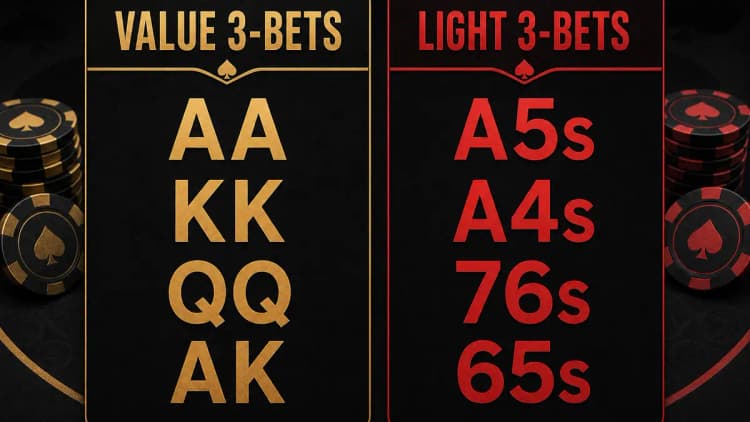
A winning 3-bet range has two distinct parts, and understanding the split is the single biggest leap in this topic.
Value 3-bets — hands you want called because you're ahead of what continues:
- •The core, almost always: QQ+ and AK.
- •Extend to JJ, TT, AQs, and KQs when you're up against a wider, later-position open — and trim back toward the core against a tight early-position raiser.
| Light 3-bet hand | Why it's a great bluff |
|---|---|
| A5s–A2s (suited wheel aces) | Your ace blocks their premiums — it drops their combos of AA from 6 to 3 and AK from 16 to 12 — so they're less likely to have a hand that continues. Plus it flops flushes, straights, and wheel draws. |
| Suited connectors (76s, 65s) | Terrific playability — they flop straights, flushes, and draws, so they win plenty even when the bluff gets called. |
| Suited one-gappers (T8s, 97s) | Same idea, slightly weaker: disguised, flexible, and cheap to fold if 4-bet. |
Here's the blocker logic in one sentence: holding an ace makes it mathematically less likely your opponent holds aces or ace-king, so A5s is a far better bluff than, say, A9o — which blocks the same premiums but plays terribly when called and mostly makes weak pairs. Backup equity matters because your opponent won't fold every time; you want a bluff that can still win the pot. That's why A5s ≈ 30% equity against a QQ+/AK calling range, while offsuit junk sits well below it. This is the same  starting-hand discipline as always — just applied to re-raising.
Linear vs. Polarized 3-Bet Ranges
You'll see these two words everywhere in 3-bet strategy. They describe the shape of your range, and picking the right one is what separates thinking players from hand-chart robots.
| Linear (merged) | Polarized | |
|---|---|---|
| Shape | One solid block of your best hands | Barbell: strongest value + bluffs, nothing in the middle |
| Example | QQ+, AK, AQs, JJ, TT, KQs | QQ+ and AK + A5s-type bluffs; flat the JJ/AQ/TT middle |
| Use it when | The open is wide and weak (late position), or you're in position. Against the same open, the small blind leans more linear than the big blind, because it rarely flats | The open is strong/tight (early position), or you're in the big blind (where you flat the middle at a discount) |
The reason is simple: against a wide, weak open, hands like AQ and TT are genuinely ahead, so you 3-bet them for value in one merged block (linear). Against a tight open, those same middle hands are dominated and get "blasted off" by 4-bets, so you 3-bet only true value plus clean bluffs and flat the middle (polarized).
One honest nuance the hand-chart crowd misses: position isn't the only factor. The real question is how likely you are to get blasted off your hand — which also depends on opponent aggression, rake, and your sizing. Facing someone who calls a lot and rarely 4-bets, with a small size and low rake, lean linear. Facing a 4-bet-happy opponent with a big size and high rake, lean polarized. Read the spot, don't memorize a rule.
How Much Should You 3-Bet? (Sizing, With the Math)
Most guides tell you "3x in position, 4x out of position" and move on. Here's the why and the actual arithmetic, using a standard open of 3 big blinds (call it a $6 open at $1/$2):
| Situation | Size | 3bb open becomes… | Why |
|---|---|---|---|
| In position (you'll act last) | ~3x the open | 9bb ($18) | Position lets you win with a smaller size, so you risk less. |
| Out of position (you'll act first) | ~4–4.5x | 12–13.5bb ($24–27) | Bigger charges them more to see a flop and denies your positional disadvantage a cheap ride. |
| Squeeze (open + a caller) | OOP size + ~1x per caller | ~15–16.5bb ($30–33) | Extra dead money and an extra player to push out. |
⚠ Isolating a limper is not a 3-bet. If everyone before you limped, your raise is the first raise of the round — a 2-bet. The sizing answers the same question, so it sits here: 3bb + 1bb per limper (add 1 more live), which lands around 4–5bb. It punishes the limp and discourages overcalls — you will still get called wide.
The math is deliberately visible because it's where beginners leak: 3 × 3bb = 9bb in position, 4 × 3bb = 12bb out of position. Two rules that override the multipliers:
- •At normal stack depths, never 3-bet tiny out of position. A small OOP 3-bet lays your opponent a great price to call and outplay you with position — the exact thing you're trying to avoid. Use the full 4x+.
- •Sizing isn't a law. Size down against players who over-fold (you're bluffing cheaper) and size up and go pure-value against calling stations who never fold. Rake and stack depth shift it too.
3-Bet, Flat, or Fold? A Decision Table
Facing an open, you have three choices, not two. This is the map that rarely gets drawn for beginners — when a hand prefers a 3-bet, a flat (call), or the muck:
| Your hand | In position (e.g. button vs a steal) | Out of position (small blind — the big blind flats wider, see below) |
|---|---|---|
| Premiums (QQ+, AK) | 3-bet for value | 3-bet for value |
| Strong (JJ-TT, AQ, KQs) | 3-bet vs wide opens; flat vs tight | Mostly 3-bet or fold — flatting OOP is weak |
| Speculative (small pairs, suited connectors) | Flat to set-mine / see cheap flops | 3-bet as a bluff, or fold |
| Blocker bluffs (A5s-A2s) | 3-bet as a light raise | 3-bet as a light raise |
| Everything else | Fold | Fold |
The big takeaway: flatting is legitimate in position — modern solvers keep a healthy flatting range on the button because you act last on every postflop street and only the two blinds are left behind you, so the squeeze risk is small and you can see flops profitably. Out of position it's weaker, but with one important split: from the small blind, lean toward 3-bet or fold with a more linear range: calling wide OOP realizes your equity poorly and builds a weak, cappable range, so you raise the top of your range and let the rest go. The big blind is the exception — because you close the action and are already getting a price, you defend by calling far wider there, especially against late-position steals. That leaves your big-blind 3-bets comparatively polarized: the strong hands and the bluffs, with the middle flatted. Position, again, changes everything — the same lesson as the position playbook.
The Squeeze Play: 3-Betting a Raiser and a Caller

A squeeze play is a 3-bet made after there's already been an open-raise and at least one caller. It's called a squeeze because you put both opponents in a vice: the original raiser now has to worry about the caller behind, and the caller — who just showed a hand not strong enough to re-raise — rarely wants to continue against your aggression.
Two things make the squeeze special:
- •There's more dead money. The pot already holds the raise and the call, so a successful squeeze wins more. Because you also size up for the caller, that doesn't always lower the fold rate your bluffs need — from the blinds it drops a little, from the button it stays about the same — but every fold now collects more chips.
- •Size it bigger. Add roughly one extra open-raise for each caller. Against a 3bb open plus one caller, a squeeze to about 15–16.5bb is standard — the extra size is what pushes both players out.
Facing a 3-Bet: Do You Call, 4-Bet, or Fold?

Here's the half of 3-betting that almost every article skips: you'll be on the receiving end about as often as you 3-bet yourself. When you open and get re-raised, you have three responses:
- •4-bet — for value with your premiums (QQ+, AK), plus the occasional blocker bluff (an A5s-type hand). A value 4-bet says "I'm not going anywhere" — a blocker-bluff 4-bet still folds to a 5-bet.
- •Call — with hands that flop well and have the equity or position to continue: pocket pairs looking to set-mine, suited broadways, and strong hands that don't want to bloat the pot into a 4-bet war.
- •Fold — everything else. Most of your opening range should simply give up to a 3-bet; that's normal, not weakness.
| Villain's fold-to-3-bet stat | What it tells you | Your adjustment |
|---|---|---|
| ~35% (rarely folds) | Most often a calling station — they continue with almost anything, so a bluff rarely gets enough folds to profit | 3-bet them for value only, stop bluffing, and value-bet relentlessly |
| ~55% (balanced) | A thinking regular | Play close to GTO — mix value and blocker bluffs |
| ~70%+ (folds too much) | An exploitable nit | 3-bet them light far more often — they hand you the pot |
Now swap back. MDF assumes a balanced opponent. At low stakes and in live games, players badly under-bluff their 3-bets — so when a passive player suddenly re-raises, believe them and defend less than the MDF baseline; in other words, fold more than 1−MDF. You don't owe a nit a "balanced" defense.
A Real 3-Bet Hand, Start to Finish
Enough theory — here's a full hand with the numbers, so you can see the whole flow. $1/$2 cash, 100bb deep.
- •Preflop: A loose cutoff opens to $6 (3bb). I'm on the button with A♠Q♠. This is a clear value 3-bet against a wide late-position open, and I'm in position, so I make it $18 (3x). The blinds fold; the cutoff calls. Pot is $39.
- •Flop: Q♦ 8♣ 4♥. I flop top pair, top kicker — my A♠Q♠ makes a pair of queens with the best possible kicker (the ace). Best five cards: Q♠ Q♦ A♠ 8♣ 4♥ = one pair (queens) with the ace kicker. Against his range of worse queens, eights, and floats, I'm way ahead.
- •The point: because I 3-bet preflop, the pot is already big and I have the betting lead, so I bet again for value and get paid by worse queens and draws. Had I just flatted preflop, three other players might have seen that flop, my hand would be far harder to play, and the pot would be a fraction of the size. The 3-bet is what turned top pair into a stack.
The 6 Most Common 3-Betting Mistakes
| The mistake | Why it costs you | The fix |
|---|---|---|
| 3-betting too small OOP | Lays a great price to call — they realize equity in position against you | At normal stack depths, use the full 4x+ out of position |
| Only ever 3-betting value | You become face-up; good players fold everything but coolers | Add suited blocker bluffs (A5s) |
| Never 3-bet bluffing at all | Leaves money on the table vs wide steals; your flats get too weak | Balance value with a few light 3-bets |
| 3-betting merged vs a nit | Your "value" is dominated by their premium-only range | Go polarized or just fold vs a true nit |
| Bluff-3-betting junk (Q7o) | Weak blockers and little backup equity — you must fold to every 4-bet | Pick blocker/playability hands only |
| Flatting too much from the small blind | Poor equity realization OOP; a weak, cappable range | Facing a raise, mostly 3-bet-or-fold from the SB; save the wide flats for the big blind |
Notice the thread running through all six: a good 3-bet has a reason — value you want called, or a bluff with blockers and backup equity. Random re-raising with no plan is how stacks disappear.

FAQ
The 3-Bet Playbook, In Short
1. A 3-bet is the first pre-flop re-raise — third bet in the sequence, because the blind counts as bet one. 2. Build two ranges: a value core (QQ+, AK) you want called, and suited blocker bluffs (A5s and friends) chosen for blockers and playability. 3. Size it ~3x in position, ~4x out — and, at normal stack depths, not small out of position. 4. Match shape to spot: linear vs wide/weak opens (and from the small blind when facing a raise), polarized vs tight opens and from the big blind. 5. Facing a 3-bet, most hands fold — 4-bet premiums, call the playable ones, and fold more than "balanced" against opponents who never bluff. 6. Then the flop arrives. A 3-bet pot plays nothing like a single-raised one — on this article's numbers (3bb open, 9bb 3-bet, 100bb deep) the pot is roughly 2.6× bigger (19.5bb vs the 7.5bb a heads-up flat would build; a larger out-of-position 3-bet pushes it toward 3.5×) and the SPR drops to about 4.7. The three-bettor still often bets its entire range on the flop — because of the shape of its range, not because the stack is shallow.
Get 3-betting right and you stop being the player who just calls with aces and wins a tiny pot. Pair it with a disciplined starting-hand range, sharp position awareness, and the full strategy framework, and your preflop game quietly moves ahead of the field.