
For my first couple of years, "c-bet" was the only flop plan I had. I raised preflop, so I bet the flop. Every time. Ace-high board, I bet. Board full of straights and flushes that clearly smashed the guy who called me? I bet anyway — and got raised, called, and check-raised off pot after pot. I thought c-betting was the strategy. It turns out the c-bet is a scalpel, and I was swinging it like a hammer.
A continuation bet (c-bet) is a bet on the flop by the player who raised before it. It's the most common bet in poker — and the most badly overused. The old advice was "c-bet almost every flop." Modern, solver-checked strategy says something more useful and more profitable: bet the flops that favor your range, and check the ones that favor your opponent's. This is the complete c-bet playbook — which flops, how often, how much, in and out of position, multiway, and when checking is the winning move. It's the flop half of a winning  Texas Hold'em strategy.
The c-bet, by the numbers
What Is a Continuation Bet (C-Bet)?
A continuation bet is a bet made on the flop by the player who was the aggressor before the flop — the last person to raise. You "continue" telling the story of strength you started preflop. Crucially, you don't need to have hit the flop to c-bet; a large share of good c-bets are made with hands that completely missed.
The reason it works is one simple statistic: two unpaired hole cards fail to pair on the flop about two-thirds of the time (67.6%). So when you bet, your opponent has often missed too — and a lot of those hands fold. You're not betting because you're strong; you're betting because they're probably weak and you were the one who claimed the lead.
Once you know the flop c-bet, the rest of the "barreling" ladder follows:
- •Delayed c-bet — you check the flop, then bet the turn. Great for pots where the flop favored your opponent but the turn changes things.
- •Double barrel — you c-bet the flop and bet again on the turn.
- •Triple barrel — you bet all three streets: flop, turn, and river. The most aggressive line, for strong value or a well-chosen bluff with blockers.
The Old "C-Bet Every Flop" Advice Is Wrong — Here's What Changed
If you learned poker before solvers, you were told to c-bet around two-thirds pot on most flops. It worked for a while because opponents over-folded. Then everyone learned to fight back — floating, check-raising, and calling down — and blanket c-betting became a leak.
Here's the crucial thing modern strategy actually says, because it's easy to get wrong: it is NOT "c-bet less everywhere." It's a split:
- •On boards that favor you, bet small and even more often than the old advice — sometimes your entire range.
- •On boards that favor your opponent, check much more — and bet bigger and more selectively when you do.
And range advantage isn't the whole story — add position on top of it and the effect gets extreme. On A-7-2 rainbow a solver has the caller checking 98.2% of its range, top pair included — its range equity trails only 45.1% to 54.9%, yet being out of position turns that modest gap into an almost total check. The full breakdown is in  top pair, still checking.
Review your own hand from this spot — The A-7-2 example above is a BTN open, BB call pot. If you have played the same situation, open the solver's Hand review ↗, set the situation (Open · Call, BTN and BB) and Your seat, pick Your 2 cards and the 3 flop cards, then enter the actions in the order they were actually played, including your opponent's. Hand review then shows whether that choice is rated Best play, Acceptable or Review this play. Hand review uses the app's preflop charts (online 6-max cash, 100bb), so its numbers can differ slightly from the example above, and it may not suit pub games or tournaments.
Which Flops to C-Bet: It's All About Board Texture
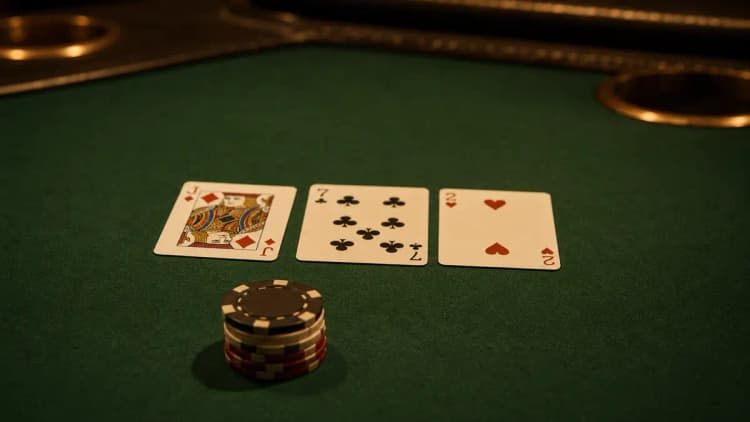
This is the heart of c-betting. Before you think about sizing or frequency, ask one question: did this flop hit my range, or my opponent's? Here's the map:
| Flop type | Example | Who it favors | In position | Why |
|---|---|---|---|---|
| High, dry, disconnected | K‑7‑2, A‑8‑3 | You (raiser) | Bet often & small (⅓) | You have more top pairs & overpairs; they missed |
| Low, connected | 7‑6‑5, 9‑8‑6 | Caller | Check more; bet big & selective when you do | Hits their suited connectors and small pairs |
| Paired low | 8‑8‑3, 5‑5‑2 | You (slightly) | Bet often & small | Neither has trips much; your overcards/overpairs lead |
| Monotone | K♠9♠4♠ | Mixed — caution | Bet less, smaller | A made flush caps both ranges; go cheap |
| Two-tone & wet | Q♥J♥7♣ | Caller-leaning | Polarize: big with value/draws, check air | Tons of draws — charge them or get out |
Two related ideas do all the work here:
- •Range advantage decides how often you bet. More of your range is strong on this board → bet more often.
- •Nut advantage decides how big you bet. You hold more of the absolute best hands (sets, straights) → bet bigger.
How Often Does a Solver C-Bet on Each Board Type?
In a single-raised pot where the button opens and the big blind calls, a solver has the button c-bet 54.7% of its whole range after the big blind checks. That average hides a wide spread: from 43.5% on ace-high flops to 67.8% on paired flops, with different main sizes. Paired and king-high flops lean on the one-third-pot bet; ace-high, ten- and nine-high and low flops actually use the 75% bet more. The tables below group all 1,755 precomputed flops by board type.
How these numbers were calculated — Results from the HoldemMaster GTO solver for a BTN open vs BB call across 1,755 flops (suit-isomorphic) — 100bb stacks · flop bets 33%/75% · turn and river bets 60% · raises 60% · no rake · 0.3% target error. Input ranges = the solver's preflop charts (consensus ranges built from public sources). It is a heads-up calculation, so it does not carry over directly to multiway pots.
By high card — the button's c-bet after a BB check
Of all 22,100 possible flops, the most common type is queen- or jack-high (23.5%), and the type the button c-bets least is ace-high (43.5%).
| Board type | Share of flops | Total c-bet | 33% | 75% |
|---|---|---|---|---|
| Paired | 17.2% | 67.8% | 60.6% | 7.2% |
| Ace-high | 19.1% | 43.5% | 16.3% | 27.2% |
| King-high | 15.9% | 57.2% | 40.8% | 16.4% |
| Queen/jack-high | 23.5% | 52.1% | 27.5% | 24.7% |
| Ten/nine-high | 14.2% | 53.2% | 19.8% | 33.4% |
| Low (eight-high or lower) | 10.1% | 57.7% | 23.8% | 33.8% |
| All flops | 100% | 54.7% | 31.7% | 23.0% |
| Board type | Bets least | Bets most |
|---|---|---|
| Paired | A♣Q♦Q♣ 37.7% | 7♥7♦7♣ 97.1% |
| Ace-high | A♣9♣2♣ 28.5% | A♥7♦2♣ 59.0% |
| King-high | K♣Q♣2♣ 32.5% | K♥7♦2♣ 90.2% |
| Queen/jack-high | Q♥J♦8♣ 35.5% | Q♥7♦2♣ 84.7% |
| Ten/nine-high | T♣9♦7♣ 38.5% | T♥6♦2♣ 73.5% |
| Low (eight-high or lower) | 8♦7♦4♣ 46.4% | 7♥6♦2♣ 76.3% |
| All flops | A♣9♣2♣ 28.5% | 7♥7♦7♣ 97.1% |
By suits and connectedness — the same calculation on another axis
| Board type | Share of flops | Total c-bet | 33% · 75% |
|---|---|---|---|
| Rainbow (three suits) | 39.8% | 58.8% | 36.1% · 22.7% |
| Two-tone (two cards of one suit) | 55.1% | 52.6% | 28.7% · 23.9% |
| Monotone (three cards of one suit) | 5.2% | 44.2% | 29.2% · 15.1% |
| Connected (unpaired · all three within five ranks) | 18.5% | 49.1% | 18.8% · 30.3% |
| Disconnected (unpaired · the rest) | 64.3% | 52.8% | 27.7% · 25.1% |
High card × suits — total c-bet
| Board height | Rainbow | Two-tone | Monotone |
|---|---|---|---|
| Paired | 70.3% | 65.3% | n/a |
| Ace-high | 44.6% | 43.6% | 35.4% |
| King-high | 63.3% | 54.9% | 40.8% |
| Queen/jack-high | 55.7% | 50.6% | 44.2% |
| Ten/nine-high | 57.9% | 50.4% | 49.7% |
| Low (eight-high or lower) | 60.6% | 55.5% | 59.1% |
How does the big blind respond to a c-bet?
Facing a 33% c-bet
| Board type | Fold | Call | Raise |
|---|---|---|---|
| Paired | 34.0% | 48.5% | 17.6% |
| Ace-high | 36.4% | 54.5% | 9.1% |
| King-high | 32.3% | 55.2% | 12.5% |
| Queen/jack-high | 29.5% | 57.0% | 13.5% |
| Ten/nine-high | 28.0% | 57.4% | 14.6% |
| Low (eight-high or lower) | 29.4% | 52.6% | 18.0% |
| All flops | 32.1% | 53.3% | 14.6% |
| Board type | Fold | Call | Raise |
|---|---|---|---|
| Paired | 48.9% | 38.1% | 13.0% |
| Ace-high | 50.4% | 46.0% | 3.6% |
| King-high | 49.7% | 45.1% | 5.1% |
| Queen/jack-high | 47.7% | 45.6% | 6.7% |
| Ten/nine-high | 46.3% | 44.7% | 9.0% |
| Low (eight-high or lower) | 46.2% | 40.8% | 13.0% |
| All flops | 48.1% | 44.4% | 7.5% |
Leading into the raiser (a donk bet) is only 2.4% for the big blind overall (1.7% at 33% plus 0.7% at 75%). Split by suits, the highest is monotone at 7.2% (92.8% check); split by height and suits together, low monotone flops reach 9.2%. The exception boards where the big blind should lead are covered in the donk bet guide.
How to read these tables — Each cell averages its flops weighted by how often they actually come up (all the suit variants of a flop counted together). For a spot that isn't the first action, like the button after a big blind check, each flop is also weighted by how often that spot is reached on it, and within a flop each hand is weighted by the probability of holding it and arriving at that spot. The flops listed under "bets least" and "bets most" each stand for their whole suit group (A♣9♣2♣ = every A-9-2 monotone flop). Because of rounding, a row can add up to 99.9–100.1.
How Often Should You C-Bet? (Frequency)
There is no single "correct" c-bet percentage — anyone who gives you one number is selling you a leak. Frequency swings with position, board, and how many players are in the pot. Here's the quick-reference:
| Situation | Rough c-bet frequency | Note |
|---|---|---|
| In position, heads-up, dry board | 70–100% (small) | Classic "range bet" — bet nearly everything, tiny |
| In position, heads-up, wet board | ~50–60% | More polarized — value and draws bet, air checks |
| Out of position, heads-up (single-raised pot, you were the raiser) | ~30–45% | Check far more to protect your checking range. As the OOP 3-bettor it flips: over 97% on all three boards we solved, almost all of it at two-thirds pot on Q♥T♥7♠ and 8♦5♣2♠ but mostly at one-third pot on A♦K♠2♥ (57.8%); see the position guide |
| Multiway (2 opponents) | ~50% or less | Someone likely connected — tighten up |
| Multiway (3+ opponents) | Strong hands & good draws only | Fold equity is basically gone |
As a health check, a solid player's overall flop c-bet rate lands somewhere around 55–70% across all boards. If you're c-betting over ~85% of flops you're auto-piloting and good players will punish it; under ~40% and you're too honest, only betting when you hit. But remember — that number is an aggregate, not a target. You get there by betting the right boards, not by hitting a quota.
For one concrete reference point: in the solver's BTN-vs-BB heads-up spot above, the button's average c-bet after a big blind check is 54.7%, and single flops range from 28.5% (A-9-2 monotone) to 97.1% (7-7-7). Learn frequency by board type, not as one number to hit.
How Much Should You C-Bet? (Sizing)
Sizing follows straight from board texture. Two gears cover almost everything:
- •Small — about one-third of the pot — on dry, static, range-advantage boards, especially in position. Your opponent's range is weak and won't improve much, so you don't need to charge draws; a small bet already puts all their air in a tough spot while keeping worse hands in to pay you. A bigger bet here just folds out the hands you want to call.
- •Big — two-thirds pot or more — on wet, dynamic boards and whenever your range is polarized. Now you need to charge the flushes and straight draws (deny their equity) and build the pot with your strong hands. A small bet lets draws call too cheaply.
- •A one-third-pot c-bet is $10 — your dry-board range bet.
- •A two-thirds-pot c-bet is $20 — your wet-board, charge-the-draws size.
Want to see how far the "big on wet boards" gear actually goes? A solver handed two sizes on Q♥T♥7♠ in a three-bet pot puts  98.4% of its range into the two-thirds bet — and the reason is a price you can calculate, not a feel.
C-Betting Out of Position

C-betting is much harder out of position in a single-raised pot — when you have to act first every street with no read on what your opponent will do (as the 3-bettor the range advantage changes this, see the position guide). Two adjustments:
1. C-bet less often. Without position you can't control the pot as well or realize your equity, so you check far more — even hands that would be automatic bets in position. On some boards a solver c-bets out of position in a single-raised pot only a quarter of the time.
2. Build a real checking range. If you only ever bet when you're strong and check when you're weak, an observant opponent reads you like a book and attacks every check. So you deliberately check some strong hands too, which keeps your checks dangerous and your whole game harder to play against. This is exactly why  position is such a structural edge — c-bets simply work better when you act last.
C-Betting in Multiway Pots
The single biggest c-bet trap is firing into multiple opponents like it's heads-up. Every extra player in the pot slashes the chance that everyone missed — so your fold equity, the whole engine of a bluff c-bet, collapses.
The rule multiway is simple: bet your strong made hands and your best draws for value and protection, and check nearly everything else. Against two players you're already tightening well past your heads-up range; against three or more, a bare bluff c-bet is just lighting chips on fire, because someone almost always has a piece. Range betting — betting your whole range small — is a heads-up idea and does not transfer to multiway pots. When in doubt with a marginal hand and two or more opponents, check.
The Delayed C-Bet
Checking the flop isn't the end of the hand. A delayed c-bet — checking the flop as the preflop raiser, then betting the turn — is one of the most underused moves in poker. It shines when:
- •The flop favored your opponent (a low, connected board), so betting was bad — but the turn changes the picture (an overcard, or a card that brings your equity up).
- •You checked back a decent hand in position and want to bet a street of value now that the board is safer.
- •You want to take away the flop raise: players who planned to bluff-raise your flop c-bet get no bet to attack, and then face your turn bet instead.
When NOT to C-Bet (Checking Is a Weapon, Not a White Flag)
Let's make the "don't" explicit, because it's where the money is saved:
- •The board smashed your opponent's range. A 7‑6‑5 or 9‑8‑7 flop hits the hands that call a raise far harder than it hits yours. Betting here with most of your range just donates chips — check far more often, and when you do bet, go big and selective.
- •You're out of position on a dynamic board with a marginal hand. Acting first with no information, keep the pot small and check.
- •You're multiway with air. Covered above — almost no fold equity, so no bet.
- •Your hand wants to protect a checking range. Sometimes you check a strong hand on purpose so your checks aren't automatically weak.
A Real C-Bet Hand, Start to Finish
Two spots from the same session show both sides of the decision.
Spot 1 — a textbook c-bet. I raise A♣K♦ and the big blind calls. Flop: K♠ 7♦ 2♣. That's a high, dry, disconnected board that belongs to my range — and I've flopped top pair, top kicker: my K♦ pairs the K♠, with the ace as the best possible kicker (best five = K♦ K♠ A♣ 7♦ 2♣). I bet one-third pot as a range bet: it pressures his missed hands and keeps worse kings and pairs in. Easy, profitable c-bet.
Spot 2 — a textbook check. Same session, I raise A♥Q♥ and the big blind calls. Flop: 7♠ 6♠ 5♦. This board crushes the exact hands he called with — suited connectors, small pairs, and straights — while I have only ace-high with no pair and no draw (no hearts on the board, so not even a backdoor flush). Two years earlier I'd have "continued" out of habit and gotten raised. Now I check and give up. If a safe turn comes and I pick up equity, a delayed c-bet is available; if not, I've lost the minimum.
Same preflop raise, opposite flops, opposite correct plays. That's the whole lesson: the board decides, not the fact that you raised.
The 7 Most Common C-Bet Mistakes
| The mistake | Why it costs you | The fix |
|---|---|---|
| C-betting every flop on autopilot | Ignores that many boards favor the caller | Read the texture first |
| Betting big with a wide range | Wide ranges want small sizing, not big | Small on dry, big only when polarized |
| C-betting light multiway | Fold equity collapses with more players | Value & draws only vs 2+ |
| C-betting OOP too often | You can't realize as much equity acting first | Check more, build a checking range |
| Betting into a board that hit them | 7‑6‑5 smashed their range, not yours | Check more; bet big and selectively when you do |
| "One-and-done" barreling | C-bet flop, always give up turn = easy to float | Have a turn plan before you fire |
| Triple-barreling with no equity | Bluffing off a stack with no outs or blockers | Bluff with backup equity or good blockers |
Every one of these traces back to the same root: c-betting on autopilot instead of reading the board. Fix that and your flop game jumps a level.


FAQ
The C-Bet Playbook, In Short
1. A c-bet is a flop bet by the preflop raiser — and it works because hands miss the flop about two-thirds of the time. 2. The board decides. Bet high, dry boards that favor your range; check low, connected boards that favor your opponent's. 3. Range advantage sets frequency; nut advantage sets size. Bet often on boards you dominate; bet big when you hold more of the nuts or need to charge draws on wet boards. 4. Small (⅓) on dry, big (⅔+) on wet. C-bet less out of position as the single raiser (as the OOP 3-bettor it flipped to over 97% on the three boards we solved), and much less multiway. 5. Checking is a weapon. The best players check often and on purpose — the c-bet is a scalpel, not a hammer.
Get this right and you stop torching pots on boards that were never yours to bet. Pair sharp c-betting with a solid 3-bet game, real position awareness, and the full strategy framework, and your flop play quietly leaves the "bet every flop" crowd behind.