I walked into my first live poker tournament with $200, a vague idea of how Texas Hold'em worked, and zero clue what a "blind level" or "bubble" meant.
Four hours later I was out. But I knew exactly what every term meant, why I lost, and when to come back.
This guide is everything I wish someone had told me before that day — how tournament structure actually works, which format you're entering, how to register without looking clueless, and what Day 1 feels like hour by hour.
At a Glance
What Is a Poker Tournament? (30-Second Answer)
A poker tournament is a competition where everyone pays the same entry fee (the buy-in), receives the same number of starting chips, and plays until one person holds every chip in the game.
One-sentence summary: In a cash game your chips are real money and you can leave anytime. In a freezeout tournament, your maximum loss is exactly the buy-in — re-entries and add-ons push it higher — but you're playing for a share of a much bigger prize pool.
That single difference changes chip value, blind pressure, and strategy from the ground up. → Full breakdown:  Poker Tournament vs Cash Game — Which Should You Play?
Poker Tournament Structure — Buy-Ins, Fees, and Starting Stacks
When you register, you pay a buy-in. That money splits two ways:
| $109 buy-in (written as "$100+$9") | Where it goes |
|---|---|
| $100 | → Prize pool, shared by all entrants |
| $9 | → House fee (rake) kept by the venue |
In exchange, you receive a starting stack — commonly 10,000 to 50,000 tournament chips, usually 100–300 big blinds deep at Level 1.
Your starting stack has no cash value. A 10,000-chip stack doesn't equal $10,000 — it's just your tournament life. All that matters is whether you have more chips than the other players when the money spots arrive.
Every tournament publishes its structure in a structure sheet: starting stack, blind levels, level duration, ante schedule, and the payout schedule. Ask for it at registration — it's the single most useful document in the room.
Poker Tournament Blind Structure — Levels, Antes, and the Clock
This is what most beginner guides skip, and it's the most important mechanical concept in tournaments.
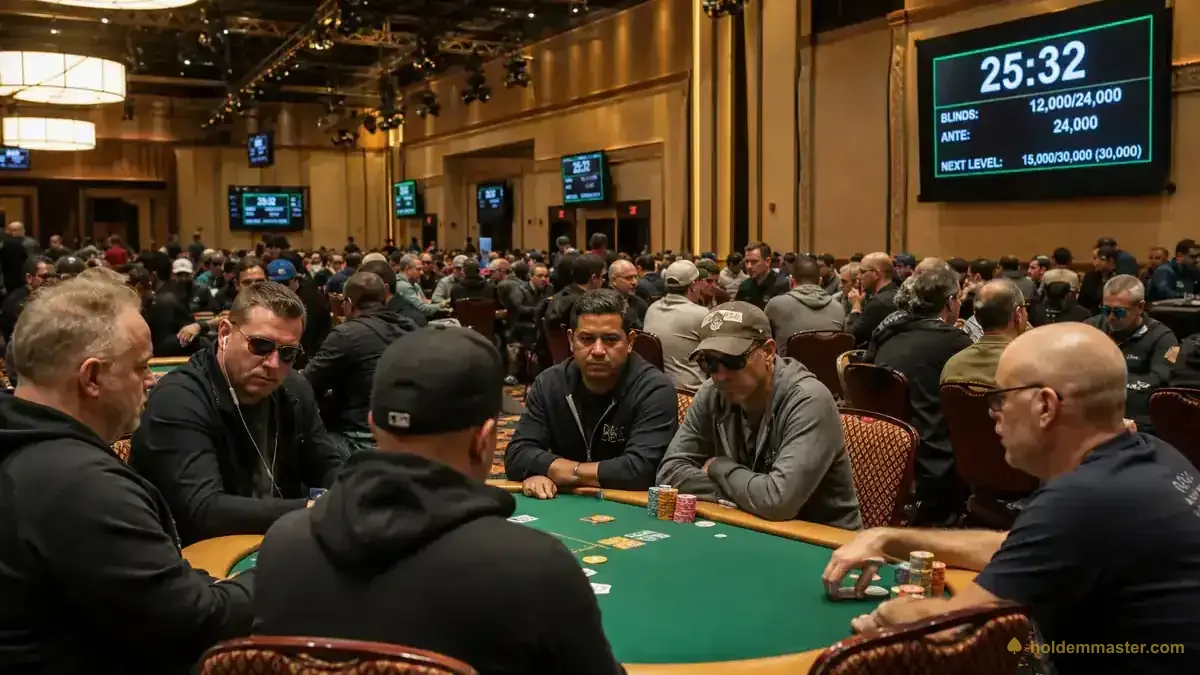
Blinds start small and increase on a timer — usually every 20–40 minutes in live events, and 60 minutes or more in flagship Main Events (WPT Australia 2026 runs its Championship Event on 60-minute levels, stretching to 90 on the later days).
| Level | Blinds | Antes | Your 10k stack = |
|---|---|---|---|
| 1 | 25 / 50 | — | 200 big blinds |
| 3 | 75 / 150 | 150 | 67 big blinds |
| 6 | 200 / 400 | 400 | 25 big blinds |
| 9 | 500 / 1,000 | 1,000 | 10 big blinds |
Rule of thumb: below 20 big blinds you're edging into push-or-fold territory, and by 15 it's your main mode. Below 10 big blinds, you must shove almost any playable hand — especially from late position or the small blind — before the blinds eat you alive.
When you get there, the exact shoving ranges live in short-stack strategy — when to push or fold.
What are antes? After the early levels, most tournaments add an "ante" — an extra forced bet collected every hand on top of the blinds. In most modern live events this is a single "big blind ante" equal to one big blind, paid by the big-blind player on behalf of the whole table (which is why the ante column above matches the big blind). This increases the pot size and speeds up play. When antes kick in, your chips shrink even faster.
New to blinds altogether? Start with what the small blind and big blind actually are — it makes every "BB" number above click.
The 4 Stages Every Tournament Goes Through
Stage 1 — Early Levels (100–200 BB deep)
You have room to play. Speculative hands, set-mining, seeing flops — all reasonable. Most beginners play too tight here. The blinds are cheap; learn the table.Stage 2 — Middle Stages (30–60 BB)
Antes are usually in by now. Stack pressure starts. Players with short stacks start shoving. This is where most of the field gets eliminated.Stage 3 — The Bubble
The most stressful stage. One more elimination and everyone remaining gets paid (ITM = In The Money). Short stacks freeze up. Big stacks bully. Smart play here can add real equity without winning a single pot — the bubble deserves its own guide.Stage 4 — Final Table
Usually 6–9 players left. Payouts increase sharply with each elimination. ICM (the Independent Chip Model) governs decision-making here — chip EV and real-money EV diverge significantly.
Types of Poker Tournaments — Freezeout, PKO, Satellite, Deepstack & More
| Format | How it works | Best for |
|---|---|---|
| Freezeout | One buy-in, no rebuy. Bust = out. | Beginners — fixed cost |
| Rebuy / Re-entry | Buy chips again during the early window — in rebuys, often without busting first | Aggressive players with a bigger bankroll |
| Bounty / KO | Win a fixed cash bounty for each player you eliminate | Action players — extra income per knockout |
| PKO (Progressive KO) | Bounties grow with each knockout — part paid to you, part added to your head | High-variance, big-upside players |
| Deepstack | Starting stack well above the standard event in the same series, plus slower levels | Players who want more postflop play |
| Satellite | Prize = entry into a bigger tournament, not cash | Budget players targeting major events |
| Turbo / Hyper-Turbo | Much shorter blind levels than the standard event, so stacks get shallow fast and push/fold arrives early | Short sessions — players comfortable with shove-or-fold |
| Mystery Bounty | A bounty event where each knockout (usually from a set stage of the event) draws a random prize — most are small, a few are jackpots | Players chasing one big payout |
| MTT | Multi-Table Tournament — large field across many tables | Any — the most common format |
| SNG (Sit & Go) | Starts when seats fill (no set start time) — usually 6–9 players | Quick game, no scheduling needed |
The three format names you'll see most often on a tournament schedule deserve a proper definition:
What Is a Freezeout Poker Tournament?
A freezeout poker tournament gives every player exactly one buy-in. Lose your chips and you're eliminated — no rebuys, no re-entries. It's the original tournament format, and the best one for beginners because your total cost is fixed the moment you register.
What Is PKO Poker? (Progressive Knockout)
A PKO (Progressive Knockout) is a bounty tournament where typically around half of each buy-in goes to the regular prize pool and the other half becomes a bounty on that player's head. When you knock someone out, you typically collect part of their bounty in cash immediately, and the rest is added to your own bounty — making you a bigger target as you win. The exact split varies by site and event; 50/50 is common but not universal, so check the lobby or structure sheet. (A full PKO strategy guide is coming to this cluster soon.)
What Is a Deepstack Poker Tournament?
A deepstack poker tournament starts you with far more chips relative to the blinds than the standard event in the same series, and usually pairs that with longer blind levels. There is no standardised threshold for it — "deepstack" is always a relative label. Work out from the structure sheet how many big blinds your Level 1 stack is worth, then compare that against the 100–200 BB of a standard event. More chips and a slower clock mean more postflop play, more room to recover from a mistake, and longer days.
What about rebuys and add-ons? In a rebuy event you can buy again during a set early window — in many events, any time your stack is at or below the starting amount, without having to bust first; an add-on is a one-time optional chip purchase usually offered when that window closes. After that, the event plays out like a freezeout.
What Is a Satellite Poker Tournament?
A satellite is a smaller tournament where the prize isn't cash — it's an entry ticket into a larger, more expensive tournament.
Example:
- •WSOP Main Event buy-in: $10,000
- •Satellite buy-in: $500 (20 players)
- •Prize: 1 seat into the Main Event
Chained satellites go even lower. A $5 super-satellite → $55 qualifier → $215 event → a $1,050 online Main Event. Many players at major events entered through a satellite chain for a fraction of the direct buy-in.
Satellite strategy is different from regular tournament play — in a satellite that awards several identical seats, once you have enough chips to guarantee a seat, stop taking risks — fold even good hands to avoid busting on the bubble. A winner-take-all satellite that awards a single seat is the exception: it is played for first place on chip EV.
How to Enter a Poker Tournament — 3 Ways
Option A: Direct Buy-In at the Casino (Easiest)
1. Find the poker room registration desk (or tournament desk for larger events) 2. Present valid photo ID + loyalty card if required 3. Pay the buy-in in cash, chips, or card 4. Receive your seat card (table number + seat number) 5. Go to your table, give the seat card to the dealer, receive your chips 6. Count your starting stack before playing your first hand — errors happenOption B: Online Pre-Registration
Most major live festivals let you register online in advance:- •Set up an account on the event's platform (e.g., the WSOP LIVE app for WSOP, the "Events" and "Live" tabs in the PokerStars lobby for EPT/APPT events)
- •Pay the buy-in online
- •Arrive at the venue → ID verification → print seat card at a kiosk or pick up at desk
- •Skips the registration line — worth doing for large events
Option C: Satellite Qualifier
- •Find satellite tournaments online (PokerStars Power Path, GGPoker's WSOP satellites) or on-site
- •Win the satellite → receive a seat ticket for the target event
- •Arrive at the main event registration desk → present ticket + ID → receive seat card
Playing in Asia? See the APT Incheon 2026 guide for a real festival's schedule, buy-ins, and registration flow.
How to Play Tournament Poker — Strategy by Stage
One post can't teach full tournament strategy — that's what the cluster guides are for — but here is the stage-by-stage skeleton every winning plan hangs on:
Early levels (100BB+): Play tight, position-aware poker and see cheap flops with hands that can crack big pairs. A disciplined starting hands chart prevents most beginner disasters. Don't bluff off your stack in the first hour — nobody folds at Level 1.
Middle stages (30–60BB): Antes make every pot worth fighting for. Open lighter from late position, steal blinds, defend your big blind more often, and start tracking who is short-stacked at your table.
Short stack (under 20BB): Push-or-fold takes over — the math here is essentially solved, and guessing costs real money. Learn the shove ranges in short-stack strategy.
Bubble and final table: Survival math overtakes chip math. Payout pressure changes which hands you can play — the bubble and ICM guides linked in the stages section above cover exactly how.
What Happens on Day 1 — Hour by Hour
This is the part most beginners only learn the hard way. Here's a realistic Day 1 timeline for a live $300 freezeout with a 12pm start time:
Poker Tournament Payout Structure — Who Gets Paid What
Typical structure: Top 10–15% of the field gets paid.
| Field Size | Players Paid | Min-Cash (typical) | 1st Place (typical) |
|---|---|---|---|
| 100 | ~13 | 1.5–2x buy-in | 25–30% of prize pool |
| 500 | ~60 | 1.5–2x buy-in | 20–25% of prize pool |
| 2,000 | ~250 | 1.7–2.2x buy-in | 13–18% of prize pool |
| 10,000 | ~1,200 | 1.5–2x buy-in | 8–12% of prize pool |
- •Prize pool: $4,592,000 ($3,200 of each buy-in goes to the pool — the rest is the fee)
- •Players paid: 180 (~12.5% of the field)
- •Min-cash: about 1.83x the buy-in
- •1st place: $662,200 (~14% of the prize pool)
Tournament Glossary — Terms You'll Hear on Day 1
These 16 terms cover most of what you'll hear at the table. For the full A-to-Z, see the poker glossary.
| Term | What it means |
|---|---|
| ITM | In The Money — you've reached a paying position |
| Bubble | The stage just before ITM — one elimination from everyone cashing |
| Hand-for-hand | All tables play one hand at a time during the bubble to prevent stalling |
| Structure sheet | The official document listing blind levels, antes, and the payout schedule |
| Chip leader | The player with the most chips |
| Short stack | A player with very few chips relative to the blinds |
| Shove / JAM | Go all-in (push your entire stack into the middle) |
| Late reg | Late registration window — you can enter after the tournament starts |
| Re-entry | Buying back in after busting (only during the late reg window) |
| Satellite | A qualifier tournament where the prize is a seat in a bigger event |
| PKO | Progressive Knockout — bounty tournaments where the prize grows |
| Mystery Bounty | A bounty format where the prize for each knockout is drawn at random |
| Turbo | A structure with much shorter blind levels; a hyper-turbo is shorter still |
| Add-on | A one-time extra chip purchase offered to everyone at the end of the rebuy period, regardless of stack size |
| ICM | Independent Chip Model — a mathematical framework for tournament chip value |
| Min-cash | The lowest payout position — the minimum you earn for making the money |