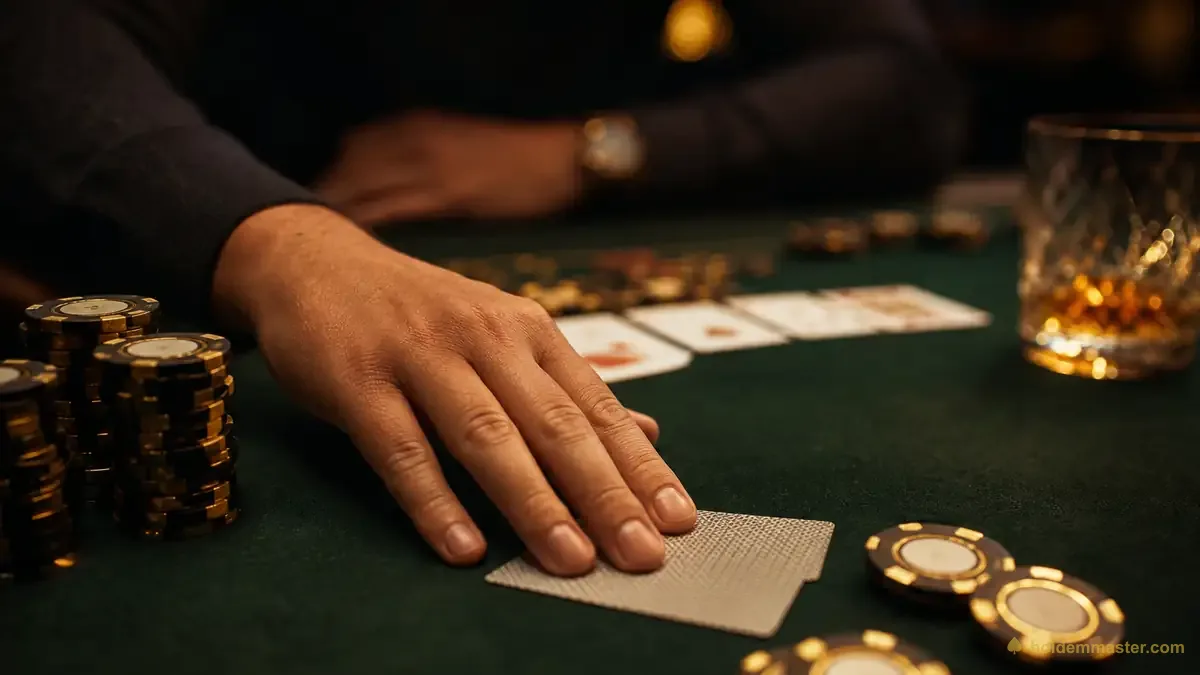
The most expensive hand of my first year wasn't one I lost — it was one I refused to lose. I flopped top two pair, a passive old-timer raised me on a paired river, and every alarm bell said he has a full house. I called anyway. I told myself I "couldn't fold after putting that much in." He tabled the boat, and I drove home replaying the exact moment I knew and called regardless. That night I learned the truth every winning player eventually accepts: the fold is the most powerful move in poker, and the hardest to make.
Folding — mucking your hand instead of calling or raising — is the single most under-rated skill in the game. It has no highlight reel and no dopamine hit, but a fold's worst-case outcome is exactly zero, while a bad call loses money over time — not on every hand, but in the long run. This is the complete guide to when to fold: before the flop, on every street after it, the exact math that decides close spots, how to lay down a genuinely good hand, and how to beat the psychology that makes folding feel impossible. It's the discipline that anchors a winning  Texas Hold'em strategy.
Why folding wins
What Folding Really Is (and Why It's the Most Underrated Skill)
Facing a bet, you have three options: fold, call, or raise. With no bet in front of you, you have two: check or bet. Folding means surrendering the pot and putting no more chips at risk. New players treat it as losing. Winners treat it as refusing to lose more.
Here's the idea that reframes everything: a fold's expected value, from that decision forward, is zero. When you're genuinely beaten (behind now, without the odds to catch up or the fold equity to push them off it), every other option is negative: calling costs you the call, raising costs you more. Zero beats negative. Folding doesn't win the pot, but it wins the long game by not donating chips to spots you're behind in.
One precise caveat, because it matters: folding is not free. The chips already in the pot are gone the moment you put them there — folding just stops you from throwing good money after bad. That distinction is the entire psychology of folding, and we'll come back to it. First, the mechanics.
When to Fold Before the Flop
The biggest leak in poker is playing too many hands, so the biggest single fix is folding most of them. A solid tight-aggressive player folds roughly 75–85% of their hands preflop — closer to 75–80% in 6-max games, and 80–85% in full-ring. If that sounds extreme, remember: the hands you keep are stronger on average than your opponents', which is where your edge comes from.
Fold preflop when:
- •Your hand is simply weak or trashy — offsuit disconnected cards (J‑4, Q‑7, K‑3), weak aces (A‑7 offsuit and below from early seats), and most offsuit "one big card" hands. If it isn't on your
 starting-hand chart for that seat, muck it.
 - •You're in early position — almost everyone else decides after you, and after the flop only the blinds act before you, so you need a stronger hand to enter. K‑J offsuit is a fold under the gun and a raise on the button.
- •You're dominated. A‑9 offsuit against a tight early-position raiser is usually beaten by their A‑T, A‑J, A‑Q, A‑K — same ace, worse kicker. Domination is the quiet killer; fold rather than get out-kicked.
- •You face a 3-bet with the weaker part of your range. You opened wide, so most of that range folds to a re-raise — continue with your best hands and let the rest go. Against a big 4-bet, fold your small pairs and speculative suited hands; their implied odds have collapsed.
When to Fold After the Flop — Street by Street
Postflop folding is where real money is saved, and each street asks a different question.
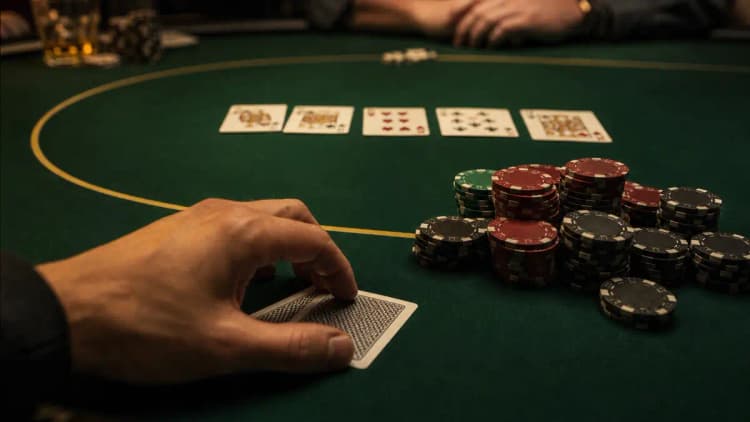
Flop — "Did this board help me, or them?" When you miss and face a bet on a board that fits your opponent's range, let it go. Ace-high with no draw on a coordinated board isn't worth a call "to see the turn." Fold weak draws too — a gutshot with no other equity and a bad price is a fold, not a chase.
Turn — the give-up street. This is the most important fold in poker and the one players skip. On the turn, ranges polarize toward "very strong or busted," and bet sizes balloon. Your flop float that didn't improve, your second pair that's now facing a second barrel, your draw that just missed with one card left and a bad price — these are turns to release, not to talk yourself into one more call. If you were "floating the flop to bluff the turn," and the turn didn't give you a reason, give up.
River — pure bluff-catching. You're no longer drawing to anything; the only question is "can my hand beat the hands they'd bet for value here?" If a passive player fires big into a scary board, the honest answer is usually no. Fold the hands that only beat a bluff when your opponent rarely bluffs. Which brings us to the math.
The Math of Folding: The Pot-Odds Threshold
Close calls aren't a feeling — they're a fraction. To call a bet profitably, your chance of winning must clear the price you're being offered. Memorize this table and half your tough spots solve themselves:
| Bet size (into the pot) | Pot odds you get | Equity you need to call | Fold if you have less |
|---|---|---|---|
| Half pot | 3 : 1 | 25% | under 25% |
| Two-thirds pot | 2.5 : 1 | ~29% | under 29% |
| Full pot | 2 : 1 | ~33% | under 33% |
| Overbet (1.5× pot) | ~1.7 : 1 | ~37.5% | under 37.5% |
Now put it to work. Say you have a flush draw — nine cards complete it — with one card to come. Nine outs out of the 46 unseen cards is 9 ÷ 46 ≈ 19.6%, or about 4-to-1 against hitting. (Quick shortcut: the  rule of 2 and 4 — outs × 2 ≈ your percentage for one card, so 9 × 2 ≈ 18%.)
- •The pot is $100 and your opponent bets $50 on the turn. You call $50 to win $150 — that's 3-to-1, so you need 25% equity. Your draw is only ~19.6%. Fold. The price is wrong.
- •Same draw, but they bet only $25 into $100. Now you call $25 to win $125 — 5-to-1, needing just 16.7%. Your ~19.6% clears it easily. Call.
The Hardest Fold: Letting Go of a Good Hand
Folding trash is easy. Folding a good hand — top pair, an overpair, even a set — is what separates winning players from the rest. The mental trap is thinking "this is a strong hand," when the only question that matters is "is it strong right now, against this line?"
Top pair is not the top of your range. In a raised or re-raised pot, top pair and overpairs are medium-strength hands. Against heavy, multi-street aggression — especially a raise on a scary river — they are often beaten, and the discipline to release them is a good laydown, not weakness. Here are the hands players marry when they should be filing for divorce:
| Hand you're clinging to | The trap | Why you should fold |
|---|---|---|
| Top pair, weak kicker | Facing big turn + river bets | You beat bluffs and worse pairs — but their value range has you out-kicked |
| Overpair (JJ/QQ) | A passive player raises a coordinated board | Passive players raise the nuts, not air — you're drawing thin |
| Top pair top kicker | Board runs out four to a flush or straight | Your one pair can't beat the flush/straight they're repping |
| A set | Big raise on a monotone or four-straight board — on the river | Set-over-set is a cooler; a completed flush isn't. On the flop the same set still makes a full house or quads ~34% of the time by the river against a made flush, and wins a stack when it does — call |
| Second pair | Calling three streets "to keep them honest" | You're paying off value three times to catch one bluff |
The set row is the one that needs its street named, because folding it too early costs more than folding it too late. Hold 9♠9♣ on a 9♥5♥2♥ flop against a made A♥K♥ flush and the set still wins 34% of the time — and no made flush holds it far below that (the floor is about 32%, against 3♥4♥ with its straight-flush outs): it fills up on the seven obvious outs (the case nine, three fives, three deuces) and whenever the turn and river pair each other. On the flop that's a call — not because the next card alone gets there often enough (seven outs is about 16%, short of most bet prices), but because when the board pairs you win everything a flush will pay, and folding sets on the flop costs far more over time than the bets you save. Only once the draw is home does the row above apply.
The mirror image matters too, because folding can be a leak of its own. A good laydown releases a beaten hand to a line that makes sense. A bad laydown folds the best hand to a scare card out of fear — and if you do it often, thinking opponents will bluff you relentlessly. The goal isn't to fold more or fold less; it's to fold when the evidence is there.
The Psychology of Folding: Sunk Cost, Ego, and Fear
Here's the secret the strategy charts don't tell you: most bad calls aren't reading errors — they're emotional ones. Three culprits do the damage.

Sunk cost — "I've already put so much in." This is the big one. The chips you bet earlier are no longer yours — they belong to the pot. Every decision is independent, judged only on what happens from here. "I'm pot-committed because I've invested so much" is the sunk-cost fallacy in a poker chair. (Real pot-commitment exists, but it comes from the current price relative to a big pot — not from what you spent three streets ago.)
Ego — "I have to know if he's bluffing." Calling to satisfy curiosity, or to avoid the sting of maybe being bluffed, is paying the maximum for information you don't need. You will get bluffed sometimes. That's fine — if your folds are never wrong, you aren't folding enough: you're paying off value bet after value bet just to make sure nobody ever bluffs you. Manage your decisions, not your ego.
Fear — folding the best hand to a scare card. The opposite failure: so afraid of being beaten that you release winners. The fix for both poles is the same phrase — fold out of math, not out of fear. Fold because the price is wrong or the story is value, not because you "have a bad feeling."
Between the two extremes sit the two losing profiles: the calling station who never folds and pays off every value bet, and the nit who folds so much that good players simply bet every pot and run them over. Winning folding lives in the disciplined middle: tight, but not scared.
"Should I Fold?" — A 30-Second Self-Check
Before any big call, run this checklist. Four of the five questions can send you straight to the fold on their own; the fifth is the one that can still argue for a call:
Can I name the worse hands they'd bet this way?
If the only hands that bet like this beat me, I'm paying off value.
Do I clear the pot-odds threshold?
If my equity is below the number in the table, the price says fold.
Is this line a value bet or a bluff?
Passive players and big river raises are usually value — believe them.
Am I only calling to "see it"?
Curiosity and ego are not reasons; that's your ego talking, not the math.
Would I bet this hand for value here myself?
If not, I'm holding a bluff-catcher — the question becomes how often they bluff, not whether I'm ahead.
None of this takes thirty real seconds once it's a habit — but slowing down for the big decisions is exactly what the calling station never does.
Note what that last question is not. A value bet has to beat their calling range; a call only has to beat their betting range, bluffs included. Facing a 1.5x-pot river overbet you need just 37.5% equity, so a hand you could never value bet can still be a profitable call when they bluff often enough. "I wouldn't bet it" means bluff-catcher, not fold.
A Real Laydown, Hand by Hand
Here's a fold I'm proud of, spelled out so you can check it yourself. $1/$2 cash, 100bb deep.
- •My hand: A♥K♣. I raise, the big blind — a tight, passive player — calls.
- •Flop: K♦ 9♠ 4♥. I've got top pair, top kicker. I bet, he calls. Standard.
- •Turn: 7♣. A blank. I bet again for value, he calls again. Still looks fine.
- •River: 9♥. The board pairs, now reading K♦ 9♠ 4♥ 7♣ 9♥, and the passive player suddenly check-raises me big.
The 7 Most Common Folding Mistakes
| The mistake | Why it costs you | The fix |
|---|---|---|
| Calling too much (the station) | You pay off every value bet in the building | Default to fold when you only beat a bluff |
| Paying off the obvious value bet | Passive big bets are almost never bluffs | Believe the story; fold |
| Marrying top pair / overpairs | They're medium hands in big pots | Fold to heavy multi-street aggression |
| Chasing draws without the price | The pot odds say your call loses long-term | Clear the threshold or fold |
| Sunk-cost calling | "Already in" is not a reason | Judge only the decision in front of you |
| Hero-calling to "keep them honest" | You catch one bluff, pay off ten values | Reserve it for players who actually bluff |
| Over-folding to every scare card (the nit) | Good players bluff you off the best hand | Fold to value lines, not to fear |
Notice both poles are here: fold more against the value-heavy players who never bluff (most of the low-stakes population), and fold less against the thinking regulars who bluff enough to exploit a nit.
FAQ
The Folding Playbook, In Short
1. A fold's worst outcome is zero — when you're beaten, that beats every negative alternative. 2. Fold most hands preflop (75–85%), after the flop, fold missed hands facing a bet on a board that suits your opponent's range, plus priced-out draws, and treat the turn as the give-up street. 3. Clear the pot-odds threshold or fold — 25% vs a half-pot bet, ~33% vs a pot-sized bet (implied odds can justify a few thinner calls, never against a short stack). 4. Lay down good hands when the line screams value — top pair is not the top of your range. 5. Fold out of math, not fear — beat the sunk-cost trap, ignore your ego, and remember the chips in the pot were never yours to protect.
Master the fold and you stop being the player who "couldn't get away from it." Pair that discipline with sharp pot-odds math, a solid 3-bet game, and the full strategy framework, and you'll quietly win the pots that matter by losing the ones that don't.