Skip to content
Global Poker CommunityLog in

HoldemMaster

HoldemMaster

Tournament

📖 16 min · Blog

APT Incheon 2026 Results — Record Field + Korea Travel Guide

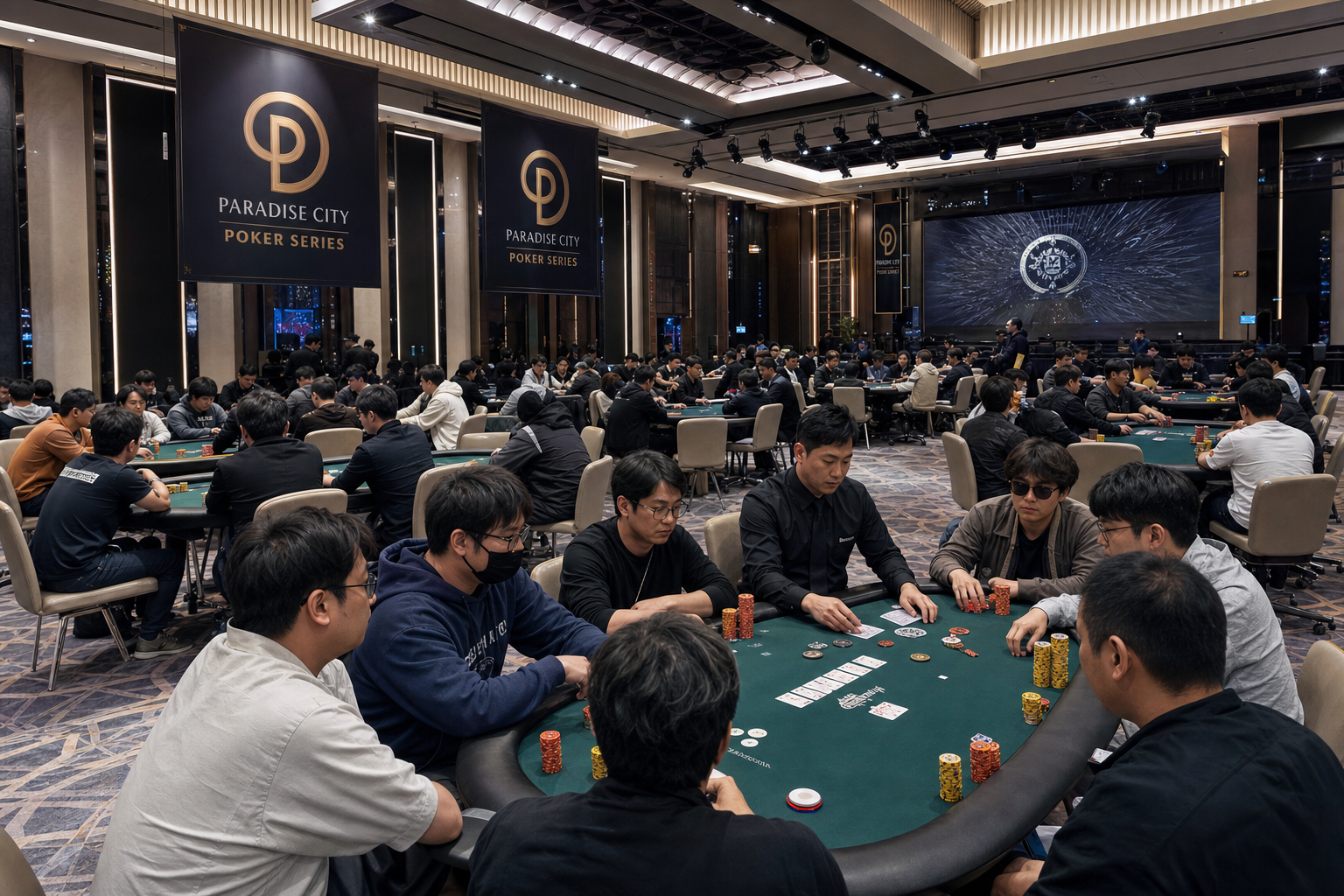
APT Incheon 2026 wrapped on Aug 16 at Paradise City Casino, Incheon. Hong Kong's Stephen Pang won the Main Event for KRW 411,180,000 (~$293,700) after a three-handed ICM deal, topping a record 1,393-entry field with a KRW 3,008,880,000 prize pool. Runner-up Shoumin Zhang (China) took KRW 366,500,000 (~$261,785), and the top three also earned APT Championship 2026 Main Event seats (~$10,000 each). Foreign nationals only (Korean citizens without overseas residency cannot enter). Seoul is ~1 hour away — for the next stop, the poker trip and the Korea trip are still the same trip.
HoldemMaster

Tournament

📖 16 min · Blog

EPT Barcelona 2026 — Complete Player Guide: Schedule, Buy-Ins & How to Qualify

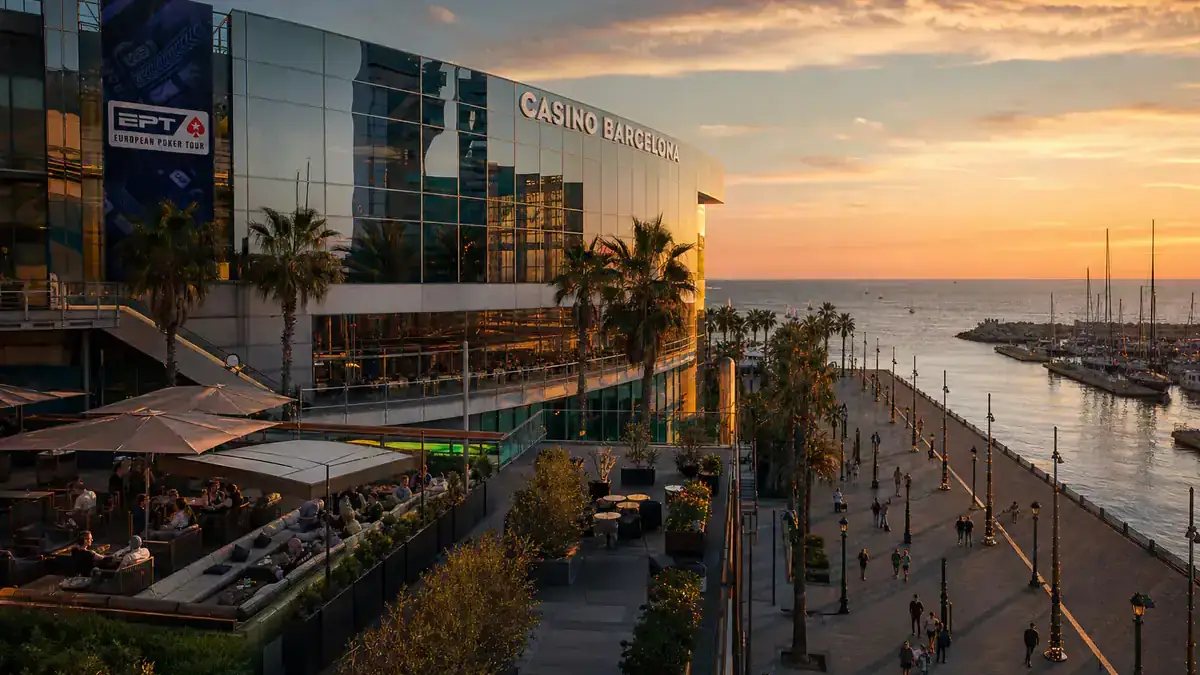
EPT Barcelona 2026 ran Aug 16–29 at Casino Barcelona. Italy's Manuel Ferrari won the €5,300 Main Event for €1,002,488, beating 1,823 entries for a share of the €8,841,550 prize pool. For 2027: the cheapest online route is the Power Path from $0.50 → Gold Pass (€5,300 ME seat + €1,100 side event + 8-night hotel + €690 expenses). You need a PokerStars Live account and a valid passport, and hotels sell out early — August is peak season in Barcelona.

HoldemMaster

glossary

📖 12 min · Blog

Texas Hold'em Glossary: Every Poker Term You'll Hear at the Table

This is a plain-English glossary of the poker terms that actually come up in a Texas Hold'em game, grouped by how you'll meet them — betting actions, positions, hands and board, player types, money, and table situations. Start with the 'most confused' terms below (check vs call, set vs trips, cooler vs bad beat), then browse by category. Terms with a deeper guide link straight to it.

HoldemMaster

Tournament

📖 14 min · Blog

WPT Australia 2026 — Complete Player Guide: Schedule, Satellites & Real Costs

WPT Australia 2026: Sep 10–30, The Star Sydney. Two flagships: AUD $1,500 WPT Prime (Sep 17–22) and AUD $5,000 WPT Championship (Sep 24–30). On-site satellites from AUD $270, with Championship qualifiers at $290 and $550. The Championship winner's first-place prize includes a $15,000 WPT World Championship seat. Must be 18+, Star Club member, and smart-casual dress enforced.

HoldemMaster

Tournament

📖 13 min · Blog

What Is ICM in Poker? The Independent Chip Model, Explained

ICM (Independent Chip Model) converts your tournament chip stack into its real prize-money value, using the payouts and everyone's stacks. Because you only win one first prize, doubling your chips never doubles your money — so the chip leader's stack is worth less than its chip share, and short stacks are worth more. That gap is why you fold hands on the bubble that would be easy calls in a cash game.

HoldemMaster

Strategy

📖 16 min · Blog

3-Betting in Poker: When to 3-Bet, How Much, and How to Face One

A 3-bet is the first re-raise before the flop — called a 3-bet because the big blind is the first bet, the open-raise the second, and your re-raise the third. Value-3-bet a tight core (QQ+, AK) plus a few suited blocker bluffs like A5s, size it around 3x the open in position and 4x out of position, and keep your overall 3-bet frequency near 6–10%. When you're the one facing a 3-bet, 4-bet your premiums, call the hands that play well, and fold the rest — folding more than 'balanced' against low-stakes players who never bluff.

HoldemMaster

Strategy

📖 11 min · Blog

Limping in Poker: Why 'Just Calling' Preflop Usually Costs You

Limping is entering a pot preflop by just calling the big blind instead of raising or folding. Open-limping (being first in) is almost always a mistake — you can't win the pot preflop, you give up initiative, and good players punish you. But limping isn't always wrong: completing the small blind, over-limping speculative hands behind other limpers, and some live and short-stack spots are legitimate exceptions.

HoldemMaster

Strategy

📖 16 min · Blog

When to Fold in Poker: The Skill That Quietly Wins the Most

Folding is the most underrated skill in poker — a fold's worst outcome is zero, while a losing call bleeds chips every time. A solid player folds around 75–85% of hands before the flop, releases missed hands and weak draws that don't meet their pot odds after it, and — hardest of all — lays down strong-but-beaten hands when a passive opponent's line screams value. Most players don't call too much because they can't read hands; they call because the chips already in the pot feel like theirs. They aren't.

HoldemMaster

Tournament

📖 13 min · Blog

How to Play the Bubble in Poker — Big, Medium & Short Stack Strategy

The bubble is the spot right before the money, where one more elimination pays everyone else. Because busting means winning nothing, survival is worth more than the chips you'd gain — so calling ranges tighten hard while shoving stays wide. Big stacks attack, medium stacks are the most trapped (not short stacks), and on a satellite bubble you fold everything, even aces, once your seat is locked.

HoldemMaster

Strategy

📖 10 min · Blog

Two Aces on the Flop and the Bet Jumps to 80%

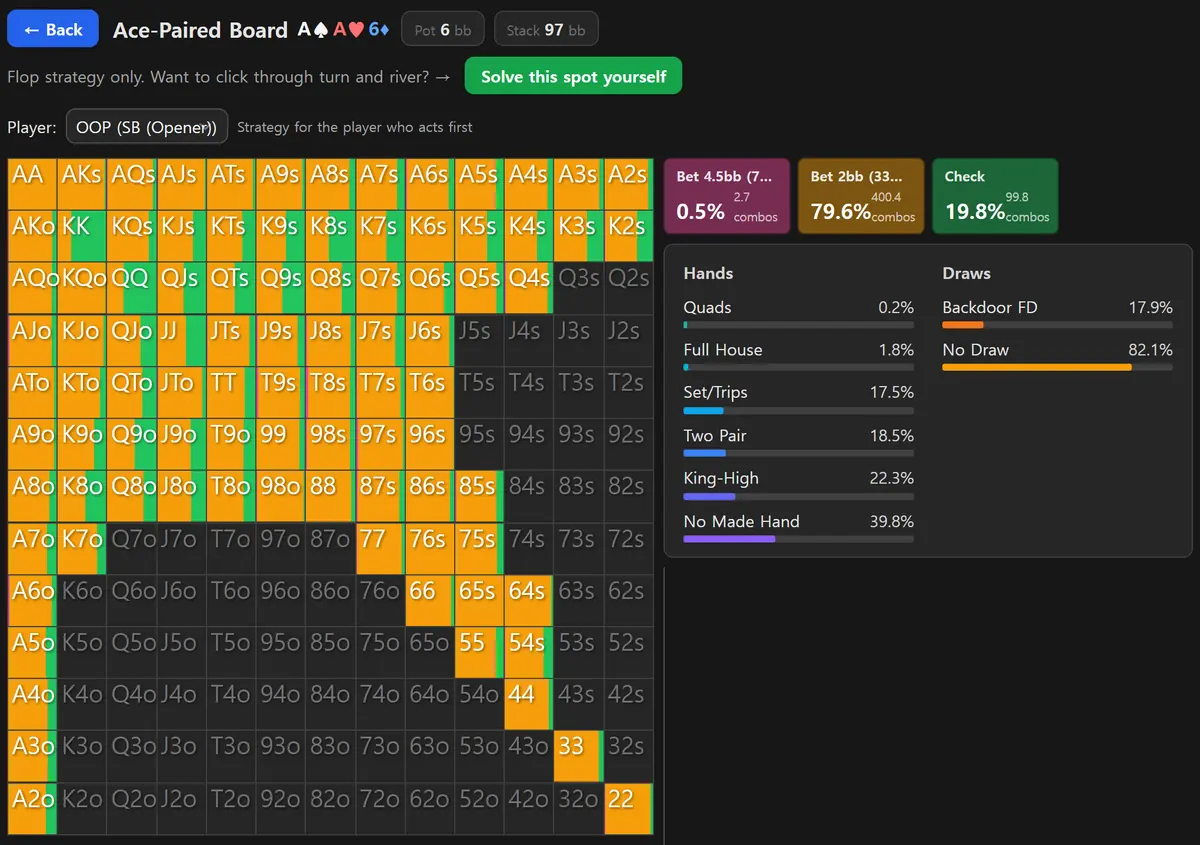
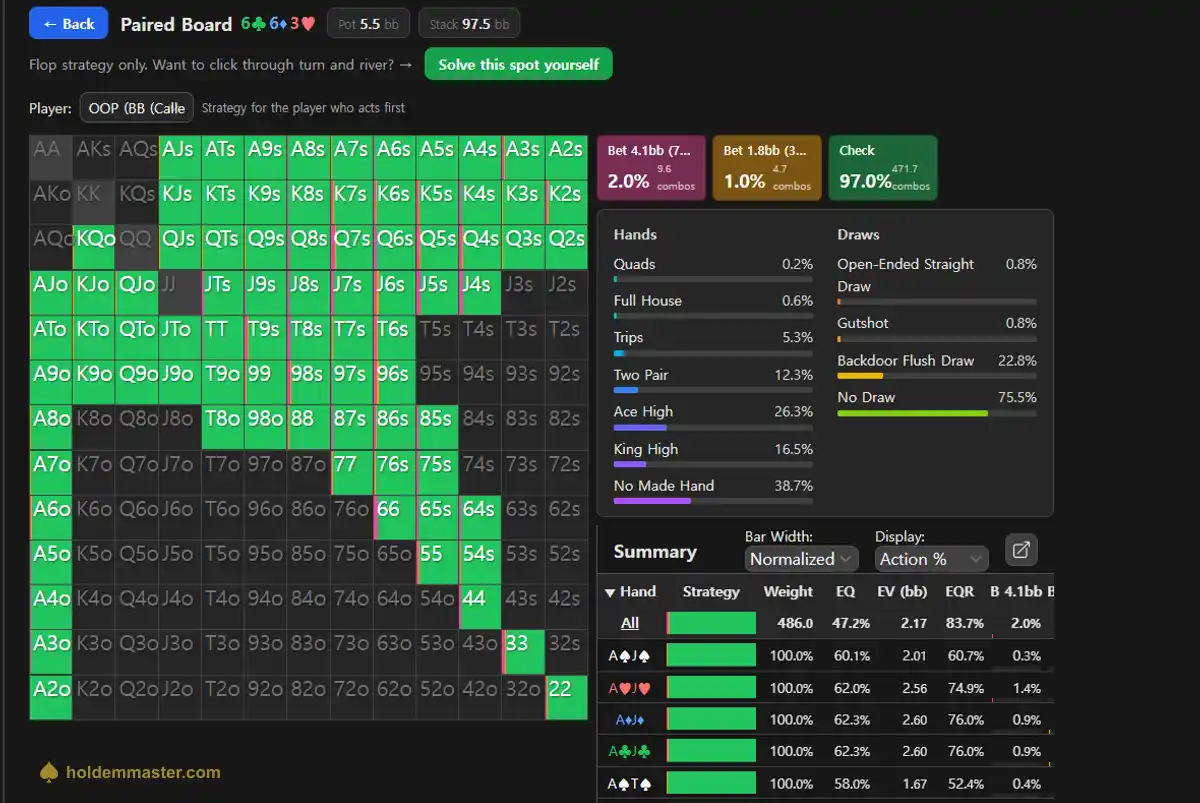
After a small-blind open and a big-blind call, the A♠A♥6♦ flop gets a bet 80.1% of the time (79.6% at a third of the pot, 0.5% at three quarters, check 19.8%). That is the reverse of the 3.0% seen on the 6♣6♦3♥ paired board — and what split them is not that the board paired, but **whose card** paired. Hands making trips with an ace run 88 combos to 66, and 16 of those combos, A-K and A-Q, are absent from the calling range entirely.

HoldemMaster

Strategy

📖 10 min · Blog

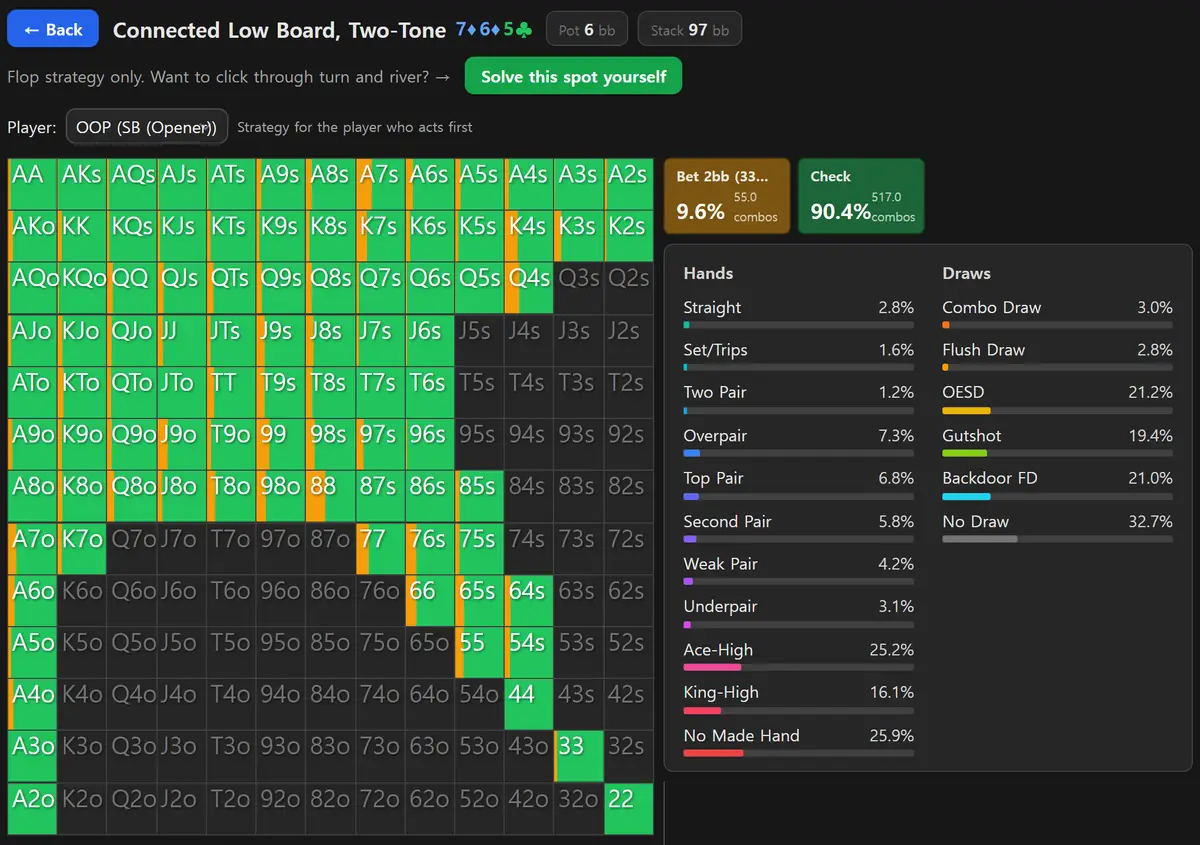
Same Seat, Same Stack — and the Bet Falls from 67% to 9.6%

After a small-blind open and a big-blind call, the 7♦6♦5♣ flop gets a bet just 9.6% of the time and a check 90.4%. Pot, stack, SPR, bet size and both ranges are identical to the previous spot — only the three board cards changed, and the bet collapsed from 67.4% to 9.6%. The range edge won preflop was an edge in **high cards**, and a low connected board erases it outright. Equity flips to 49.6% against 50.4% and the out-of-position realization drops to 85.3%.

HoldemMaster

Strategy

📖 10 min · Blog

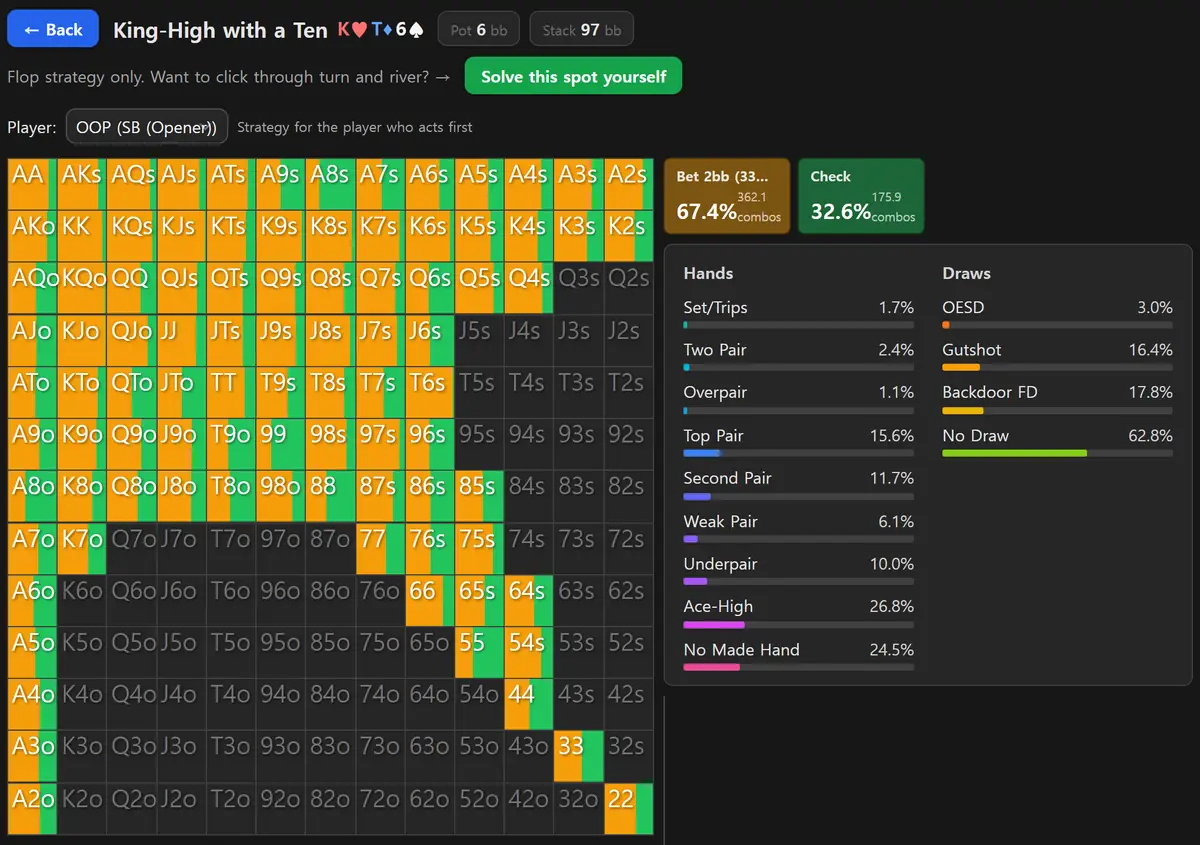
The Player With No Position Bets First — 67.4% of the Time

After a small-blind open and a big-blind call, the K♥T♦6♠ flop gets a bet 67.4% of the time and a check 32.6%. In the seven single-raised pots earlier in this series the out-of-position player bet only 0.1% to 23.7% — and two things changed, not one. Here the out-of-position player is the raiser rather than the caller, and the board favors that range. Together they push the out-of-position equity realization to 103.1%.

HoldemMaster

Strategy

📖 10 min · Blog

Three Combos Hit This Flop — and It Still Bets 97.8%

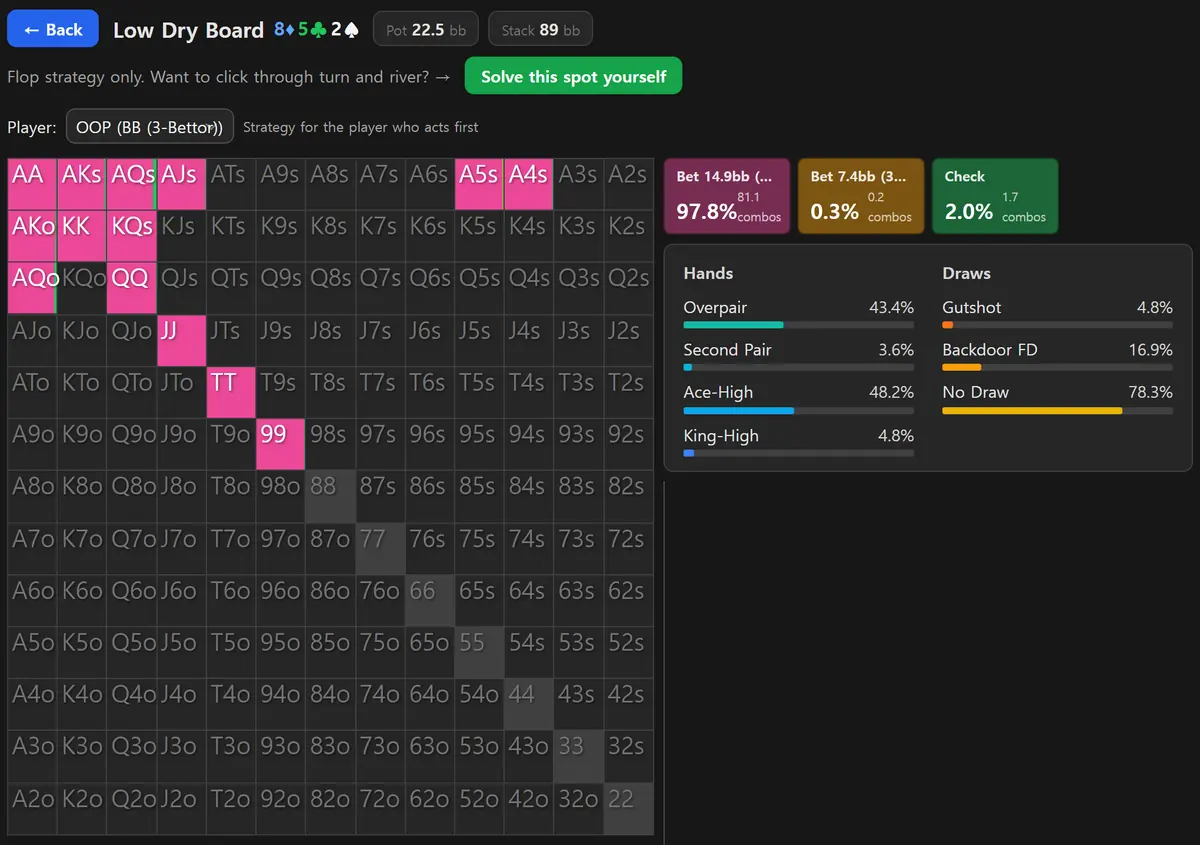
After a big blind three-bet and a button call, the flop 8♦5♣2♠ gets a two-thirds-pot bet 97.8% of the time. The odd part: of the big blind's 83 combos, exactly three paired this board — the A5s — and none of 88, 55 or 22 is in the range at all. The bet goes anyway because the range splits into 36 combos of overpairs and 40 combos of ace-high with nothing in between. A polarized shape bets big.

HoldemMaster

Strategy

📖 12 min · Blog

Two Sizes Offered, One Size Used

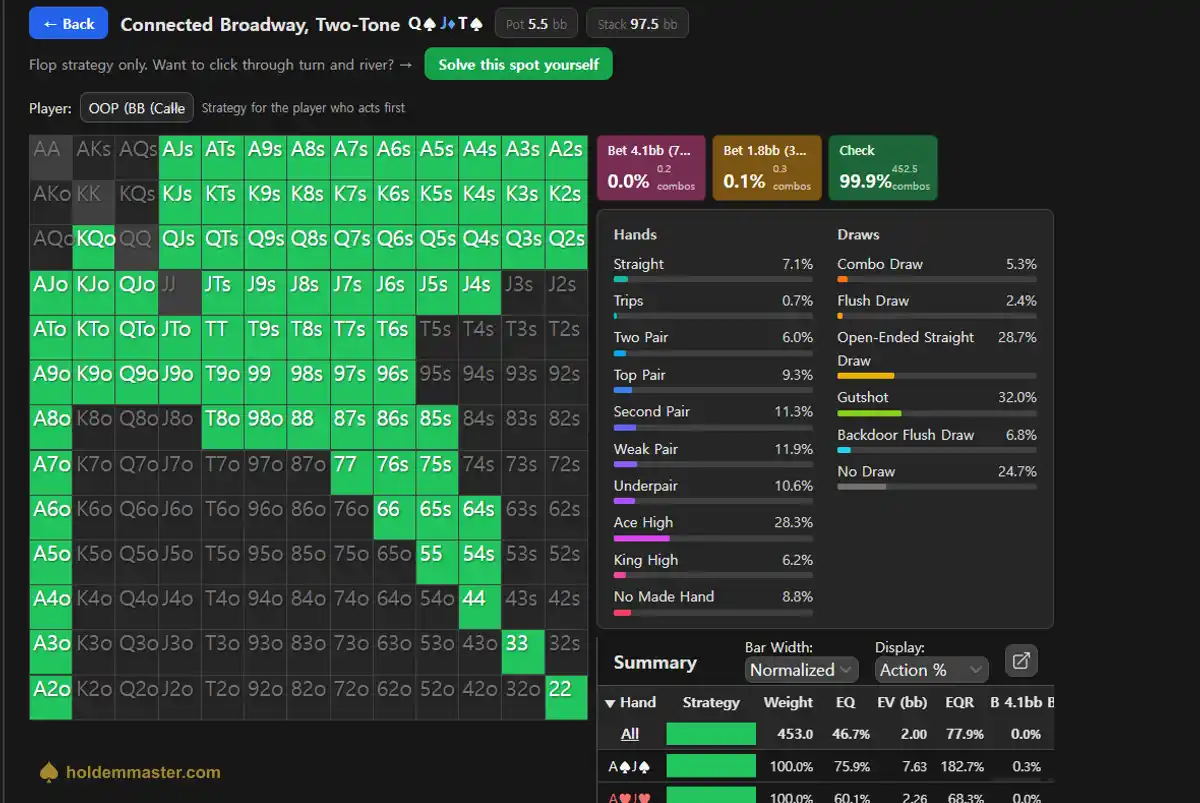
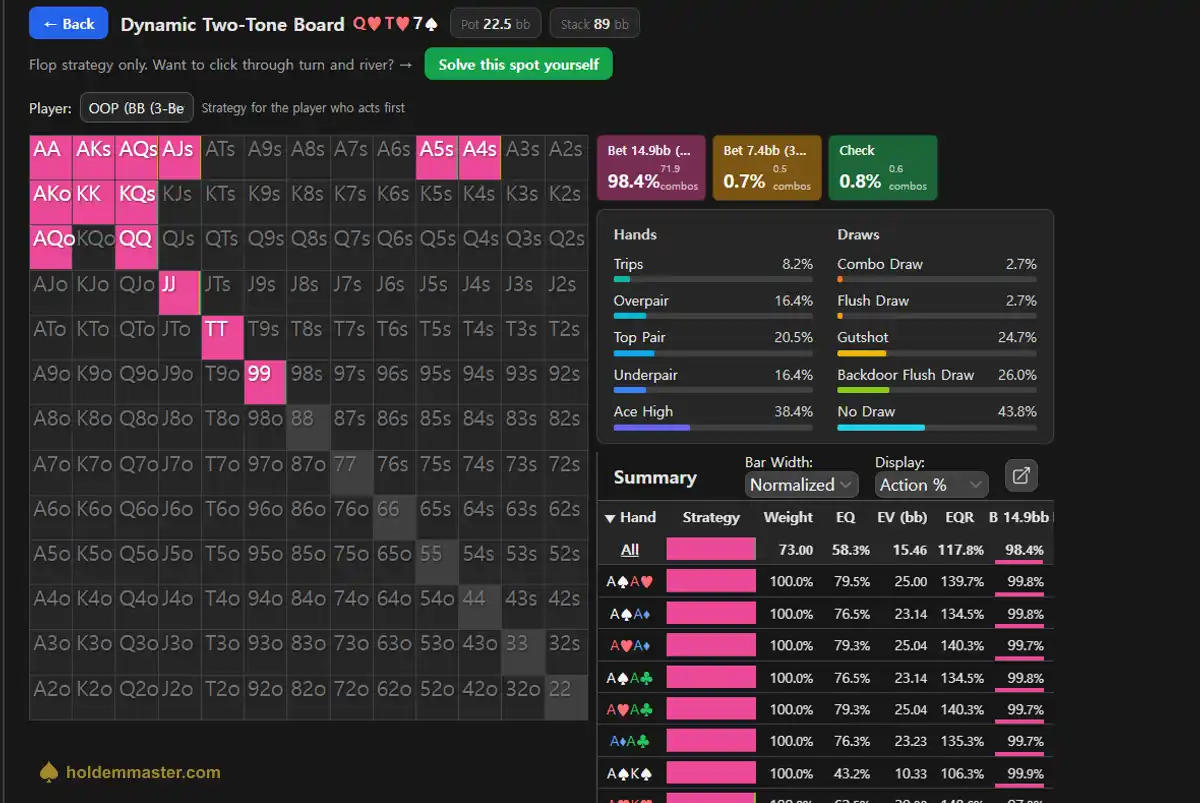
On Q♥T♥7♠ in a 3-bet pot the big blind bets two thirds of the pot (14.9bb) 98.4% of the time. The small size gets 0.7% and checking 0.8% — together barely one combo out of 73. One board earlier, on A♦K♠2♥, the same range split its sizing 57.8/42.2. What collapsed the split is not strength but price. On a board this wet the size is decided by what it costs the caller to keep drawing, and the small bet does not charge enough.

HoldemMaster

Strategy

📖 12 min · Blog

Nobody Checks This Flop

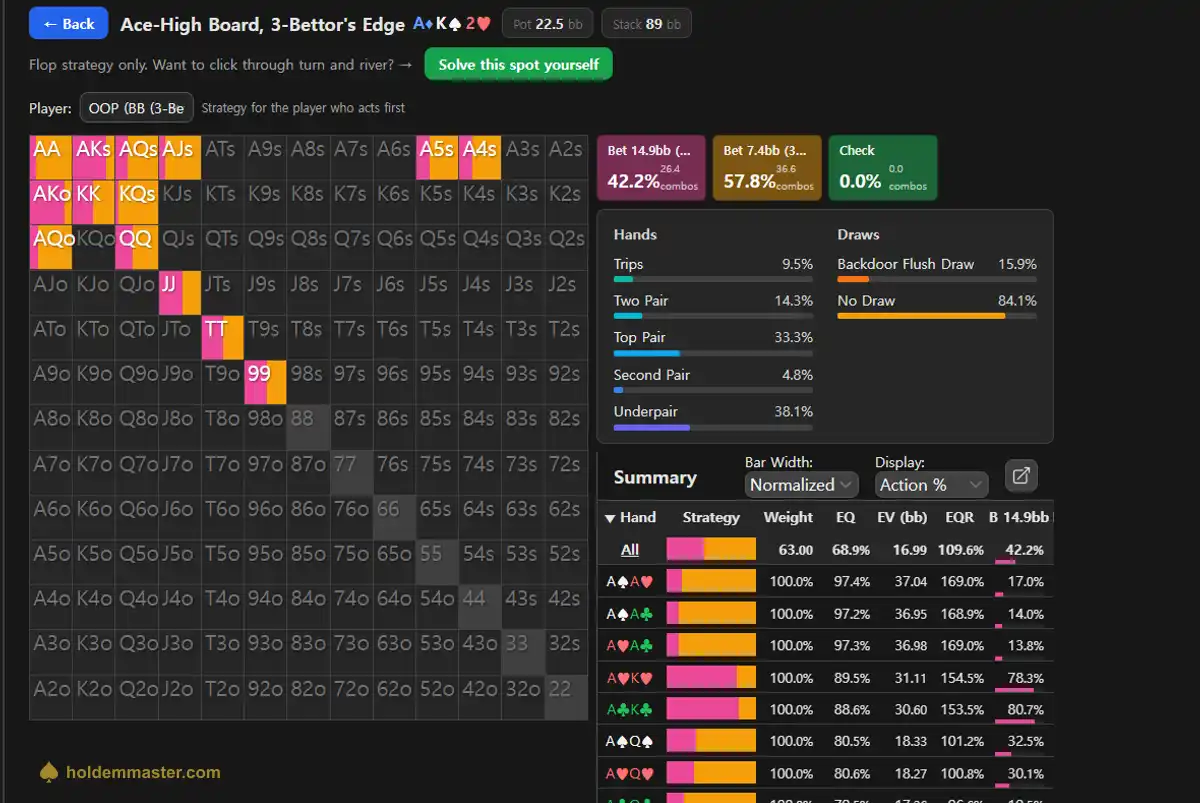
On A♦K♠2♥ in a 3-bet pot the big blind bets 100% of the time. Checking is 0.0% — not one combo out of 63. In the seven earlier spots its default was to check, between 76.2% and 99.9% of the time. What flipped is not the board but the preflop action: the big blind three-bet instead of calling, so it owns the top of this flop while the button four-bet its pocket aces and kings away. And with an SPR of 4.0 there is no later street to defer to.

HoldemMaster

Strategy

📖 11 min · Blog

Neither Range Holds a Straight Here

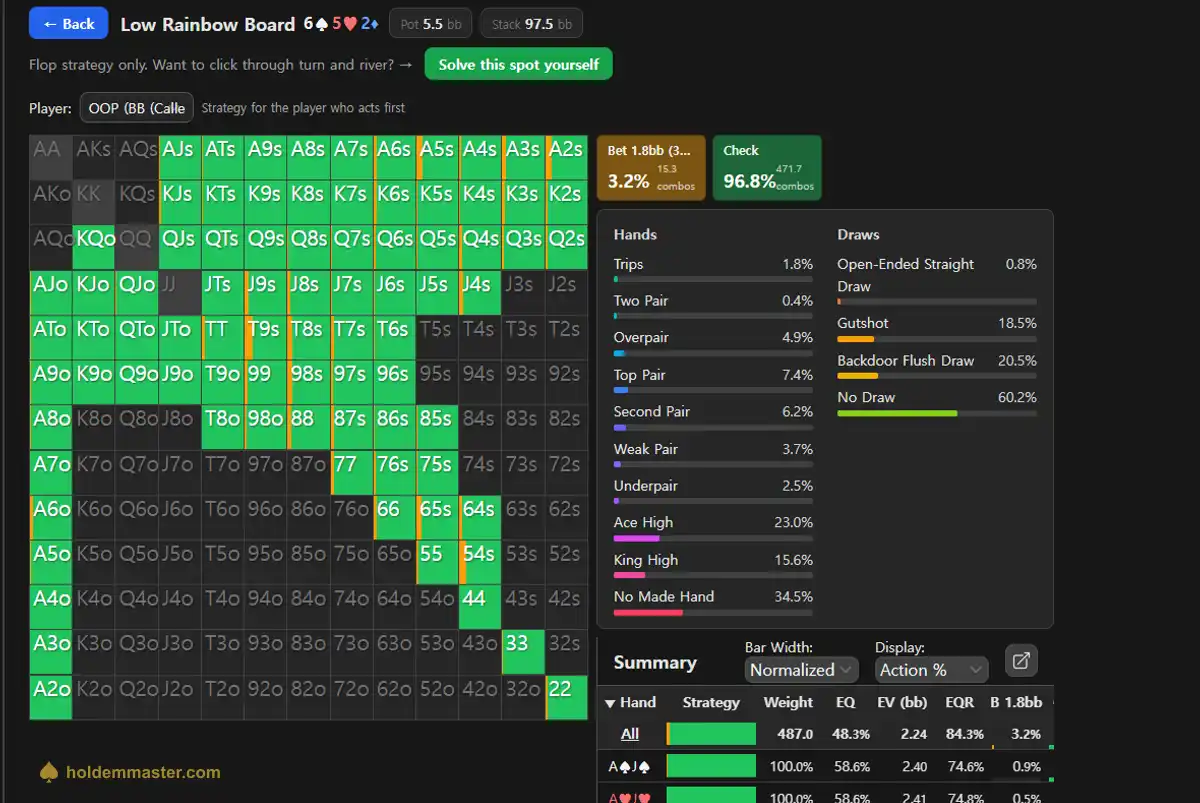
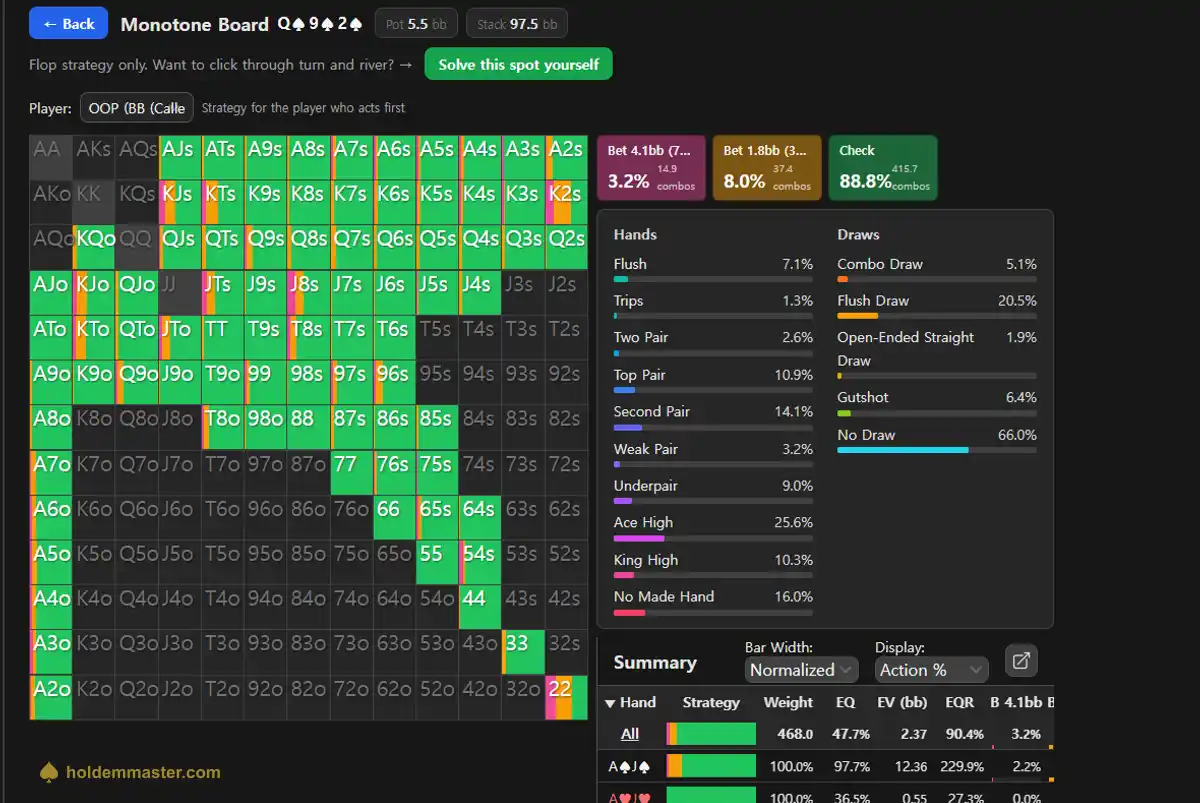
On the low rainbow flop 6♠5♥2♦ the big blind checks 96.8% and leads just 3.2% — even though its 48.3% equity is the second highest of the seven spots where it defends. Only one hand makes a straight here, 4-3, and neither range holds it. Nobody has a top end, so nobody leads out of position. The action comes later: re-solve the same tree to see past the flop and the big blind check-raises a 1.8bb bet 14.9% of the time, almost all of it draws.

HoldemMaster

Strategy

📖 15 min · Blog

Continuation Bet (C-Bet): When to Fire the Flop, How Much, and When to Check

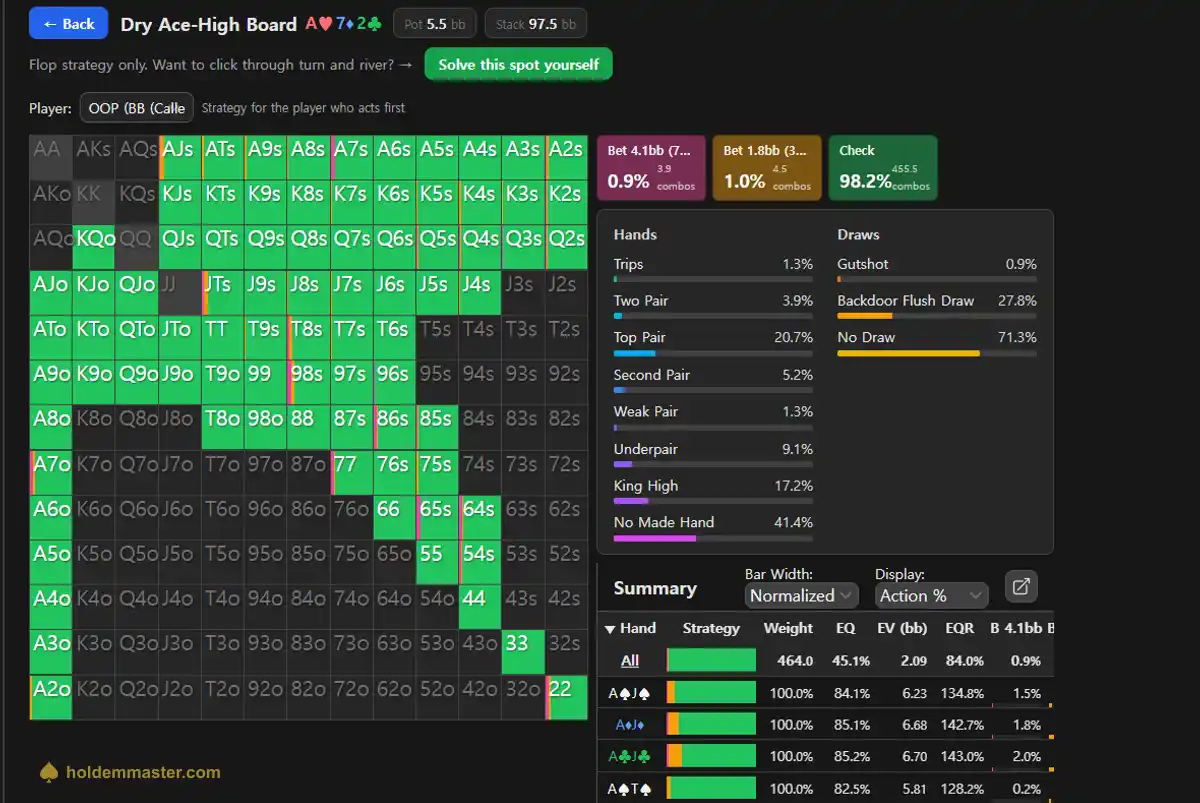
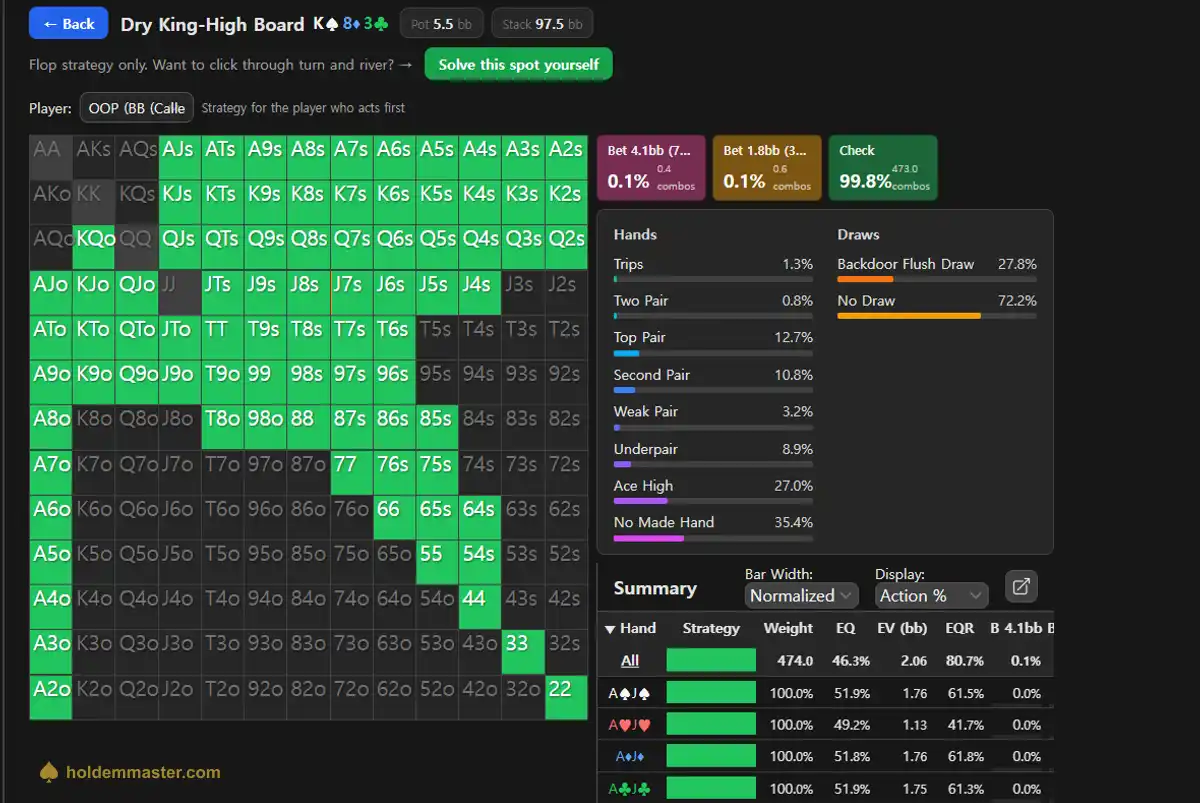
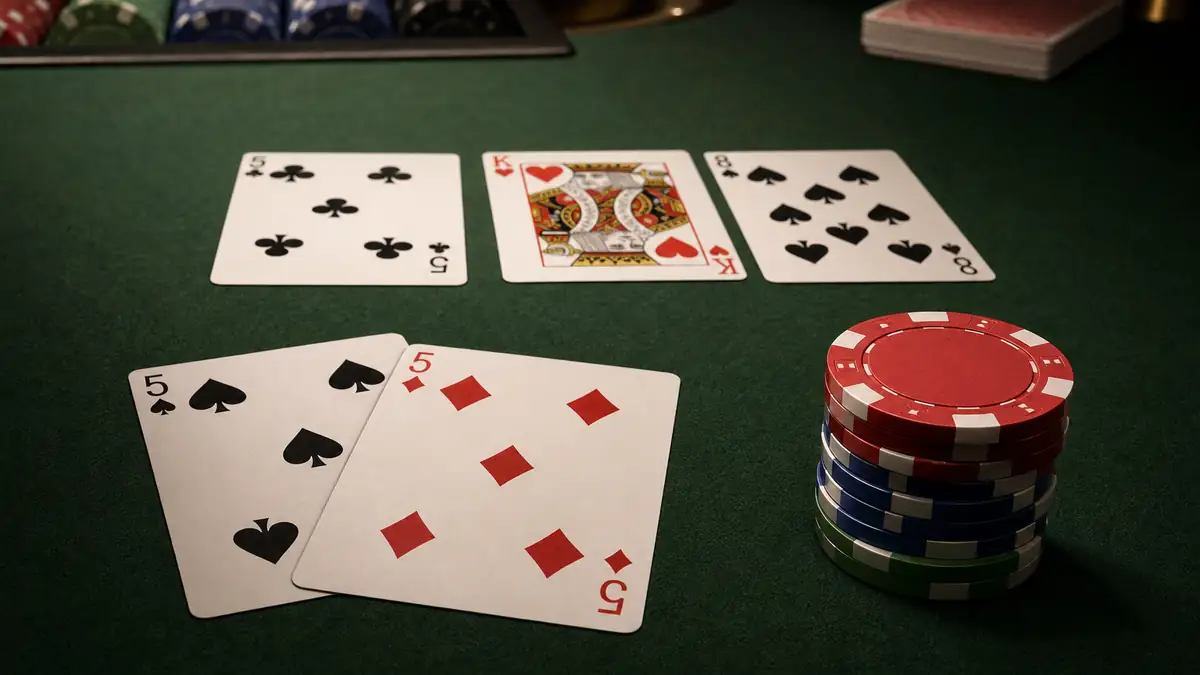
A continuation bet (c-bet) is a bet on the flop by the player who raised preflop. The modern rule isn't 'c-bet every flop' — it's to bet the flops that favor your range (high, dry boards like K-7-2) small and often, and check the ones that favor your opponent (low, connected boards like 7-6-5). Size small — about one-third pot — on dry boards, big — two-thirds or more — on wet ones, c-bet less out of position, and much less multiway.
HoldemMaster

Tournament

📖 12 min · Blog

WSOP 2026 Main Event — Who Won, Full Payouts, How to Get There

Lucas Jumalon won the 2026 WSOP Main Event on August 5 for $10,000,000. He is 22, from Spokane, and came in with just over $180,000 in career earnings — his best previous score was $22,945. He walked into the final table with 194,000,000 chips, more than the next three stacks put together, and never gave the lead up. Lauri Saaskilahti took second for $6,000,000 after starting seventh in chips. Ninth place still paid $1,000,000.

HoldemMaster

Tournament

📖 13 min · Blog

How to Play a Short Stack in Poker — Push/Fold Strategy by Stack Depth

A short stack (roughly under 20–25 big blinds) can't play normal postflop poker, and from about 15 big blinds down it switches to push/fold: move all-in first-in to keep your fold equity, and never open-limp or min-raise-then-fold. Shove wider from late position, keep your calling range tighter than your shoving range, and don't blind down to nothing 'waiting for a hand' — your fold equity is the weapon, and it fades hard below about 8 big blinds.

HoldemMaster

Strategy

📖 14 min · Blog

Texas Hold'em Strategy: The 5 Decisions Behind Every Winning Hand

Every winning Texas Hold'em decision reduces to five repeatable questions: where am I sitting (position), is this hand worth playing, do I raise or fold (never limp), do I keep betting on the flop, and when do I let go? A tight-aggressive player who answers those five well folds ~80% of hands preflop, plays them aggressively when they do, and beats almost every casual game — no memorized tip list required.