For my first year at the table I "played my draws" without ever counting them. A flush draw and a gutshot felt about the same — both were "cards that could come" — so I called the same on both and wondered why I kept losing. The fix wasn't a strategy course. It was a five-minute habit: stop, and actually count the cards that save me.
That habit is called counting outs —  poker's real answer to "counting cards" — and it's the skill that sits underneath every drawing decision in poker. Before you can ask "is this call profitable?" you have to answer "how many cards win the hand for me?" This guide is the counting half — the
  poker odds and probability chart is the reference behind it, and pot odds is what you do with the number once you have it.
Outs at a glance
What Are Outs in Poker?
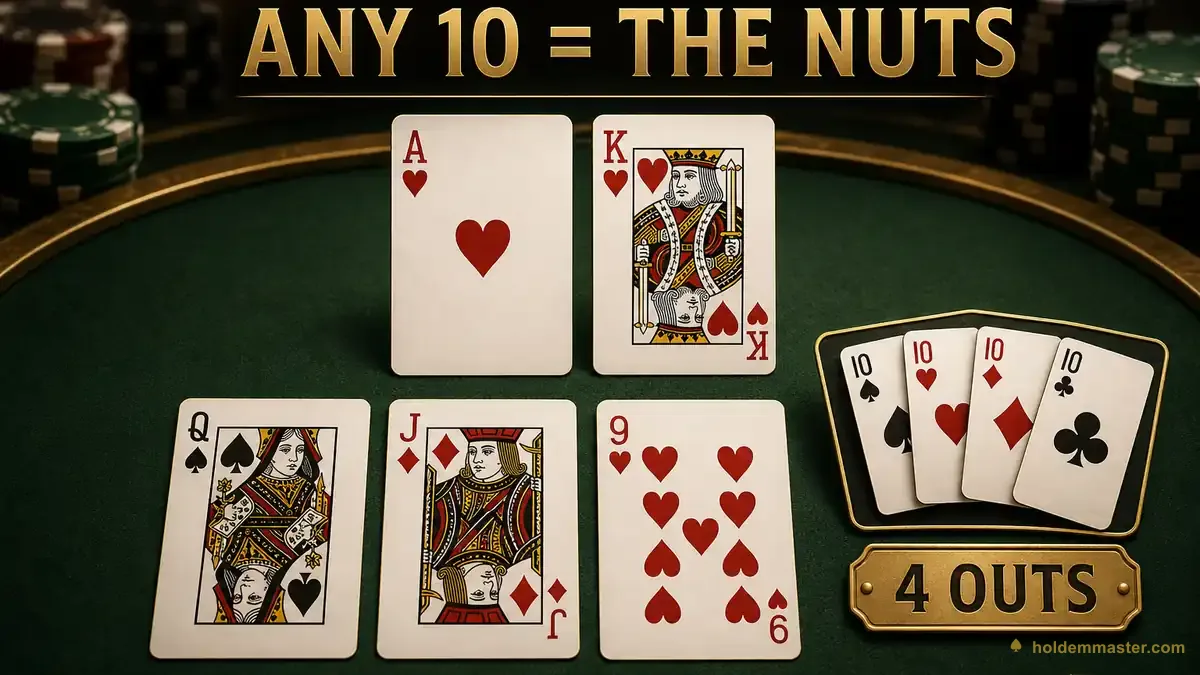
An out is any card still in the deck that turns your hand into a likely winner. If you hold a flush draw, every remaining card of your suit completes it — and each one is an out as long as that flush would actually win.
The word "likely" is doing quiet work there. A true out has to actually win the hand, not just improve your cards. Pairing your ten when a flush is already on the board isn't an out — you improved, but you're still losing. Learning to count outs is really learning to count the cards that win, and to ignore the ones that only look helpful.
Everything downstream — your equity, your pot odds, your call-or-fold — starts from this one number. Get the out count wrong and every calculation after it is wrong too. And once you know the count, the  drawing odds tell you exactly how often each draw actually gets there.
How to Count Your Outs (Step by Step)
✦ Quick answer
Count the unseen cards that reach your target hand, then remove candidates that would still leave you beaten. Start from the suit or rank total and subtract the cards already visible. Keep each physical card in the count only once, even when it completes two different draws.
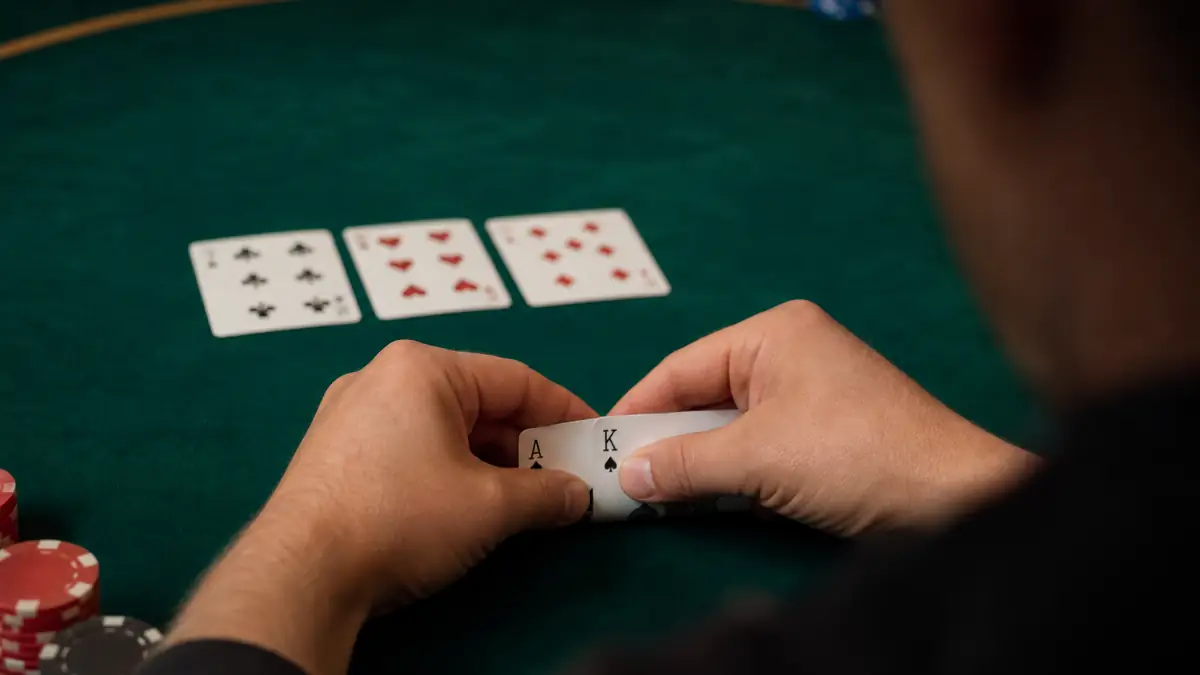
Counting outs is a three-step routine you run on every draw until it's automatic:
Name your draw
What hand are you chasing? Flush, straight, a bigger pair, a set — be specific about the target
Count the cards that complete it
There are 13 of each suit and 4 of each rank. Subtract the ones you can already see (your cards + the board)
Strip out the fakes
Cross off any "out" that completes your hand but still loses — a flush card that pairs the board, a straight that hands someone a higher one
Take a flush draw: 13 cards of your suit exist, you can see four of them (two in your hand, two on the board), so 13 − 4 = 9 outs. That subtraction — counting the ones you can't catch because you're already holding them — is where beginners slip.
The counting only uses cards you can see. You don't subtract your opponent's unknown cards; you treat every unseen card as still live. That's why the raw counts below are the same whatever anyone else holds — they're the starting point, before you cross off the dirty outs further down.
Poker Outs Chart: Every Common Draw
✦ Quick answer
The standard starting counts are nine for a flush draw, eight for an open-ended straight draw, and four for a gutshot. Combined draws need an overlap deduction. Overcards and non-nut draws need another check: these counts describe cards that improve your hand, and only the ones likely to win deserve full value.
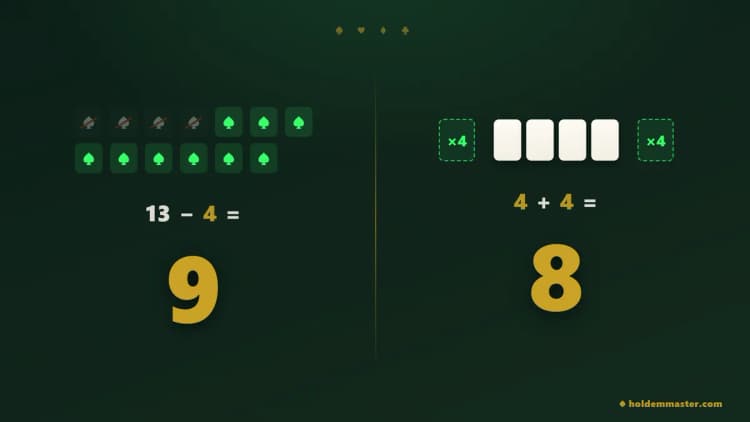
Use these raw counts as a starting point, then apply the dirty-out checks below:
| Your draw | Outs | Why |
|---|---|---|
| Flush + open-ended straight | 15 | 9 flush + 8 straight − 2 shared cards — the monster |
| Flush + gutshot | 12 | 9 flush + 4 gutshot − 1 shared card |
| Flush draw | 9 | 13 of a suit − 4 you can see |
| Open-ended straight draw | 8 | Four cards on each end |
| Two overcards | 6 | Three of each rank to pair |
| One pair → two pair or trips | 5 | 3 to pair your kicker + 2 to trip up |
| Gutshot (inside straight) | 4 | Only one rank fills the hole |
| One overcard | 3 | Three cards to make top pair |
| Pocket pair → set | 2 | The last two of your rank |
The two combo draws at the top are where players fumble the arithmetic, so they get their own section below. Everything else is straight subtraction: count the ranks or suits that finish your hand, take away what you can see.
Outs to Odds: The Conversion Chart
✦ Quick answer
Nine outs hit the next card from the flop 19.1% of the time, or at least once by the river 35.0% of the time. The second figure includes two chances. Select the one-card column when pricing only the turn; the two-card column assumes you will see the full runout.
| Outs | Flop → turn (1 card) | By the river (2 cards) | River odds |
|---|---|---|---|
| 2 | 4.3% | 8.4% | 11-to-1 |
| 4 | 8.5% | 16.5% | 5-to-1 |
| 6 | 12.8% | 24.1% | 3.1-to-1 |
| 8 | 17.0% | 31.5% | 2.2-to-1 |
| 9 | 19.1% | 35.0% | 1.9-to-1 |
| 12 | 25.5% | 45.0% | 1.2-to-1 |
| 15 | 31.9% | 54.1% | 0.85-to-1 |
Two numbers matter for every draw. "By the river" counts both remaining cards and applies when no more betting can happen — you're all-in, or you've called an all-in and no one left in the hand can still bet. "Flop → turn" counts just the next card (9 ÷ 47 = 19.1%; from the turn to the river it becomes 9 ÷ 46 = 19.6%) — use this the moment there's more betting to come, because you're only guaranteed to see one card at a time. Beginners quote the fat "by the river" number while facing a turn bet, talk themselves into a call, and pay for it.
Notice the 15-out monster: with two cards to come it completes 54.1% of the time — against a single pair that usually makes it a favorite, the rare draw you can happily get all-in with on the flop. Against a set it isn't: the board can pair and fill up the set — the J♠ T♠ on 9♠ 8♣ 2♠ example below is only about 40% against pocket nines.
The Rule of 4 and 2: Outs → Odds in Your Head
✦ Quick answer
Once you have a clean out count, multiplying by four estimates the chance of hitting across two cards; multiplying by two estimates one card. These shortcuts get less reliable as a draw grows. They estimate completion, so counting a card that still loses cannot be fixed by choosing the right multiplier.
- •On the flop (two cards to come): outs ×4 ≈ your % to hit by the river.
- •On the turn (one card to come): outs ×2 ≈ your % to hit on the river.
The main weakness is high out counts on the flop. The exact two-card calculation accounts for hitting on either street without counting a double hit twice. The ×4 estimate starts running slightly high at 7 outs, but the gap grows with bigger draws; the usual correction below is used for more than 8 outs.
| Outs | Rule says (×4) | True by river | Off by |
|---|---|---|---|
| 8 | 32% | 31.5% | +0.5% |
| 9 | 36% | 35.0% | +1% |
| 12 | 48% | 45.0% | +3% |
| 15 | 60% | 54.1% | +6% |
The tidy fix for big draws: for more than 8 outs on the flop, multiply by 4 and then subtract (outs − 8). For 15 outs: (15 × 4) − 7 = 53%, almost exactly right. For everyday draws of 8 outs or fewer, plain ×4 and ×2 are all you need. The full derivations live in the probability chart.
Combo Draws: Why 9 + 8 Isn't 17
✦ Quick answer
A flush draw plus an open-ended straight draw has 15 distinct completing cards, not 17: two straight cards already belong to the flush suit. A flush draw plus a gutshot has 12 because one card overlaps. Count the union of the draws, then separately discount any cards that would still lose.
- •Flush outs: 9 (every spade)
- •Straight outs that aren't spades: Q♥ Q♦ Q♣, 7♥ 7♦ 7♣ = 6
- •Total: 15 outs, not 17
Dirty Outs: The Cards That Only Look Like Wins
✦ Quick answer
A dirty out improves your hand without reliably putting it ahead. Flush cards on paired boards, low flushes against higher flush draws, and overcards against strong made hands all need scrutiny. Start with the raw count, then reduce it according to the opponent's plausible holdings rather than paying for every improvement as a win.
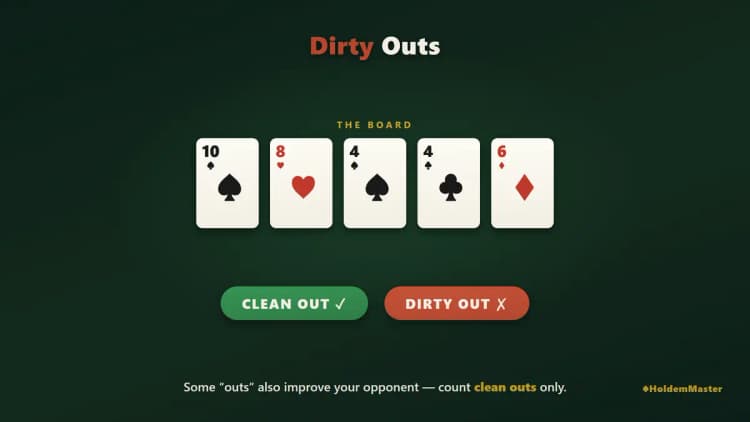
Three situations to train your eye for:
The non-nut flush
Holding 8♠7♠ on K♠9♠2♣, you have 9 spade "outs" — but if a spade comes and an opponent was drawing to the same flush with a higher spade, you make a flush and still lose. Discount your outs when you're not drawing to the nut flush
The paired board
A flush draw on a board like J♥8♥8♣ looks like 9 clean outs, but the board is already paired — a made full house may be waiting, so some of your flushes are dead on arrival
Overcards into strength
Two overcards (A-K on Q-8-3) count as 6 outs on paper, but if a big raise screams a set or two pair, pairing your ace often isn't good — count 3 at most, not 6, and none at all once you are sure of the set or two pair
You rarely know the exact discount, and that's fine. The move is directional: when the board or the action tells you an out might not win, shave the count down before you convert. A player who counts 9 outs on a paired board and calls the pot is paying full price for a draw that's quietly worth less than that. Reading which outs are clean is a board-texture skill — build it with how to read the board.


FAQ
The 3 Things to Remember
1. Count what wins, not what improves. An out has to make the best hand, not just a better one. Subtract only the cards you can see. 2. Convert with 4 and 2. Outs × 4 on the flop, × 2 on the turn. On the flop, trim the ×4 estimate for big draws (over 8 outs) by subtracting (outs − 8). 3. Discount the dirty ones. Non-nut flushes, paired boards, and overcards into strength all shrink your real out count. When in doubt, count fewer.
Nail the count and the rest of poker math falls into place. Take your out count straight into how to calculate pot odds to see if the price is right, or back up to the full poker odds and probability chart for the exact number behind every draw.