The first time a dealer read my hand better than I did, I was tabling what I thought was ace high. "Straight," she announced, pushing me a pot I had mentally given up — my 8-6 had quietly connected with three board cards while I was busy mourning a missed flush draw.
The cards speak, but only if you can read them. Looking at 7 cards and instantly knowing your best 5 is the single most practical skill a new Hold'em player can train — and it's a method, not a talent. This guide is that method.
The Short Answer
✦ Quick answer
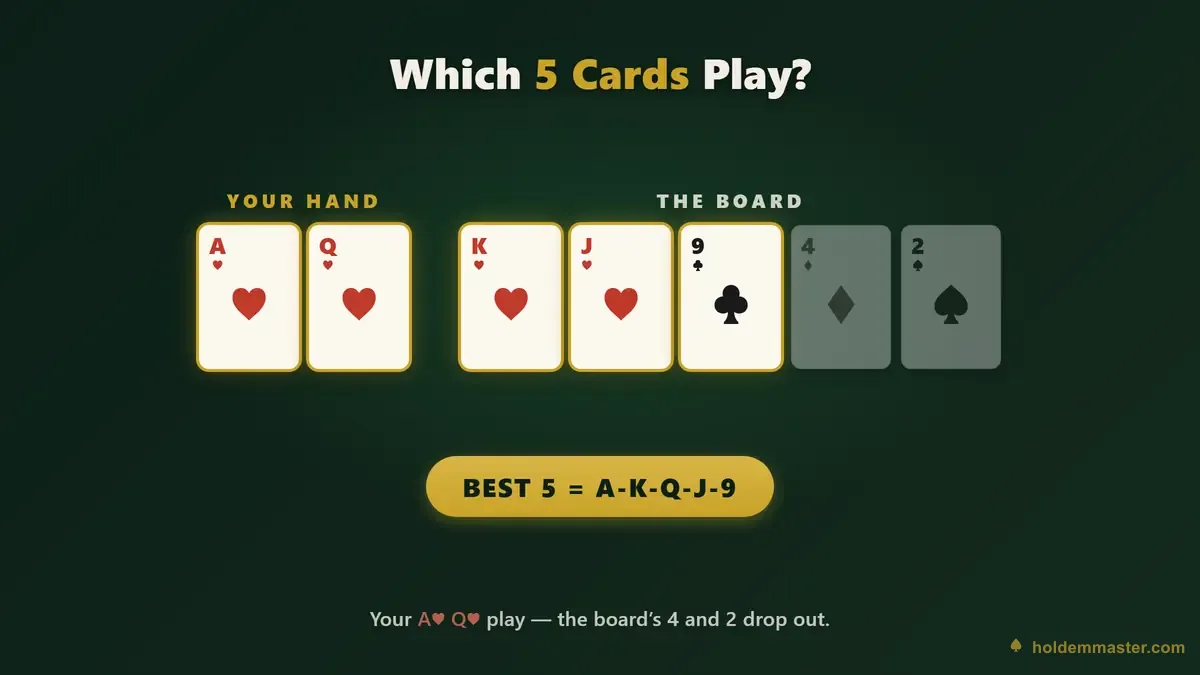
Your final hand is the best 5-card combination you can build from your 2 hole cards plus the 5 community cards. You may use both hole cards, just one, or none at all ("playing the board"). Scan all 7 cards in a fixed order — flush, straight, paired ranks, high card — then place what you find on the ladder of  poker hand rankings.
How to Make the Best 5-Card Hand From 7 Cards
In Texas Hold'em you are dealt 2 hole cards, and the board eventually shows 5 community cards. Out of those 7, you play exactly 5 — the strongest 5 available. There are only three ways it can go:
| How many hole cards you use | What it looks like | Of the 21 possible 5-card picks |
|---|---|---|
| Both | Your two cards connect with three board cards | 10 of the 21 ways |
| One | One card pairs or completes something; the other sits out | 10 of the 21 ways |
| None ("playing the board") | The 5 community cards are already your best 5 | 1 of the 21 ways |
Three quick examples, fully worked out:
| Your hole cards | Board | Best 5 cards | Hand |
|---|---|---|---|
| A♠ K♥ | Q♦ J♣ 10♠ 2♦ 7♣ | A-K-Q-J-10 | Broadway straight (both hole cards play) |
| 9♥ 9♦ | 9♠ 2♦ J♣ 5♥ K♣ | 9-9-9-K-J | Three nines, K and J kickers |
| 7♦ 2♣ | A♠ K♠ Q♠ J♠ 10♠ | The board itself | Royal flush — playing the board |
How to Read the Board in 4 Steps
This is the exact scan I run on every river, in this order — from the hardest hand to spot down to the easiest:
Check for a flush
Count suits across all 7 cards. Any suit appearing 5+ times = flush. This is the hand beginners miss most.
Check for a straight
Line up all 7 ranks mentally and look for 5 in a row. Ace counts high or low, never both.
Check paired ranks
Pairs, trips, full houses, quads — match ranks between your hand and the board.
Take the highest
Whatever the strongest thing you found is, that's your hand. Add the highest remaining cards until you hold exactly 5.
Walk-through: you hold A♥ 5♥ and the board reads A♦ 7♦ 4♠ 10♣ 2♠.
- •Flush? Hearts 2, diamonds 2, spades 2, clubs 1 — no.
- •Straight? Ranks A-T-7-5-4-2 — no five in a row (the wheel A-2-3-4-5 misses a 3).
- •Paired ranks? Yes — A♥ + A♦.
- •Best 5: A-A-T-7-5. One pair of aces with T-7-5 behind it — not "a pair of aces and that's it." Those three side cards decide ties.
What Does "Playing the Board" Mean in Poker?
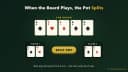
Playing the board means your hole cards add nothing — the 5 community cards are already the best 5-card hand you can make.
Board: A♠ A♦ A♣ 7♥ 7♦ — a full house, aces full of sevens. You hold K♣ Q♣. Test it: keeping the full house (A-A-A-7-7) beats any 5-card combo using your king or queen (A-A-A-K-7 is only three of a kind). Your best hand is the board itself.
Here's the part that matters for your stack: the board belongs to everyone still in the hand. If nobody can improve on it, the pot is chopped — the full mechanics are in the  split pot rules. But before you assume a chop, ask who CAN beat the board:
- •Anyone holding the last A♥ has four aces.
- •Anyone holding the last two sevens (7♠ 7♣) has four sevens.
- •Anyone holding a pocket pair 8-8 through K-K has a bigger full house.
How to Spot a Straight on the Board
A straight is 5 consecutive ranks. The reliable method: list all 7 ranks from high to low and look for any 5 in a row.
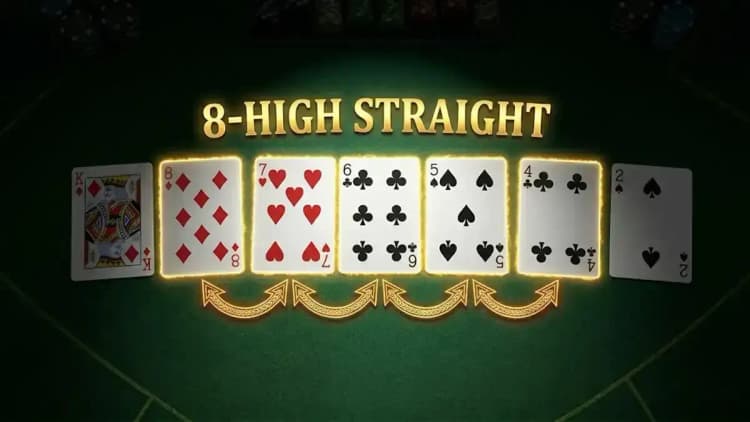
You hold 8♦ 6♣. Board: 7♥ 5♠ 4♣ K♦ 2♠. Ranks in order: K, 8, 7, 6, 5, 4, 2. There it is — 8-7-6-5-4, an eight-high straight — even though your two hole cards look like junk side by side.
| Hold | Board | Straight? |
|---|---|---|
| 8♦ 6♣ | 7♥ 5♠ 4♣ K♦ 2♠ | Yes — 8-7-6-5-4 |
| J♠ 9♣ | 10♥ 8♦ 7♠ 2♣ K♥ | Yes — J-10-9-8-7 |
| A♥ 3♦ | 2♠ 4♣ 5♥ 9♦ K♠ | Yes — A-2-3-4-5 (the wheel) |
| K♥ Q♦ | J♠ 10♣ 8♥ 3♦ 2♠ | No — K-Q-J-10 needs a 9 or an ace |
- •Can you use an ace in a straight? Yes, at either end: high in A-K-Q-J-10 (Broadway) or low in A-2-3-4-5 (the wheel — the lowest straight there is).
- •Can a straight wrap around? No. K-A-2-3-4 is not a straight — it's just ace high. Hold A♦ 2♦ on K♠ Q♥ 3♣ 4♦ 9♠ and you have no pair, no straight, nothing but A-K-Q-9-4.
How to Spot a Flush on the Board
A flush needs 5 cards of one suit among your 7. The board tells you instantly whether one is even possible:
| Suited cards on board | What it means |
|---|---|
| 0–2 | No flush possible for anyone |
| 3 | Anyone holding 2 of that suit has a flush |
| 4 | Anyone holding just 1 of that suit has a flush |
| 5 | The board itself is a flush — a card of that suit higher than the board's lowest one improves it, and on a connected board any card of that suit that completes a straight flush — even a lower one — beats every flush |
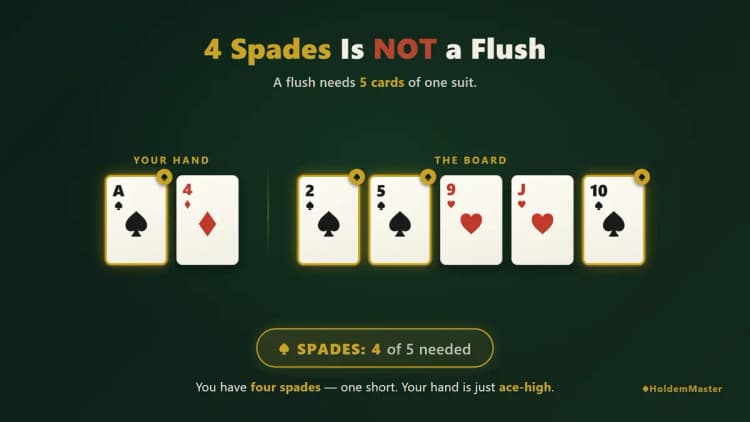
The classic misread: holding A♠ 4♦ on a board of 2♠ 5♠ 9♥ J♥ 10♠ and announcing a flush. Count it: the board has three spades (2♠ 5♠ 10♠), your ace makes four. Four is not five. Your actual hand is ace high — A-J-10-9-5 — and it feels terrible to learn that after you've called a river bet.
The reverse trap matters just as much: on a 4-flush board you hold ZERO of that suit, and — as long as the board isn't paired — any opponent with a single card of it has you beat. And if you're weighing a made flush against a made straight, flush beats straight, always.
What Happens When the Board Pairs? Trips, Boats, and Quads
The moment two community cards share a rank, the ceiling of the hand jumps: trips, full houses, and quads are all live.
Board: K♣ K♦ 7♠ 3♥ 2♣
| You hold | Your best 5 | Hand |
|---|---|---|
| K♥ 9♦ | K-K-K-9-7 | Three kings (both hole cards play) |
| 7♥ 7♦ | 7-7-7-K-K | Full house, sevens full of kings |
| A♠ Q♦ | K-K-A-Q-7 | Just one pair — the board's kings — with A-Q behind |
Paired board = re-read the hand from scratch before putting chips in.
Can You Have a Flush and a Pair at the Same Time?
You can HOLD both — you can never PLAY both. A poker hand is exactly 5 cards, so overlapping combinations don't stack; you simply play the stronger one.
- •You hold A♠ K♠ on Q♠ 7♠ 2♠ K♦ 3♣. You've made a pair of kings AND five spades. Your hand is the nut flush, A♠ K♠ Q♠ 7♠ 2♠ — the pair of kings simply never comes up.
- •You hold 8♥ 8♦ on 7♣ 6♦ 5♠ 4♥ K♦. Pair of eights AND 8-7-6-5-4. Your hand is the eight-high straight — not "a pair with a straight." At showdown you don't have to call it: cards speak, and the dealer reads the hand (TDA Rule 12). What you do have to do is turn both cards face up — cards only speak for a properly tabled hand (Rule 13-A) — and if the dealer misreads it, say so before the pot is pushed.
What Is the Best Possible Hand? Reading the Nuts
Strong players run one more scan: not "what do I have?" but "what is the best hand ANYONE could have on this board?" That hand is called the nuts (more table slang like this in the poker glossary).
Board: Q♣ 9♥ 6♣ 5♦ 2♠
1. Flush possible? Only two clubs — no. Nobody on earth has a flush here. 2. Board paired? No — so no full houses or quads exist either. 3. Best straight? The board's 9-6-5 plus 8-7 in the hole makes 9-8-7-6-5. Nothing higher connects.
So the nuts is 8-7 — a nine-high straight, and even pocket queens (top set) loses to it. Running this 3-question check on every river tells you whether your "strong" hand is actually the ceiling or just furniture.
Wet Board vs Dry Board: Reading the Texture
Once you can read your own hand, the same scan tells you how dangerous the board is for everyone — what players call texture.
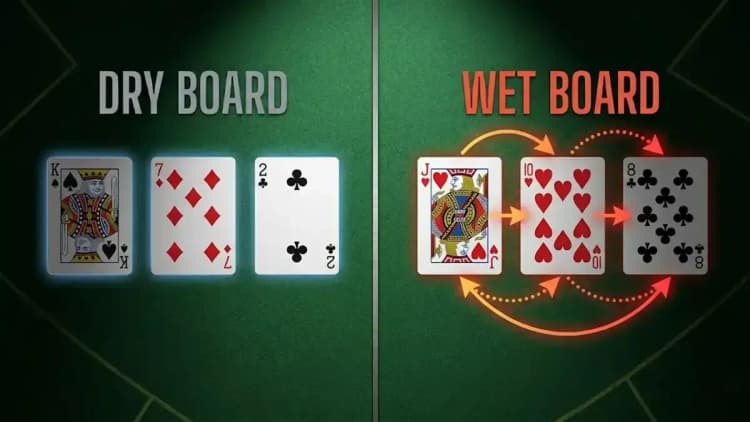
On J♥ 10♥ 8♣, any heart, any 9, any 7, and any Q changes who's winning. On K♠ 7♦ 2♣, almost nothing does. Same pair, completely different pressure — that's why the scan-order habit (flush → straight → pairs) doubles as your danger radar.
Board Reading Mistakes That Cost Real Money
Mistake 1 — Missing a straight you already made
Tunnel vision on your pair or busted draw. My 8-6 story at the top of this page is exactly this — check for straights even when you think you know what you have. The dealer will catch it at showdown; your stack prefers YOU catch it before folding.
Mistake 2 — Counting four suited cards as a flush
Four spades among your 7 is not a flush — you need five. And the mirror image: board 9♠ 6♠ 3♠ Q♠ J♦ with A♥ K♥ in hand gives you A-K-Q-J-9 — high card only — while any opponent holding a single spade has a flush.
Mistake 3 — Forgetting the board is shared
Beginners fold to "he must have a club" on a three-club board — but those clubs help an opponent only if his HOLE cards are clubs. Everyone rents the same board; only hole cards make anyone's hand different from yours.
Mistake 4 — Ignoring the boat on a paired board
You river a flush, the board shows two queens, and you never ask the question. Any Q-x has trips; any pocket pair matching the board has a full house — and full house beats flush. Paired board + big bet = check for boats before you celebrate.

FAQ
The Takeaways
1. Exactly 5 from 7 — both hole cards, one, or none. Overlapping hands never stack; play the strongest. 2. Scan in order — flush → straight → paired ranks → high card. The hands you miss are the ones the scan exists for. 3. Read it for everyone — the board is shared, so the same scan reveals the nuts, the danger, and whether your hand is the ceiling or the floor.
If you're still learning the game flow itself, start with the beginner's guide to Texas Hold'em rules, then lock in the ladder with the full hand rankings.