The most expensive word in poker is "hope." I spent my first year calling turn bets because my flush draw might get there on the river, and I bled chips doing it. The night it finally clicked was a $50 call into a $150 pot — I did the math for once, realized I needed just 25% to break even, and never looked at a call the same way again.
Pot odds are the single piece of math that separates calling on a feeling from calling for a reason. They take five minutes to learn and a few sessions to make automatic. This guide gives you the 10-second method, a bet-size cheat sheet you can picture at the table, and the one thing most players get wrong: how pot odds, equity, and implied odds actually fit together.
The numbers behind your draws come from the  poker odds and probability chart — this guide is how you turn those numbers into a correct call or fold.
Pot odds at a glance
What Are Pot Odds in Poker?
Pot odds are the price you're being offered to keep playing. They compare the size of the pot to the size of the bet you have to call — the reward versus the risk.
Say the pot is $150 and you must call $50. You're being offered $150 to win for a $50 risk — you're "getting 3-to-1." The bigger the pot relative to the call, the better your price, and the less often you need to win to make calling worth it.
That "how often you need to win" number is the whole point. Getting 3-to-1 means the call pays for itself if you win just 25% of the time or more. Pot odds turn a fuzzy "should I call?" into a hard target: do I win often enough to beat this price?
How to Calculate Pot Odds (Step by Step)
✦ Quick answer
Calculate the final pot first, including the bet you face and your own call, then divide the call by that total. The result is a break-even equity percentage. Keep the pot's timing consistent: money already included in the current pot must not be added a second time.
Add up the final pot
Current pot + the bet + your call. Example: $100 pot + $50 bet + your $50 call = $200
Divide your call by that final pot
$50 ÷ $200 = 0.25
That's your required equity
You need to win at least 25% of the time to call profitably
Compare it to your actual equity
Flush draw with 9 clean outs ≈ 35% to hit with two cards to come and no more betting → 35% beats 25% → call
That's it. Required equity = your call ÷ the final pot. If your real chance of winning is bigger than that number, calling makes money in the long run — even when you'll lose the hand more often than not.
✦ The one rule that removes all confusion
Always include your own call in the final pot. "Getting 3-to-1" and "needing 25%" describe the same spot — the ratio is the price, the percentage is the target. Most beginner mistakes come from mixing the two conventions; pick the percentage and never look back.
Pot Odds as a Ratio vs. Percentage
✦ Quick answer
A pot-odds ratio compares the money you can win with the call you risk; a percentage expresses how often that risk must succeed. At 4-to-1, you risk one unit to win four, so you must win one time in five: 20%. A bigger reward for the same call lowers the break-even percentage.
| You're getting… | Equity you need |
|---|---|
| 1-to-1 | 50% |
| 2-to-1 | 33% |
| 2.5-to-1 | 28.6% |
| 3-to-1 | 25% |
| 4-to-1 | 20% |
| 5-to-1 | 16.7% |
| 6-to-1 | 14.3% |
How Much Equity Do You Need to Call?
✦ Quick answer
A half-pot bet requires 25% equity to call; a pot-sized bet requires 33%, and a double-pot bet requires 40%. The target depends on the bet's size relative to the pot, not its dollar amount. Work out that target first, then judge your hand against the range offering you that price.
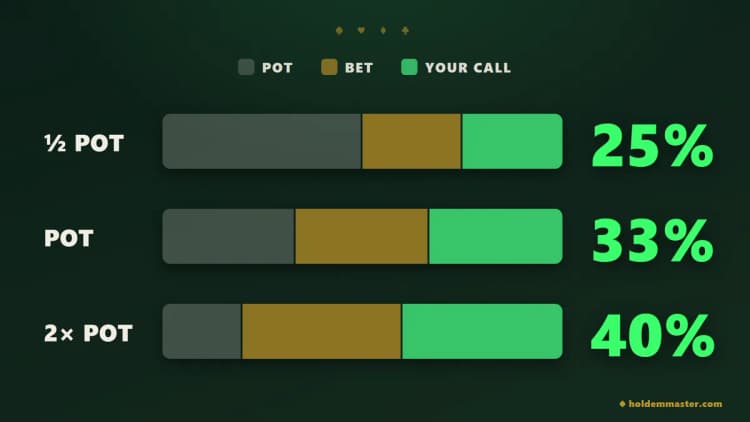
Memorize these seven anchors so you can price the call before deciding whether your hand is strong enough:
| Opponent bets | You're getting | Equity you need |
|---|---|---|
| ¼ pot | 5-to-1 | 16.7% |
| ⅓ pot | 4-to-1 | 20% |
| ½ pot | 3-to-1 | 25% |
| ⅔ pot | 2.5-to-1 | 28.6% |
| ¾ pot | 2.3-to-1 | 30% |
| Pot-size | 2-to-1 | 33% |
| 2× pot | 1.5-to-1 | 40% |
Even a massive 2×-pot overbet only asks for 40% equity. You almost never need to be a favorite to call profitably — a common misread that makes people fold correct calls. The bigger the bet, the more equity you need, but it climbs slower than most players think.
Pot Odds Chart: Which Draws Beat Which Bets
✦ Quick answer
Whether a draw meets the price depends on both its clean outs and the number of cards this call buys. A flush draw's two-card chance is much higher than its one-card chance. Use the column for the actual decision, and do not treat merely making a pair or flush as a guaranteed win.
 Count your outs before using the chart. The six-out overcard row assumes either pair wins; discount pair-making cards that still lose to the opponent's likely hands.
| Your draw | Outs | Chance to hit, 1 card (turn → river) | Chance to hit, 2 cards (flop → river) |
|---|---|---|---|
| Flush + open-ender | 15 | 32.6% | 54.1% |
| Flush draw | 9 | 19.6% | 35.0% |
| Open-ended straight | 8 | 17.4% | 31.5% |
| Two overcards | 6 | 13.0% | 24.1% |
| Gutshot straight | 4 | 8.7% | 16.5% |
Read it against the bet-size table above. Facing a half-pot bet (need 25%): if the bet puts you all-in so you see both cards, a flush draw (35%) is a clear call — but on a single card from the flop (9 ÷ 47), that same draw is only 19.1%, which doesn't meet the price on its own. That gap is exactly where implied odds come in.
Pot Odds vs. Equity vs. Implied Odds
✦ Quick answer
Pot odds set the price, equity measures your expected share, and implied odds estimate additional money won later. Start with the first two. Only count a future payoff if there are chips left to win and an opponent likely to pay; completing a second-best hand can instead cost more.
Pot odds vs.  equity is the core decision: call when your equity beats your pot odds.
  Implied odds are the tie-breaker for draws that just miss the price. If your flush draw needs 25% but only has 19.6% on the river card, you can still call if you'll extract enough extra bets when you hit to cover the difference. That's why you can profitably call a flop bet with a draw, and why deep stacks make draws more valuable.
The dark mirror is reverse implied odds — the chips you'll lose when you hit but still lose the hand (your flush completes, but the board pairs and someone has a boat). Second-best draws quietly bleed money, which is why the nut flush draw is worth so much more than a baby one.
The Rule of 4 and 2: Turning Outs Into Odds Fast
✦ Quick answer
Use the Rule of 4 and 2 to estimate whether a draw is near the price of a call. Four times your outs approximates two cards, while twice your outs approximates one. Before choosing the multiplier, ask whether the present call gets you to the river without another payment; a close decision deserves the exact table.
- •On the flop, with two cards still to come: multiply your outs by 4.
- •On the turn, with one card to come: multiply your outs by 2.
Full derivations for every draw and made hand live in the probability chart. Here, the shortcut is all you need.
Common Pot Odds Mistakes Beginners Make
✦ Quick answer
The costly pot-odds mistakes are using the wrong final pot, counting cards that still lose, and buying one card with a two-card estimate. Future money can also be imaginary: deep stacks do not guarantee payment. Check the price, clean outs, and remaining betting separately before calling a draw.
Forgetting to include the call
Required equity is call ÷ final pot — count your own chips going in, or you'll overstate the equity you need and fold calls you should make
Counting tainted outs
A flush out that also pairs the board can make someone a full house. Discount "dirty" outs before you trust the number
Misusing the Rule of 4
×4 only applies when you'll see both cards for free (all-in). Facing a turn bet, it's ×2 — using ×4 talks you into losing calls
Ignoring implied & reverse implied odds
Deep stacks reward drawing hands; a non-nut draw that hits into a bigger hand is a trap, not a payday
Calling on hope
"It might get there" is not a reason. If your equity doesn't beat your pot odds (plus implied odds), it's a fold
A real hand, start to finish
I'm holding A♥ K♥ on a Q♥ 7♥ 2♣ flop — the nut flush draw, 9 outs. Pot is $100, villain bets $50. My pot odds: I'm getting 3-to-1, so I need 25%. If I got to see both cards I'd be at ~35% — but this call only buys the turn, and the turn alone is 19.1%, short of the price. What closes the gap is implied odds: if a heart lands I stack a top-pair hand. Easy call.
Turn is the 3♠ — a brick. The pot is $200 and villain jams $200 — a pot-sized bet, so now I'm only getting 2-to-1 and need 33%. But with one card left my flush is just 19.6% (I count only the 9 hearts — against a pot-sized jam, pairing my ace or king often still loses, so the overcards aren't clean outs). The direct price says fold; my implied odds are now zero because villain is all-in and can't pay me more. Against the sets and two pair that jam a brick turn like this, 19.6% is the best case — against a set, the 2♥ and 3♥ pair the board and fill him up, leaving 7 clean outs (7 of the 46 cards I can't see, about 15.2% — or 7 ÷ 44, about 15.9%, once his two cards are counted out too) — and even if a few top-pair hands sneak into his range, the overcards only drag the call up to about break-even. Fold — and the exact spot where "hope" used to cost me a stack.
FAQ
The 3 Things to Remember
1. The formula: required equity = your call ÷ the final pot (with your call included). Half-pot = 25%, pot-size = 33%. 2. The comparison: call when your equity beats your pot odds. For a draw, outs × 4 or × 2 estimates it — count clean outs only, and use ×2 when more betting is coming. 3. The tie-breaker: implied odds rescue draws that just miss the price — but only when there are chips behind to win and an opponent likely to pay them off; drawing to the nuts makes that payoff safer.
Do this a few hundred times and it stops being math and becomes instinct. You'll fold the hopeless calls, make the profitable ones, and stop paying the "hope" tax. From here, sharpen the raw numbers behind every draw in the poker odds and probability chart, or make sure you're entering pots with hands worth drawing to using the starting hands chart by position.