My first live session, I picked up A♣ 4♦ and thought "an ace, how bad can it be?"
I called a raise, missed the flop, called again, missed the turn. By the river I'd lost 40 big blinds with nothing.
Here's the uncomfortable math behind that hand: Texas Hold'em has 169 distinct starting hand types — and roughly 80% of the hands you're dealt should be folded preflop. Learning which hands to play — and from which seat — is the single biggest improvement beginners make in their first month. Hand selection is the second of the five decisions behind every winning hand: get it right and every later street gets easier.
This page is the one-stop version: the 10 best starting hands, what makes a hand good in the first place, the full starting hands chart by position (9-max and 6-max), GTO preflop charts vs beginner charts, a printable PDF cheat sheet, and a quick quiz to test yourself.
Starting hands, by the numbers
The 10 Best Starting Hands in Poker, Ranked
These are the best starting hands in poker — the ones you should almost always raise preflop, from any seat at the table:
| Rank | Hand | Why it's strong |
|---|---|---|
| 1 | AA | Best preflop hand — ~85% favorite over one random hand |
| 2 | KK | Loses only to AA preflop — still raise and re-raise |
| 3 | Strong, but reassess when an A or K hits the flop | |
| 4 | JJ | Premium — raise strong, slow down vs. heavy action on A/K/Q flops |
| 5 | TT | Top-5 hand — raise first in, tread carefully vs. big 3-bets |
| 6 | AKs | Suited ace-king — dominates other big cards, makes the nut flush draw |
| 7 | AKo | Off-suit AK — raise from any position |
| 8 | AQs | Suited AQ — strong, but fold to big 3-bets out of position |
| 9 | KQs | Suited KQ — good in late position, trickier from UTG |
| 10 | AJs | Suited AJ — strong in position, fold to heavy resistance |
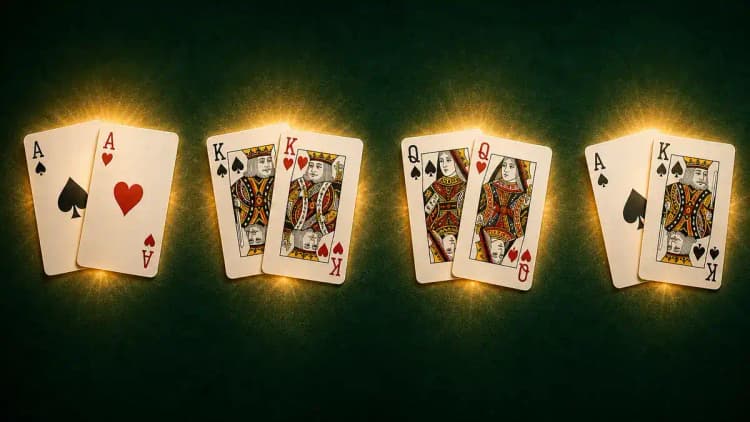
With hands 1–5 (the pocket pairs), always raise and often re-raise preflop to build the pot. With AK and AQ, the goal is to get heads-up where your big cards have maximum equity. One number worth memorizing: AK is roughly a coin flip against every smaller pocket pair (the classic "race") and around 43–46% against QQ — close enough that raising and re-raising with AK stays correct.
Pocket rockets, cowboys, big slick — if the table slang is new to you, the poker glossary covers every hand nickname. And if you're fuzzy on what beats what once the board comes, review the poker hand rankings first.
What Counts as a Good Starting Hand in Poker?
Good starting hands in poker share one trait: they make strong five-card hands more often than the hands they run into. High pairs start ahead. Big suited cards make top pair with the best kicker, nut flushes, and high straights. Everything else needs help — and hands that need help are only worth playing when the help is cheap.
Sorted into tiers, good starting hands in poker look like this:
| Tier | Examples | How to play it |
|---|---|---|
| Premium | AA, KK, QQ, JJ, AKs, AKo | Raise from any position, re-raise aggressively |
| Strong | TT–88, AQ, AJs, ATs, KQs | Raise from most positions, slow down vs. heavy 3-bets |
| Speculative | Small pairs (77–22), suited connectors (JTs, T9s, 98s), suited aces (A2s–A9s) | Late position only — they need cheap flops and position |
| Trash | Weak offsuit aces (A4o), king-rag (K3o), low offsuit junk | Fold preflop — these cost chips every session |
Poker Starting Hands Chart by Position (Full 9-Max Chart)
Your position at the table changes which hands are profitable.
From early position, many players still act after you — so you need stronger hands. From the button, you act last on every postflop street, which means you can play a much wider range profitably.
Here is the poker starting hands chart for a standard 9-max table:
| Position | Open range | Key hands to play |
|---|---|---|
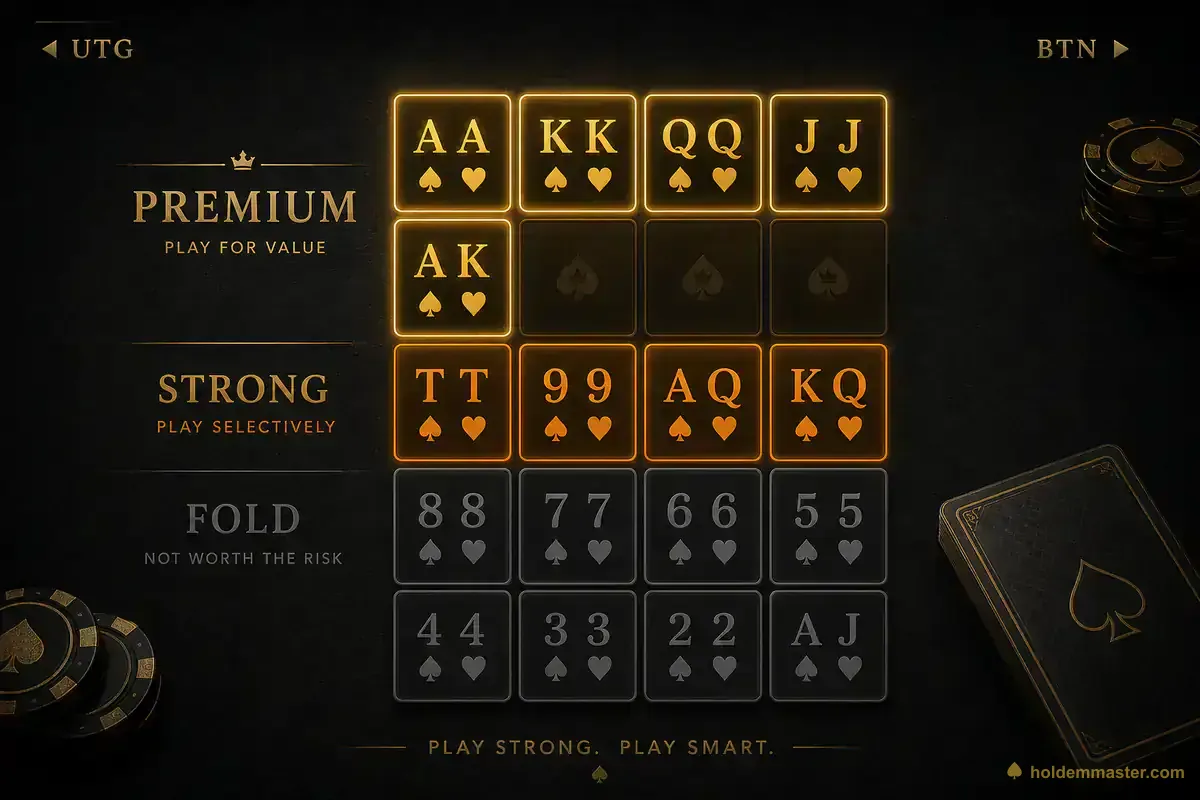
| UTG (Early) | Top ~13% | TT+, AJs+, AKo, KQs |
| MP (Middle) | Top ~17% | Add 88, 99, ATs, KJs, QJs, JTs |
| CO (Cutoff) | Top ~27% | Add 55–77, A9s+, KTs+, suited connectors (T9s, 98s) |
| BTN (Button) | Top ~43% | Add 22–44, A2s+, suited broadways, weaker offsuit hands |
Two things that table is not saying. The percentage is a share of all 1,326 starting-hand combinations, so ~13% is about 172 of them — that is how wide a solid regular opens under the gun, not how wide this page asks a beginner to open. And the hands beside each seat are the core: the UTG row above is 58 combinations, and each row below it only lists what that seat adds. The sections that follow widen the core as you improve; the last stretch up to a full ~13% belongs to the GTO charts further down.
See how the opening range widens seat by seat — UTG, MP, CO, and BTN (the full 13×13 grid of all 169 hands is in the hand chart tool linked below):
Opening range by position — action folds to you
Want it as a standalone tool with expanded ranges per seat? Use the Texas Hold'em starting hand chart tool. For a breakdown of every seat name (UTG, HJ, CO, BTN, SB, BB), see the  poker positions guide.
Early position (UTG): the tightest range
UTG is the hardest seat to play. Eight players still act behind you. Any hand you open here needs to hold up against strong ranges.
The core of the UTG range (a full ~13% range widens to mid pairs like 77–99, more suited broadways, and a few offsuit hands like AQo as you improve):
- •Pocket pairs: TT, JJ, QQ, KK, AA
- •Premium suited: AKs, AQs, AJs, KQs
- •Premium offsuit: AKo (and sometimes AQo)
- •KJo, QJo, KTo — too many dominated scenarios against the players who call a UTG open
- •77, 88 — fine from the button; from UTG they sit at the outer edge of the full ~13% range above, so they're the first pairs to drop when the table is tough
- •Weak suited aces (A2s–A7s) — save these for late position
Late position (cutoff and button): the widest range
The button is the best seat in poker. You act last on the flop, turn, and river every hand. That advantage lets you profitably add:
- •Small pocket pairs (22–66) — hoping to flop a set
- •Any suited ace (A2s–A9s) — nut flush draw potential
- •Suited connectors (T9s, 98s, 87s) — cheap, high-implied-odds hands
- •Weaker broadway offsuit (KTo, QJo) — only in late position, never early
6-Max Starting Hands: How the Chart Changes
Most online cash games are 6-max, and the chart shifts in one direction: wider. Remove the three tightest seats from a 9-max table and every remaining position effectively "moves up." The first player to act in 6-max is opening into five opponents, not eight — so UTG in 6-max plays roughly like MP in 9-max (~15–17% instead of ~13%).
The mistake to avoid is playing a 9-max chart in a 6-max game: you'll fold hands that are clearly profitable and get eaten by the blinds. The reverse mistake — 6-max ranges at a full-ring table — is how weak aces end up dominated all night. Once the chart feels automatic, position play is the skill that converts those wider ranges into actual profit: stealing, isolating, and pressuring the blinds from the seats that allow it.
What Percentage of Starting Hands Should You Play?
Across a full session, a solid beginner target is playing roughly 15–20% of the hands you're dealt — which means folding 80–85% preflop. That's not one flat number: the per-seat figures above — ~13% from UTG, ~17% from MP, ~27% from the cutoff, ~43% from the button — are how wide you open an unopened pot. Your session average lands lower than the raw mean of those, because you're often facing a raise (where you continue with far fewer hands) and you spend many orbits stuck in early seats and the blinds.
If you're playing 30–40% of hands at a full-ring table, you're not "seeing more flops" — you're paying rake and reverse-implied odds on hands the chart already told you to fold. Track it honestly for one session; the number is usually higher than it feels.
One scope note: this is about what percentage of your range to play, not about how often specific hands win against each other. For hand-vs-hand win rates (AK vs QQ, pair vs two overcards, and the rest), see the poker odds and probability guide — that's its job, not this chart's.
GTO Preflop Charts vs Beginner Charts: Which to Use?
I keep solver outputs open when I study, and I still hand every beginner a simplified chart first. These are two different tools, and knowing which one to use is worth more than either chart alone.
GTO preflop charts come from solvers (PioSOLVER, GTO Wizard and friends). They're theoretically unexploitable — and they're also full of mixed frequencies: open this hand 25% of the time, fold it 75%, 3-bet this combo but only with these suits. Beginner charts — like the one on this page — compress all of that into one clear action per hand.
Here's why memorizing solver charts blindly backfires: GTO frequencies are a defense against perfect opponents. Your opponents at low stakes call too much, fold too rarely, and never 3-bet light — against them, the solver's carefully balanced bluffs make less money than simply raising good hands and folding trash. You end up making mixed-frequency moves you can't explain, in games where the plain move earns more. Learn the simplified chart until raise-or-fold is automatic; add GTO preflop charts when you move online or start studying seriously. The bridge between the two is understanding  poker equity — the win-share math that solver EVs are built on.
The Worst Starting Hands (That Look Playable)
The worst starting hands in poker aren't random junk like 7-2 — nobody needs a chart to fold that. The expensive ones are the hands that look playable and consistently lose chips over sessions:
| Hand type | Why it loses | What beginners think |
|---|---|---|
| Weak aces (A2o–A8o) | Makes second-best pair vs. better aces | "I have an ace, it must be good" |
| Low offsuit connectors (76o, 65o) | Rarely hits cleanly, hard to play when it does | "It could make a straight" |
| King-rag offsuit (K3o, K4o) | Dominated by every better king | "A king is a big card" |
| Any two suited cards | Makes a flush by the river only ~6.4% of the time (flops one ~0.8%) | "But they're the same suit" |
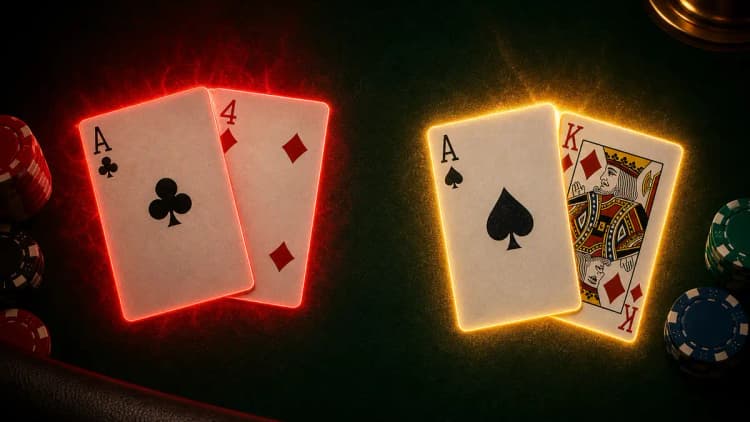
The most expensive mistake beginners make is calling raises with weak aces like the A♣ 4♦ from the intro. When you finally hit your pair of aces, you're often second-best to A♠ K♦ or A♥ Q♦ — and you lose a big pot convinced you have top pair. You do. So do they, with a better kicker.
(And the actual worst hand in poker? 7-2 offsuit — more on that, and the famous "7-2 rule," in the FAQ below.)
Printable Starting Hands Chart (PDF Cheat Sheet)
Charts only work if they're in front of you when it matters. For home games and study sessions, we made the whole thing printable:
📄PDF Cheat SheetDownload the free printable poker starting hands chart (PDF)Printable PDF · quick table referencePDF ↓ — one page: the full 9-max opening chart plus the one-line 6-max adjustment, cheat-sheet format. Print it, or keep it open on your phone between hands.
Then use it literally, every hand, for your first 20+ sessions:
Check your position first
Before you even look at your cards, note where you sit relative to the button
Match your hole cards to the chart
Find your hand in the range for that position
Raise or fold
Avoid calling (limping) as a default action
Fold everything else
Even when it feels too tight — especially then
It feels boring. That's the point. Tight-aggressive preflop selection is the foundation of every winning poker style, from beginner cash games to high-stakes tournaments.
Test Yourself: Preflop Hand Quiz
Three chart spots. Decide before you peek at the answers:
Got all three? Try the full 10-question poker hand quiz — best five cards from seven, against the clock.