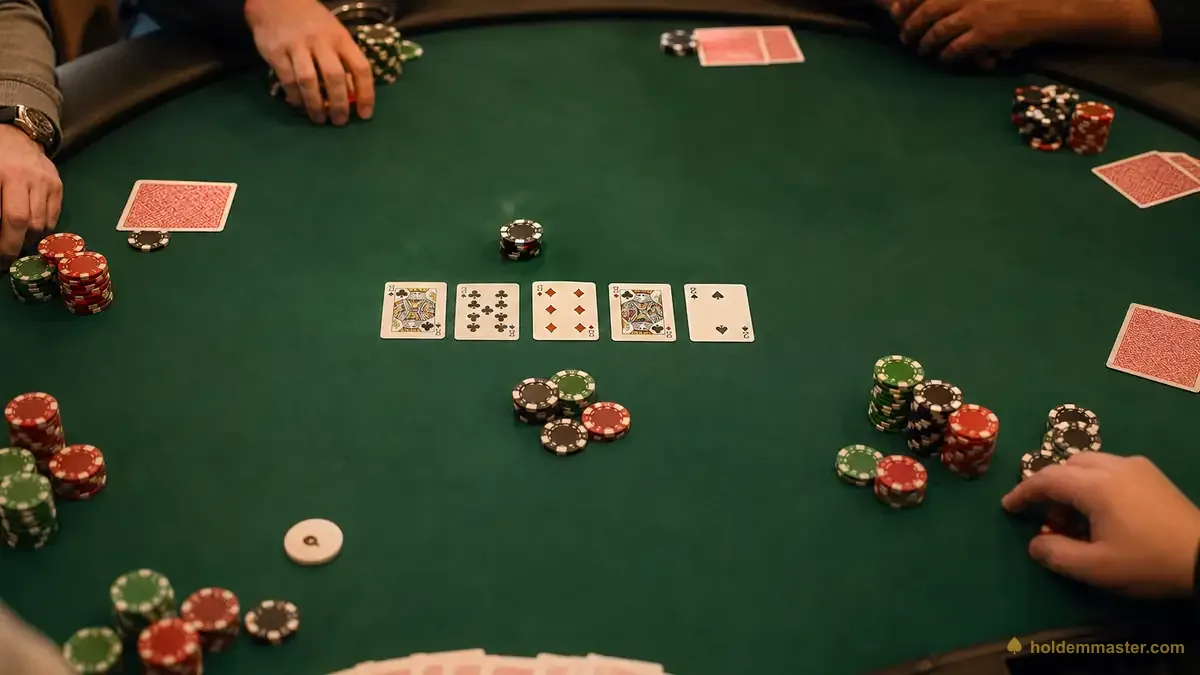
The first time I set-mined a pair of fives in a live game and hit my set on the flop, the guy next to me groaned "what are the odds?" — and I actually knew: about 1 in 8.5. That one number is why I called in the first place.
Poker isn't a guessing game. Every call, fold, and shove is a probability question in disguise, and the players who win are the ones who've turned "what are the odds?" into a reflex. This is the complete poker odds and probability chart for Texas Hold'em — every made hand, every flop, every draw — with the one mental shortcut that lets you do the math at the table in two seconds.
The numbers that matter most
Poker Hand Odds Chart: The Probability of Every Hand
✦ Quick answer
A poker hand's probability depends on how many cards you get to use. In Hold'em, the best five of seven produce one pair 43.8% of the time and two pair 23.5%. Those river frequencies differ from a random five-card deal; choose the matching column before comparing how rare two hands are.
- •5-card odds = the chance a single random five-card hand is that hand (the classic textbook number).
- •Hold'em (by the river) = the chance you end up with that hand after seeing all seven cards (your two hole cards + five community cards). This is the number that actually matters at the table.
| Hand | 5-card odds (dealt) | Hold'em odds (by river) |
|---|---|---|
| Royal Flush | 1 in 649,740 (0.000154%) | 1 in 30,940 (0.0032%) |
| Straight Flush | 1 in 72,193 (0.00139%) | 1 in 3,590 (0.0279%) |
| Four of a Kind | 1 in 4,165 (0.0240%) | 1 in 595 (0.168%) |
| Full House | 1 in 694 (0.144%) | 1 in 39 (2.60%) |
| Flush | 1 in 509 (0.197%) | 1 in 33 (3.03%) |
| Straight | 1 in 255 (0.392%) | 1 in 22 (4.62%) |
| Three of a Kind | 1 in 47 (2.11%) | 1 in 21 (4.83%) |
| Two Pair | 1 in 21 (4.75%) | 1 in 4.3 (23.5%) |
| One Pair | 1 in 2.4 (42.3%) | 1 in 2.3 (43.8%) |
| High Card | 1 in 2.0 (50.1%) | 1 in 5.7 (17.4%) |
✦ The stat that surprises everyone
High card is the most common five-card hand (50.1%), but in Hold'em it drops to 17.4% — third most common, behind one pair (43.8%) and two pair (23.5%). Why? Seven cards give you so many chances to pair up that "no pair by the river" becomes the exception. More cards, more connections.
 poker hand rankings: probability is the ranking — measured over five cards.
What Are the Odds of Being Dealt Each Starting Hand?
✦ Quick answer
Pocket aces arrive about once per 221 deals, but any pocket pair appears about once per 17. The difference is the number of combinations: there are 1,326 possible two-card deals, and a particular pair is only six of them. Any two suited cards arrive 23.5% of the time, while A-K suited specifically is just 0.30%.
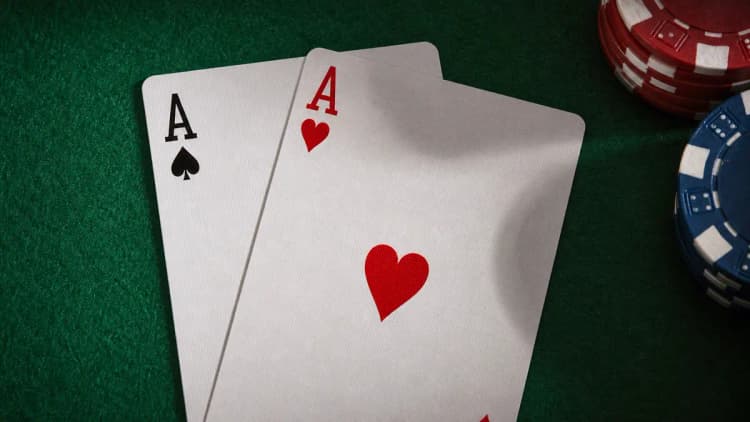
Before any flop, there are exactly 1,326 possible two-card starting hands. Here's how often the ones people ask about show up.
| Starting hand | Odds | How often |
|---|---|---|
| A specific pocket pair (e.g. A-A) | 1 in 221 (0.45%) | Once every ~221 hands |
| Any pocket pair | 1 in 17 (5.9%) | Roughly twice an hour live |
| A-K suited (specific) | 1 in 332 (0.30%) | Rare |
| A-K (suited or offsuit) | 1 in 83 (1.2%) | — |
| Any two suited cards | 1 in 4.3 (23.5%) | Almost every fourth hand |
What Are the Odds of Flopping Each Hand?
✦ Quick answer
With a pocket pair, you flop a set or better 11.8% of the time. With two suited cards, a made flush is only 0.84%, while a flush draw is 10.9%. These are conditional odds: start with the hole cards shown in the table, not the frequency of that hand across every random deal.
| You flop… | Holding | Odds | Against |
|---|---|---|---|
| A set (or better) | A pocket pair | 11.8% | ~7.5 to 1 |
| A flush | Two suited cards | 0.84% | ~118 to 1 |
| A flush draw | Two suited cards | 10.9% | ~8 to 1 |
| A straight | Suited connectors (e.g. 8-7) | 1.3% | ~76 to 1 |
| Two pair | Two unpaired cards | 2.0% | ~49 to 1 |
| A full house | A pocket pair | 0.98% | ~101 to 1 |
| Quads | A pocket pair | 0.245% | ~407 to 1 |
For set mining, 7.5 to 1 is a theoretical break-even payoff, not a sufficient stack rule: it assumes every hit wins and gets paid. In practice, the usual guideline — effective stacks of 15–20× the call — allows for missed value and losing sets; even that is a heuristic, not an automatic call. That's the bridge to pot odds, below. For the full derivation of every row here — plus the set-mining stack rule and the made-vs-draw-vs-complete flush split — see the deep dive on  drawing odds and the odds of flopping each hand.
Drawing Odds: Hitting Your Flush or Straight by the River
✦ Quick answer
A nine-out flush draw completes about 35% of the time over the turn and river, compared with 19.6% on the river alone after a missed turn. An eight-out straight draw is slightly less likely. These are completion probabilities, not guaranteed wins: first discount cards that improve your hand but leave an opponent ahead.
| Draw | Outs | Flop → river (2 cards) | Turn → river (1 card) |
|---|---|---|---|
| Flush + open-ended (combo) | 15 | 54.1% | 32.6% |
| Flush + gutshot | 12 | 45.0% | 26.1% |
| Flush draw | 9 | 35.0% | 19.6% |
| Open-ended straight | 8 | 31.5% | 17.4% |
| Two overcards | 6 | 24.1% | 13.0% |
| Gutshot (inside) straight | 4 | 16.5% | 8.7% |
| Pair → set | 2 | 8.4% | 4.3% |
| Set → full house or quads | 7 (flop) / 10 (turn) | 33.4% | 21.7% |
The six-out overcard row assumes pairing either rank wins. Against two pair, a set, or a stronger draw, some or all of those pair-making cards may be dirty — discount them rather than treating six as guaranteed winning outs. The set row counts the fourth card of your rank too: a full house alone is about 29.1% from the flop and 19.6% on the turn.
The classic spot: you flop a flush draw (nine outs). You'll get there 35% of the time by the river — better than one in three. An open-ended straight draw (eight outs) hits 31.5%. Note the two columns: once the turn bricks you have one card to come instead of two, so your odds roughly halve — 35% becomes 19.6% for the flush draw — which is exactly why draws get more expensive to chase street by street.
How to Calculate Poker Odds: Counting Outs and the Rule of 2 and 4
✦ Quick answer
The Rule of 2 and 4 estimates a draw's completion percentage: use twice the outs for one remaining card and four times the outs for the turn and river together. The two-card estimate can price a flop call only if no further payment is needed to see both cards. It is a shortcut, not exact equity.
Count your outs
The unseen cards that complete your hand (flush draw = 9)
On the flop, if you'll see both cards without paying again
Multiply outs × 4 → your approximate % to hit by the river
On the turn (1 card to come)
Multiply outs × 2 → your approximate % to hit on the river
Worked example. You have four cards to a flush after the flop. That's 9 outs (13 of your suit − 4 you can see). On the flop: 9 × 4 = 36% — the true figure is 35.0%, so you're spot on. On the turn if you missed: 9 × 2 = 18% (true: 19.6%).
That's the shortcut: clean outs → the multiplier for the cards you'll see → a draw estimate to use alongside your  equity. Everything else is just knowing what to do with that number. The one skill this rule assumes you've mastered is the count itself — for combo draws, overlapping outs, and the "dirty" outs that shouldn't count, see the full guide to
  counting outs in poker.
Pot Odds: Turning Your Odds Into a Call or Fold
✦ Quick answer
Pot odds turn a call into a break-even target: divide the call by the pot after adding it. Compare that price with your chance of winning over the cards the call actually buys. A two-card flush figure cannot justify paying for only the turn when another bet may follow; future payoffs need a separate estimate.
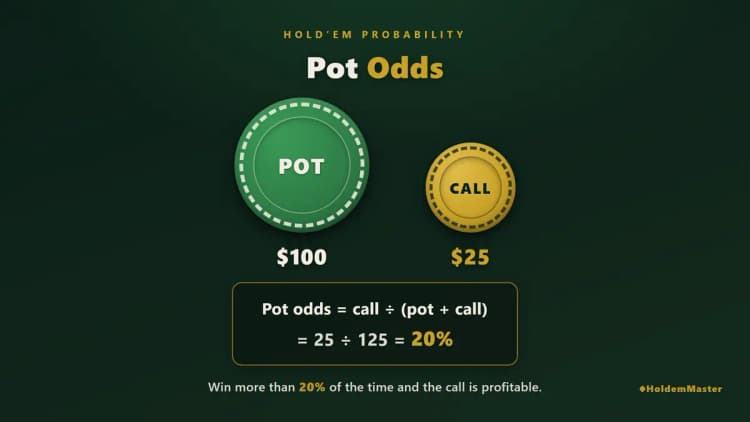
Worked example. The pot is $100. Your opponent bets $50, making it $150. You must call $50 to win that $150.
Pot after the bet
$100 + $50 = $150
Your call
$50 to win $150 (final pot $200)
Pot odds
50 ÷ 200 = 25% — you need at least 25% equity
Your equity
Flush draw with 9 clean outs ≈ 35% by the river (Rule of 4: 9 × 4 = 36%), which assumes you see both cards
Decision
With both cards to come: 35% > 25% → a clearly profitable call
That's the moment all the numbers pay off — but match the number to the street you're paying for. When both cards are coming (you're all-in, or the turn checks through), a clean draw's 35% beats the 25% price and calling wins money in the long run even though you'll lose the hand more often than not. When your opponent will fire again on the turn, this call only buys you the turn card — from the flop that's 9 ÷ 47 = 19.1%, below the price — and the draw then needs  implied odds, the money you win on the streets after you hit, to cover the gap. Spending the ×4 number on a one-card decision is the most common way beginners overrate a draw. For the full method and the bet-size cheat sheet, see how to calculate pot odds.
How Rare Is a Royal Flush? (And a Straight Flush)
✦ Quick answer
A royal flush appears roughly once in 30,940 random seven-card Hold'em hands, far more often than in a five-card deal. A non-royal straight flush is about 1 in 3,590 by the river — less rare, but still exceptional. Neither figure describes your chance from a particular draw: once hole cards and a flop are known, the calculation is conditional on those cards.
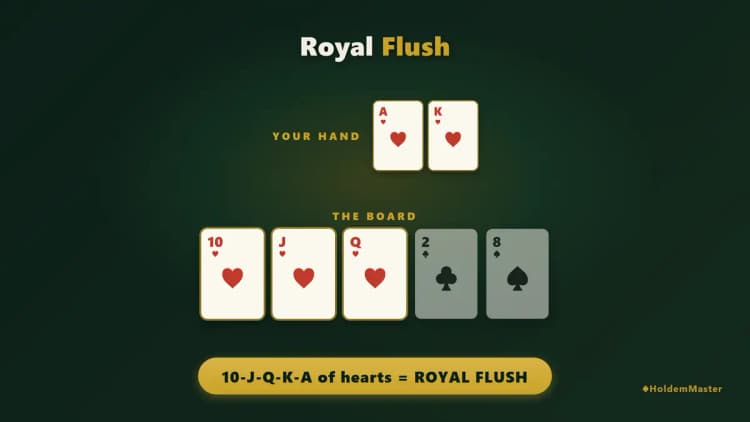
- •Royal flush: as a dealt five-card hand, 1 in 649,740. Playing Hold'em to the river, it improves to about 1 in 30,940 because you're choosing your best five from seven cards. Either way, most players go years between them.
- •Straight flush: about 1 in 72,193 as a five-card hand (about 1 in 3,590 by the river in Hold'em). Still a once-a-year sighting for most.
Long-Shot Odds: Coolers, Quads, and Bad Beats
✦ Quick answer
Long-shot poker odds need a starting condition. Flopping quads with a pocket pair is about one in 408; being dealt aces is one in 221 before you see any cards. These events explain rare outcomes, but a rare loss alone does not show whether the preceding decision was correct.
| Long shot | Odds |
|---|---|
| Being dealt pocket aces | 1 in 221 |
| Flopping quads with a pocket pair | 1 in 408 |
| Flopping a straight flush (suited connectors 54s–JTs) | ~1 in 4,900 |
| Making a royal flush by the river | 1 in 30,940 |


FAQ
 the pot odds guide — ratios, bet-size shortcuts and the costly mistakes
The 3 Numbers to Burn Into Memory
1. Flop a set: ~12% (1 in 8.5). The hit rate starts the set-mining calculation; stack depth and likely payment decide whether the call pays. 2. Flush draw by the river: 35%. Nine outs, Rule of 4 → 9 × 4 = 36%. 3. Pot odds beat gut feeling. Match the probability to the cards this call buys, then compare the price with your chance to win — completing a draw is not always enough.
Poker rewards the players who've made these automatic. Learn the chart, drill the Rule of 2 and 4, and start asking "what are the odds?" before you act instead of after. Next, put the math to work by learning which starting hands to play from each position, or brush up on why a flush beats a straight so you always know what your outs are worth.