
For my first two years I did what everyone does: I read the tip lists. "Ten quick tips." "Nine essential rules." I could recite them all — play fewer hands, be aggressive, respect position — and I was still losing. The problem wasn't that the tips were wrong. It was that they were a pile of disconnected rules with nothing tying them together, so at the table, in the moment, I had no idea which one applied.
What finally made me a winning player wasn't a longer list. It was realizing that every hand of Texas Hold'em is the same five decisions, asked over and over — where am I sitting, is this hand worth playing, do I raise or fold, do I keep betting, and when do I let go. Get those five right and you beat almost every casual game you sit in. This is the complete Texas Hold'em strategy framework built around them, with links to the deep-dive on each one so you can drill wherever you're leaking.
What actually separates winners from everyone else
Poker Strategy Isn't a List of Tips — It's Five Decisions
Open any "beginner poker strategy" article and you get a numbered listicle: ten tips, nine rules, seven habits. They're not wrong — but a list is the worst way to learn, because the game doesn't hand you a numbered menu. It hands you a seat, two cards, and a bet to react to.
So instead of a list, use a decision spine. Every hand you play walks through the same five questions in the same order. Each one has a dedicated playbook on this site — this hub is the map that connects them:
| # | The decision | The question you're really asking | Deep dive |
|---|---|---|---|
| 1 | Position | Where am I sitting, and who acts after me? | Position play |
| 2 | Hand selection | Is this hand even worth entering the pot? | Starting hands |
| 3 | Preflop aggression | Do I raise or fold rather than open-limp? | Why limping costs you |
| 4 | Continuation | Do I keep betting on the flop, or shut down? | Betting actions |
| 5 | Discipline | When do I let a hand go? | Pot odds & folding |
The magic isn't in any single decision — it's that they chain. Good position makes hand selection easier. Tighter hand selection makes your raises scarier. Scary raises win more pots on the flop. And knowing when to fold keeps the pots you lose small. Miss one link and the chain snaps. Let's walk each one.
Decision 1 — Where Am I Sitting? (Position)

Before you even look at your cards, the most important information is already fixed: your seat. In Hold'em, the player who acts last after the flop has an enormous edge — they see what everyone else does before committing a chip. That's why the  button is the most profitable seat in the game and the blinds are the least.
Acting last lets you do three things nobody in early position can:
- •Gather information — you watch everyone check, bet, or fold before you decide, so you're never guessing blind.
- •Control the pot — you can check behind to keep it small with a marginal hand, or bet to build it with a strong one.
- •Steal more — a bet from late position is more believable and gets through far more often.
Decision 2 — Is This Hand Even Worth Playing? (Hand Selection)
The single biggest leak in poker is playing too many hands. New players call with any ace, any two face cards, any two suited cards — and then spend the rest of the hand in trouble. The fix is the least glamorous skill in the game and the most profitable: fold most of what you're dealt.
How much is "most"? A solid  tight-aggressive beginner folds roughly 80% of their hands before the flop. That sounds absurdly tight until you internalize why: the hands you do play are stronger on average than your opponents', so you win the pots that matter and skip the marginal spots that quietly bleed chips.
Which hands make the cut depends on your position (Decision 1 feeding Decision 2), but a starter rule of thumb:
- •Always raise: big pairs (A‑A down to T‑T), and A‑K.
- •Usually raise: medium pairs, A‑Q, and strong suited broadways (K‑Q, A‑J suited) — more freely the later your seat.
- •Speculative, position-dependent: small pocket pairs and suited connectors, which want cheap multiway pots (more on the math below).
- •Fold: almost everything else, especially offsuit junk like J‑4, Q‑7, K‑3.
Decision 3 — Raise or Fold. Don't Just Limp.
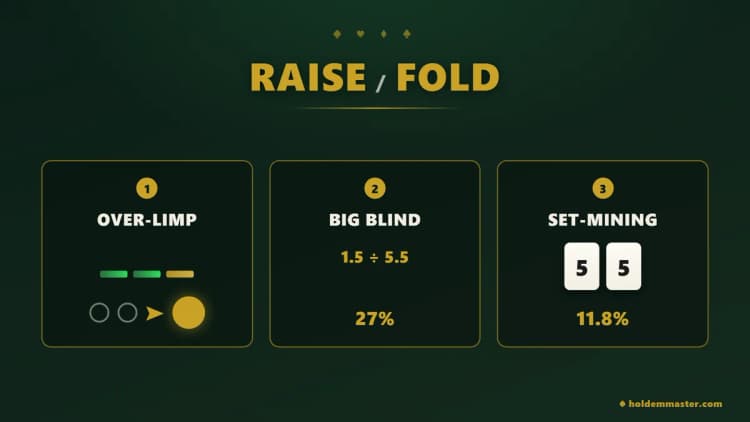
Once you've decided a hand is worth playing, there's a second decision most beginners get wrong: how to enter the pot. The answer, almost always, is raise — don't limp.
To limp is to just call the big blind instead of raising. It feels safe and cheap, and it's one of the most expensive habits in poker, for three reasons:
1. A limp can never win the pot preflop. When you raise first-in, everyone might fold and you scoop the blinds for free. Limp, and that chance is exactly zero — you've thrown away the cleanest way to win. 2. You surrender initiative. The preflop raiser gets to keep telling a story on the flop (Decision 4). Limp, and you hand that story to someone else. 3. You paint a target on yourself. Strong players raise big behind a limper to isolate them, then out-play them in position all hand. An open-limp announces "weak, passive player here."
The default that fixes it is blunt: if a hand is good enough to play, it's good enough to raise; if it isn't, fold. And when someone else has already raised, raising again — a  3-bet — is how you punish wide opens and build pots with your best hands. The exceptions to that raise-or-fold default are real, and every one of them is about price. Over-limping — calling behind someone who already limped, in position, with a speculative hand like a small pair — buys a cheap seat in a multiway pot. Defending your big blind is the bigger one: against a 2.5bb open (heads-up, small blind folded, no antes) you have 1bb already posted, so you're calling 1.5bb into a 4bb pot and need only 1.5 ÷ 5.5 = 27% equity on paper. You'll realize less than your raw equity out of position, so treat 27% as the floor, not the finish line. And because your call closes the action, a wide slice of the BB range flat-calls rather than 3-bets or folds. Set-mining a small pair against a raise with deep stacks is the third (the math is below). Those are discounts, not strategies — outside spots like them, raise or fold. The first-in rule itself is a normal-depth cash-game default: completing the small blind in an unraised pot and the button open-limps solvers use at short tournament stacks are the main legitimate limps it doesn't cover.
Decision 4 — Do I Keep Betting on the Flop? (The C-Bet)
You raised preflop, someone called, and now the flop is out. This is where most pots are actually won and lost — and the tool is the  continuation bet (c-bet): betting the flop after you were the preflop raiser, whether or not the board helped you.
The c-bet works because you are the one who represented strength preflop, so the board "belongs" to you. But here's the mistake to avoid: there is no single correct c-bet percentage. Old advice said "bet almost every flop." Modern strategy says it depends on three things:
- •Position — in position on a dry, high-card board (say K‑7‑2), you can c-bet often; out of position the frequency drops sharply because you have less information and less fold equity. The exact bands live in the c-bet guide.
- •Board texture — dry boards that miss your opponent favor betting; wet, connected boards (9‑8‑7 with two of a suit) that hit calling ranges call for caution.
- •Number of opponents — heads-up you can bet freely; into two or more callers, c-bet less than half the time, because someone connected with something.
Decision 5 — When Do I Fold? (The Decision That Saves the Most Money)
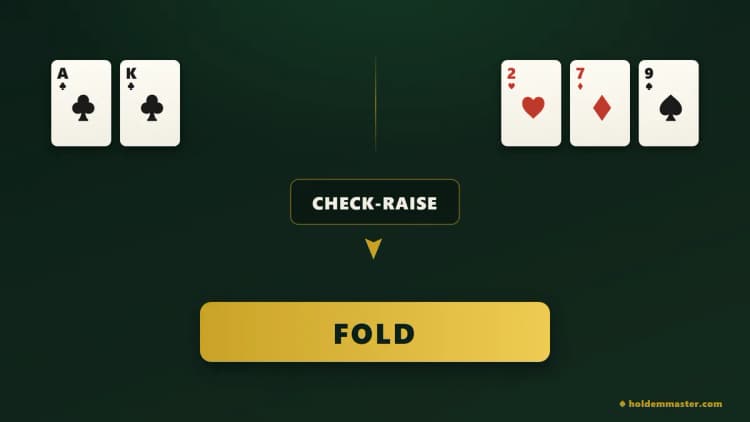
Aggression wins pots. Discipline keeps stacks. The decision that separates break-even players from winners isn't a hero call or a slick bluff — it's the boring, repeated act of folding when you're beaten.
Here's a concrete one from a hand I played. I raised A♣K♣ and got one caller. The flop came 2♥ 7♦ 9♠ — a total miss. I have ace-high, no pair, no draw. I fire a c-bet (Decision 4, in position, dry board), and my opponent check-raises me. At that point the math is simple: I have the best possible high card and nothing else, and a check-raise on that board is almost never a bluff at low stakes. So I fold ace-high and lose the minimum. Two years earlier I'd have "just called to see" — and paid off a set of nines every time.
The general rule:  when the story your opponent is telling beats the hand you actually hold, and you don't have the odds to draw out, let it go. Folding a good-but-beaten hand feels like losing. It's actually the single most profitable habit in the game. When you do have a draw, the fold-or-call decision comes down to
  pot odds — the price you're getting versus the chance you hit a hand that wins.
The Math You Can't Skip
You don't need to be a mathematician, but two numbers underpin half your decisions.
Pot odds tell you whether a call is profitable: compare the price of the call to the size of the pot, then to your chance of hitting a winning card. If the pot lays you 4-to-1 and your draw comes in and wins about 1-in-5, calling is roughly break-even; better than that, it's a profit. This is the engine behind every "do I chase this draw?" spot — and the pot odds guide turns it into a 10-second table read.
Set-mining odds explain why small pairs are speculative. Call a raise with pocket fives hoping to flop a set — three-of-a-kind — and you'll connect only about 11.8% of the time, roughly 1 in 8.5. When it works it's gorgeous: flop 5♣ K♠ 2♦ holding 5♠5♦ and you've got a hidden set that stacks an overpair. But because you miss ~88% of flops, set-mining is only profitable when the effective stacks are deep enough to pay you off when you hit — a rough guide is at least ~15–20× the size of the call. Shallow stacks? That speculative call becomes a leak. The full odds and probability chart has every number you'll ever need.
The 6 Leaks That Cost Beginners the Most — and the Fix
If you strip strategy down to what actually loses money for new players, it's the same short list every time. Fix these six and you've done 90% of the work:
| The leak | Why it bleeds chips | The fix |
|---|---|---|
| Playing too many hands | Weak starting hands flop weak made hands that cost you postflop | Fold ~80% preflop (Decision 2) |
| Calling too much | A call has no fold equity — nobody folds to a call — and it lets others in cheaply | Raise or fold; stop "calling to see" (Decision 3) |
| Being too passive | Winners bet and raise for value; passivity wins tiny pots and loses big ones | Take the aggressive line when you have it (Decision 4) |
| Ignoring position | Playing junk out of position means guessing every street | Play tighter early, looser late (Decision 1) |
| Chasing draws without odds | "Hope" calls that the pot doesn't justify | Check pot odds before every draw call (Decision 5) |
| Playing on tilt | Emotional decisions torch a good session | Quit when you're not thinking clearly |
Notice that five of the six map directly onto the five decisions. The framework isn't abstract — it's literally the list of leaks, turned right-side up.
Tight-Aggressive: The One Style to Start With
If the five decisions are the what, tight-aggressive (TAG) is the how — the single style every source agrees is the right starting point. It's two words doing all the work:
- •Tight — you play few hands (Decision 2). You fold and fold and fold, and wait for spots where you're likely ahead.
- •Aggressive — but when you do play, you come in raising and betting (Decisions 3 and 4), not calling. You put opponents to decisions instead of the other way around.
FAQ
The Five Decisions, One More Time
1. Position — play more hands late, fewer early; the button is your most profitable seat. 2. Hand selection — fold ~80% preflop; the hands you keep are stronger than your opponents' on average. 3. Raise or fold — don't open-limp at normal cash-game depth (completing the small blind in an unraised pot is the exception); a raise can win the pot now, a limp never can. 4. Continuation — c-bet when you have initiative, but adjust for board, position, and opponents. 5. Discipline — fold beaten hands and draws without odds; it's the move that saves the most money.
That's the entire framework. Not ten tips to memorize — five questions to ask, in order, every single hand. Get good at answering them and you'll quietly pass the players still hunting for a longer list. Start with the starting hands chart and real position awareness, layer in pot odds, and you've built a game that beats almost every table you'll sit at.