My first live session, the dealer said "action is on you" and I froze — full seconds of silence while the whole table stared.
Check? Call? Raise? I knew the hand rankings. I did not actually know the rules of the actions themselves — and that's the gap this guide closes.
Texas Hold'em has only 5 betting actions, but the rules around them (when checking is legal, how big a raise must be, how many times you can re-raise) trip up beginners for weeks. If you're brand new, skim the  full Texas Hold'em rules guide first — then come back here for the action-by-action rulebook.
Quick summary
What Are the 5 Betting Actions in Texas Hold'em?
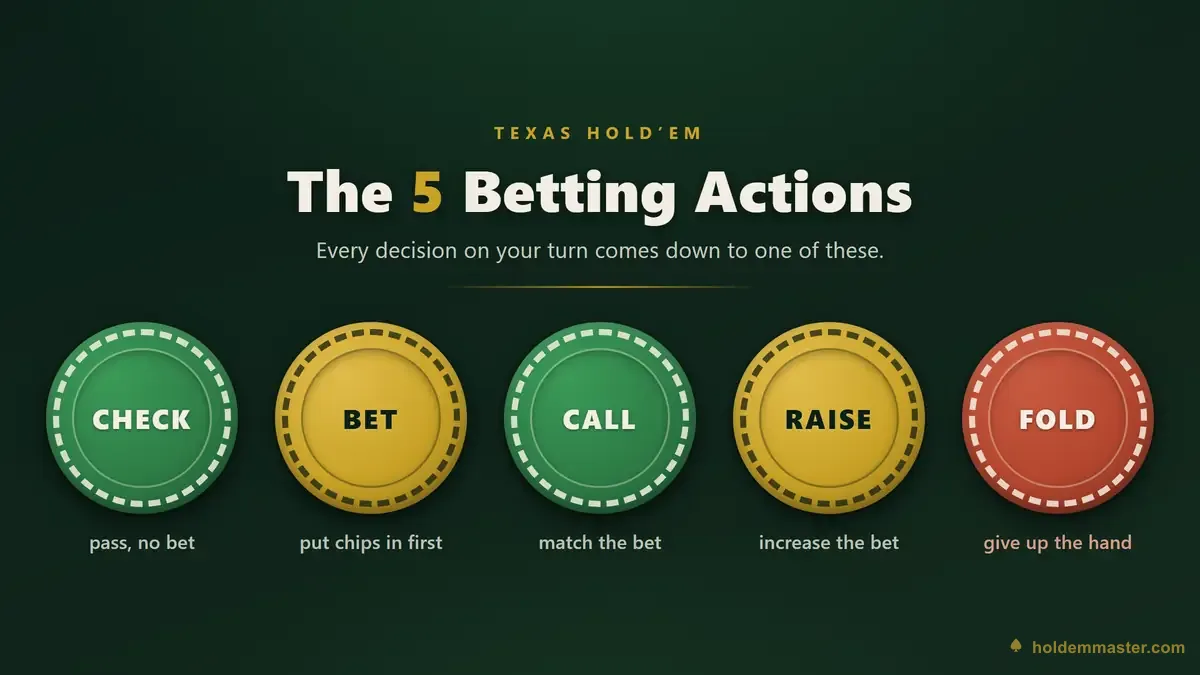
Every single decision you make at a poker table is one of these five:
| Action | When available | Chip cost |
|---|---|---|
| Fold | Any time the action is on you | Free — but you forfeit chips already in the pot |
| Check | Only when there is no live bet in front of you (preflop: as the big blind, or as the player who posted a live straddle) | Free — you pass without adding chips |
| Call | After someone has bet or raised | You match the current bet exactly |
| Bet | First wager of the round | Your chosen amount (minimum = 1 big blind) |
| Raise | After someone has bet | At least the size of the previous bet or raise on top |
The single most important rule beginners miss: you cannot check once there is a live bet in front of you. The moment there are chips in the pot you haven't matched, your options shrink to fold, call, or raise.
What Is a Check in Poker?
A check means: "I pass — no bet from me, but I'm staying in the hand."
It costs nothing. In live poker you signal it by tapping the table or saying "check." The action moves to the player on your left. If everyone checks around, the next community card is dealt — or, on the river, you go straight to showdown.
Checking is not surrendering. You keep your cards, you keep every option, and you've paid zero to see what happens next.
When Can You Check in Poker?
You can check in two kinds of situation:
- •No one has bet yet on the current street (flop, turn, or river)
- •You are the big blind preflop and no one raised — your blind already counts as a live bet, so you may check and see the flop for free (the same goes for a player who posted a live straddle)
For the full street-by-street picture of who acts when, see the  Texas Hold'em order of play.
What Is a Call in Poker? (Check vs Call)
A call means you match the current bet exactly to stay in the hand. Someone bets $10, you call $10 — no more, no less.
Check vs call is the single most common beginner mix-up, so here's the clean split:
| Check | Call | |
|---|---|---|
| When it exists | No live bet in front of you (preflop: as the big blind, or as the player who posted a live straddle) | Someone has bet before you |
| Chip cost | Free | You match the current bet |
| What it says | "I pass, still in" | "I pay to continue" |
What Is a Fold in Poker — Can You Fold at Any Time?
Folding means you surrender your cards and quit the hand. You pay nothing new, but every chip you already put in stays in the pot.
Yes — whenever the action is on you, you can fold, even before betting anything, and the fold is binding. It isn't free of consequence, though: in a tournament, folding when there is no bet in front of you counts as a "non-standard fold" under WSOP Rule 84 and can draw a warning. And note the trap: folding when you could check for free is throwing away a hand for no reason. If nobody has bet, just check.
One rule of live etiquette: don't fold out of turn. Wait until the action reaches you — folding early gives information to players still deciding, and most cardrooms will warn or penalize it. Knowing when folding is the right play is its own skill — that's covered in when to fold in poker.
What Is a Min-Raise? Texas Hold'em Bet & Raise Rules
In No-Limit Hold'em (the format you'll almost always play):
- •Minimum bet: 1 big blind
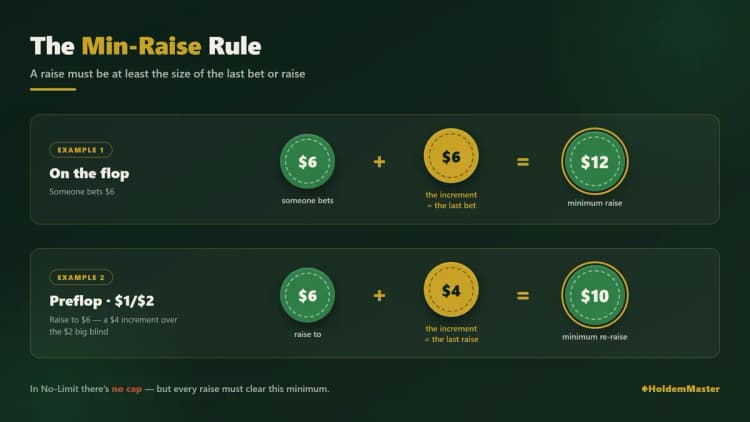
- •Minimum raise (the min-raise): at least the size of the previous bet or raise added on top
- •Maximum: your entire stack — that's the "no limit"
| Street | Action so far | Minimum raise |
|---|---|---|
| Flop | Player bets $6 | $6 more → $12 total |
| Preflop (blinds $1/$2) | Player raises to $6 (a raise of $4 over the $2 blind) | $4 more → $10 total |
Two live-poker rules that come with raising:
1. Announce "raise" before moving chips. Say "call" and then push out more? Your declaration was already binding (Rule 90.d) — the extra doesn't count. A real string bet is something else: a bet or raise made in multiple motions that include a return to your stack without announcing "raise" first — or a deceptive gesture meant to induce action out of turn (Rule 103). 2. One motion. If you don't announce, your chips must go in as a single forward motion.
How much you should raise (2.5x opens, 3x 3-bets, sizing by board texture) is strategy, not rules — that lives in the Texas Hold'em strategy pillar.
How Many Times Can You Raise in Poker?
In No-Limit Hold'em: there is no cap. You can raise, get re-raised, and raise again ("re-raise", "raise a raise" — same thing) until someone runs out of chips. Raise → 3-bet → 4-bet → 5-bet → all-in is a legal, if terrifying, sequence.
Two boundaries still apply:
- •Each re-raise must meet the min-raise increment rule above
- •You cannot raise your own bet. If you bet and everyone just calls, the round ends — you only get to raise again if someone raises you first
What Does Going All-In Mean?
All-in means betting every chip you have left. You can do it any time the action is on you — as a bet, a call, or a raise.
If your all-in is smaller than the current bet, you're not folded: you simply compete for a main pot capped at your contribution, while the extra chips from bigger stacks form a side pot you can't win. (If someone is even shorter than you, you still play for the side pot they can't reach — each all-in caps only its own layer.) And an all-in that's less than a full min-raise generally does not reopen raising for players who already acted — a subtle rule that surprises even regulars.
The full mechanics — side pot math, who shows first, table stakes — are in all-in rules and side pots, and what happens when all-in hands tie is in split pot and chop rules.
Knowing the Actions Is Step One — Choosing Them Is Strategy
This guide covers what each action is and when it's legal. Which one to pick — when to bet, when a call is profitable, when a good hand must be folded — is a different skill tree:
- •The framework for every decision: Texas Hold'em strategy — the 5 decisions
- •Judging your hand's raw strength first: poker hand rankings
- •Why your seat changes everything: poker positions explained
Live Betting Mistakes I See Every Week
I play a weekly low-stakes live game, and the same action errors repeat like clockwork:
Mistake 1 — Calling when you could check
First to act on the flop, nobody has bet, and a newer player pushes chips in silently, "to call." There's nothing to call: under WSOP Rule 90.a a bet is made by declaration or by pushing out chips — he just bet without meaning to. Had he said "call," Rule 90.b.1 would have made it a check instead. When the street is unopened, check and see the card for free.
Mistake 2 — "I call... actually, raise!"
"I call... actually, raise!" Nope. In live poker your action locks the moment you announce it — under Rule 90.d a verbal declaration in turn is binding. (That is not a string bet, by the way; a string bet is the multiple-motion push with a return to your stack covered in the FAQ. Same result though: the first word rules.) I've watched dealers rule this a flat call mid-sentence more times than I can count. Announce "raise" first, then move chips.
Mistake 3 — The big blind folding a free flop
Everyone limps, action reaches the big blind, and they fold. That's a free flop thrown in the muck. If no one raised, the BB can check and see three cards for zero extra cost — the blind is already live. This comes up every single orbit.
Mistake 4 — The silent single chip
Facing a $10 bet, a player silently throws in one $100 chip expecting change and a raise. The one-chip rule is in the WSOP rules verbatim (Rule 97): an unannounced single oversized chip is just a call. To raise, "raise" has to come out before the chip hits the table surface.