
The one that still stings: I had pocket aces, got it all in against a player who called with pocket fives, and watched one of the last two fives slam onto the river. I'd done everything right. My money went in as better than a 4-to-1 favorite, and I still lost the whole stack to one of the two cards in the deck that could beat me. That's a bad beat, and if you play poker long enough, it will happen to you thousands of times.
A bad beat is when you get your chips in as a heavy statistical favorite and lose anyway, because your opponent catches a lucky card to suck out on you. The key word is favorite — you were winning when the money went in, and only an improbable runout flipped the result. It's one of the most over-used words in the whole  poker glossary, so below is exactly what counts as a bad beat, how it differs from a
  cooler, what a "bad beat jackpot" pays, and the counterintuitive truth every winning player eventually learns: bad beats are usually a good sign.
The bad beat, at a glance
What Is a Bad Beat in Poker?
A bad beat is a hand you lose despite being a strong statistical favorite when the chips went in, because your opponent hit an unlikely card to overtake you. You got your money in "good," ahead in the math — usually the correct play — and the deck produced one of the runouts that beat you. The loss isn't your fault; it's variance doing its worst.
The mechanism is always a suckout: a card — on the flop, turn or river — that arrives after the money goes in and turns a losing hand into a winning one. Your aces were crushing their pocket fives until that third five appeared. Your top pair was ahead of their flush draw until the last heart fell. That moment — the favorite getting run down by a draw that had no business getting there — is the beating heart of the term. Understanding it is also the first step to not letting it wreck your session, the same emotional discipline that separates a pro from a fish.
Bad Beat vs Cooler: The Difference That Matters
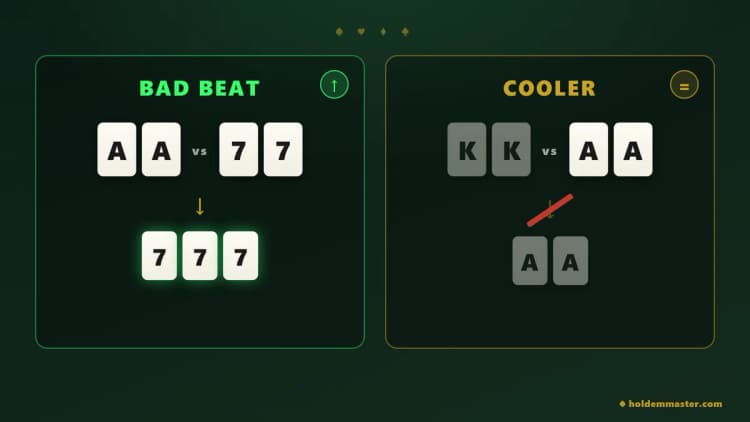
People use "bad beat" and "cooler" interchangeably, and there's no single official line between them — but in the strict sense this guide uses, they're opposites, and knowing which one just happened tells you whether to be annoyed at the deck or impressed by it. The whole difference is who was ahead when the money went in, and whether a suckout occurred:
| Bad Beat | Cooler (strict sense) | |
|---|---|---|
| Who led when chips went in | You were the favorite (often 80%+) | You were behind |
| Did a suckout happen? | Yes — a lucky card flipped it | No — the leader led all the way |
| Could you have folded? | Depends — the bad beat itself doesn't tell you whether your play held up | No — hand too strong to fold |
| Classic example | AA loses when 7‑7 spikes a set | KK runs into AA |
| The feeling | "I got outdrawn" | "I never had a chance" |
A quick litmus: if you were a heavy favorite when the money went in and your opponent needed to improve to win, it's a bad beat. If they were already ahead when the money went in and you simply couldn't fold your monster, that's a cooler in the strict sense — no suckout, no bad beat. And note the trap: flopped set over flopped set is not a bad beat. When your set of queens loses to a set of kings made on the same flop, nobody got lucky on the river — the bigger set was ahead the entire time. That's a cooler wearing a bad beat's clothes. (If the kings only found their set on the turn or river after the money was in, the test says suckout — that one is a bad beat. If the chips only went in after the bigger set arrived, it's still a cooler.)
How Big a Favorite Makes It a "Real" Bad Beat?
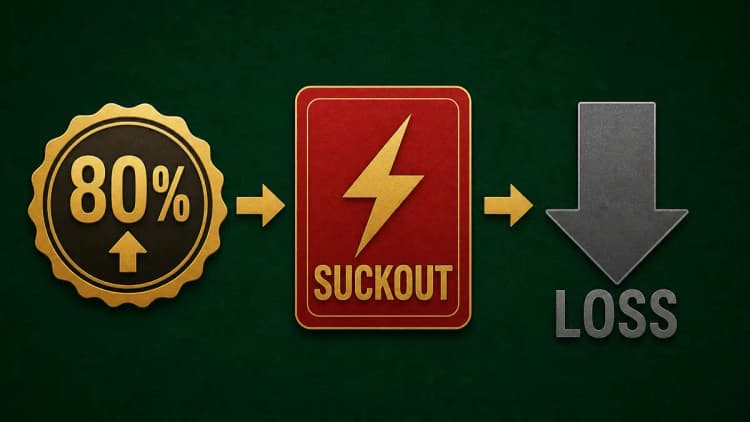
Here's where casual players and serious ones part ways: not every loss as a favorite is a bad beat. There's an unwritten equity bar, and it matters if you want to use the term honestly.
- •~80% or more, and you lose to a suckout — a genuine bad beat. Your aces (a ~4-to-1 favorite over a lower pair) getting cracked is the textbook case. A one-outer — losing to the single remaining card in the deck — is the purest bad beat of all.
- •60–70% favorite losing — unpleasant, but really just variance. You were only a modest favorite; the other outcome was always going to happen fairly often.
- •A coinflip is never a bad beat. Losing A‑K to Q‑Q (about 43/57 offsuit, 46/54 suited), or a pair to two overcards, is close enough to a coinflip — calling that a bad beat is like calling a lost coin toss a robbery. If it was close to even money, you didn't get beaten, you just lost a flip.
 misplayed hand.
Classic Bad Beat Examples (With the Odds)
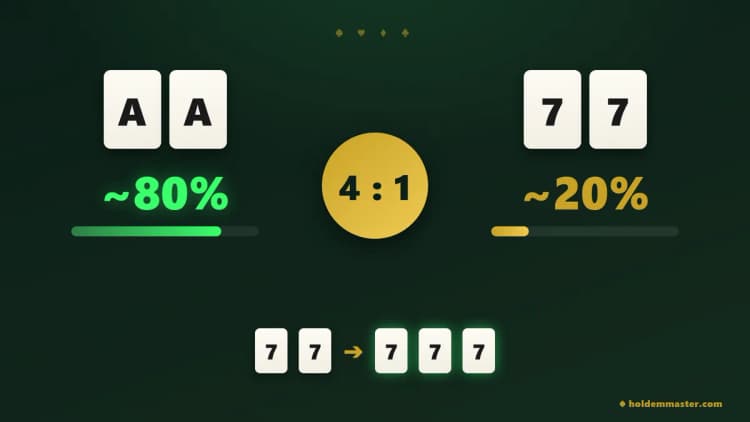
Every bad beat has the same shape: you're the favorite, the underdog needs help, and the help arrives. The most common versions, with approximate preflop/flop equities:
| The beat | You had | You were | How it happens |
|---|---|---|---|
| Aces cracked by a set | AA vs a lower pair (e.g. 7‑7) | ~80% (4:1) | Their pair hits a set on the flop, turn or river |
| Aces vs a random hand | AA all-in preflop | ~85% | Any two cards run you down |
| Overpair vs a flush draw (borderline) | Overpair on the flop | ~63% (1.7:1) | Their nine flush outs, plus backdoor two pair or straight, get there by the river |
| Runner-runner | A made hand ahead on the flop | ~90%+ | Two perfect cards (turn and river) complete a draw |
| The one-outer | A near-locked hand | ~96% | The single card left in the deck beats you |
By the bar in the previous section, overpair vs flush draw is the family's borderline case: at ~63%, it's more variance than a "true" bad beat — but it's what the table calls it anyway.
The most iconic is aces cracked by a set. You get pocket aces all in preflop against pocket sevens — you're roughly an 80% favorite, a 4-to-1 lock in your favor. But there are two more sevens in the deck, and if one hits the board, their three-of-a-kind usually beats your pair — only an ace or a rare runout (a flush, a straight, or trips on the board) saves you. Four times out of five you scoop it; the fifth time, you've got a bad beat story nobody wants to hear. The math was never wrong — you just landed on the wrong side of it, which is exactly why a single hand tells you nothing about whether you played well.
What Is a Bad Beat Jackpot?
Some cardrooms turn the pain into a prize. A bad beat jackpot is a progressive pot — built from a small extra drop taken out of pots as they're played — that pays out when a very strong hand loses at showdown. The idea is to reward the player who suffers a spectacular beat, and the payout is often life-changing.
The rules vary by room, but the common structure looks like this:
- •The qualifier. A typical minimum is "aces full of jacks or better, beaten by four of a kind or better." Some rooms set the bar higher (quads beaten). The losing hand has to be huge — you can't trigger it with a normal cooler.
- •Both hole cards must play. Nearly every room requires both of the loser's hole cards (and often the winner's) to be part of the hand, so you can't claim it on a hand made entirely by the board.
- •The split. The player who took the bad beat gets the biggest share, the winner of the hand gets the second share, and the other players dealt into that hand split the rest.
| Who | Typical share |
|---|---|
| Loser (the bad-beat hand) | ~50% |
| Winner of the hand | ~25% |
| Others dealt into the hand | ~25% (split evenly) |
One thing the jackpot does not use: the litmus at the top of this page. Its qualifier is written in hand strength, not in who was ahead when the money went in. Run the test on the classic trigger: you hold A♠A♥ on a board of A♣ J♠ J♦ 7♥ 2♣ for aces full of jacks, and your opponent holds J♥J♣ for four jacks. Both hands were complete on the flop and that is where the chips went in, so nobody was outdrawn after the money was committed — by the standard above that is a cooler, and it is exactly what the jackpot pays. Treat "bad beat jackpot" as a cardroom product name, not a second definition of the term.
One important caveat: every casino and poker site sets its own qualifier and split — some use 40/30/30, some require a pocket pair to make the qualifying quads, some rake the jackpot drop differently. Never assume; always check the specific room's posted rules before you count on a payout.
The Most Famous Bad Beat in Poker
If you want to feel better about your own beats, remember that the worst ones happen on the biggest stages. The most legendary occurred at the 2008 World Series of Poker Main Event, where Motoyuki Mabuchi turned his pocket aces into four of a kind — quad aces, a hand only a straight flush can beat — and still lost. On a board of A♥ 9♣ Q♦ 10♦, Justin Phillips (holding K♦ J♦) had already made an ace-high straight — Broadway, A-K-Q-J-10 — on the turn, ahead of Mabuchi's set of aces. The river A♦ completed Mabuchi's quads while, on the very same card, turning Phillips' straight into a royal flush — the 10‑J‑Q‑K‑A of diamonds. The river action, as PokerNews reported it: Mabuchi checked, Phillips bet, Mabuchi announced "gamble!" and moved all in, and Phillips called instantly. The one card that made four aces was the one card that could beat them.
By the bar above, the river wasn't the suckout — Phillips had already passed Mabuchi's set when the turn 10♦ completed his straight, so the big river all-in went in with Phillips ahead. The suckout came a street earlier. But poker remembers it as the most famous bad beat ever dealt, and the name stuck.
That's the ceiling of bad-beat pain: not an 80% favorite going down, but four aces — a hand you could play a lifetime without ever losing — beaten by a straight flush, the one category of hand that outranks four of a kind. It's worth keeping in your back pocket the next time your aces get cracked: however badly the deck treated you, someone once lost with quad aces.
Why Bad Beats Are Actually Good for You
Now the truth that turns bad beats from tilt-fuel into a quiet source of confidence. A steady stream of bad beats is usually a sign you're playing in a beatable game.
Think about what a bad beat requires: an opponent who put their money in behind, as a mathematical underdog, and got lucky. Most of the time that's a player making losing decisions — exactly the opponent you want. If nobody at your table ever made those losing calls, it would mean everyone was folding their weak hands correctly — a far tougher game to beat. As one well-known coaching maxim puts it, a suckout from a weak player is a gift: it's the price of admission for getting their chips the other four times.
Over a large enough sample, luck evens out around your expectation. If you're the one getting it in good, you'll take more beats than you deliver — they're the other side of all the pots you win as the favorite. What drives your long-term results is the quality of your decisions. Getting your money in good and losing is still a winning decision over time — as long as getting it in really was good (a bad sizing or an ICM spot can still make it a mistake, as the FAQ below explains). The edge is what compounds over thousands of hands; a single beat is noise around it.
How to Deal With a Bad Beat
Once you've checked that getting it in was right — sizing, stack depth, tournament pressure — a bad beat carries no lesson about your play, and its main danger is what it does to your next few hands. Protect them:
1. Accept it out loud. A simple "I got it in good, nothing I could do" beats stewing in silence. Naming it as variance closes the file. 2. Watch for tilt. The pot you lost is gone; the three reckless hands you play trying to win it back are the actual cost of a bad beat. If you feel the heat rising, that's your cue to slow down. 3. Take a break. Sit out an orbit, get water, walk away for five minutes. It's the cheapest insurance in poker against turning one lost hand into a lost session. 4. Trust your bankroll. Bad beats are why you keep a bankroll built to absorb variance. In a cash game, one beat is a rounding error across tens of thousands of hands — the lasting damage comes from letting it change how you play. In a tournament it can end your run outright; that's the variance you accept when you enter. 5. Skip the bad beat story. Nobody wants to hear it, and retelling it just makes you relive the tilt. The mark of a pro isn't never taking beats — it's forgetting them by the next hand.


FAQ
The 3 Things to Remember
1. A bad beat is losing as a big favorite to a lucky suckout — you were ahead when the money went in and got outdrawn. If getting it in was the right play, it's variance, not a mistake. 2. Strictly defined, it's the opposite of a cooler. A bad beat needs a big edge and a suckout (the underdog improves); a strict cooler has no suckout (the leader stayed ahead). If you were a heavy favorite going in and your opponent had to improve to win, it was a bad beat. 3. Bad beats are secretly good for you. They mean opponents are putting money in behind and getting lucky — most of the time, losing decisions that pay you off far more often than they burn you. Get it in good, shrug off the beat, and let variance even out.
Bad beats are the tax you pay for playing a winning game. The best players take plenty of them — often more, because they're the favorite more often — they've just learned to log them as variance, protect the next hand from tilt, and get back to out-playing the table. Get your money in good often enough — as long as getting it in really was good — and the deck's cruelty becomes your profit.