
I still remember the hand that taught me the word. I flopped a set of kings, got it all in on the turn, and turned my cards over already reaching for the pot — then watched my opponent flip up a set of aces. I hadn't done anything wrong. There was no bad play to regret, no draw I should have folded to. I'd been beaten from the moment the chips went in, and there was nothing I could have done about it. That's a cooler, and once you understand it, you stop blaming yourself for the losses that were never yours to avoid.
A cooler is a hand where you make a very strong holding, lose a big pot, and folding was never a real option — the other hand was simply bigger. Below is exactly what it means, the line this guide draws between a cooler and a bad beat (players swap the two words all the time), the classic cooler match-ups, and the honest part nobody likes: when "it was just a cooler" is really a polite excuse for a mistake. It's one of the most-misused terms in the whole  poker glossary, so let's pin down exactly what counts.
The cooler, at a glance
What Is a Cooler in Poker?
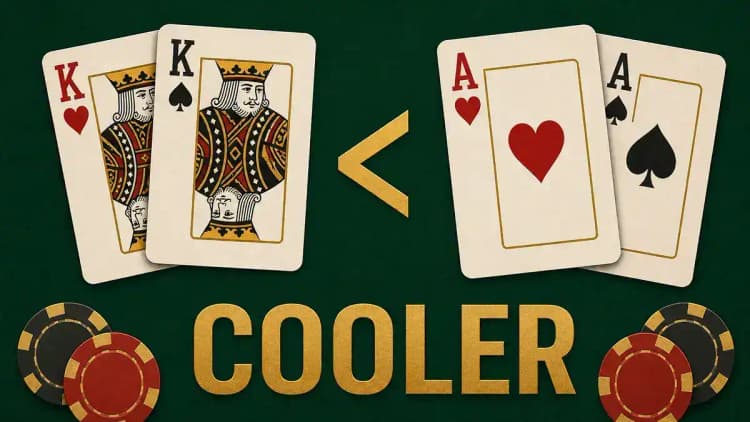
A cooler is a hand in which two very strong holdings collide, and the losing hand was too strong to correctly fold. In the strict sense this guide uses, the loser was also behind when the chips went in; plenty of players use the word more loosely, for any big hand that runs into a bigger one — even when a late card decides it. Either way, the hand is simply too good to lay down — so the chips go in, and the second-best monster pays off the best one. Nobody misplayed it. The loss wasn't a mistake; it was the unavoidable price of holding a premium hand at the same moment someone else held a slightly bigger one.
The word paints the picture: you got "cooled off" — your hot hand went cold through no fault of your own. You'll also hear it used as a verb ("I got coolered") and as a near-synonym, "setup," because it feels like the deck was set up to take your whole stack. What makes a cooler different from an ordinary loss is that a good player in the same spot would have lost a big pot too. Recognizing that is the first step to not letting these hands wreck your session — the same discipline that separates a winning player from a  fish.
fish.
Cooler vs Bad Beat: The Difference Everyone Gets Wrong
This is the distinction that makes or breaks your understanding of the term — and almost every casual player uses the two words interchangeably. Both feel terrible, and there's no single official definition — but in the strict sense this guide uses, they are opposites:
- •A cooler — you were behind when the money went in and stayed behind. No lucky card saved anyone; the winner was ahead the entire time. You lost because your huge hand met a bigger one.
- •A bad beat — you were ahead (often a big favorite) when the money went in, and your opponent sucked out — hit a lucky card on the flop, turn or river to overtake you.
| Cooler (strict sense) | Bad Beat | |
|---|---|---|
| Who led when chips went in | You were behind | You were ahead (favorite) |
| Did a suckout happen? | No — winner led all the way | Yes — a lucky draw hit |
| Could you have folded? | No — hand too strong | Depends — the bad beat itself doesn't tell you whether your play held up |
| Classic example | KK runs into AA | AA cracked when 7‑7 spikes a set |
| The feeling | "I never had a chance" | "I should have won that" |
Here's the same players showing both, so it clicks. Bad beat: you hold A♠A♥, get it all in preflop against 7♣7♦, and a 7 hits the board — your aces were a ~4‑to‑1 favorite (about 80%) and got outdrawn. Cooler: flip it around — you hold the 7♣7♦, flop a set of sevens, and stack off against a set drawn from a bigger pair. You were the underdog from the flop on, and a flopped set is almost never folded. Same cards, opposite stories. Both are bad luck, not mistakes — what's worth checking is whether your play actually held up; if it didn't,  review your play instead of shrugging it off.
Classic Cooler Examples (The Whole Family)

Coolers come in a recognizable family. In almost every one, both hands are strong enough that folding would be a losing play over the long run — which is exactly why they're unavoidable. The straight row needs one caveat, and the table gives it:
| Cooler | The clash | Why you can't fold |
|---|---|---|
| Kings vs Aces | KK all-in preflop against AA | KK is a ~4.5:1 dog to AA, and you're almost never folding kings preflop |
| Set over set | Your flopped set vs a bigger flopped set | A flopped set is almost never folded; the lower set is drawing nearly dead |
| Flush over flush | Your K‑high flush vs an A‑high flush | A king-high flush looks enormous — you rarely put them on the exact nut flush |
| Full house over full house | Your full house vs a bigger full house | A boat is a monster; laying one down is nearly impossible |
| Boat vs quads | Your aces full vs four of a kind | The ultimate cooler — a full house losing to quads |
| Straight over straight | Your straight vs a higher straight | A straight near the nuts is too strong to release — but the bottom end (the "idiot end") is usually a fold, not a cooler |
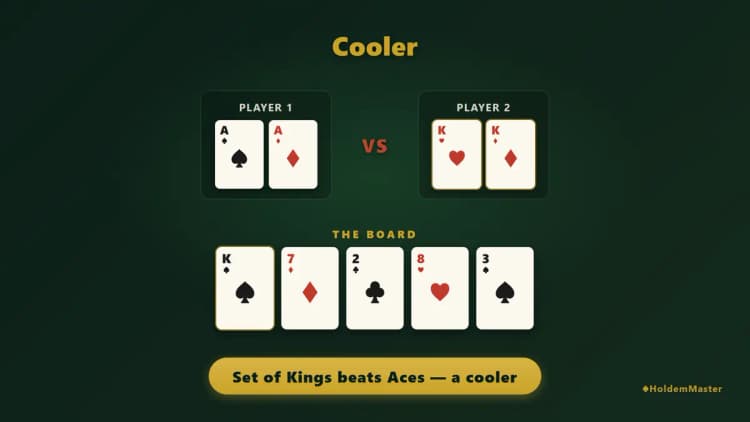
The most iconic is set over set. Say you hold 7♣7♦ and the flop comes J♦ 7♥ 2♣ — you've flopped middle set, three sevens. It's a hand you'll happily stack off with almost always. But your opponent holds J♠J♥ and flopped top set, three jacks. By the river on a J♦ 7♥ 2♣ 5♠ Q♦ board, your best five cards are 7‑7‑7‑Q‑J and theirs are J‑J‑J‑Q‑7 — three jacks beat three sevens, and your only escape was the single remaining seven in the deck. You didn't misplay a thing; you were simply drawing to one card the whole time. That's a cooler in its purest form, and it's why understanding which hand wins a showdown matters even when the result is out of your hands.
Is a Cooler the Same as a "Setup"? And What Does "Coolered" Mean?
These three ways of talking about the same disaster trip up a lot of players, so quickly:
- •Setup — an informal synonym for a cooler. It stresses the trapped feeling — as if the deck were "set up" so you'd lose your whole stack with a hand you couldn't get away from. If someone says "that was a total setup," they mean a cooler.
- •Coolered (verb) — to be on the losing end of a cooler. "I got coolered" means you lost a big pot with a hand too strong to fold. By definition, saying it correctly is an admission that you made the right play and still lost.
- •Cold deck — a related old-school term. Some poker glossaries use it for the single unavoidable losing hand itself; at the table people mostly use it for a stretch where the cards run brutally against you. Historically it also referred to a cheating move: swapping in a pre-arranged "cold" deck.
Can You Actually Avoid Coolers?
Mostly no — and here's the part good players understand that beginners don't: you shouldn't even try. The reason coolers cost you money is the same reason you win money: you get maximum chips in with premium hands. If you started folding sets and full houses to dodge the rare cooler, you'd bleed far more value in all the hands where your monster was actually best. Over the long run, paying off the occasional cooler is simply the cost of stacking everyone else the vast majority of the time.
That said, "unavoidable" has a small asterisk at the highest level. Skilled players can occasionally lay down the second-best hand when the action screams the nuts — an opponent who only ever raises this line with one exact holding, a sizing that makes no sense unless they have it. Folding a big hand in that spot is one of the hardest, most advanced skills in poker. But those reads are rare, and for the vast majority of coolers the correct, profitable play is to get the money in and move on. Playing your position well helps you read those spots — it doesn't let you dodge the deck.
When "It Was a Cooler" Is Just an Excuse
Now the uncomfortable truth, and the reason this word matters for your improvement. "Cooler" is the single most abused excuse in poker. It's far more comfortable to tell yourself the deck set you up than to admit you overplayed top pair, called a river you had no business calling, or got your stack in bad. Losing players lean on "it was a cooler" precisely because it ends the conversation and requires no study.
There's a clean litmus test, and honest players use it after every big loss:
Would I make the exact same play again, with only the information I had at the time — ranges, price and stack depth, not just gut feel? If no, I misplayed — and that's a leak to fix, not bad luck. If yes — and it still holds up when you actually run those ranges and that price (plenty of wrong calls feel right every time) — it was bad luck: in the strict sense, a cooler if two strong hands collided and you were behind when the money went in, a bad beat if you were ahead and got outdrawn. A priced-in draw that missed is neither — just variance.
A true cooler means you played correctly with a strong hand and ran into a bigger one. The moment your "cooler" involves a call that doesn't hold up on ranges and price, a bluff you talked yourself into, or a fold you should have made, it stops being a cooler and becomes a mistake wearing a disguise. Being ruthlessly honest about which is which — instead of filing every loss under "unlucky" — is exactly what separates players who improve from players who stay fish forever.
How to Recover From a Cooler
Because a cooler carries no lesson, the only real damage it can do is to your next decisions. Protect those:
1. Name it and release it. Review it once with the litmus test — ranges, sizing, stack depth. If it holds up as genuinely unavoidable, let it go; replaying it again and again teaches you nothing. 2. Watch for tilt. The most expensive thing about a cooler isn't the pot you lost; it's the three bad hands you play afterward trying to win it back. Recognize that urge and slow down. 3. Trust your bankroll. Coolers are why you keep a bankroll big enough to absorb variance. In a cash game, one cooler is a rounding error over tens of thousands of hands — the lasting damage comes from letting it change how you play. In a tournament it can end your run on the spot; that's the variance you accept when you enter, not a reason to play differently. 4. Take a breath, or a walk. If a big cooler rattled you, stepping away for five minutes is cheaper than staying and spewing. The hand is over; your edge is in every hand still to come.


FAQ
The 3 Things to Remember
1. A cooler is an unavoidable loss with a hand too strong to fold — in the strict sense, you were behind when the money went in and no suckout happened. Either way, a good player in your spot would have lost a big pot too. 2. Strictly defined, it's the opposite of a bad beat. A bad beat is being ahead and getting outdrawn; a cooler is being behind going in, with only a small chance to catch up. Both are bad luck rather than mistakes — whether there's anything to fix depends on whether your play held up (next point). 3. Be honest about the difference between a cooler and a mistake. If the play still holds up on ranges and price with the same information — not just conviction — shrug it off. If it doesn't, it wasn't a cooler — it was a leak in disguise.
Even the best players lose about as many coolers as everyone else — give or take the rare second-best hand they manage to lay down; they just don't let them do any extra damage. Log it as variance, protect your next few decisions from tilt, and get back to out-playing the table. The deck cools everyone off eventually — winning is what you do in all the hands that aren't coolers.