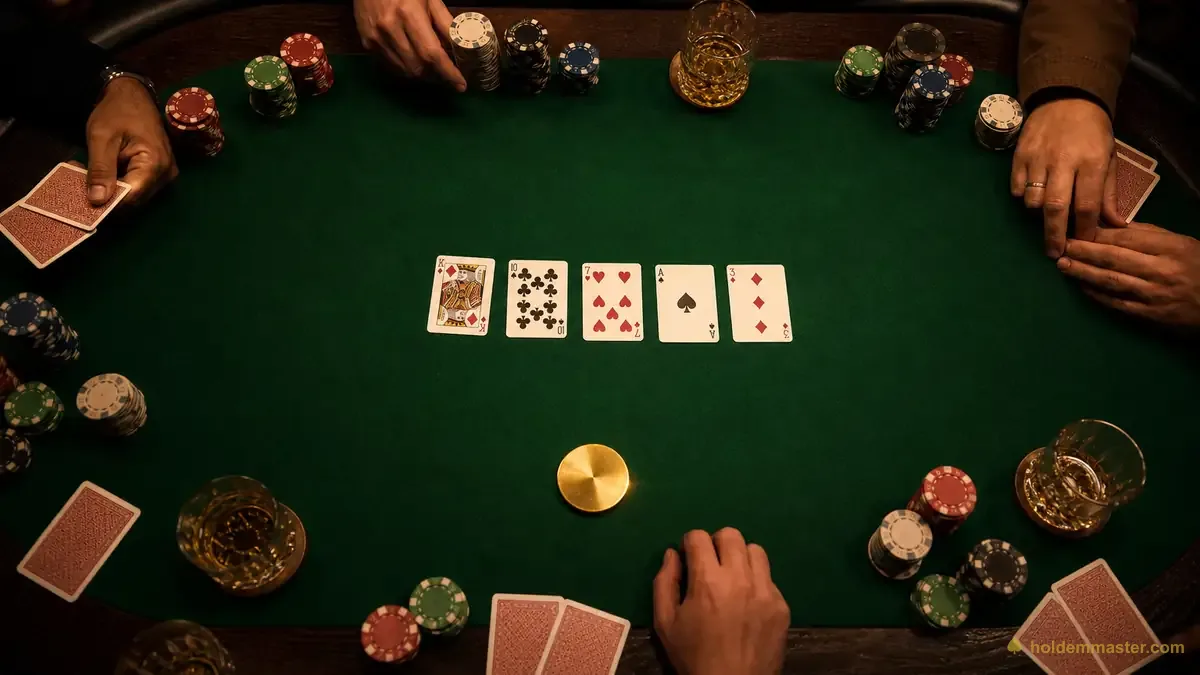
The first time I sat in a live game, the table might as well have been speaking another language. Someone was "under the gun," another guy "three-bet the cutoff," the dealer asked if I wanted to "run it twice," and when I lost with kings I was told it "wasn't even a bad beat, just a  cooler." I nodded like I understood. I did not.
Poker has its own vocabulary, and knowing it does two things: it stops you looking like a  fish, and it lets you actually follow the strategy that makes you money. This glossary collects the terms that genuinely come up at a Texas Hold'em table — grouped by how you'll actually run into them, not just dumped in one giant A-to-Z wall. Start with the terms people mix up most, then browse whichever category you need. Where a term has a full guide, you'll find a link straight to it.
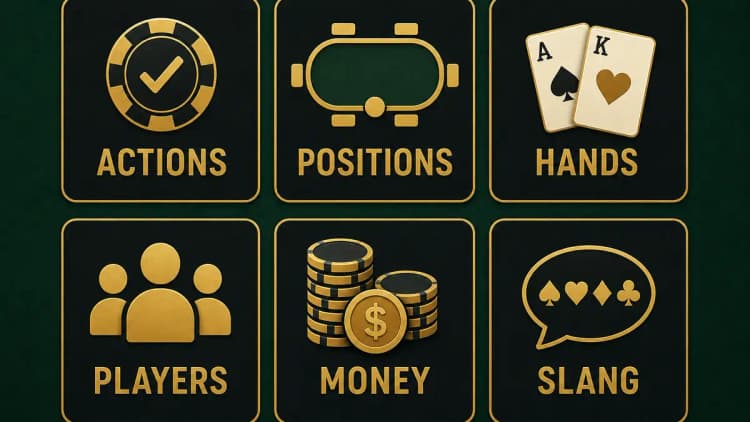
The glossary, at a glance
The Terms People Mix Up Most
If you only clear up eight mix-ups, make it these — they're the ones that cause the most confusion (and the most costly mistakes) at the table:
| These get mixed up | The difference |
|---|---|
| Check vs Call | A check risks no chips (only when you have no outstanding bet to match); a call matches an existing bet. |
| Blind vs Ante | Blinds are positional forced bets (SB/BB); antes seed the pot — traditionally from everyone, though most tournaments today use a big blind ante paid by one seat. |
| Set vs Trips | Both are three of a kind — a set uses a pocket pair; trips uses one hole card + a board pair. |
| Cooler vs Bad Beat | A cooler = a hand too strong to fold runs into a bigger one (in the strict sense, you were behind going in); a bad beat = you were a big favorite going in and got outdrawn. |
| Value bet vs Bluff | A value bet wants a call from worse; a bluff wants better hands to fold. |
| Pot odds vs Implied odds | Pot odds count only chips in the pot now; implied odds add what you'll win later. |
| VPIP vs PFR | VPIP = how often you play; PFR = how often you raise. PFR can never exceed VPIP. |
| The 3-bet count | Blinds are bet 1, the open-raise is bet 2, so the re-raise is the 3-bet (not the first raise). |
Betting Actions
Everything you can physically do on your turn. If you're brand new, start with the  order of betting.
| Term | Meaning |
|---|---|
| Check | Pass the action without betting — only when you have no outstanding bet to match. |
| Bet | Be the first to put chips in the pot on a betting round. |
| Call | Match the current bet to stay in the hand. |
| Raise | Increase the current bet, forcing others to match more or fold. |
| Fold | Give up your hand and any claim to the pot. |
| All-in | Commit all your chips; you can only win the part of the pot you covered (see side pot). |
| Limp | Enter preflop by just calling the big blind instead of raising — usually a weak, passive play. |
| Open (open-raise) | Be the first player to enter the pot with a raise. |
| 3-bet | The re-raise after an open (the third bet, counting the blinds as the first). |
| 4-bet | A re-raise of a 3-bet. |
| C-bet | A "continuation bet" on the flop by the player who raised preflop. |
| Donk bet | Leading into the previous street's aggressor from out of position (once seen as a mistake, now a low-frequency tool). |
| Value bet | A bet with a strong hand hoping to get called by a worse one. |
| Bluff / Semi-bluff | A bluff bets a weak hand to fold out better; a semi-bluff does it with a draw that can still improve. |
| Check-raise | Check, then raise after an opponent bets — a strong, deceptive line (legal in modern rooms). |
| Min-raise | The smallest legal raise. |
| String bet | An undeclared reach-back for more chips — only the first motion counts (usually ruled a call). Declaring the full raise amount first makes split motions legal — the safe habit is to state the amount before reaching for chips, or to push the whole raise in one motion. |
| Jam / Shove | To move all-in. |
| Snap call | An instant, no-hesitation call. |
| Hero call | Calling with a weak hand because you've read the opponent as bluffing. |
Positions
Where you sit decides when you act — and acting last is a permanent edge. For how to actually use them, see position play.
| Term | Meaning |
|---|---|
| Button (BTN) | The dealer position; acts last postflop — the best seat at the table. |
| Small blind (SB) | With three or more players, the forced bet left of the button; acts first postflop (worst postflop seat). Heads-up, the SB is on the button and acts last postflop. |
| Big blind (BB) | The larger of the two blinds; stakes are named by the blind sizes ($1/$2), and one big blind is the standard unit for measuring stacks. |
| UTG (under the gun) | First to act preflop — needs the tightest opening range. |
| Cutoff (CO) | Right of the button; second-best seat, great for stealing blinds. |
| Hijack (HJ) | Two seats right of the button; middle position (MP), just before the cutoff. |
| Lojack (LJ) | Right of the hijack; also middle position (MP) — labels shift with table size. |
| Early / Middle / Late | Groupings by how soon you act — early = tightest, late = widest and most profitable. |
| In / Out of position | You're in position if you act after your opponent, out of position if you act first. |
For the full seating map, see the  table positions guide.
Hands & the Board
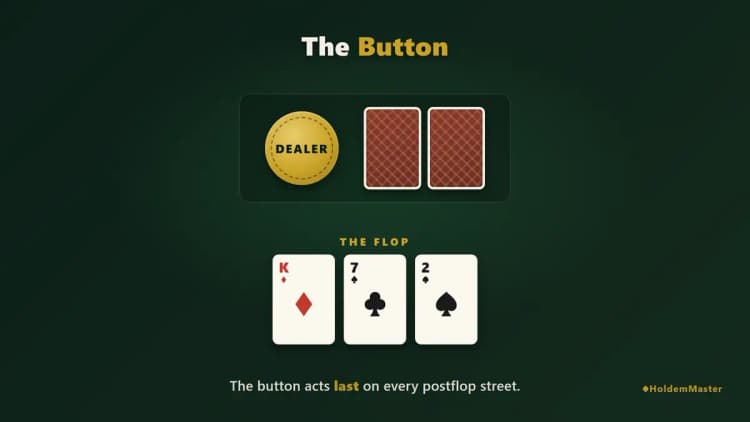
The cards themselves, and what you make with them. New to the flow of streets? Start with the order of play.
| Term | Meaning |
|---|---|
| Hole cards | Your two private face-down cards. |
| Community cards | The five shared face-up cards everyone uses. |
| Flop / Turn / River | The first three shared cards / the fourth / the fifth and last. |
| The nuts | The best possible hand given the current board (it can change on later streets). |
| Kicker | A side card that breaks ties between otherwise equal hands (see tie-breakers). |
| Pocket pair | Two hole cards of the same rank. |
| Overpair | A pocket pair higher than every card on the board. |
| Top pair | Pairing the highest board card with a hole card. |
| Set | Three of a kind using a pocket pair + one board card (well disguised). |
| Trips | Three of a kind using one hole card + a pair on the board (weaker kicker control). |
| Two pair | Two different pairs. |
| Boat / Full boat | Slang for a full house — three of a kind plus a pair (it "fills up"). |
| Quads | Slang for four of a kind. |
| Made hand | A complete hand now, as opposed to a draw. |
| Draw | A hand that needs to improve — e.g. a flush draw (4 to a flush) or straight draw. |
| Gutshot | An inside straight draw needing one middle rank (4 outs). |
| Open-ender | An open-ended straight draw, completed at either end (8 outs). |
| Backdoor | A draw needing two running cards (turn and river). |
| Runner-runner | Hitting a hand with both the turn and river — a backdoor draw that got there (e.g. "runner-runner flush"). |
| Overcard | A card higher than the board. |
| Suited connectors | Two consecutive same-suit cards (e.g. 8♥9♥). |
| Broadway | The 10-J-Q-K-A straight, the highest straight. |
| The wheel | The A-2-3-4-5 straight, the lowest straight (ace plays low). |
| Cooler | A big hand that loses to a bigger one with no misplay — full guide. |
| Bad beat | Losing as a big favorite to a lucky draw — full guide. |
Still learning what beats what? The hand rankings guide has the full order.
Player Types & Slang
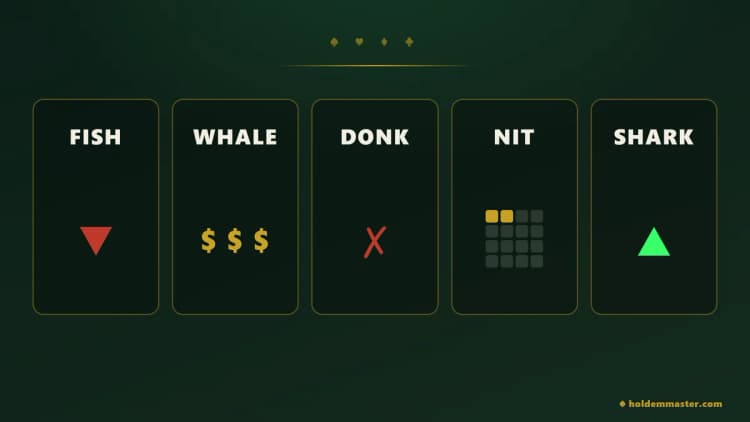
The zoo of nicknames for the people across the felt. The full breakdown lives in the fish guide.
| Term | Meaning |
|---|---|
| Fish | A weak, losing recreational player — the table's profit source. |
| Shark | A strong, winning player who preys on weaker ones. |
| Whale | A wealthy, weak recreational player at big stakes — a "fish with deep pockets." |
| Nit | An extremely tight player who only plays premium hands. |
| Donkey (donk) | A derogatory term for a bad, unskilled player. |
| Calling station | A passive player who calls far too much and rarely folds or raises. |
| Reg | A "regular" — a habitual, usually competent player at a stake. |
| Grinder | A player who profits through steady volume and discipline. |
| LAG / TAG | Loose-aggressive / tight-aggressive — two aggressive styles most winning players build on (the style alone doesn't make anyone a winner). |
| Maniac | A hyper-aggressive player who raises and bluffs wildly. |
| Mark | The weak player the table is trying to win money from. |
Money & the Game
Chips, stakes, and the two formats. The big fork is  cash game vs tournament.
| Term | Meaning |
|---|---|
| Blinds | The forced SB/BB bets that start the action — also the name for stake levels (blinds explained). |
| Ante | Traditionally a small forced bet from everyone to seed the pot, separate from the blinds — most tournaments now use a big blind ante paid by one seat for the table. |
| Pot | The total chips being played for. |
| Side pot | A separate pot made when a player is all-in and others keep betting. |
| Stack | The chips in front of a player. |
| Bankroll | The money set aside for poker overall — not the chips on the table. |
| Buy-in | The amount needed to enter a game or tournament. |
| Rake | The house's cut of most cash-game pots — full guide. |
| Rakeback | A rebate returning part of the rake you've paid. |
| Straddle | An optional blind (usually 2× BB) buying last preflop action — full guide. |
| Cash game | Real-value chips, join or leave anytime, fixed blinds. |
| No-limit (NLH) / Limit | In no-limit, an opening bet can range from one big blind to your whole stack (a smaller all-in is allowed); limit uses fixed bet sizes. Pot-limit, the PLO format, caps bets and raises at the pot size. Hold'em is almost always no-limit. |
| PLO | Pot-Limit Omaha — a popular variant where you get four hole cards and must use exactly two (not the same game, but you'll hear it named). |
| Tournament | Fixed buy-in, rising blinds, play until you bust or win. |
| Freezeout | A tournament with no rebuys — out means out. |
| GTD (guaranteed) | A tournament's promised minimum prize pool, paid even if entries fall short. |
| Hand-for-hand | Near the money bubble, every table plays one hand at a time so no one can stall into the cash. |
| Bounty (knockout) | A tournament paying a prize for each player you eliminate. |
| Sit & Go (SNG) | A small tournament that starts as soon as it fills. |
| MTT | A multi-table tournament that merges tables as players bust. |
| ICM | The Independent Chip Model — converts tournament chips into real-money equity near pay jumps. |
| Bad beat jackpot | A promo prize paid when a very strong hand loses — how it works. |
Situations, Stats & Etiquette
The words for what's happening — and how to behave while it does.
| Term | Meaning |
|---|---|
| Showdown | Revealing hands after the final bet to decide the winner (showdown rules). |
| Muck | To discard a hand face-down. |
| Chop / Split pot | Dividing the pot when hands tie (split pots). |
| Slow roll | Deliberately delaying showing a winning hand to taunt — a serious etiquette breach. |
| Tilt | Emotionally-driven bad play, usually after a loss. |
| Tell | A physical or behavioral cue that leaks information about a hand. |
| Pot odds | The ratio of the pot to the cost of a call — how to calculate. |
| Implied odds | Pot odds adjusted for the chips you expect to win on later streets. |
| Equity | Your percentage share of the pot right now (probability guide). |
| EV (expected value) | The average long-run result of a decision; +EV wins over time. |
| VPIP | How often a player voluntarily puts money in preflop — the loose/tight stat. |
| PFR | How often a player raises preflop — the aggression stat (never higher than VPIP). |
| GTO | Game Theory Optimal — a balanced, unexploitable strategy from solvers. |
| Range | The full set of hands a player could hold in a spot; pros think in ranges, not single hands. |
| Cold deck | An unlucky deal producing a cooler (originally a cheat's pre-stacked deck). |
| "Don't tap the glass" | Don't criticize weak players — you'll scare away the ones you profit from. |
| Run it twice | All-in players deal the remaining board twice, each for half the pot, to cut variance — mostly a cash-game practice, and everyone involved must agree. |
| Heads-up | Playing one-on-one — either a two-player game or the final two of a tournament. |
| RFI (raise first in) | The range-and-stats shorthand for the open-raise: how often you open the pot when no one has entered before you. |
| Splash the pot | Throwing chips messily into the pot instead of stacking them in front of you — discouraged, since the amount can't be verified. |

FAQ
Where to Go Next
This glossary is the map; the real learning is in the guides it links to. A few good starting points:
- •The absolute basics: how to play Texas Hold'em and the order of betting.
- •Hands: what beats what and the tie-breaker rules.
- •The math: pot odds, outs, and probability.
- •The slang, in depth: fish, cooler, bad beat, straddle, and rake.