You turn over a pair of aces. So does your opponent. The dealer counts the side cards for a second — then pushes the whole pot to them. Same pair. How did you lose?
I have watched that exact moment stall more games than any other rule: someone half-stands, the dealer taps the felt, and the whole table waits for an explanation. Here it is. Every tie in Texas Hold'em is settled by one fixed procedure that sits one level below the poker hand rankings — the rankings tell you which hand wins; tie-breaker rules tell you which player wins when both hands are the same rank.
Most of the work is done by one card: the kicker. The full definition — which hands have one and how many — lives in  what is a kicker in poker. This guide is the procedure: exactly how ties are broken for the same pair, two pair, trips, straights and flushes — and the fifth card everyone forgets.
Tie-breaks at a glance
How Are Ties Broken in Poker? The 3-Step Order
Ties are broken in a fixed order: compare hand rank first, then the cards that make the hand, then the kickers from highest to lowest — and if all five cards still match, the pot is split. Every showdown runs the same three checks:
| Step | Compare | Detail |
|---|---|---|
| 1 | Hand rank | The higher category always wins (a flush beats a straight, etc.) |
| 2 | The cards that make the hand | Same rank? The higher pair / trips / top card wins |
| 3 | Kickers, highest first | The first difference wins the pot |
If step 1 settles it, you never reach step 2. If step 3 runs out of cards, the hands are identical and the pot is split — how the chips are then divided (odd chips, three-way chops, side pots) is split pot rules territory. Steps 2 and 3 are where the arguments happen, so that's where we're going.
Who Wins if Two Players Have the Same Pair?
The higher first kicker wins. One pair uses three kickers, compared one at a time from the top — the first difference decides the pot.
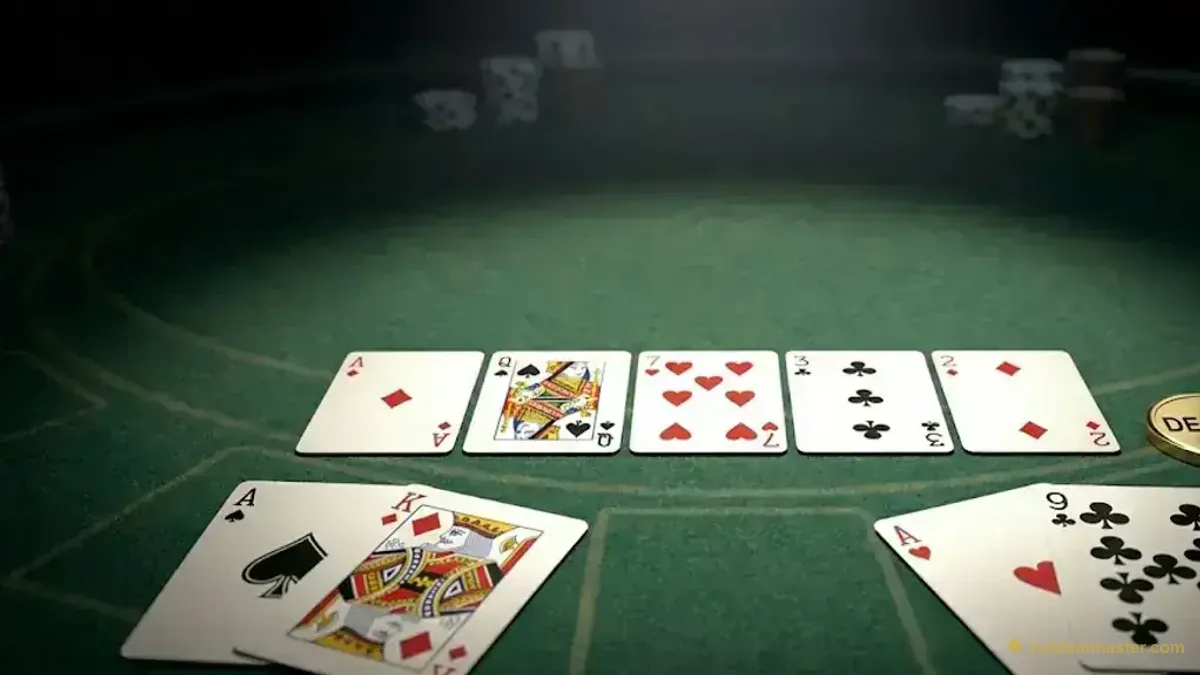
Take the hand in the photo above:
Player A: A♠ K♦ · Player B: A♥ 9♣ Board: A♦ Q♠ 7♥ 3♣ 2♦
| Player | Best Five | Kickers | Result |
|---|---|---|---|
| A | A♠ A♦ K♦ Q♠ 7♥ | K-Q-7 | Wins |
| B | A♥ A♦ Q♠ 9♣ 7♥ | Q-9-7 | Loses |
Same pair of aces, so the kickers go head-to-head in order: K beats Q — fight over. B's nine is still in the hand as the second kicker, but the comparison never gets that far.
Notice B's top kicker is the board's queen, not the 9 they're holding. A kicker only counts if it actually lands in your best five — a higher board card pushes your hole card down the list. It's also why the second card you start with matters as much as the ace itself: A-K and A-9 are both "a pair of aces" here, and only one of them wins (starting hands chart).
Poker Tie-Breaker Rules for Every Hand
Each hand rank has its own comparison order — some go to kickers, others are settled entirely by the cards that make them. The badge shows whether a kicker comes into play:
The three rows that cause the most table arguments:
- •Trips use two kickers, top one first. On a board of A♣ A♥ 7♦ 5♣ 2♠, a player with A♠ J♠ makes A-A-A-J-7 and beats A♦ 10♦'s A-A-A-10-7 — the jack outranks the ten, and the shared 7 is never even checked.
- •Full houses have no kicker. Trips rank first, then the pair: K-K-K-A-A beats K-K-K-Q-Q on the pair.
- •Flushes compare all five cards — never suits. An ace-high flush beats a king-high flush; identical ranks split. The full matchup (and the boards that fool people) is in does a flush beat a straight.
Who Wins if Both Players Have Two Pair?
Compare the higher pair, then the lower pair, then the single kicker — in that order. Two pair carries exactly one kicker, so after the pairs themselves there's only one card left to argue about.
On a board of K♦ 9♣ 9♠ 5♦ 2♥, K♠ Q♦ makes K♠ K♦ 9♣ 9♠ Q♦ and K♥ J♥ makes K♥ K♦ 9♣ 9♠ J♥. Same kings-and-nines, so the lone kicker settles it: queen over jack.
Then there's the trap that decides real money — counterfeiting:
You: 5♠ 4♠ · Opponent: A♣ K♦ Flop: 5♦ 4♥ K♣ — your two pair (fives and fours) leads their pair of kings Turn 9♠, river 9♥ — final board 5♦ 4♥ K♣ 9♠ 9♥
| Player | Best Five | Hand |
|---|---|---|
| You | 9♠ 9♥ 5♠ 5♦ K♣ | Nines and fives — your fours are gone |
| Opponent | K♦ K♣ 9♠ 9♥ A♣ | Kings and nines — wins |
The board pairing nines handed both players a better second pair — your fours got counterfeited, and the only comparison left was top pair: kings over nines. The hand that led the flop loses the pot without either player improving their own cards.
Can You Have a Higher Straight? (Where the Wheel Ranks)
Yes — straights are ranked purely by their top card, and the ace-low wheel is the lowest straight in the game.
On a board of 4♦ 3♣ 2♠ K♦ Q♥, a player with A♠ 5♠ makes the wheel: 5-4-3-2-A. A player with 6♥ 5♥ makes 6-5-4-3-2. The ace plays low in a wheel, so A-2-3-4-5 sits at the very bottom of the straight ladder — the six-high straight wins. Two straights with the same top card are identical, and identical hands split.
At the other end of the ladder, the highest straight in poker is Broadway — A-K-Q-J-10. No straight beats it (though a flush or anything above it still does), and the wheel sits at the bottom, so every straight in the game ranks somewhere between those two by its top card alone.
Two things the wheel does not do: the ace can't wrap around the middle (Q-K-A-2-3 is nothing), and it can't be high and low at once. Flushes follow the parallel rule — all five cards compared from the top, suits irrelevant — with the details over in flush vs straight.
Does the 5th Card Matter in Poker?
Yes — whenever the first four cards of two hands are identical, the fifth card is the whole pot.
Board A♥ K♣ Q♦ 4♣ 2♥, and it's A♠ 8♠ against A♦ 7♦. Both have a pair of aces. First kicker: the board's K — tie. Second kicker: the board's Q — tie. Third kicker: 8 beats 7. The literal fifth card of the hand just decided everything above it.
The same logic runs quads-on-board pots: everyone shares four cards, so the fifth is the entire showdown. And it runs high-card and flush ties, where every card down to the last one is compared. The fifth card only stops mattering when the board outranks it — which is the last piece of the puzzle.
Do Suits Matter in Poker?
No — not for deciding who wins. Suits do exactly one job in Texas Hold'em: five of the same suit make a flush. Beyond that they carry no rank, so two hands that match rank for rank always split the pot, and no card ever outranks another because of its suit.
The question keeps coming up because suit order genuinely exists in poker — just not in this game. Stud and razz use it to decide who brings it in and who takes an indivisible chip. Hold'em uses it for neither.
The cleanest proof is the one chip that cannot be divided. The 2026 WSOP tournament rules say "In button games with 2 or more high or low hands, the odd chip goes to the first seat left of the button" (Rule 73). Even when a pot physically will not split evenly, the rule reaches for the seat, not the suit — and the suit-based method in the back half of that same rule is written for stud and razz only.
One more thing worth knowing: in Hold'em two flushes are always the same suit anyway, because all five community cards are shared and a board can't hold three hearts and three spades at once. So "my spades beat your hearts" is not a rule you lost to — it's a hand that cannot be dealt.
When Your Kicker Doesn't Play — and the Pot Splits
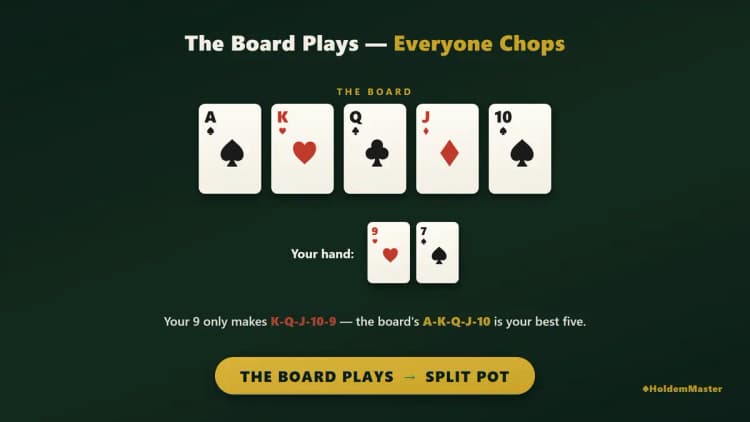
If your hole cards can't crack the board's own best five, they don't play — and when that's true for everyone, the pot is split.
Take the board above: A♠ K♥ Q♣ J♦ 10♠, Broadway already complete. Your 9♥ 7♠ does make a straight — K-Q-J-10-9 — but it's lower than the ace-high straight sitting on the felt, so your best five is the board itself. So is everyone else's.
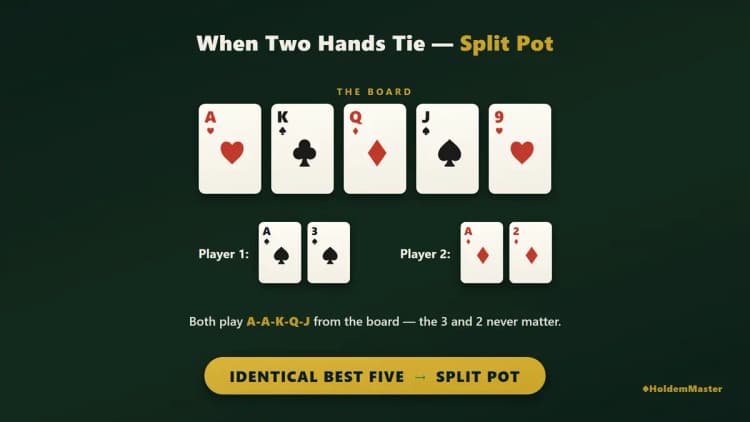
The subtler version is when your hand plays but your kicker doesn't. Board A♥ K♣ Q♦ J♠ 9♥: A♠ 3♠ against A♦ 2♦. Both pair the ace, and all three kicker slots fill from the board — A-A-K-Q-J for each player. The 3 and the 2 are dead weight; identical best fives, chop.
Spotting these runouts before the river bet is a skill of its own — that's reading the board. And what happens to the chips once hands tie — equal shares, the odd chip, three-way chops, all-in side pots — is all in the  split pot rules guide.

FAQ
The Takeaways
1. Every tie runs the same procedure: hand rank → made cards → kickers → split — no exceptions, no suits. 2. A kicker only counts if it makes your best five — board cards can replace it, and a double-paired board can counterfeit your two pair entirely. 3. Straights rank by their top card (the wheel is the lowest), flushes compare all five — and when nothing separates the hands, the pot is chopped.
Lock in the full order with the complete hand rankings, get the side card itself down in what is a kicker, and see exactly how tied pots get divided in the split pot guide.