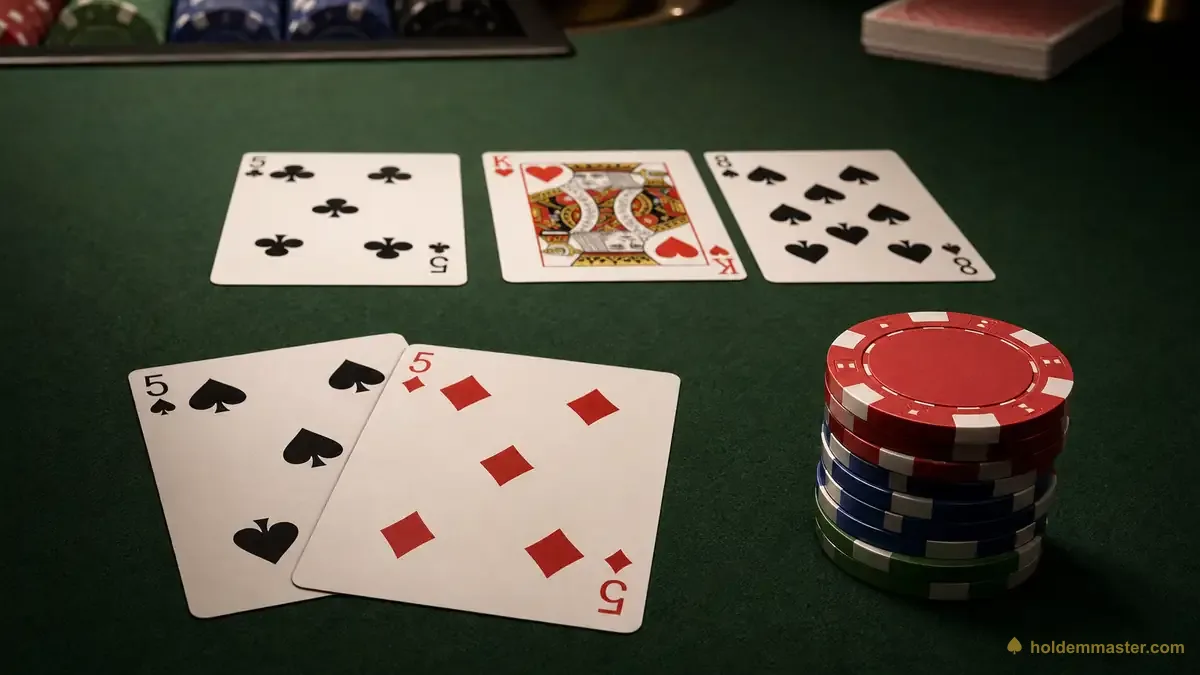
The hand that made me learn this cold: I called a raise with pocket fives, flopped my set, stacked a guy holding aces, and my buddy asked how I "knew" to call. I didn't know — I knew the number. You flop a set about 1 in 8.5 tries, and the stacks were deep enough to pay me off when I did. That single fraction turned a "feels lucky" call into a profitable one.
That's what drawing odds really are: not luck, but the fixed math of a 52-card deck. How often you flop a set, flop a flush, complete a draw by the river — every one of these is a number you can derive, and the players who win have them memorized. This guide is the probabilities behind the flop and the draw, each with the actual combinatorics so you can see why the number is what it is. It's the companion to the full  poker odds and probability chart; once you know the odds here,
  counting outs and pot odds turn them into decisions.
The numbers to burn in
The Flop Lifecycle: One Table Every Odds Page Splits Up
✦ Quick answer
Flopping a hand and completing a draw are different events. Two suited hole cards make a flush immediately only 0.84% of the time; once you have flopped a flush draw, its two-card completion chance is 35%. Read each column from its stated starting point rather than treating every percentage as a preflop chance.
| Holding | Flop it made | Flop the draw | Complete draw by river |
|---|---|---|---|
| Pocket pair → set | 11.8% (7.5-to-1) | — | set→boat or quads 33.4% by river |
| Two suited → flush | 0.84% (118-to-1) | 10.9% flush draw | 35% (9 outs) |
| Connectors 54–JT → straight | 1.3% (76-to-1) | ~10% OESD | 31.5% (8 outs) |
| Two unpaired → pair | ~32% | — | — |
| Pocket pair → quads | 0.245% (407-to-1) | — | — |
Read across a row and you see the whole lifecycle of a hand. Two suited cards almost never flop a made flush (0.84%) — but they flop a flush draw thirteen times more often (10.9%), and that draw gets there by the river 35% of the time. Conflating those three numbers is the single most common odds mistake, so we'll pull each apart below with the math shown.
Odds of Flopping a Set (and the Set-Mining Math)
✦ Quick answer
A pocket pair flops a set or better 11.8% of the time — about 1 in 8.5, or 7.5-to-1 against — but that hit rate alone does not justify a call. For set mining (calling a raise with a small pair mainly to flop three of a kind), the practical guideline is roughly 15–20 times the call in effective stacks. You still need an opponent likely to pay, because some sets win little or lose.
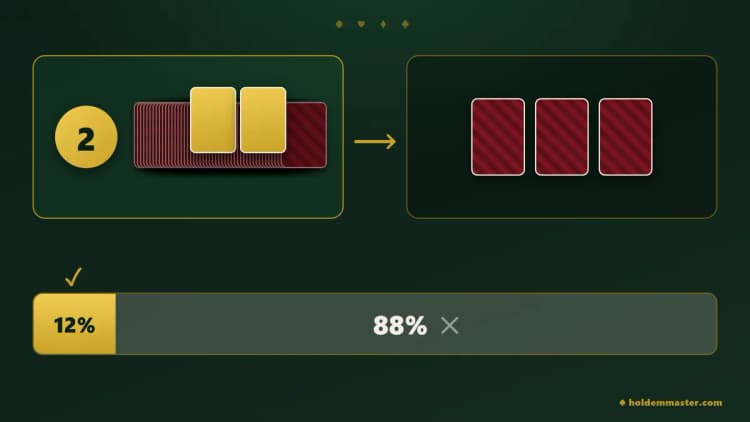
That 11.8% starts with the two matching cards left after you receive a pocket pair. The flop is three cards drawn from the 50 you can't see, so count the opposite event first — the chance you miss both matching cards:
| Step | Math |
|---|---|
| Flops that miss your pair | C(48,3) = 17,296 |
| Total possible flops | C(50,3) = 19,600 |
| Chance you miss | 17,296 ÷ 19,600 = 88.2% |
| Chance you flop a set | 1 − 0.882 = 11.8% |
When set mining actually pays
Flopping a set 11.8% of the time means you whiff 88% of the time and fold. To profit, the 12% you hit has to pay for all the times you miss. Breakeven is 7.5-to-1 — so if you call to set-mine, you want the pot plus what you can win on later streets to be worth at least 7.5× your call, and in practice 15-to-1 or better to cover the times your set doesn't get paid or gets outdrawn.
Set mining is the purest  implied odds play there is — a tiny chance to win a big pot later. The full framework — the formula, draw-by-draw stack multiples, and reverse implied odds — lives in that guide.
Two related numbers people ask about:
- •Hitting a set by the river (from preflop, seeing all five board cards) is 19.2% — 1 − C(48,5)/C(50,5). Higher than the flop figure because you get two more cards, but you can't count on reaching the river cheaply, which is why the flop number rules set-mining.
- •Set over set — two players with pocket pairs flop a set on the same hand, and the smaller one loses to the bigger — has no single fixed figure because it depends on how many opponents hold pairs, but with two players both holding pairs, both flopping a set lands near ~1%. It's the classic cooler — and the loss alone doesn't tell you whether the set-mining call was right; the price and the stacks do.
Flush Odds: Made vs Draw vs Complete
✦ Quick answer
Two suited cards can flop a made flush, flop a draw, or miss both. The first two chances are 0.84% and 10.9%; only after the draw exists does the 35% river-completion figure apply. That last number covers both remaining cards, so it cannot price a call that buys only the turn.
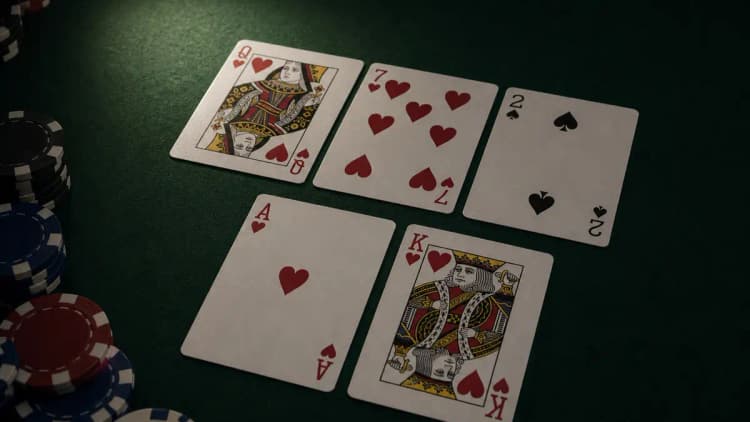
The first two count different flops from the same two hole cards (three cards from 50 unseen); only the third starts after the flop, with two cards to come:
| Question | Odds | The math |
|---|---|---|
| Flop a made flush (3 of your suit) | 0.84% · 118-to-1 | C(11,3) ÷ C(50,3) = 165 ÷ 19,600 |
| Flop a flush draw (2 more of your suit) | 10.9% · 8-to-1 | C(11,2)×39 ÷ C(50,3) = 2,145 ÷ 19,600 |
| Complete a flopped flush draw by river | 35.0% · 1.9-to-1 | 1 − C(38,2) ÷ C(47,2) |
So the honest sentence is: two suited cards flop a draw far more than a made flush, and that draw is 35% to get there — 1.9-to-1 against, so closer to one in three than to a coin flip. Chasing every suited hand "for the flush" ignores that you'll flop the made flush less than once per 100 hands.
The completion figure splits by street, which matters the moment there's betting left:
- •Flop → river (both cards): 35.0% — use this only when you'll see both cards with no more betting (you're all-in, or you've called an all-in and no one left in the hand can still bet).
- •Flop → turn (one card): 9 ÷ 47 = 19.1%.
- •Turn → river (one card): 9 ÷ 46 = 19.6%.
Straight Odds: Flopping One vs Drawing to One
✦ Quick answer
Mid-ranked connectors flop a made straight about 1.3% of the time; hands near either end of the ranks have fewer possible runs. After a draw forms, an open-ender has eight completing cards and a gutshot has four. Their by-the-river chances count two cards, while the next-card chances below count only flop to turn.
Connectors like 8♠7♠ have their own lifecycle. You'll flop a made straight only 1.3% of the time (76-to-1) — rarer than most players assume. That figure holds for 54s through JTs, the connectors that can fill a straight from either end; hands at the edge of the deck have fewer runs, down to 0.33% for A-K. Far more often you flop a draw:
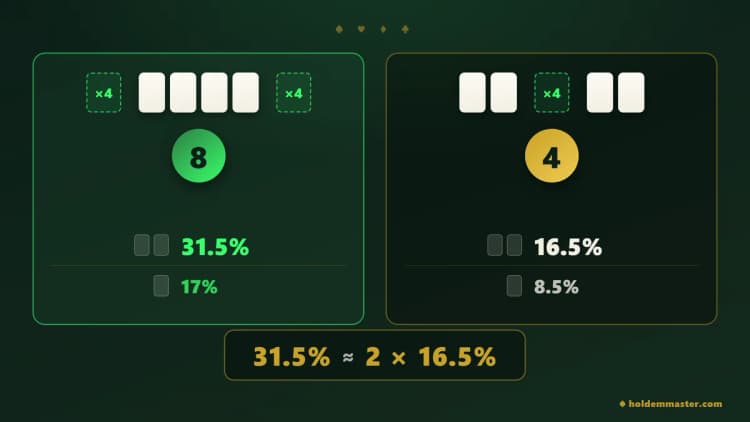
- •Open-ended straight draw (OESD): ~10% of flops with connectors. Eight outs, completes 31.5% by the river — 1 − C(39,2)/C(47,2) — or 17% from flop to turn.
- •Gutshot (inside) straight draw: four outs, completes 16.5% by the river, 8.5% from flop to turn. About half as likely to complete as an open-ender, which is why the same connectors play so differently depending on the flop.
Rare Flops: Quads, Trips, Full Houses & Straight Flushes
✦ Quick answer
With a pocket pair, flopping quads is 0.245% and flopping a full house is 0.98%. With two unpaired cards, flopping trips is 1.35%, a different route from a set. Every row below specifies the holding first, then counts the qualifying flops out of the same 19,600 possibilities.
| Flop this | Holding | Odds | The math |
|---|---|---|---|
| Quads | A pocket pair | 0.245% · 407-to-1 | 48 ÷ 19,600 |
| Full house | A pocket pair | 0.98% · 101-to-1 | 192 ÷ 19,600 |
| Trips | Two unpaired cards | 1.35% · 73-to-1 | 264 ÷ 19,600 |
| Straight flush | Suited connectors 54s–JTs | 0.02% · ~4,900-to-1 | 4 ÷ 19,600 |
One crucial distinction the top pages routinely botch: a set is a pocket pair plus one matching board card (11.8%), while trips is one unpaired hole card that the board pairs twice (1.35%). Same three-of-a-kind on paper, wildly different odds and playability — a set is disguised, trips are obvious. Don't let anyone tell you they're the same shape.
The straight flush number is the one to frame: with suited connectors from 54s up to JTs there are exactly four flops that make it (one three-card run in your suit for each straight the hand can sit in; the edges have fewer — QJs three, KQs two, A2s one), so 4 ÷ 19,600 ≈ 1 in 4,900. That's why flopped straight flushes are stories people tell for a decade.
The full house figure counts every way the flop hands you a boat with a pocket pair — including the flops that come as trips of another rank on top of your pair — which is why it reads 0.98% rather than the narrower ~0.73% some tables quote for "set plus a board pair" only.
Odds of Being Dealt Your Hand
✦ Quick answer
A specific pocket pair has six combinations among the 1,326 possible deals, while any pocket pair has 78. A-K suited has only four. These are chances before seeing your cards; once you hold a hand, questions about an opponent receiving the same ranks must account for the cards you have removed.
| Dealt this | Odds | How often |
|---|---|---|
| Pocket aces (specific pair) | 220-to-1 · 0.45% | 6 ÷ 1,326 |
| Any pocket pair | 16-to-1 · 5.9% | 78 ÷ 1,326 |
| A-K suited | 331-to-1 · 0.3% | 4 ÷ 1,326 |
| Two suited cards | 3.25-to-1 · 23.5% | almost every 4th hand |
The one that surprises people: if you hold aces at a 10-handed table, the chance a second player also has aces is about 1 in 136 (nine opponents each 1 ÷ C(50,2) = 1/1,225). Rare — and when it does happen it is almost never the disaster people imagine: aces against aces chops the pot about 96% of the time (each side wins outright only about 2% — when the board makes a flush in one player's suit). It's just the deck. For which of those 1,326 hands are worth playing from each seat, see the starting hands chart by position.

FAQ
The 3 Things to Remember
1. Flop a set: 11.8% (7.5-to-1). The starting point for every set-mining call — stack depth and an opponent likely to pay decide whether it's profitable, so aim to win 15× or more when you hit. 2. Made vs draw vs complete are different numbers. Two suited cards flop a made flush 0.84%, a flush draw 10.9%, and complete that draw 35%. Never quote the wrong one. 3. A big draw is about one in three by the river. Flush draw 35%, open-ender 31.5% — and roughly one in five to six on a single street.
Every figure here comes straight from the deck, not a gut feeling. Take these into how to count outs to build the number in real time, then pot odds to turn it into a call or fold — or back up to the complete poker odds and probability chart for every made-hand and long-shot number in one place.