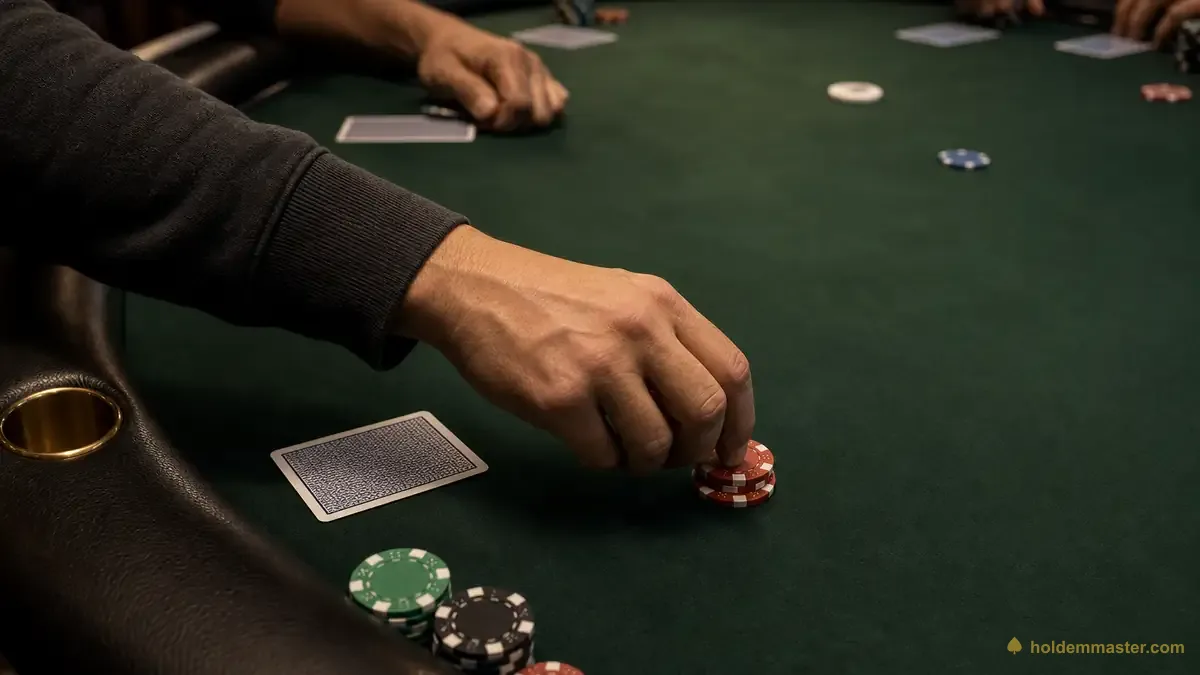
The first time someone straddled at my $1/$2 table, I had no idea why the guy under the gun tossed out $4 before the cards came — and why the dealer suddenly started the action one seat further along. I called it "the rich-guy bet" for about a month before I learned what it actually does: a straddle doubles the stakes and buys one player the last word before the flop, all before anyone has looked at a card.
If you've seen a live game where an extra blind appears out of nowhere, this is the term you're looking for. It's one of the most misunderstood entries in the whole  poker glossary, so let's get it exactly right. Below is exactly what a straddle is, every type you'll run into, who acts first when one is posted, and the honest answer to the only question that matters: should you actually do it?
Straddle at a glance
What Is a Straddle in Poker?
A straddle is a voluntary blind bet — normally twice the big blind — posted before the cards are dealt. In a $1/$2 game the under-the-gun player (immediately left of the big blind) can drop $4 "on the straddle," and the game instantly plays like a $1/$2/$4 table for that hand.
Two things make it more than just extra money in the pot:
- •It's a live blind. Exactly like the big blind, the straddler has bought the option to raise even if everyone just calls — a "third blind" with the right to act on it.
- •It's posted blind. You straddle before looking at your cards (in most rooms, before they're even dealt). You're committing money with no information, which is one of the main reasons it's usually a bad idea — more on that below.
 what the small and big blinds are, a straddle is simply an optional third one that the player chooses to post to inflate the stakes and grab position.
How a Straddle Works: Who Acts First and Last
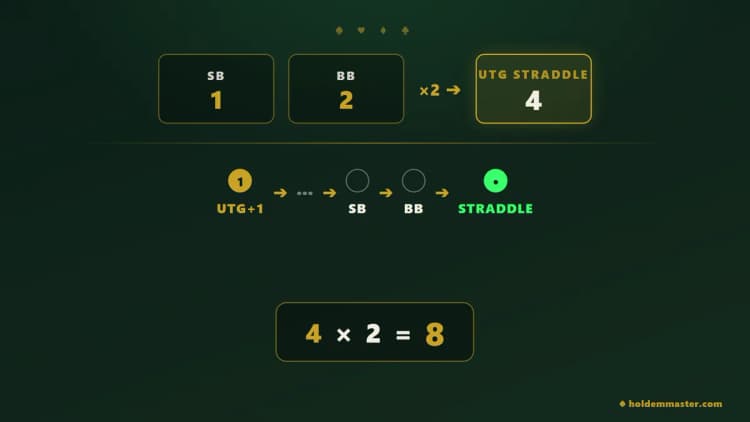
This is the part definition pages skip, and it's where new players get lost. A straddle rearranges the preflop action order. Walk through a standard $1/$2 game where UTG straddles to $4:
UTG posts the straddle
The under-the-gun player puts out $4 (2× the $2 big blind) before cards are dealt
First to act = left of the straddler
Action now begins with the player to the straddler's left (UTG+1), not UTG — the straddle acts like a new big blind
Around the table
Everyone must call $4 (not $2) to play; they can fold, call, or raise — and the minimum raise is now $8, double the straddle, just as over a normal big blind
Blinds decide
The small and big blinds act in turn, facing the $4 price
The straddler acts LAST
If no one raised, the straddler can check their option or raise — the last word before the flop
That "last action preflop" is what the straddler is paying for. But note the catch: for a UTG straddle, the last-action privilege is preflop only. Once the flop comes, the betting order snaps back to normal — the small blind acts first, and the straddler is back in an early, out-of-position seat with a bloated pot. That is one of the main reasons UTG straddling is so often a money-loser: you pay double to be last for one street, then play the next three streets out of position to everyone but the blinds.
Types of Straddle (UTG, Mississippi, Button & Sleeper)
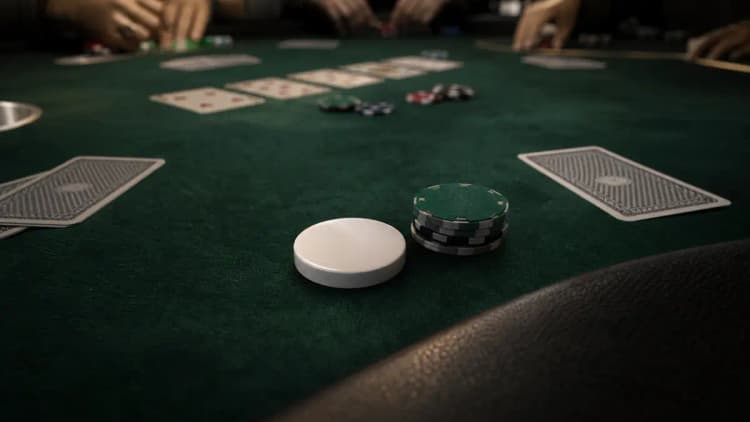
Not all straddles are the same — and the differences are all about where the action starts and how long you keep last position. Here's how they compare:
| Type | Who posts it | Action starts | Last to act | Buys the option? |
|---|---|---|---|---|
| UTG (standard) | Under the gun | Left of straddler | Preflop only | Yes |
| Mississippi | Any seat (often button/CO) | Left of straddler | Preflop — postflop only from the button* | Yes |
| Button | The button | Small blind | Pre + postflop | Yes |
| Sleeper | A non-UTG seat | Normal (UTG) | Preflop, only if folded to it | House rules |
| Re-straddle | Left of a straddler (some rooms allow any seat) | Left of re-straddler | Preflop only | Yes |
*A Mississippi straddle is last after the flop only when it is posted on the button — and that comes from the button itself, not from the straddle, so a straddle from the cutoff buys you the last word preflop only.
- •UTG straddle — the classic. Posted under the gun, last action preflop only. The most common and the weakest, positionally.
- •Mississippi straddle — can be posted from any position, most powerfully from the button or cutoff. Action starts to the straddler's left, so a button Mississippi straddle adds the last word preflop to the postflop position the button already has — the one straddle with a real positional case. Not allowed everywhere.
- •Button straddle — a Mississippi-style straddle specifically from the button; the button keeps last action all the way down. Exact flow (where the small blind fits) varies by room — confirm with the dealer.
- •Sleeper straddle — a blind from a non-UTG seat that stays "asleep": it's inactive unless the action folds all the way to it. It doesn't buy position the way a live straddle does; whether it gains the option to raise as a live blind once it "wakes up" is house-rules territory. Rare, and almost never seen online.
- •Re-straddle (double straddle) — a player to the left can straddle over a straddle, for a minimum of double the previous one ($4 → $8 → $16). Whether it's allowed, and from which seats, is pure house rules.
How Much Is a Straddle?
The standard straddle is exactly 2× the big blind — $4 in a $1/$2 game, $10 in a $2/$5 game. That's the default in nearly every cardroom.
Some no-limit rooms allow more:
- •Uncapped / all-in straddle — a few rooms let the straddler post any amount, up to their entire stack, as a blind bet. A large blind straddle can turn a small game into a very big one for a single hand.
- •Re-straddle progression — where re-straddling is allowed, each one is at least double the last: $4, then $8, then $16, and so on. Games where the whole table straddles and re-straddles can balloon the effective stakes several times over.
Is Straddling Allowed in Tournaments?
Almost never. Straddling is a cash-game feature. Tournaments run on a fixed blind-level structure that has to stay identical at every table for fairness, and a voluntary extra blind would break that — so the overwhelming majority of tournaments, live and online, prohibit straddling entirely.
Even in cash games it's house-rules dependent. It's usually optional (some games are spread with a mandatory straddle), and some rooms allow only the UTG straddle, some permit Mississippi and button straddles, some cap the size, some ban re-straddles. Online, straddles are rare and, where offered, usually limited to a simple UTG button toggle. The difference between a cash-game bet like this and the rigid tournament format is a whole topic on its own — see tournament vs cash game.
Is Straddling Profitable? Should You Straddle?
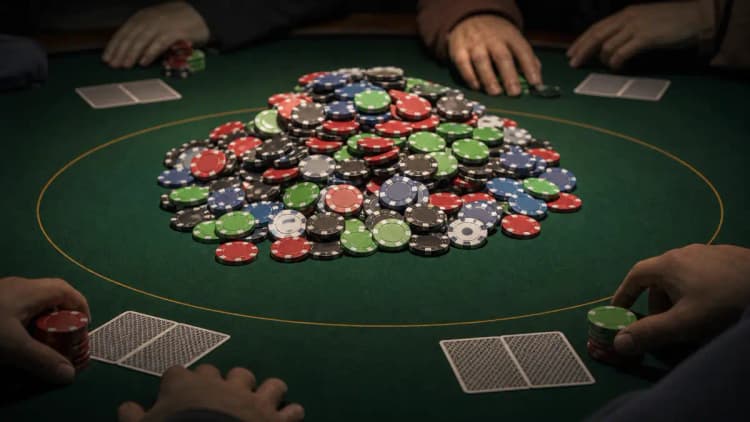
The honest answer, and the one the solvers agree on: for almost everyone, no. GTO Wizard's analysis is blunt: putting money in without looking at your cards is "a massive disadvantage," and even straddling the button is "still almost always a money-losing proposition." Three reasons it costs you — two at the table, one from the house:
You commit blind
Money goes in before you see your cards, so you're playing a bloated pot with no information — the same disadvantage that makes the blinds the worst seats at the table. It also halves your effective depth: at $1/$2 a $200 stack is 100 big blinds, but with a $4 straddle on, the same stack plays like 50
A UTG straddle buys position for one street
It makes you last preflop, then leaves you out of position to every caller but the blinds for the next three streets, in a pot you inflated yourself. Nor does a straddle loosen up the late seats: in GTO Wizard's straddled-pot sims ↗ (UTG straddles to 2bb), the button opens fewer hands — around 15–20% fewer — not more
It can increase pot rake
In pots eligible for rake, a bigger pot can mean a bigger charge until the cap is reached. That increase does not apply to preflop pots under no-flop-no-drop rules, time-charge games, or pots already at the cap
So when is it defensible? Only in specific spots, and almost never as a pure profit play:
- •A loose-passive table where opponents call the bigger blind with junk and play fit-or-fold after the flop — you can occasionally exploit that, ideally straddling from late position.
- •A game where everyone already straddles — if everyone takes turns straddling on equal terms, the stakes rise without giving one player a relative disadvantage. GTO Wizard notes that this can generally favor the stronger players at the table, though the shallower effective stacks can reduce their edge.
- •Action / social games where you're there for fun, not maximum EV — a perfectly valid reason, just be honest that it's costing you.
FAQ
The 3 Things to Remember
1. A straddle is an optional third blind, usually 2× the big blind, posted before the cards — it doubles the stakes and buys the last action preflop. 2. The seat decides the position, not the name of the straddle. A UTG straddle is last preflop only. The only straddle that is also last after the flop is one posted from the button — because postflop the order always follows the button. Everything is house-rules dependent. 3. It's -EV for almost everyone. Committing blind, bloating the pot out of position, and potentially paying more rake outweigh the fun. As a general rule, straddle for the entertainment, not the image or the profit.
Now that you know the extra blind, tighten up the fundamentals it distorts: what the blinds actually do, why position wins money, and how betting actions and raises work once the straddle resets the price.