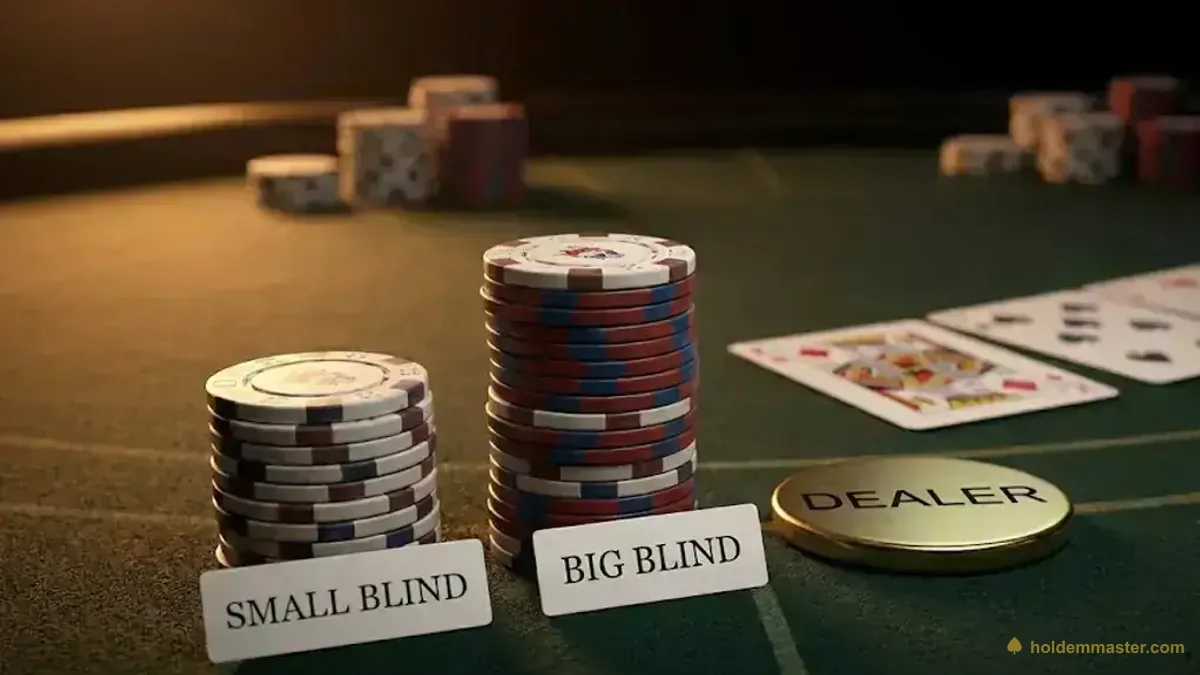
The first hand of live poker I ever played, the dealer tapped the felt in front of me before I'd seen a single card: "Small blind, please." I froze — pay? For what? Twelve years and thousands of hours later, I still watch someone new freeze at that exact moment almost every session.
Blinds are the engine that keeps poker moving — the first piece of the rules of Texas Hold'em that actually costs you chips. Once they click, all the game's number-talk ("2BB raise," "20BB stack") suddenly makes sense. Here's everything in one quick read.
✦ Quick answer
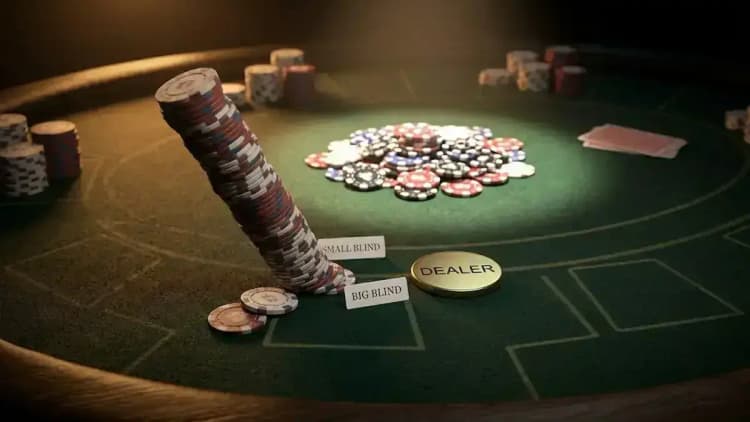
A blind is a forced bet posted before any cards are dealt. The small blind (SB) sits directly left of the dealer button; the big blind (BB) is to the small blind's left. The big blind is usually double the small blind and acts as the table's standard betting unit.
The core numbers
What Is a Blind in Poker — and Why Does It Exist?
A blind is a bet you're forced to make before your cards arrive — you're betting "blind," sight unseen. Two players post them on every normal hand: the small blind and the big blind, the two seats immediately left of the dealer button. (The one exception is a dead button, which can leave the small blind unposted for a hand.)
Why force anyone to pay? To keep the game alive. Without blinds, every player could fold and wait endlessly for premium hands; pots would be empty, bluffing would be pointless, and the game would stall. Two forced bets every hand guarantee there's always something to fight for.
What Is the Small Blind?
The small blind (SB) is the smaller of the two forced bets, posted by the player sitting directly left of the dealer button. It's usually half the big blind — in a $1/$2 game, the small blind is $1.
It's also famously the trickiest seat at the table: you've paid half a bet with a random hand, and from the flop onward you act first on every street, with the least information. That's why the small blind loses money long-term for virtually everyone — the goal is to lose less there, not to win.
What Is the Big Blind?
The big blind (BB) is the full base bet, posted by the player immediately left of the small blind. In a $1/$2 game, the big blind is $2. If nobody raises before the flop, the big blind gets a special perk — the "option" to check and see the flop for free.
Searchers look up "big blind" on its own for a reason: it's not just a seat, it's the measuring stick for the entire game.
| BB expression | What it means | Real example ($1/$2 game) |
|---|---|---|
| 2BB raise | Raise to twice the big blind | Raise to $4 |
| 20BB stack | 20 × the big blind in chips | $40 stack |
| 3BB open | Standard preflop raise size | Raise to $6 |
| BB defense | Calling a raise from the BB seat | You've posted $2, facing $6 raise → call $4 more |
| 100BB deep | Full stack, standard cash game | $200 at a $1/$2 table |
Understand the big blind and the game's number-talk — raise sizes, stack depth, tournament pressure — all unlocks at once.
Small Blind and Big Blind Rules: Who Posts Them, and When
Both blinds are posted before the deal, and the dealer button moves one seat clockwise after every hand — so the blind seats rotate with it and everyone pays both blinds once per orbit. Nobody gets to skip their turn by sitting out — step away and you either post the blinds you missed or wait for the big blind to reach you again.
| Small Blind | Big Blind | |
|---|---|---|
| Position | Directly left of button | Two seats left of button |
| Amount | Usually half the BB | The full base bet |
| Preflop order | Acts second-to-last | Acts last (the "option") |
| Postflop order | Acts first (a disadvantage) | Acts second |
Note: before the flop, action starts with the player left of the big blind and the BB acts last — they see everyone else's decision first. From the flop onward the order resets and the blinds act early. The street-by-street sequence is mapped out in the order of play in Texas Hold'em, and every seat name around the button is covered in poker positions explained.
How Big Are the Blinds? Stakes in Cash Games and Tournaments
Stakes are written SB/BB. A "$1/$2" game means a $1 small blind and a $2 big blind; the small blind is the smaller number, the big blind the larger.
| Stakes | Small Blind | Big Blind | Typical buy-in / level |
|---|---|---|---|
| $0.5/$1 | $0.50 | $1 | $60–$100 |
| $1/$2 | $1 | $2 | $100–$300 |
| $2/$5 | $2 | $5 | $200–$500 |
| $5/$10 | $5 | $10 | $500–$2,000 |
| 25/50 (tournament) | 25 chips | 50 chips | Blind level 1 |
| 100/200 (tournament) | 100 chips | 200 chips | Mid-level |
The golden rule: always check the stakes sign before sitting down — some rooms run non-standard structures like $1/$3 or $2/$3.
- •Cash game: blinds stay fixed. Sit in a $1/$2 game and it's $1/$2 until you leave. (For a deeper comparison, see tournaments vs cash games.)
- •Tournament: blinds rise on a timer (e.g. 25/50 → 50/100 → 100/200), so the pressure builds as the night goes on. Blind levels, the clock, and structure sheets are covered in how poker tournaments work.
What Is a Big Blind Ante? (Plus the Straddle)
From the early or middle stages of most tournaments, an ante is added — a small extra forced bet collected every hand on top of the blinds, which builds the pot and rewards aggression. The common modern version is the big blind ante: instead of everyone tossing in chips, the big blind posts one ante — typically equal to one big blind — for the whole table, which keeps the game fast and clean. When and how antes kick in is part of the tournament blind structure.
One more forced-bet cousin you'll see in cash games: the straddle — a voluntary extra blind (usually 2x the BB) posted from the seat left of the big blind, which temporarily raises the stakes for that hand. It has its own rules, types, and action order — the full breakdown is in  what a straddle is and whether you should post one.
Who Posts the Blinds in Heads-Up Poker?
When only two players are left (or in a heads-up match), the usual rule flips. The dealer button posts the small blind and acts first before the flop, while the other player posts the big blind and acts last preflop — then first on every later street. It's the one time the button pays a blind, and it catches almost everyone the first time.
What Happens If You Miss Your Blind? (Dead Blinds)
Sit down at a live cash game and you usually can't play for free: most rooms have you either post a big blind to be dealt in right away or wait for the blind to reach your seat — though some rooms don't require new players in no-limit or pot-limit games to post at all (WSOP Live Action Rules 104.a), so ask the dealer before you sit. If you step away and miss your blinds, in most card rooms you post them on return to rejoin — the missed big blind plays as a live bet, and the missed small blind is a dead chip pulled straight into the pot. Online tables handle all of this automatically.
How to Play From the Blinds — the 30-Second Version
The blinds are where I watch beginners quietly bleed the most chips — not in one big pot, but a little every orbit. Two habits fix most of it:
- •Small blind: keep it simple. Second-to-last preflop but first to act after the flop, the clean beginner approach is raise or fold, not call. Limping and getting played back at out of position is a steady chip leak — the small blind is the seat I see new players lose from most over a full session.
- •Big blind: defend with the odds. You've already posted one full bet, so you can profitably call raises wider than any other seat. Facing a 2.5 BB open (with the small blind folding), you call 1.5 BB into a 4 BB pot — about 2.7-to-1, meaning roughly 27% equity breaks even on the call. That math is pot odds, and it's why "big blind defense" exists.
- •Late position: the steal. When everyone folds to the button or cutoff, a raise aimed at winning just the two blinds is a blind steal — and re-raising back is a re-steal. Steal sizes, ranges by seat, and how wide to defend are strategy topics, covered in depth in the in position vs out of position strategy guide.
FAQ
The Takeaways
1. Blinds are forced bets before the deal: small blind left of the button, big blind to its left, BB usually double the SB. 2. The big blind is the table's unit — raises, stacks, and tournament pressure are all measured in BBs. 3. Play the blinds carefully: raise-or-fold the small blind, defend the big blind with pot odds, and study steals from late position when it folds to you.
New to the game overall? The  beginner's guide to Texas Hold'em rules covers the basics, the order of play in a hand shows exactly when each blind acts, and poker positions explained covers how your seat — not just the blinds — shapes every decision.