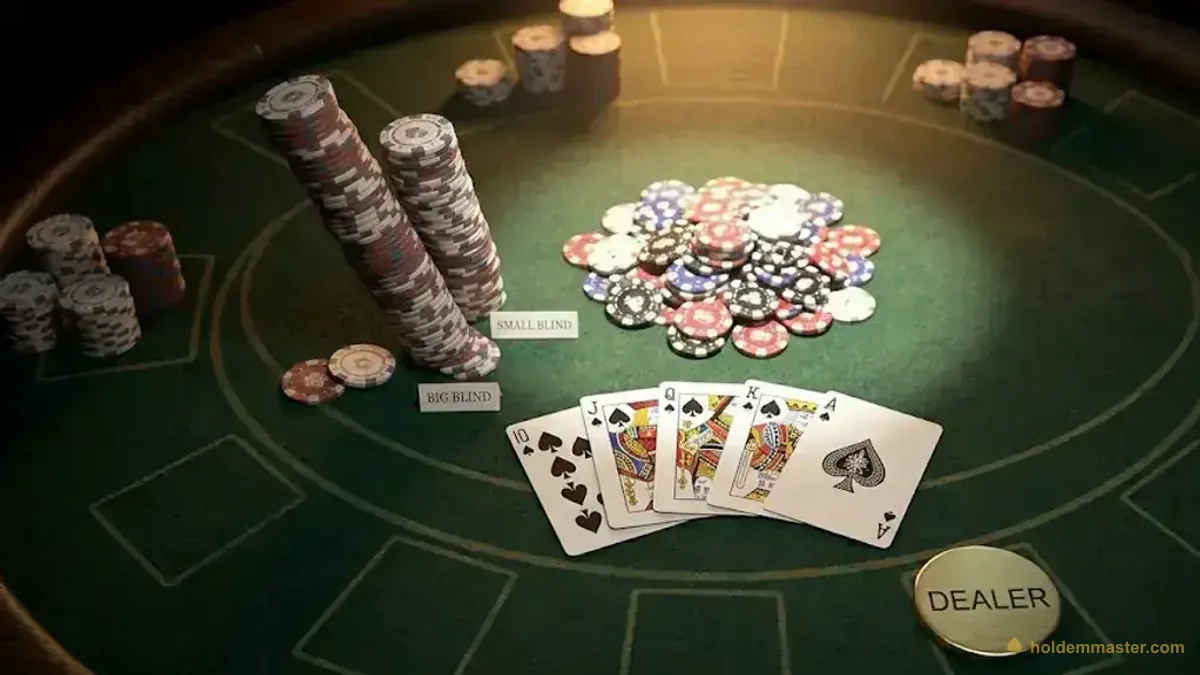
You're heads-up on the river. You made your flush, you're sure it's good — and then the dealer pushes the pot the other way. The board was paired, your opponent had a full house, and you never saw it coming.
Almost every "I thought I won" moment comes down to one thing: not reading the poker hand rankings fast enough. The order itself takes five minutes to learn. Reading it live, under pressure, with a paired or coordinated board — that's the part nobody explains well.
I've spent more nights than I can count watching that exact "I thought I won" face across a table, and it almost always traces back to one missed detail on the board. This guide fixes both problems. You'll get the full ranking order with the real odds, every tiebreaker rule, three live board puzzles so you can practice "find your best five," and a 1-second routine for reading any board at the table.
What Are the Poker Hand Rankings, Best to Worst?
From best to worst, the ten Texas Hold'em hands rank: Royal Flush, Straight Flush, Four of a Kind, Full House, Flush, Straight, Three of a Kind, Two Pair, One Pair, and High Card. The core rule is simple — the rarer a hand is to make from five cards, the higher it ranks. (The order was fixed by five-card odds; over seven cards a couple of frequencies cross — by the river a lone high card is actually rarer than two pair — but the ranking doesn't change.) Below is the entire hierarchy with the long-run odds of holding each by the river.
| # | Hand | Also called | What it is | Odds (by river) |
|---|---|---|---|---|
| 1 | Royal Flush | "Royal" (the ace-high straight flush) | A-K-Q-J-10, one suit | 0.0032% |
| 2 | Straight Flush | A-5 only: "steel wheel" | 5 in sequence, one suit | 0.0279% |
| 3 | Four of a Kind | "Quads" | Four cards of one rank | 0.168% |
| 4 | Full House | "Boat" / "Full boat" | Three of a kind + a pair | 2.60% |
| 5 | Flush | — | Any 5 of one suit | 3.03% |
| 6 | Straight | — | 5 in sequence, mixed suits | 4.62% |
| 7 | Three of a Kind | "Trips" / "Set" | Three cards of one rank | 4.83% |
| 8 | Two Pair | — | Two different pairs | 23.5% |
| 9 | One Pair | — | Two cards of one rank | 43.8% |
| 10 | High Card | "No pair" | No combination at all | 17.4% |
These are the standard seven-card hand frequencies for a full 52-card deck — the same probabilities every poker solver and training site uses.
✦ The one rule that wins arguments
One Pair and High Card together make up roughly 61% of all seven-card hands by the river. Big hands feel common because they're memorable — but most pots are decided by a pair or a high card and the  kicker.
Card Strength: The 30-Second Foundation
Before hands, you need card strength. Two things only.
Rank order (high to low)
A > K > Q > J > 10 > 9 > 8 > 7 > 6 > 5 > 4 > 3 > 2
The Ace is the strongest card and also the only one that bends the rules: it plays high (A-K-Q-J-10) and low (A-2-3-4-5, "the wheel"). It cannot wrap around the middle — Q-K-A-2-3 is not a straight.
Suits don't rank
In standard Texas Hold'em, no suit is stronger than another. Spades do not beat hearts. Suits only matter for making a flush, never for breaking a tie. If two players have the same five cards in different suits, the pot is split — every time.
What Are the 10 Poker Hands? (Each One Explained)
Here is every hand from strongest to weakest, with an example and the one rule that decides each matchup. The five that cause the most confusion — full house, flush, straight, and the two kinds of three-of-a-kind — get the extra attention.
#1 — Royal Flush
A♠ K♠ Q♠ J♠ 10♠ — the highest straight flush, and the best hand in poker.
It cannot be beaten; the only possible tie is a royal flush that sits entirely on the board for everyone to share, which splits the pot. You'll see one roughly once in 31,000 hands, so most players go years without hitting one. When you do, your only job is to get as many chips in as possible.
#2 — Straight Flush
9♥ 8♥ 7♥ 6♥ 5♥ — five cards in a row, all one suit.
Only a higher straight flush or a royal flush beats it. The lowest version, A-2-3-4-5 of one suit, is called the "steel wheel." When two straight flushes clash, the one with the higher top card wins.
#3 — Four of a Kind (Quads)
8♣ 8♦ 8♥ 8♠ K♥ — all four cards of one rank.
Between two quads, the higher four-of-a-kind wins. If the quads are on the board (all four shared), the highest kicker decides it — and the Ace kicker plays.
#4 — Full House (Boat)
Q♠ Q♥ Q♦ 5♣ 5♠ — three of a kind plus a pair.
Compare the three-of-a-kind first: QQQ55 beats JJJ99 because queens top jacks, no matter how big the pair is. Only if the trips tie do you compare the pairs.
✦ The most common cooler
In twelve years around the felt, "my nut flush lost to a boat" is the single most frequent beat I hear players groan about. Any time the board pairs, check for a full house before you commit with a flush or a straight.
#5 — Flush
A♦ J♦ 8♦ 6♦ 2♦ — any five cards of one suit, sequence irrelevant.
Two flushes are compared card by card from the top: A-J-8-6-2 beats A-J-8-5-2 because the 6 tops the 5. Four cards of a suit is not a flush — you need five.
#6 — Straight
7♠ 6♥ 5♣ 4♦ 3♠ — five cards in sequence, suits mixed.
- •The nuts: A-K-Q-J-10 ("Broadway") is the highest straight.
- •The wheel: A-2-3-4-5 is the lowest straight (the Ace plays low).
- •Illegal: you cannot wrap around — K-A-2-3-4 is not a straight.
#7 — Three of a Kind (Trips / Set)
J♣ J♠ J♥ A♦ 4♠ — three cards of one rank.
There are two ways to make it, and the difference matters:
- •Set: a pocket pair plus one matching board card (e.g. you hold J♣ J♠, board has J♥). Disguised and dangerous.
- •Trips: a pair on the board plus one in your hand. Easier for opponents to read and to share.
#8 — Two Pair
10♠ 10♥ 8♣ 8♦ A♠ — two different pairs.
Compare in order: high pair → low pair → kicker. KK99-A beats QQJJ-A because kings top queens before anything else is checked.
#9 — One Pair
K♠ K♦ 9♥ 6♣ 2♠ — two cards of one rank.
The most common made hand in Hold'em. Two equal pairs go to kickers: pair rank → kicker 1 → kicker 2 → kicker 3, highest first. This is where most "same hand" losses happen — guard your kicker.
#10 — High Card
A♣ Q♠ 9♥ 5♦ 3♣ — nothing connects.
At showdown, the highest card wins, then the next, and so on down all five. If all five match, it's a split. This is what you're left with when a bluff gets called and misses.
How Do Kickers and Ties Work in Poker?
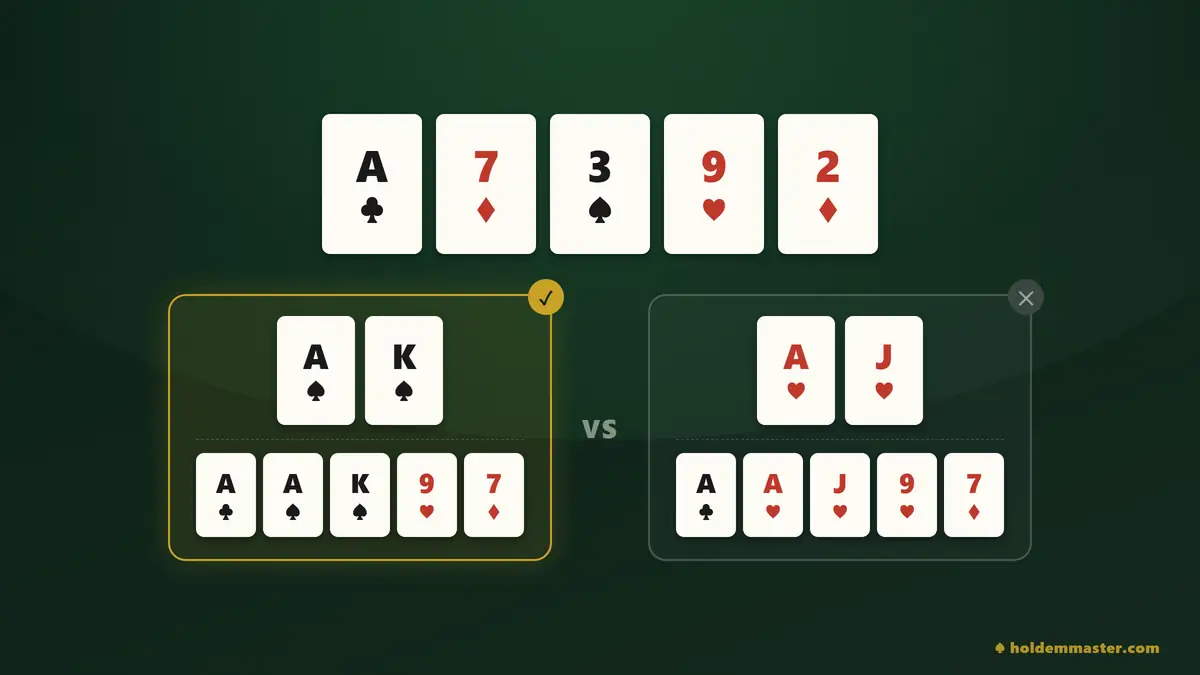
When two players hold the same hand type, the winner is decided by comparing the cards inside the hand first, and then a kicker — a side card that isn't part of the made hand — breaks the tie when everything else matches. This is the part that decides real pots, and the part most charts skip. Work through this exact order:
1. Compare the hand rank. A flush always beats a straight, full house always beats a flush, and so on. 2. Compare the cards that make the hand. A pair of aces beats a pair of kings; a queen-high flush beats a jack-high flush. 3. Compare the kickers. If the made hand ties, the leftover cards break it, one at a time from the top. 4. Still identical? Split the pot. Suits never break the tie.
The badge on the right shows whether a kicker is used to decide the hand.
A kicker is simply a card that isn't part of your made hand but is still used to break ties. With A-A-K vs A-A-Q, both have aces — the king kicker wins. This is why pros care so much about the quality of their high cards, not just whether they paired. For every hand's tie rule in one place, see the kicker and tie-breaker guide; when the best five cards match exactly, the pot is split.
Read the Board: 3 Live Puzzles
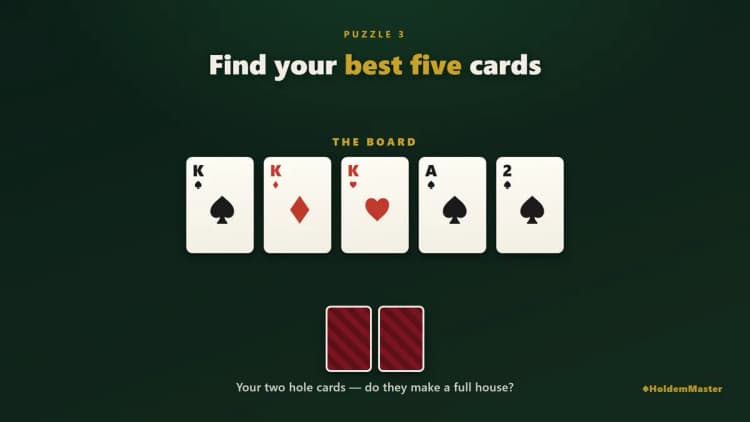
Knowing the order isn't the same as reading it fast. Here are three real spots. Cover the answer, find your best five cards out of seven, then check.
Puzzle 1 — The hidden full house
You hold Q♥ Q♦. What's your best hand?
Puzzle 2 — The flush that's actually better
You hold 6♥ 2♣. The board has four hearts.
Puzzle 3 — When you have to share
You hold A♥ 3♣. The board already has trip kings.
What Beats What in Poker? The Matchups People Argue About
The short answers to the arguments that break out at every table: a flush beats a straight, a full house beats a flush, four of a kind beats a full house, and the wheel (A-2-3-4-5) is the lowest straight, never the highest. Here are the matchups people get wrong most often.
| Matchup | Winner | Why |
|---|---|---|
| Flush vs Straight | Flush | #5 beats #6 |
| Full House vs Flush | Full House | #4 beats #5 |
| Three of a Kind vs Two Pair | Three of a Kind | #7 beats #8 |
| Straight vs Three of a Kind | Straight | #6 beats #7 |
| A-2-3-4-5 vs 10-J-Q-K-A | Broadway (A-high) | The wheel is the lowest straight |
| Same pair, K kicker vs J kicker | K kicker | Higher kicker wins |
| Four of a Kind vs Full House | Four of a Kind | #3 beats #4 |
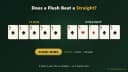
Why Does a Flush Beat a Straight?
A flush beats a straight because it is simply harder to make: in a 52-card deck there are fewer ways to draw five cards of one suit (3.03% of seven-card hands by the river) than five in sequence across any suits (4.62%). The ranking isn't arbitrary — it's pure probability. The harder a hand is to make, the higher it ranks. That single principle explains the entire hierarchy — see the exact numbers in the  poker odds and probability chart.
It also explains the one big exception you'll meet: in Short Deck (6+) Hold'em, where the 2s through 5s are removed, flushes become harder than full houses — so in that format a flush beats a full house. The math changed, so the order changed. More on game-by-game differences below.
The 1-Second Hand-Reading Routine
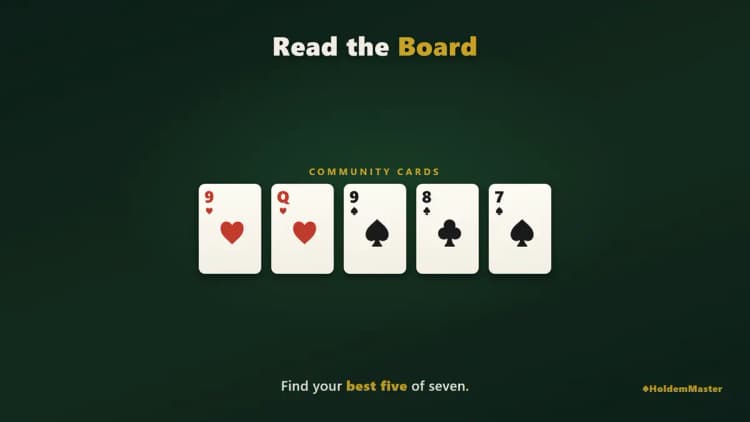
Under a time bank, run this scan in order every time the board is complete:
I still run this exact scan — flush, then straight, then pairs — on every single board, no matter how many hours I've been sitting there. Danger first (flush/straight on the board), then whether the board is paired (which threatens everything). Build the habit and you'll stop making rushed river calls.
How Do You Memorize Poker Hands Fast?
The fastest way to memorize poker hands is to stop treating them as ten random items: learn them in three groups (Premium, Middle, Common), drill only the confusing pairs, then call the winner on poker streams before the dealer announces it. Here's the three-step plan.
| Step | What to do | Time |
|---|---|---|
| 1 | Learn three groups: Premium (#1–3), Middle (#4–6), Common (#7–10) | 1 day |
| 2 | Drill only the confusing pairs: flush vs straight, full house vs flush | 3 days |
| 3 | Watch poker streams and call the winner before the dealer announces | 1–2 weeks |
Are Poker Hand Rankings the Same in Every Game?
Mostly yes — the same ten-hand order carries across Texas Hold'em, Omaha, and Seven-Card Stud. The main exceptions are Short Deck (6+), where a flush beats a full house, and Omaha's rule that you must use exactly two of your hole cards. Here's how the common variants compare.
| Game | Hand rankings | Key difference |
|---|---|---|
| Texas Hold'em | Standard (this guide) | Use any 0–2 of your hole cards |
| Omaha | Standard | Must use exactly 2 of your 4 hole cards |
| Seven-Card Stud | Standard | No community cards |
| Short Deck (6+) | Modified | Flush beats full house; often A-6-7-8-9 counts as a straight |

FAQ
The 3 Things to Remember
1. The order: Royal Flush > Straight Flush > Four of a Kind > Full House > Flush > Straight > Three of a Kind > Two Pair > One Pair > High Card. 2. The trap: a flush (#5) beats a straight (#6) — and any paired board can hide a full house that beats both. 3. The reality: most pots are won with one pair or high card, so your kicker is worth more than you think.
Learn the order in an afternoon, drill the confusing pairs, and run the flush → straight → pairs scan on every board. Do that and you'll never again push the pot the wrong way.
Once you know the rankings, the natural next step is knowing which hands to start with — use the Texas Hold'em starting hands chart by position to see exactly which hole cards to play from each seat.