The first big pot I ever lost in a live cash game went exactly like this: I rivered a ten-high straight, slid it forward like it was gold — and a quiet regular flipped over two hearts. The dealer pushed the pot the other way, and I replayed that hand the whole drive home.
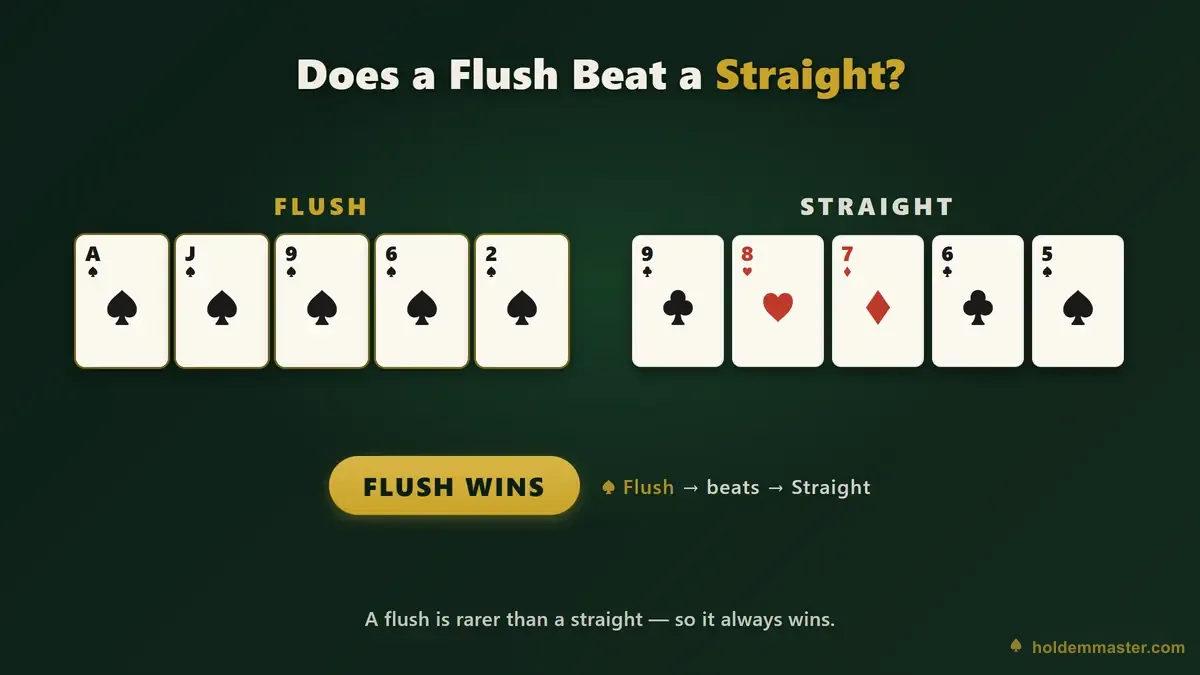
If that just happened to you, the short answer is yes — a flush beats a straight, every single time. The interesting parts are why, what else beats a flush, and the three board spots where players still get it wrong live at the table.
The Short Answer
✦ Quick answer
A flush always beats a straight in Texas Hold'em — no exceptions in the standard game. A flush (five cards of one suit) is statistically harder to make than a straight (five cards in sequence): about 5,108 five-card combinations versus 10,200.
Does a Flush Beat a Straight? Where the Two Hands Sit
Yes — and it's not close to a judgment call. The flush sits one rung above the straight, and that never changes in standard Hold'em. Here's the neighborhood around the two hands people confuse most:
| Rank | Hand | Example |
|---|---|---|
| #2 | Straight Flush | 9♥ 8♥ 7♥ 6♥ 5♥ |
| #4 | Full House | J♠ J♥ J♦ 8♠ 8♥ |
| #5 | Flush | A♠ J♠ 9♠ 6♠ 2♠ |
| #6 | Straight | 9♣ 8♥ 7♦ 6♣ 5♠ |
| #7 | Three of a Kind | Q♠ Q♥ Q♦ 7♠ 3♣ |
 full poker hand rankings guide — this article zooms in on the flush-versus-straight matchup and its closest neighbors.
Why Does a Flush Beat a Straight? The Math
Hand strength in poker is decided by one thing: how hard the hand is to make. The rarer it is, the higher it ranks. Nothing about the order is arbitrary — it's pure frequency.
Count the 2,598,960 possible five-card hands from a 52-card deck and the order falls out on its own:
| Hand | Combinations | Probability | Verdict |
|---|---|---|---|
| Four of a Kind | 624 | 0.024% | Beats flush |
| Full House | 3,744 | 0.144% | Beats flush |
| Flush | 5,108 | 0.197% | Beats straight ✅ |
| Straight | 10,200 | 0.392% | Loses to flush ❌ |
| Three of a Kind | 54,912 | 2.11% | Loses to straight |
 poker odds and probability chart.
Why this feels backwards
A straight only needs five ranks in a row, and the suits don't matter. That freedom creates a huge number of combinations. A flush is the opposite: every one of the five cards has to share the same suit, and only one of four suits can do it at a time. Far fewer ways to get there means the flush is rarer — and rarer always wins.
3 Board Spots That Still Fool Players

Knowing the rule isn't the same as reading it live — that skill is exactly what reading the board trains. These are the three spots where the mistake actually happens.
Spot 1 — You make a straight, but the board is three of a suit
You hold 9♠ 10♠ for a clean 6-7-8-9-10 straight. Feels strong — but the board shows three hearts. If your opponent holds two hearts, they have a flush, and flush beats straight. Any time three or more of one suit are on the board, a flush is live; price your bets and calls accordingly.
Spot 2 — A made straight with a flush draw on top
You hold 9♥ 5♥. You've already got the 5-6-7-8-9 straight — so why keep eyeing the hearts? Because you also hold four to a flush (9♥ 8♥ 7♥ 5♥): any heart on the river upgrades your straight to a flush, and the 6♥ specifically completes a 5-6-7-8-9 straight flush (#2) that crushes everything. When you can draw to a bigger hand for free, play with that upgrade in mind.
Two warnings that belong with it. First, this straight is not the nuts — anyone holding T-9 already has the higher 10-9-8-7-6. Second, the highest heart you own is the 9♥. Any river heart except the 6♥ also hands a flush to every opponent holding two hearts, and a single heart above the nine is enough to beat you — A♥ 2♥ does it. The upgrade is real, but it is no licence to build a big pot.
Spot 3 — You have the flush, they table a straight
You hold A♠ 6♠ → A♠ J♠ 9♠ 7♠ 6♠, an ace-high flush. Your opponent shows 10♥ 8♦ for a 7-8-9-10-J straight and announces it confidently. Don't blink: your flush is higher. Flush over straight, always.
What Beats a Flush in Poker?
Your flush is a favorite against most of the deck — but exactly four hand types (plus a bigger flush) beat it:
The matchup people argue about most after flush vs straight is flush vs full house — and the boat wins. I've paid off more paired-board boats holding a pretty nut flush than I'd like to admit, so the danger sign I watch for now is simple: a paired board. Watch this one:
You hold A♠ 5♠ for the nut flush: A♠ K♠ 9♠ 5♠ 4♠. Your opponent holds K♦ 9♦ and tables 9♦ 9♠ 9♥ K♦ K♠ — nines full of kings. Full house beats flush, and no flush survives it. On an unpaired board your ace-high flush is beaten only by a straight flush; the moment the board pairs, full houses and quads enter the picture.
When two players hold the same hand type, the winner comes down to card-by-card comparison — the full system is in the poker tie-breaker and kicker rules.
Flush vs Flush, Straight vs Straight — Who Wins the Tie?
Yes, one flush can absolutely be higher than another. Suits are irrelevant — compare the five cards from the top down, highest first:
| Player | Flush | Result |
|---|---|---|
| A | A♠ J♠ 9♠ 6♠ 2♠ | Wins |
| B | K♥ Q♥ 10♥ 8♥ 3♥ | Loses |
Straights are even simpler: compare the highest card only — there's no kicker.
- •A-K-Q-J-10 (ace high, "Broadway") is the strongest straight.
- •A-2-3-4-5 (the "wheel," ace plays low) is the weakest.
| Player | Straight | Result |
|---|---|---|
| A | Q-J-10-9-8 | Wins |
| B | J-10-9-8-7 | Loses |
What Is a Straight Flush? When Both Happen at Once

A straight flush is five consecutive cards of one suit — like 9♥ 8♥ 7♥ 6♥ 5♥. It's the #2 hand in poker, beaten only by a royal flush (which is simply the ace-high straight flush, A-K-Q-J-10 suited). At just 36 combinations (~0.00139% of five-card hands; about 0.028% by the river in Hold'em), it's rarer than everything except the royal itself.
The catch: the same five cards must be both suited and in sequence. Watch the difference on the board 8♥ 7♥ 6♥ Q♠ 3♦:
- •Hold K♥ 2♥ → your five hearts are K-8-7-6-2. Not consecutive — that's a plain flush, not a straight flush.
- •Hold 10♥ 9♥ → your five hearts are 10-9-8-7-6. Consecutive and suited — a 10-high straight flush.
Are Poker Hands Ranked Differently in Short Deck?
Yes — Short Deck (6+) Hold'em is the one common format that reorders these hands. In Short Deck (6+) Hold'em, the 2s through 5s are removed from the deck. With fewer cards, a flush becomes harder to make than a full house — so in that format the ranking shifts and a flush beats a full house. The principle never changes: the rarer hand wins. Only the deck changed. In standard Texas Hold'em with a full 52-card deck, a flush beats a straight and loses to a full house, every time.


FAQ
The Takeaways
1. Flush (#5) beats straight (#6) — no exceptions in standard Hold'em. 2. It wins because it's rarer: 5,108 flush combos against 10,200 straight combos among five-card hands — and 3.03% against 4.62% across all seven cards to the river. 3. Watch the board: three of one suit means a flush is live, a paired board means a full house can beat your flush, and suited plus connected is a straight flush.
Lock in the full order with the complete hand rankings, learn how close hands are decided in the tie-breaker and kicker guide, and if you're brand new, the beginner's guide to Texas Hold'em rules ties it all together.