The 2026 World Series of Poker ended on July 15. The Main Event didn't.
Nine players bagged chips on July 13 and then went home for three weeks. They came back on August 3, and over three nights they played down to a champion for $10,000,000 and the last bracelet of the 57th WSOP.
It ran to August 5. Here's who won and what every seat paid, what the ladder looked like from the inside, and — if you read the results and think I could be at that table — what the road there actually looks like from a US address.
New to how these events are built?  The tournament guide covers buy-ins, blind levels and Day 1 in one place.
At a Glance
✦ Quick answer
Lucas Jumalon won the 2026 WSOP Main Event and $10,000,000, beating a field of 9,208 entries that built an $87,568,080 prize pool. He took the title at 22 years old, having walked into the final table with 194,000,000 chips (129 big blinds) — more than the next three stacks combined — and holding the lead until the last hand. Play ended August 5. Runner-up Lauri Saaskilahti earned $6,000,000, and ninth place still paid $1,000,000.
Who Won the 2026 WSOP Main Event?
Lucas Jumalon won it for $10,000,000. The final table started August 3 and finished on August 5. Below is every finishing position with the payout, next to the chip count each player bagged on July 13 — so you can see how much the chip order actually predicted.
| Finish | Player | Country | Payout | Chips (chip rank) |
|---|---|---|---|---|
| 🏆 1 | Lucas Jumalon | United States | $10,000,000 | 194,000,000 (1st) |
| 2 | Lauri Saaskilahti | Finland | $6,000,000 | 37,500,000 (7th) |
| 3 | Gregor Mueller | Canada | $3,750,000 | 48,500,000 (4th) |
| 4 | Michael Gagliano | United States | $2,750,000 | 46,500,000 (5th) |
| 5 | Hanming Feng | United States | $2,250,000 | 25,000,000 (8th) |
| 6 | Rami Hammoud | Canada | $1,750,000 | 79,000,000 (2nd) |
| 7 | Jamie Shaevel | United States | $1,500,000 | 56,000,000 (3rd) |
| 8 | Mario Boos | France | $1,250,000 | 44,000,000 (6th) |
| 9 | Evagoras Evagorou | Cyprus | $1,000,000 | 22,500,000 (9th) |
Read the right-hand column and the story stops being "the chip leader won." Rami Hammoud came in second in chips with 79,000,000 and finished sixth. Lauri Saaskilahti came in seventh in chips with 37,500,000 and finished second — a $4,250,000 swing in the opposite direction of the stacks. Hanming Feng started eighth of nine with 17 big blinds and laddered to fifth.
Only two seats finished where they started: Jumalon first and Evagoras Evagorou ninth. Everyone in between moved.
Four Americans, two Canadians, a Frenchman, a Finn and a Cypriot made up the nine. Evagoras Evagorou is the first Cypriot to reach a WSOP Main Event final table.
How Did Lucas Jumalon Build That Stack?
He walked in with more chips than the next three players combined — the number that made the 2026 final table different from every other one. PokerNews put it plainly:
"Lucas Jumalon's 194,000,000 chips is more than the next three players combined (183,500,000). This is unprecedented since the official final table expanded to nine players in 2001."
Twenty-five years of nine-handed WSOP final tables, and nobody has ever walked in holding this much of the table's equity.
Jumalon is 22 years old, from Spokane, Washington, and graduated from Grand Canyon University with a degree in business administration and data analytics. With the win he becomes the second-youngest Main Event champion ever, behind Joe "The Kid" Cada, who was 21 when he won in 2009.
The résumé he brought into this is the part that will make you sit up. Per The Hendon Mob, Jumalon had just over $180,000 in career live earnings before this Main Event. His best previous score was $22,945, for winning a $400 PokerNews Daily Deepstacks event at the 2025 WSOP. He won $10,000,000 with a previous career-best cash smaller than a used car — roughly 436 times his best previous result ($10,000,000 ÷ $22,945 = 435.8).
How he got the stack. Jumalon started Day 8 third of the 21 players left with 40,800,000 (68 big blinds) — good, not dominant. The hand that changed the tournament came against Malcolm Trayner, the reigning Aussie Millions Main Event champion: Jumalon turned a set of jacks into a full house to crack Trayner's pocket queens. He was up to 155,000,000 by dinner break, and later busted Trayner in 10th — the hand that set the final table.
What Did Each WSOP 2026 Final Table Place Pay?
Every one of the nine cashed for seven figures — $1,000,000 was the floor. Here is the full ladder, with the jump each finish was worth over the one below it:
| Finish | Payout | Jump from the spot below |
|---|---|---|
| 1st | $10,000,000 | +$4,000,000 |
| 2nd | $6,000,000 | +$2,250,000 |
| 3rd | $3,750,000 | +$1,000,000 |
| 4th | $2,750,000 | +$500,000 |
| 5th | $2,250,000 | +$500,000 |
| 6th | $1,750,000 | +$250,000 |
| 7th | $1,500,000 | +$250,000 |
| 8th | $1,250,000 | +$250,000 |
| 9th | $1,000,000 | — |
Read that right column and you're reading the whole strategic story of those three nights. The jumps from 9th to 6th were $250,000 apiece — real money, but survivable to pass on. The jump from 2nd to 1st was $4,000,000, which is what Jumalon and Saaskilahti were playing for heads-up.
That gap between what a chip is worth and what a finish is worth is exactly what  ICM — the Independent Chip Model measures. It is why the two short stacks could not simply fold their way up the ladder even though every pass was worth a quarter million, and why a big stack that is not the big stack is in an awkward spot: Hammoud's 79,000,000 was second-most at the table and still finished sixth, while Saaskilahti's 37,500,000 finished second. Chips set the odds at a final table; they do not set the payouts.
How to Watch the WSOP 2026 Final Table on ESPN
All three nights aired on US television. The times were:
| Date | Time (ET) | Channel |
|---|---|---|
| Monday, August 3 | 9:00 PM – Midnight | ESPN2 |
| Tuesday, August 4 | 9:00 PM – Midnight | ESPN |
| Wednesday, August 5 | 10:30 PM – 1:30 AM | ESPN |
| Edited programs | August 10, 9:00–11:00 PM | ESPN2 |
ESPN Networks carried it in the US and over 70 countries. Eurosport and TNT Sports handled the UK and 60-plus countries across Europe and Asia.
Two things changed this year. The first is the delay itself: the final nine were confirmed on July 13 and did not resume until August 3, a three-week gap that's new for 2026. The second is behind the camera — PokerGO is out of live streaming (it's still involved in production), and the WSOP put 99 events on its official YouTube channel for free instead.
9,208 Entries and 111 Countries — the 2026 Main Event by the Numbers
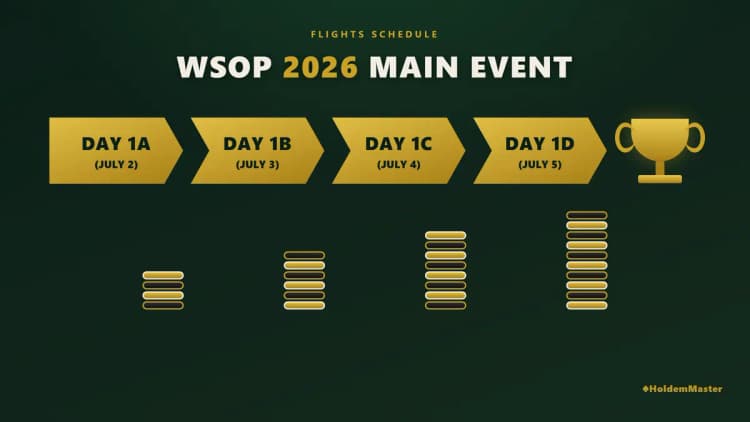
Event #82, the $10,000 No-Limit Hold'em World Championship, ran four Day 1 flights across July 2–5.
| 2026 Main Event | |
|---|---|
| Entries | 9,208 — fourth-largest field ever |
| Prize pool | $87,568,080 |
| Countries represented | 111 — a record |
| Non-American entries | 3,574 (38.8%) |
| American entries | 5,634 — the largest national contingent |
| Starting stack | 60,000 |
| Levels | 120 minutes |
| Format | Freezeout, 21 and over |
For scale on where 9,208 sits: 2024 drew 10,112, 2023 drew 10,043, and 2025 drew 9,735.
Top 10 countries by entries:
| Country | Entries | Country | Entries |
|---|---|---|---|
| USA | 5,634 | Brazil | 172 |
| Canada | 371 | China | 169 |
| UK | 356 | Israel | 154 |
| France | 296 | Spain | 148 |
| Japan | 222 | Germany | 146 |
Two numbers worth holding together: 5,634 of the 9,208 entries were American, and four of the nine seats at the final table were American. The 120-minute levels are the other thing to notice — this is the slowest structure in poker, which is why a Main Event run takes nearly two weeks and why deep stacks stay playable long enough for a stack like Jumalon's to be built rather than flipped into.
251,899 Entries — the Biggest WSOP Ever Held
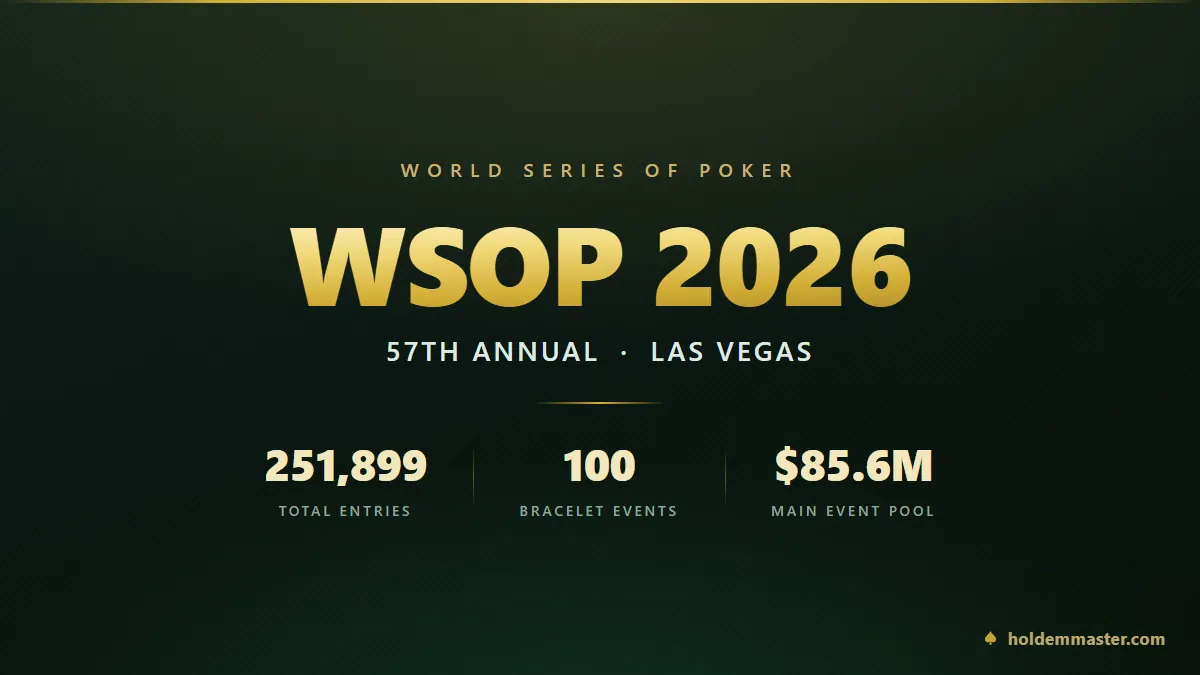
The 57th WSOP ran May 26 through July 15 across the Horseshoe and Paris Las Vegas — that is the bracelet-event schedule, with the Main Event final table sitting three weeks later on August 3–5. It broke the attendance record for the series as a whole:
| Series total | 2026 |
|---|---|
| Total entries | 251,899 — an all-time record |
| Paid out | $469,975,059 |
| In-the-money finishes | 35,157 |
| Bracelet events | 100 (all 100 awarded — the Main Event was the last one) |
| Biggest single field | #63 $1,000 Mystery Millions — 22,811 entries |
| Ladies Championship | 1,475 entries — the largest women's event in poker history |
Prize money was the second-highest ever, not the highest — 2025 still holds that record at $481,761,919. More people played for slightly less money, which is what happens when a record share of the volume comes from the cheap end of the schedule.
Bracelets by country, across the 99 events that finished before the Main Event: USA 58, Canada 7, then China, the UK and Japan on 4 apiece and Brazil on 3. American players won more than five times as many bracelets as the next country. The hundredth bracelet — the Main Event — went to an American too: Jumalon.
How an American Actually Gets to That Table
Here's where a lot of guides get this wrong for US readers, so let's be blunt about it.
The WSOP's own site promotes online qualifying with the line "Qualify for as Little as $0.50", and the ladder behind it looks like this:
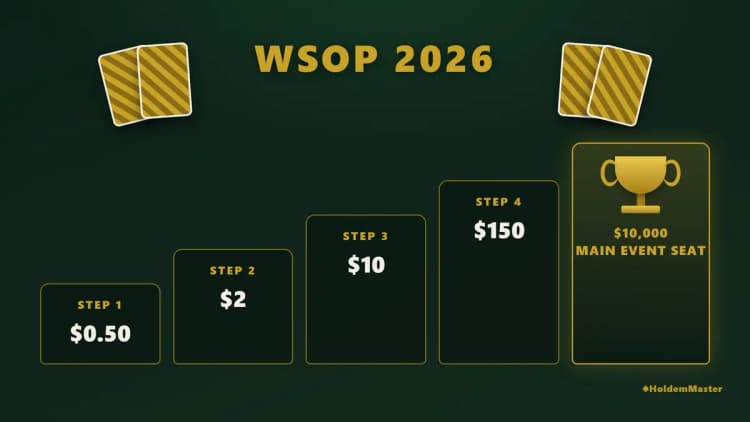
⚠️ That ladder runs through GGPoker, and US players cannot use GGPoker. If you're reading this from a US address, the fifty-cent route in the graphic above is not open to you. It's real, it works, and it's for players outside the United States.
What Americans actually have:
- •Online: WSOP.com, which operates in Nevada, New Jersey, Michigan and Pennsylvania only. If you don't live in or travel to one of those four states, there is no legal US online route to a seat.
- •The wider legal map: online poker is legal in six states — Nevada, New Jersey, Michigan, Pennsylvania, Delaware and West Virginia. The four above are where WSOP.com runs.
- •Live satellites at the series. This is the route open to anyone who can get to Las Vegas, and it's the one most people underuse.
| Satellite | Buy-in | Start | Target stack |
|---|---|---|---|
| Deepstack Step | $150 | 10 a.m. | 200,000 |
| Landmark | $585 | 10 a.m. and 4 p.m. | 200,000 |
| Turbo | $1,100 | 8 a.m. | 150,000 |
| Landmark | $2,200 | 7 p.m. | 200,000 |
These aren't winner-take-all. Reach the target stack and you're done — you take a $10,000 Main Event seat or $10,000 in chips, your choice. That structure changes how you play them completely: once you're at the number, every additional chip is worth nothing to you and every hand you play risks the seat. Fold your way in.
The cash option matters more than it looks. If you hit the target in a $585 satellite and you'd rather have the money than the seat, you take $10,000 in chips and walk. That's a legitimate outcome, not a consolation prize.
Planning further ahead? The live tournament calendar tracks what's running and when, and  tournament vs cash game is worth reading before you commit a bankroll to a satellite grind.
Registration Rules That Catch People Out
You can qualify for the Main Event and still not get into the Main Event. Every one of these trips somebody up every summer.
The account setup is not what it used to be:
Create a Caesars Rewards account
You need this one and the next one. Neither works alone
Create a WSOP LIVE account
It is no longer Bravo Poker Live — if you're going off an old guide, this is the change that will strand you
Verify in person at the Versailles Ballroom
On the Paris side. Even if you paid in the app, you show up with your ID. First time only — but you do have to do it
The WSOP recommends arriving an hour early for that first verification. Take the advice; the room during a Main Event flight is not where you want to discover a paperwork problem.
Paying for a $10,000 seat is its own obstacle course:
- •Credit cards and PayPal carry a 2% fee — debit cards carry none. A $10,000 Main Event entry comes to $10,200 on credit or PayPal, and exactly $10,000 on debit: a $200 swing for picking the right piece of plastic. 🪶 One catch — debit cards carry daily spending limits set by your bank, so a single $10,000 charge may not clear. Raise the limit before you fly. Card payments are capped at $10,000 per transaction, and that cap is measured against the event's buy-in, not the total you end up paying — the rules give an example where one card covers the $10,000 Main Event and the $1,500 Monster Stack, but not a $50,000 event. So the 2% does not push you over the limit. ⚠️ The registration page still prints "3%" — the season rulebook is the authority here, but it also says fees can change, so read the final amount on the payment screen.
- •Virtual and digital cards are not accepted. The name on the card has to match the name on your ID.
- •ACH is available to US residents only — one of the very few places American players have it easier than everyone else. Non-US players use Luxon Pay.
- •Wires start at $100,000 and need pre-approval. Cashier's checks need pre-approval too.
- •You can open a tournament account (TA) at the Paris with cash or chips. For a multi-week trip this is the least painful option.
- •You cannot register on someone else's behalf. Not for your friend, not for your backer, not for your spouse.
- •If your ID has no physical address on it, you need a second document that shows one — driver's license, utility bill, or credit card statement.
What You Can and Can't Do at a WSOP Table
If you've only played online or in a local card room, the floor rules at a WSOP table are stricter than you expect — and one of them is genuinely reassuring.
There are seven official words: bet, call, fold, check, all-in, pot (Pot-Limit games only), and complete. Use them and nothing else can be misread. English only at the table while a hand is live.
Here's the reassuring part: you don't have to call your hand in English. A verbal declaration of hand value isn't binding — the cards decide at showdown. Table your hand face up and the dealer reads it. If you're not fully confident announcing a hand out loud in a room full of pros, that's fine; just know what beats what so you know when to turn your cards over.
Note what the last one rules out: the Main Event is a freezeout. One bullet, no second chances, 9,208 entries. That's the whole reason the thing carries the weight it does.


FAQ
The Takeaways
1. Lucas Jumalon won it at 22 for $10,000,000, becoming the second-youngest Main Event champion behind Joe Cada. 2. He came in with 194,000,000 chips — more than the next three stacks combined, which had never happened at a nine-handed WSOP final table since 2001 — and never lost the lead. 3. The chip order did not hold below him. The second-biggest stack finished sixth; the seventh-biggest finished second for $6,000,000. Ninth place still paid $1,000,000. 4. 9,208 entries from a record 111 countries built an $87,568,080 prize pool paid to the top 1,383; 5,634 of those entries were American. 5. The $0.50 qualifying ladder is not open to US players — that's GGPoker. Americans have WSOP.com in four states, or live satellites in Las Vegas from $150.
Sources
Every figure above was checked against primary sources. Verified: July 29, 2026 — final results and payouts re-verified August 6, 2026, and the card-payment fees re-verified against the official rulebook PDF on August 15, 2026.
- •★Final results and payouts (verified Aug 6, 2026) — WSOP official result, Event #82 ↗ · champion Lucas Jumalon (United States) $10,000,000, all nine finishing positions with country and payout, end date August 5 (official page End Date field reads "Aug 05 01:48 AM"), 9,208 entries, 1,383 paid, prize pool $87,568,080
- •★All 100 bracelets awarded (verified Aug 6, 2026) — WSOP official 2026 event schedule ↗ · the Winner column was read for every row from Event #1 to #100 — all 100 have a champion, no gaps
- •Final table field, seats and stacks — WSOP — The 2026 World Series of Poker Main Event Reaches Its Final Table ↗ · the official nine, chip counts, and the three-week delay
- •Final table confirmation, remaining payouts, and the Jumalon profile — PokerNews ↗ · the "more than the next three players combined" stat, Hendon Mob career earnings, the Day 8 run and the Trayner hand
- •Broadcast schedule — ESPN Press Room ↗ and ESPN ↗ · ESPN2/ESPN air times, the August 10 edited programs, and the international carriage
- •Registration, payment and table rules — WSOP official registration page ↗ · Caesars Rewards + WSOP LIVE accounts, Versailles Ballroom verification, the $10,000 card cap, ACH and Luxon Pay, the seven official words and conduct rules
- •★2026 WSOP Tournament Rules (PDF) — the authority on payment fees (checked Aug 15, 2026) — 2026-WSOP-Tournament-Rules.pdf ↗ · Rule 5, verbatim: an additional 2% fee for Visa, Mastercard, Discover, American Express or PayPal, no fees on debit card purchases, and "Fees are subject to change". ⚠️ The registration page still prints "3%" and says nothing about PayPal or debit — we treat the season rulebook as the authority. Check the final amount on the payment screen before you confirm.
- •Full bracelet winners list — poker.org ↗ · used to count bracelets by country
- •Main Event country breakdown — pokerfuse ↗ · 111 countries, 3,574 non-American entries, top-10 nations by entries
- •Series totals — Card Player ↗ · 251,899 entries, $469,975,059 paid out, 35,157 in-the-money finishes
⚠️ Rules, fees and payment methods change season to season. The card cap, accepted payment types, account requirements and satellite menu are all set per series and have already changed once — Bravo Poker Live became WSOP LIVE. Check the official registration page ↗ before you enter anything.