Every poker player who came from blackjack asks the same question in their first session: "can I just count cards here?" I did too — I spent a month trying to keep a running count at a Hold'em table before a dealer laughed and told me I was wasting my brainpower on the wrong math. He was right. Blackjack counting is useless in poker, but that doesn't mean counting is. It just means you count different things.
Yes, you "count cards" in poker — just not the deck. You count outs, blockers, and dead cards, and it's completely legal. This guide explains exactly why the blackjack method dies at a poker table, what the poker version actually is, whether any of it is against the rules, and the poker family where old-school counting genuinely works.
The number-crunching side of this — turning cards you can see into a real decision — starts with  counting your outs, which is the true "counting" skill in poker.
Counting in poker, at a glance
Can You Count Cards in Poker?
Yes and no — you can't count the deck the way you do in blackjack, but you absolutely count outs, blockers, and dead cards, and all of it is legal. The blackjack habit of tracking high and low cards to find a "hot deck" gives you zero edge in poker. The poker version is different math for a different game.
If you're picturing a running high-low count from the movies, drop it — it dies at a poker table for structural reasons (next section). But if "counting cards" means using the cards you can see to figure out what's likely coming and what your opponent can't have, then poker is all counting. That's the skill that separates winners from hopefuls.
Why Blackjack Card Counting Doesn't Work in Poker
Blackjack counting works because a shoe is played down over many hands while you try to beat a fixed-rules dealer — poker breaks all three of those conditions. Here's exactly why the method doesn't transfer:
The deck resets every hand
Blackjack counting feeds on a shoe dealt down over many hands, where information accumulates. Poker reshuffles every single hand, so nothing carries over — each hand starts from a full, random deck
Too few cards are exposed
Every player's hole cards are face down. You see your own two cards, the shared board and whatever gets shown down — a handful of cards — enough to count outs for the hand in front of you, never enough for a blackjack-style running count
You play opponents, not the house
There's no fixed dealer to gain an edge over. A "deck rich in high cards" means nothing when pocket aces are premium regardless — you win by having a better hand or making a better decision, not by a favorable count
In blackjack, a high-card-heavy deck mathematically favors you, so you bet big when the count is good. In poker there is no equivalent "favorable deck" — the edge comes from playing the players and the cards you can see right now: outs, blockers, the board.
Card Counting: Poker vs Blackjack
The two games ask for completely different information, which is why one method can't cross over. Side by side:
Blackjack rewards memory of what's already gone; poker rewards reading what you can see right now — the board, the action, and the cards your own hand removes from your opponent's range.
The Real "Card Counting" in Poker: Outs, Blockers & Card Removal
Poker's version of counting is three live skills — counting outs, using blockers, and tracking dead cards — all done in your head, all legal, and all worth far more than a blackjack count ever would be.
Counting your outs
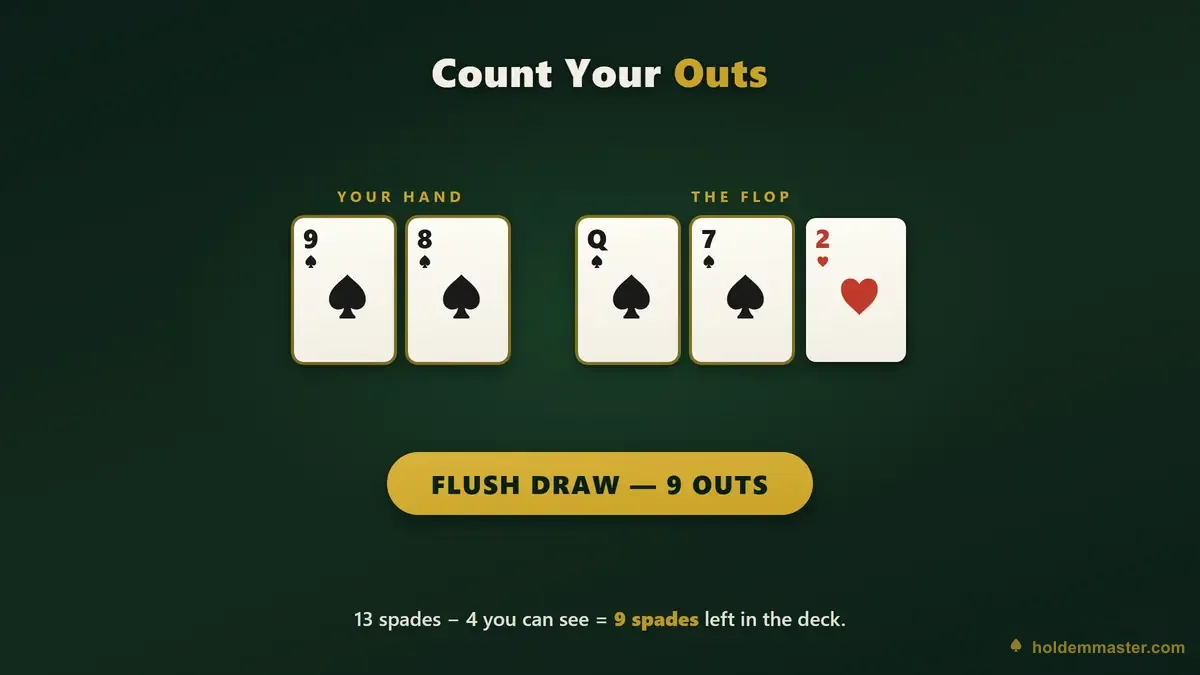
An out is any unseen card that improves your hand into a likely winner. A flush draw has 9 outs (13 of a suit minus the 4 you can see) — the suited board cards are already subtracted in that 9, so don't cross them off a second time as "dead cards". Convert outs to a rough win chance with the Rule of 4 and 2: multiply by 4 with two cards to come, by 2 with one.
A 9-out flush draw hits by the river about 35% of the time (9 × 4 = 36% as a quick estimate — the true figure is 35.0%). That figure counts both remaining cards, so it settles the call only when you'll actually see both — no more betting to come, as when you're all-in or have called an all-in and no one left in the hand can still bet. Facing a flop bet you'll have to pay again on the turn, count only the next card: 9 ÷ 47 = 19.1%. The full method — dirty outs, combo draws, exact percentages — is in the guide to counting outs, and the odds behind every draw live in the  probability chart.
Blockers (card removal)
A blocker is a card in your hand that reduces the combinations your opponent can hold. If the board shows three spades and you hold the A♠, your opponent cannot have the nut flush — you're holding the one card that makes it. That makes your bluffs far more credible, because the scariest hand they'd call with is impossible.
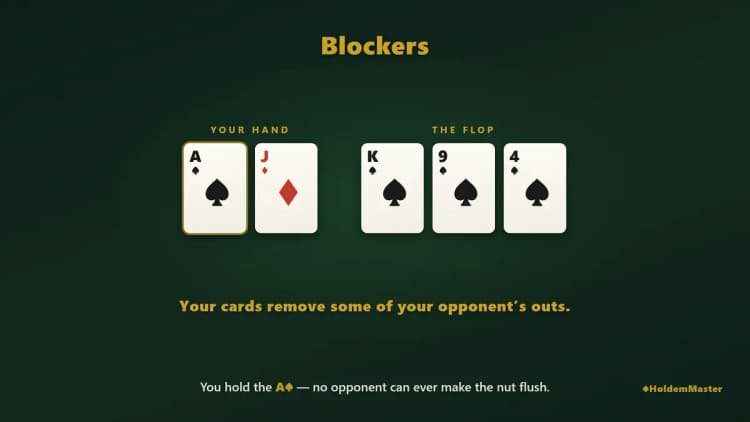
Blockers also work partially. On a Q-J-9 board, the nut straight is K-10. There are normally 16 ways to hold K-10 (4 kings × 4 tens); if you hold one king or one ten yourself, you knock that down to 12 combinations, so their range holds 25% fewer nut-straight combinations. This is the core of modern bluff selection — more in the guide to 3-betting and blockers.
Card removal & dead cards
Every card you can see removes possibilities. In Hold'em an out can't be sitting on the board — if it were, your hand would already be made — so the dead cards to track are the ones exposed off the board: a card flashed by mistake, a hand shown before it hit the muck, a neighbor's fold you happened to see. (One exception: a board card dealt too early is shuffled back into the stub and can still come.) Each out among them is one you no longer have; any other exposed card just shrinks the unseen deck. Adjusting for them is a constant, quiet habit good players keep on every street. It's counting, just not the kind that needs a running total.
Is Counting Cards Illegal in Poker?
No — counting outs and using blockers in your head is legal, ordinary poker skill, not outside assistance. The line to watch is devices and advice from others during play, and each room or event sets its own rules for those.
The blackjack comparison is about whom you play against. At a poker table, you compete with other players; the room charges for running the game rather than playing a hand against you. Mental out-counting is part of that game, not a reason by itself to treat you as a blackjack-style counter.
At tournaments using the 2026 Poker TDA rules ↗, Rule 5C bars operating electronic or communication devices with a live hand. Rule 5D goes further: betting apps, charts, and other strategy tools are not for use at the table, and outside strategy data is not permitted. Study with tools away from play; make the table decision yourself.
The Poker Family Where Traditional Counting Works: Seven Card Stud
In Seven Card Stud, a big chunk of every player's cards are dealt face up — so you genuinely can count the deck the old-fashioned way. If you need a specific card to complete your hand, you can look around the table and literally count how many of your outs are already showing in opponents' up-cards. Every one you spot is a dead out.
In Hold'em the only cards dealt face-up are the five shared community cards — everything else stays face-down unless it's shown at showdown, tabled in an all-in, shown voluntarily, or exposed by accident (a flashed card), so there is little to track. But Stud — and its relatives Razz and Stud Hi-Lo, which deal the same face-up cards — rewards exactly the kind of card-tracking that blackjack counters are good at. It's the closest poker gets to the movie version.
How to Start "Counting" in Your Next Session
You don't need a system — just three habits that turn visible cards into better decisions.
Count your outs on every draw
The moment you have a draw, count the cards that complete it and multiply — ×4 only when both cards are coming (you're all-in, or both the turn and the river are free), otherwise ×2 for the next card alone. Call when that chance — clean outs only — beats the price, or implied odds cover the gap
Ask what your hand blocks
Before you bluff, check whether you hold a card that makes their strongest calling hand impossible or less likely
Adjust for dead cards
Subtract any out you've seen exposed off the board — a flashed card, a shown hand, a fold you glimpsed. A card you have seen is out of the deck (it can't come on the board — unless it was a board card dealt too early and shuffled back into the stub — and no other player can be holding it) — but glimpsed by accident only: deliberately trying to see another player's cards is not part of this method — accidental exposure only
Do this for a few sessions and it becomes automatic — you'll be "counting cards" every hand, just the poker way. The next step is turning those counts into calls and folds with pot odds, the math that tells you whether your outs are worth the price.
FAQ
The 3 Things to Remember
1. Blackjack counting is dead in poker. The deck reshuffles every hand, too few cards show, and you play opponents, not the house — so tracking high and low cards earns you nothing. 2. Poker counting is outs, blockers, and dead cards. All mental math, all legal, and all far more valuable than a running count would be. 3. It's a skill, not a secret. Do the counting yourself and keep outside tools for study. Count your outs, ask what you block, and subtract the dead cards you've seen — every hand.
Start with the number that decides most hands: your outs. See the full method in the guide to counting outs, then turn those counts into profitable calls with pot odds.