
For a year I thought "equity" was just a fancy word for "how likely I am to win." Then I lost three big pots in a night where I was the favorite going in, and a better player told me the thing that reframed the whole game: your equity is what you're owed, not what you collect. You can be 40% to win a hand and realize almost none of it — or be behind and still print money. Understanding the gap between those is most of what separates winning players from hopeful ones.
Equity is the single number that ties every other piece of poker math together — outs, pot odds, position, and aggression all resolve into one question: what share of this pot is really mine? This guide covers what equity is, how to estimate it, and the three things nobody tells beginners: why you don't keep all of it, how a folding opponent hands you extra, and why your big hand shrinks against a crowd.
The raw win-percentages behind every hand come from the  poker odds and probability chart; this guide is how you turn those percentages into decisions at the table.
Equity at a glance
What Is Equity in Poker?
Equity is your share of the pot — the slice your hand is owed on average when the hand is played all the way to showdown, with split pots counted pro rata. If the pot is $100 and 60% of it is owed to you, your hand is worth $60 right now, even though the chips haven't been pushed yet.
Think of it as your slice of the pie. Every hand still live has a slice; the slices always add up to 100%. When you're heads-up with 70% equity in a $200 pot, $140 of it is "yours" in the long run — you won't win this pot 70% of the time and lose the rest, but across a thousand identical spots, that's the share you collect.
That's the whole reason equity matters: it turns "am I ahead?" into "how much of this pot do I own?" — and that's the number you compare against the price of a call.
How to Estimate Your Equity Fast
On a draw, multiply your clean outs by 4 on the flop (if you'll see both cards) or by 2 on the turn — that's your chance to hit, a fair stand-in for equity when hitting wins and missing loses; preflop, memorize the handful of matchups that come up again and again. You'll almost never compute exact equity at the table — you estimate, and these two shortcuts cover 90% of spots.
Draws (the Rule of 4 and 2): count your  outs, then multiply. A flush draw is 9 outs → 9 × 4 = 36% on the flop (true value 35%). The exact numbers for every draw live in drawing odds; here's the quick reference:
| Draw | Outs | Chance to hit (2 cards) |
|---|---|---|
| Flush + open-ender | 15 | 54.1% |
| Flush draw | 9 | 35.0% |
| Open-ended straight | 8 | 31.5% |
| Gutshot straight | 4 | 16.5% |
Preflop matchups (memorize these): all-in before the flop, the same fights repeat. Learn these and you'll instantly know your equity in most preflop all-ins. Every figure below counts split pots pro rata.
| Matchup | Equity | Type |
|---|---|---|
| AA vs KK | 82% / 18% | Overpair dominates |
| QQ vs AK | ~57% / ~43% | Pair edges the "race" |
| 22 vs AK | ~52% / ~48% | The true coin flip |
| AK vs AQ | ~74% / ~26% | Domination |
| 88 vs A7 | ~70% / ~30% | Pair vs one overcard |
Two things trip people up here. A pair against two overcards (QQ vs AK) is not a 50/50 — the pair is a modest favorite, around 57/43 offsuit (a touch tighter, ~54/46, when the AK is suited). Players call any pair-against-overcards race a "coin flip", but a low pair against two bigger cards, like 22 vs AK, is genuinely close to 50/50.
Equity vs Pot Odds: The One Rule That Decides Every Call
Call when your equity is bigger than your pot odds — that comparison is exact when no more betting follows.  Pot odds tell you the equity you need to break even; equity tells you what you have. If you have more than you need, calling makes money.
Facing a half-pot bet, your pot odds require 25% to call. If this call puts you all-in on the flop or lets you see both remaining cards without another payment, a clean flush draw's ~35% clears that price. If another bet can follow on the turn, the call buys only one card: 9 ÷ 47 = 19.1%, below 25% on the draw alone.
But here's the catch almost every guide skips: "your equity equals your pot share" is only true when there's no more betting. The moment more money can go in on later streets, a raw 35% doesn't automatically translate to 35% of the final pot — you might get blown off your draw, or pay off when you hit second-best. That gap is exactly where  implied odds (money you'll win later) and equity realization (below) come in. Equity is where the math starts, not where it ends.
Fold Equity: How You Win Pots When Your Hand Is Behind
Fold equity is the extra equity you gain from the chance your opponent folds — it's why a bet can win a pot your hand alone would lose. When you bet, you have two ways to win: your opponent folds now, or they call and you win at showdown. Checking only gives you the second one.
Heads-up, for a pure bluff with no chance to win when called and no further betting, the break-even is simple: you need your opponent to fold often enough to cover the risk. Betting $50 into a $100 pot, your break-even fold rate is bet ÷ (pot + bet) = 50 ÷ 150 = 33%. If they fold more than a third of the time, betting profits — even with the worst hand at the table.
Now add a draw. In this heads-up semi-bluff example, the pot is $100 and you shove your last $50 on the flop. Your opponent folds 40% of the time; when called, assume your clean flush draw has 35% equity. Both cards will be dealt with no further betting, so that two-card figure fits the calculation.
EV = (0.40 × $100) + (0.60 × [0.35 × $150 − 0.65 × $50])
EV = $40 + (0.60 × [$52.50 − $32.50]) = $40 + $12 = +$52
The shove is worth +$52 relative to giving up the pot, with $40 of that expectation coming from folds. This isolates fold equity's contribution; it does not compare the shove with every possible checking or calling line. Change the opponent's fold frequency or calling range and the EV changes too.
Equity Realization: Why 40% Equity Doesn't Mean You Win 40%
Equity realization is how much of your raw equity you actually collect — and it's usually less than 100%, because position and betting cost you. Your "40% to win" assumes you always reach showdown; in reality you get bet off draws, forced to fold, and pushed around out of position. What you keep is:
Realized equity = raw equity × realization%
A hand with 40% raw equity that only realizes 75% of it is really worth 0.75 × 40% = 30%. That's why you can be "ahead of your opponent's range" and still lose money — out of position you rarely get to cash in the full slice.
What moves your realization up or down:
Position
Acting last often helps you realize equity through information and pot control, but neither position guarantees a result above or below 100%. The ranges and board matter too
Playability
Suited connectors and hands that flop draws realize well; offsuit clunkers realize badly even with decent raw equity
Stack depth & skill
Deeper stacks make marginal equity harder to realize out of position (in position they often help you realize more); tougher opponents cut realization too
This is the single most important idea most beginner guides leave out, and it's why the  same hand plays completely differently by position. Raw equity is the starting point — what you'd bank if the chips went in right now; realization is what you actually take home. Position influences that gap alongside ranges, board texture, stack depth, and the way the hand is played.
All-In Equity: When Raw Equity Is All That Matters
Once no more betting can happen — at most one player left in the hand still has chips behind (heads-up with an all-in, or everyone else all-in) — you realize 100% of your equity, and raw equity becomes the final word. Every complication above (position, folding, getting bet off) disappears, because no more betting can happen. Whatever your raw equity is — your share of the pot, splits counted pro rata — that's exactly what you'll collect over time.
This is why preflop all-in equities matter so much: AA all-in against KK banks its full 82% — no realization tax, no fold equity, just the raw number playing out. It's also why a "coin flip" (22 vs AK at ~52/48) is a genuine near-tossup all-in, even though the same two hands played postflop would diverge wildly based on the board and who has position.
An all-in with no betting left is the cleanest spot in poker where, with cards still to come, the pie is sliced exactly as the math says — which is both its appeal and its danger.
Multiway Equity: Why Your Big Hand Shrinks Against a Crowd
Your equity drops fast in multiway pots, because the same 100% pie now gets split among more hands. Preflop against random hands, pocket aces are around 85% heads-up, but against three opponents that slides to ~64%, and against four to ~56% — still the best hand, but no longer the crush it feels like. Three-way, equity averages 33% by definition, because three players divide one pot.
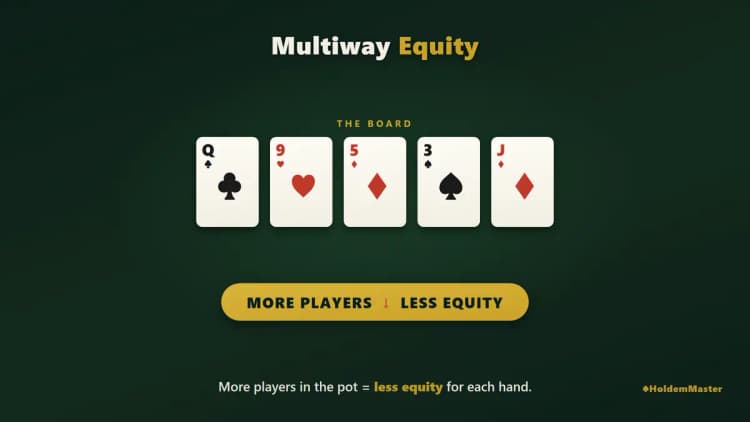
Two things get worse multiway, not just your raw share:
- •Fold equity collapses. To win a pot with a bet, now everyone has to fold — much less likely with three opponents than one. Bluffs and thin semi-bluffs lose value fast.
- •Realization drops. More players left to act means more bets and raises that can push you off your hand before showdown, so you realize even less of an already-smaller slice.
Putting It Together: How Pros Actually Use Equity at the Table
Good players don't compute exact equity — they run a fast four-step estimate that layers realization and fold equity on top of the raw number. Here's the thought process, in the order it actually happens:
Estimate raw equity
Outs × 4 or × 2 for draws; recall the matchup preflop
Discount for realization
Out of position or hard to play? Shave it down — 40% raw might be 30% real
Add fold equity
If you're betting, how often does villain fold? That's extra equity your hand alone doesn't have
Compare to the price
Calling? Realized equity vs your pot odds. Betting? How often villain folds vs the break-even fold rate — bet ÷ (pot + bet) for a pure bluff, lower when your hand still has equity if called → call, bet, or fold
The night I mentioned at the top, I was making step one and stopping — counting my raw equity and ignoring that out of position, against a good player, I'd never realize it. Once I started discounting for position and thinking about their folds instead of just my cards, the leaks closed. Equity isn't a number you look up; it's a lens you run every decision through.


FAQ
The 3 Things to Remember
1. Equity is your share of the pot — equity% × pot size. Call when it beats your pot odds. That comparison is the backbone of every decision. 2. You rarely keep all of it. Realized equity = raw × realization%, and position, ranges, and board texture all move it. Raw equity is the starting point, not the payout. 3. Aggression manufactures equity. Fold equity lets a bet win pots your hand would lose — but it collapses multiway, where you need everyone to fold.
Master this and the rest of poker math clicks into place. From here, turn equity into correct calls with the pot odds guide, or see how deep stacks change the picture with implied odds.