The hand that finally taught me what a kicker is cost me a full buy-in. I had A♠ 9♣, the board paired my ace, and I shoved thinking top pair was gold. He flipped A♥ K♦ — same pair of aces, but his king outkicked me, and the pot slid his way. I hadn't lost to a better hand; I'd lost to a better side card. That side card is the kicker, and it decides more pots than any beginner realizes.
A kicker is the tiebreaker built into poker itself — when two players hold the same rank, the highest leftover card wins. Most guides give you a one-line definition and an AK-vs-AQ example. This one gives you the full picture: exactly which hands have a kicker (and how many), the one exception everyone gets wrong, and why "playing the board" means your kicker suddenly doesn't matter at all.
Where a kicker fits in the bigger picture of  poker hand rankings is simple: it only comes up after two players tie on rank — it never beats a higher-ranked hand.
Kickers at a glance
What Is a Kicker in Poker?
A kicker is the highest card in your five-card hand that isn't part of your ranked combination — it settles the winner when two players share the same rank. It's also called a "side card." In Hold'em a hand is always five cards (your best five out of seven), so once your pair or trips is locked in, the remaining slots are filled by kickers.
The key idea: a kicker never beats a higher-ranked hand. A pair of kings with a deuce kicker still crushes a pair of tens with an ace kicker — rank first, kicker only as a tiebreaker. Kickers only matter when the ranks are identical: pair vs. the same pair, trips vs. the same trips.
Say you hold A-K and your opponent holds A-Q, and the board pairs an ace. You both have "a pair of aces" — identical rank. Now the side cards decide, and your king outkicks their queen. Nobody made a better hand; the kicker just did its quiet job.
Which Poker Hands Have a Kicker — and Which Don't
Only hands that use fewer than five cards for their combination have kickers — everything that fills all five cards on its own has none. This is the table competitors bury in paragraphs. Here it is at a glance:
| Hand | Has a kicker? | Kicker cards |
|---|---|---|
| High card | Yes — all five compared in order | 4 |
| One pair | ✅ Yes | 3 |
| Two pair | ✅ Yes | 1 |
| Three of a kind | ✅ Yes | 2 |
| Four of a kind | ✅ Yes (rarely matters) | 1 |
| Straight | ❌ No | — |
| Flush | ❌ No* | — |
| Full house | ❌ No | — |
| Straight flush / Royal flush | ❌ No | — |
The logic is pure arithmetic: combination cards + kickers always equal five. One pair uses 2 cards, so 3 kickers fill the rest. A straight, flush, full house, or straight flush already uses all five, so there's nothing left to kick with — two straights or two full houses are settled by the ranks inside them, not by a side card.
*Flushes are the asterisk: technically a flush has no "kicker." When two flushes clash, you compare all five cards highest-to-lowest (an ace-high flush beats a king-high flush). People loosely call the top card a "kicker," but strictly it's a five-card high-card comparison. Full tie-break order for every hand lives in  how ties are broken in poker.
How Many Kickers Does Each Hand Use?
High card uses four kickers, one pair three, three of a kind two, and two pair and four of a kind just one. Knowing the count tells you exactly how deep a tiebreaker can run — and which hands can never be separated by a side card at all.
| Hand | Combination | + Kickers | = 5 cards |
|---|---|---|---|
| High card | 1 | 4 | ✅ |
| One pair | 2 | 3 | ✅ |
| Three of a kind | 3 | 2 | ✅ |
| Two pair | 4 | 1 | ✅ |
| Four of a kind | 4 | 1 | ✅ |
This matters at showdown because kickers are compared in order, highest first. With one pair, if the first kickers tie, you move to the second, then the third. Two players can hold the same pair and the same top kicker and still get separated by the third card — which is exactly why "my kicker was good" isn't always good enough.
AK vs AQ: How a Kicker Decides the Winner
Let's run it card by card so the mechanic is concrete.
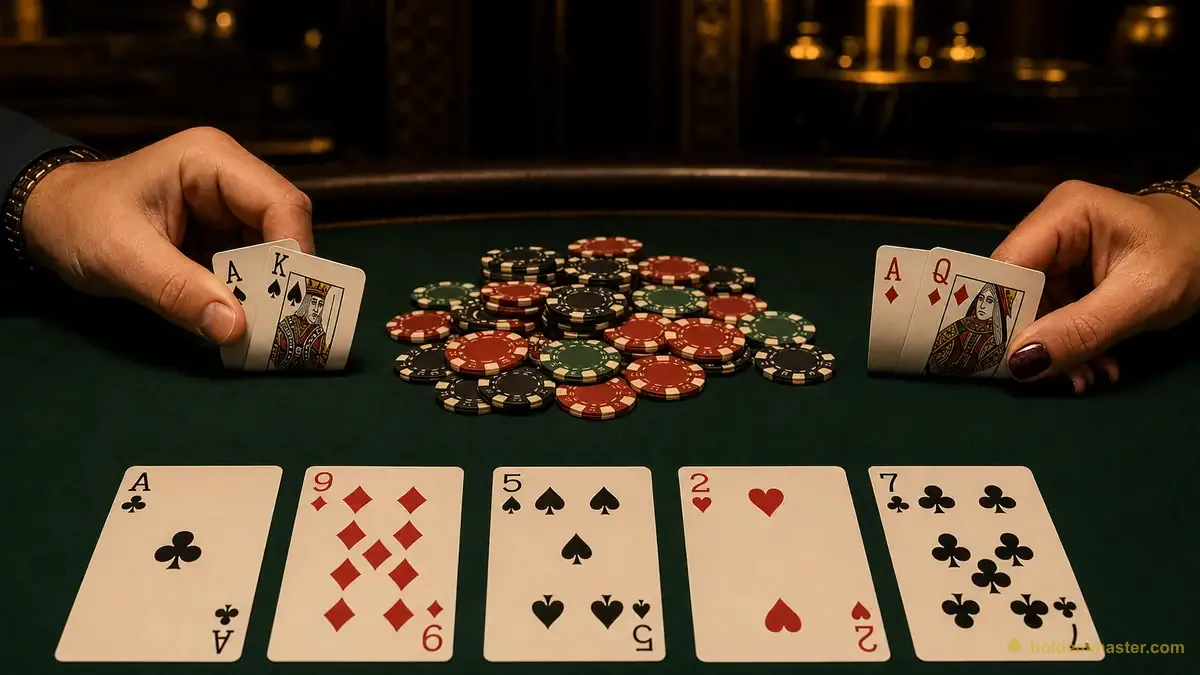
The board is A♣ 9♦ 5♠ 2♥ 7♣. You hold A♠ K♠, your opponent holds A♦ Q♦.
- •You: A♠ K♠ + board → a pair of aces. Best five = A♠ A♣ K♠ 9♦ 7♣ (pair of aces, kickers K-9-7).
- •Opponent: A♦ Q♦ + board → also a pair of aces. Best five = A♦ A♣ Q♦ 9♦ 7♣ (kickers Q-9-7).
Playing the Board: When Your Kicker Doesn't Play
If your hole cards can't improve on what the five community cards already make, you're "playing the board" — and your side cards stop deciding anything. Everyone who can't improve on it uses the identical five cards — and if nobody can, the pot is split.
The board is 10♠ J♦ Q♣ K♥ A♠ — a made ten-to-ace straight (Broadway), in mixed suits so no flush is possible.
- •You hold 2♣ 3♦. Your best five is the board straight; the 2 and 3 add nothing.
- •Your opponent holds 4♥ 5♦. Same story — the board straight is their best five too.
Why Does A9 Lose to AK? (The Dominated Ace)
A hand is "dominated" when it shares a card with a stronger hand and will lose the kicker battle nearly every time it connects — the classic trap is a weak ace like A9 against AK. This is where kickers stop being trivia and start costing money.
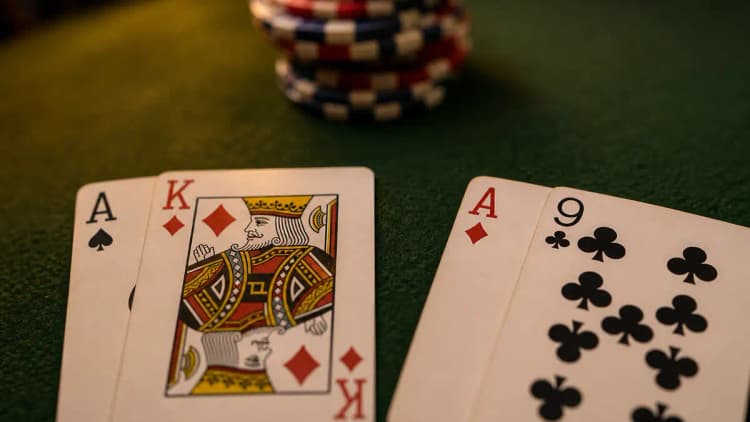
Back to my buy-in. Board A♦ 7♣ 2♥ Q♠ 4♦, no straight or flush out there.
- •A9: A♠ 9♣ → pair of aces, best five A♠ A♦ Q♠ 9♣ 7♣.
- •AK: A♥ K♦ → pair of aces, best five A♥ A♦ K♦ Q♠ 7♣.
 starting hands chart treats A9 offsuit so much more cautiously than AK — the kicker is the difference between a premium hand and a trap.
Does Four of a Kind Have a Kicker?
Yes — four of a kind has a one-card kicker, but it almost never decides a hand in Hold'em: that would take two players tied on the very same quads, which requires all four cards to sit on the board — a rare runout. This is the exception most guides fumble by lumping quads in with "five-card hands that have no kicker."
The math is clear: four cards make the quad, one card is the kicker. It only matters when two players somehow tie on the same four of a kind — which in Hold'em requires all four to sit on the board (since there are only four of each rank). If the board is 5♠ 5♥ 5♦ 5♣ K♦, everyone has quad fives, and the fifth card is the kicker: a player holding an ace plays 5-5-5-5-A and beats a player who takes the board's 5-5-5-5-K. Rare, but real — and being right about the edge cases is what separates a trustworthy guide from a hand-wavy one.


FAQ
The 3 Things to Remember
1. Kicker = side card, tiebreaker only. It settles ties between equal ranks and never beats a higher-ranked hand. 2. Combination + kickers = five. High card has 4 kickers, one pair 3, trips 2, two pair and quads 1; straights, flushes, full houses, and straight flushes have none. 3. Kickers decide real money. Domination (A9 vs AK) and playing the board both come down to the kicker — pick hands with strong side cards and know when yours is dead.
Get the kicker right and a whole category of "how did I lose that?" hands stops being a mystery. From here, see the full poker hand rankings order, or the complete tie-breaking rules for every hand type.