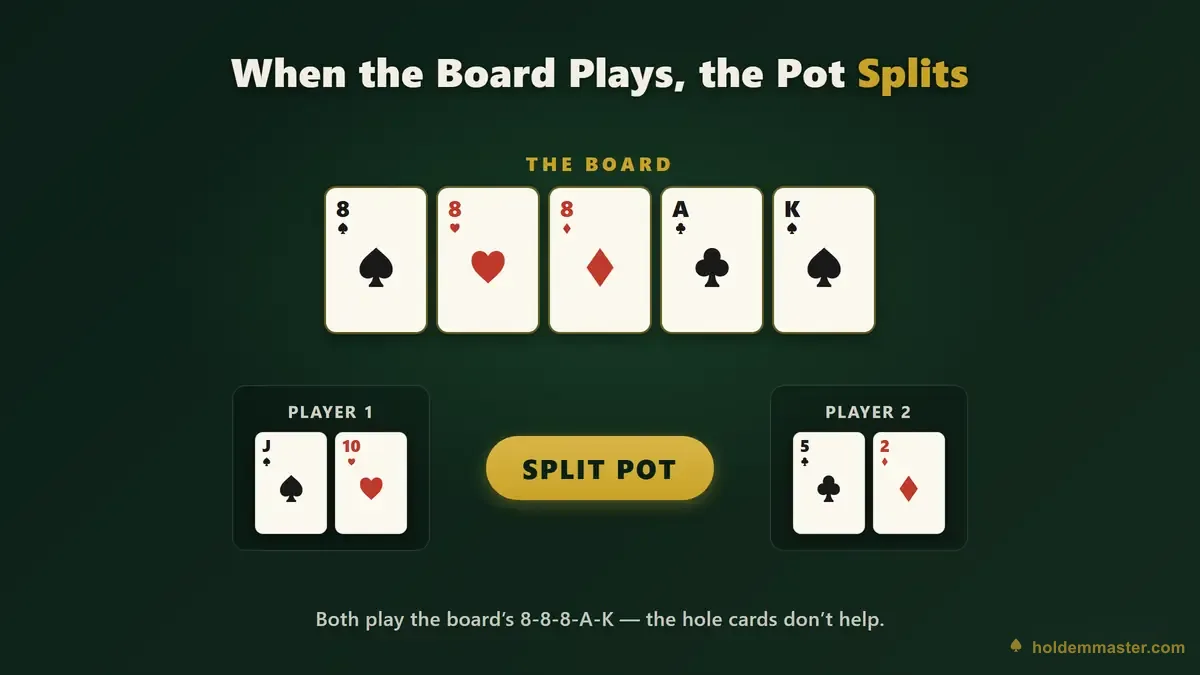
Early in my poker days I led every street — raised preflop, bet the flop and turn, got called on the river. I flipped over J♠ 10♥. My opponent turned over 5♣ 2♦. "I win, right?" The dealer said nothing and pointed at the board: 8♠ 8♥ 8♦ A♣ K♠. Neither of our hole cards beat trip eights with an ace-king kicker, so the dealer quietly cut the pot in half.
Getting half a pot you were sure you'd won is jarring. But split pots follow clear rules — and they answer the question new players ask most: can you tie in poker? Yes. Here is every way it happens.
✦ Quick answer
A pot is split (also called a chop) when two or more players have the identical best five-card hand at showdown. The chips are divided equally. Suits never break the tie, and any leftover odd chip goes to the first tied player left of the dealer button.
The core numbers
What Is a Split Pot in Poker? (And Is a "Chop" the Same Thing?)
A split pot happens when two or more players have the identical best five-card hand at showdown, so the dealer divides the chips equally between them. A chop — or a "chopped pot" — is the exact same thing in table slang ("we're chopping"). Rulebooks say split; players say chop. People search both, so you'll see them used interchangeably.
The foundation: your hand is always the best five cards out of seven — your two hole cards plus the five on the board. Where every five-card hand ranks is covered in the  complete poker hand rankings. When two players' best fives are identical in rank, neither is "more" of a winner — the pot splits, full stop.
Can You Tie in Poker? The 5 Situations That Split the Pot
Yes — ties are a normal, legal outcome in Texas Hold'em, and they're more common than beginners expect. Because everyone shares the same five community cards, two players often arrive at the same best five. These are the five ways it happens.
1. Identical best five cards
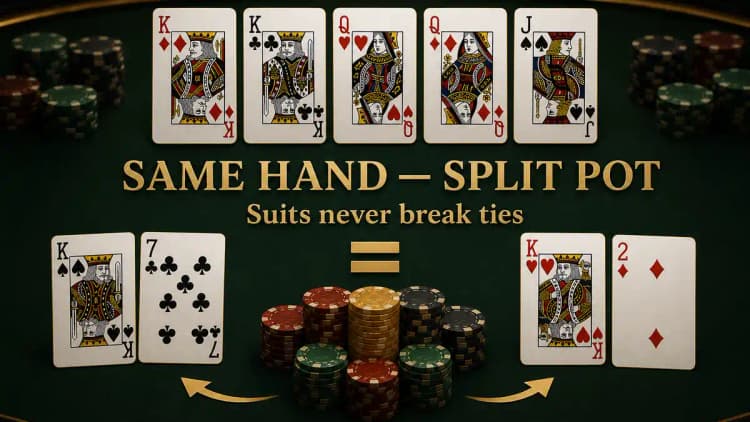
Two players make the exact same five-card hand — same ranks, even if their hole cards differ in suit.| Player A | Player B | |
|---|---|---|
| Hole | K♠ 7♣ | K♥ 2♦ |
| Board | K♦ K♣ Q♥ Q♦ J♠ | (same) |
| Best five | K-K-K-Q-Q | K-K-K-Q-Q → split |
Both make the full house KKK-QQ from the board plus a king. The suits of those kings don't matter.
2. The board plays
The five community cards are already the strongest hand for everyone left — that's the 8-8-8-A-K pot from my story. It's common enough to get its own section below.3. The same straight
Two straights with the same top card tie, regardless of suit. On a board of 7♣ 6♦ 5♥ K♠ 2♣, both A's 9♠ 8♠ and B's 9♥ 8♦ make 9-8-7-6-5 — same height, so split.4. The same flush
There's no suit ranking, so two flushes with the same five ranks tie. In practice this almost always means the board itself is a five-card flush. On K♠ J♠ 8♠ 4♠ 2♠, if A holds A♥ Q♦ and B holds 10♥ 9♦, neither has a spade — both play the board's K-J-8-4-2 flush and chop.But check before you assume: any spade in your hand higher than the board's lowest spade improves the flush. Here even the humble 3♠ makes K-J-8-4-3 and wins the whole pot — and A♠ makes the nut flush.
5. Identical down to the last kicker
Pairs and two pairs are usually decided by kickers — but if the kickers match too, it's a split. Board A♦ Q♠ 9♣ 6♥ 2♠ with A♠ K♦ vs A♥ K♣ gives both players A-A-K-Q-9 → split. When the kickers differ, the higher one wins outright — exactly how that comparison works, hand by hand, is in the tie-breaker and kicker rules.
Can Two Players Win the Same Pot? When the Board Plays
Yes — and it doesn't even take two monster hands. When the five community cards already form the best possible five for everyone still in, the board plays and every remaining player shares the pot, whether that's two players or five.
That's my 8-8-8-A-K hand: my J♠ 10♥ and his 5♣ 2♦ both played the board's trip eights with ace-king kickers — identical fives, a chop once both hands were tabled. The extreme case is a board like A♠ K♠ Q♠ J♠ 10♠ (a royal flush): no hole cards can improve it, so everyone left chops.
The check: does your best five — using at least one hole card — beat the board's own five? If yes, you play your hand. If not, the board plays and you're likely chopping. The full method for scanning a board this way is in how to read the board and find your best 5.
And the part that matters most at the table: your hand only wins if you turn it face up. A mucked hand is dead even when it would have chopped — when you're playing the board you must still show your hole cards face up, or you forfeit your share of the pot (WSOP live-action Rule 172; the WSOP tournament rules repeat it in Rule 75). Who shows first and how the sequence runs is covered in the showdown rules.
3 Things That Never Break a Tie in Poker
These are the misconceptions behind most "wait, why is it a split?!" arguments.
❌ "My suit is higher, so I win"
A spade flush does not beat a heart flush. Texas Hold'em has no suit ranking — identical ranks split, full stop. (This trips up players coming from games that do rank suits.)❌ "My hole cards are higher, so I win"
Board 9♠ 8♦ 7♣ 6♥ 5♠ — a made straight. You hold A♠ K♦; your opponent holds 2♣ 3♥. Split. Both of you play the board's 9-8-7-6-5, because your big hole cards never enter the best five. A high hole card only matters when it actually plays as a kicker — what a kicker is and when it plays draws that line precisely.❌ "I used both my cards and they used one"
How many hole cards you use is irrelevant. The only thing that counts is the strongest five of seven. If both players land on the same best five, it's a chop no matter how you got there.Who Gets the Extra Chip? The Odd Chip Rule
Sometimes a pot won't divide evenly — a 101-chip pot between two players is 50 each with one chip left over, and there are no half-chips. Before that last chip is pushed to anyone, the dealer breaks it down into the smallest denomination in play (TDA Rule 20): if 5s are the smallest chips on the table, a lone 25 becomes five 5s, which divide again, and only the chip that still won't divide is the "odd chip." Then the standard rule:
The leftover odd chip goes to the first tied player left of the dealer button (the earliest winning seat clockwise from the button).
In a three-way split with two odd chips, the two earliest seats clockwise each get one. House rules can vary — a few card rooms award the odd chip by high card or suit instead — so if real money rides on it, ask the floor. Online, the software assigns it automatically by position.
Do Side Pots Split Too? Ties When Someone Is All-In
When someone is all-in, the chips form a main pot (everyone is eligible) plus one or more side pots (only the deeper stacks who kept betting). Each pot is awarded — or chopped — separately, based on the best hand among that pot's eligible players.
A worked example: A is all-in for 100; B and C each put in 300. That's a main pot of 300 (100 × 3) and a side pot of 400 (200 + 200, B and C only). The board runs A♦ J♥ 7♠ 4♣ 2♥:
| Player | Hole | Best five | Result |
|---|---|---|---|
| A (all-in) | A♠ Q♦ | A-A-Q-J-7 | chops main pot → 150 |
| B | A♣ Q♥ | A-A-Q-J-7 | chops main (150) + wins side (400) |
| C | K♦ K♠ | K-K-A-J-7 | loses both → 0 |
A and B tie with aces and identical kickers, so they split the main pot; the side pot is contested only by B and C, and B's aces beat C's kings outright. An all-in player can only ever win or chop the pots they actually contributed to. How those pots get built in the first place — capping, re-raise eligibility, showdown order — is covered in the all-in rules and side pots guide.
Is the Pot Ever Split Half High, Half Low?
Not in Texas Hold'em. You may have heard of "split-pot games" like Omaha Hi-Lo or Stud Hi-Lo, where the pot is designed to split between the best high hand and the best qualifying low hand (eight-or-better) — and the high hand scoops when no low qualifies. That's a different game family. Standard Hold'em is high-only — the pot splits only when best five-card hands genuinely tie.

FAQ
The Takeaways
1. Yes, you can tie in poker — a pot splits (chops) whenever two or more players share the identical best five of seven. 2. Suits, higher hole cards, and how many cards you used never break a tie. 3. The odd chip goes to the first tied player left of the button, and side pots are settled separately from the main pot.
Brush up on the order in the complete hand rankings, master close hands in the kicker and tie-breaker guide, and settle the classic argument in does a flush beat a straight.