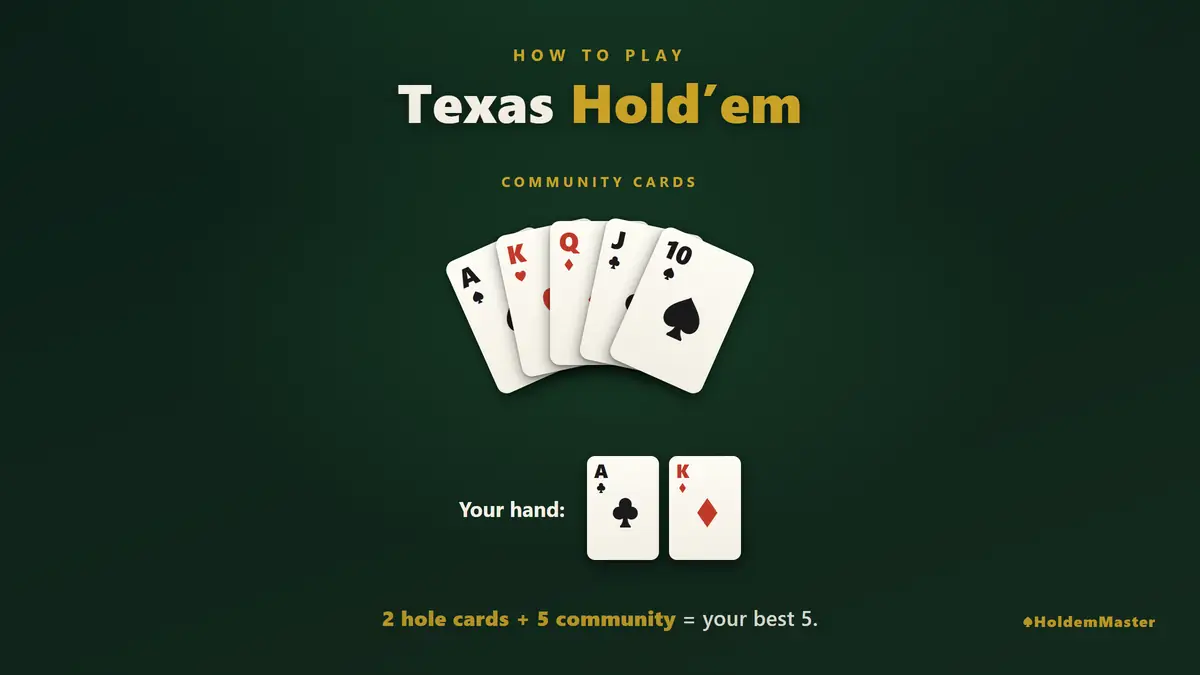
If you searched for Texas Hold'em rules for beginners, you probably do not need a casino rulebook yet.
You need to know what the blinds are, when it is your turn, how the five community cards work, which hand wins, and how many chips to give everyone when playing at home.
This guide explains how to play Texas Hold'em for beginners in plain English, with the exact order of play, beginner chip setup, dealing basics, and a printable cheat sheet you can keep beside the table.
Everything below comes from actually running the game — kitchen tables, home games, and card rooms — not just the rulebook, so I'll point out the exact spots where new players trip up in real life.
How to play Texas Hold'em in 30 seconds
1. Two players post blinds (forced bets) 2. Everyone gets 2 hole cards face-down 3. Bet, call, raise, or fold — preflop 4. Dealer reveals 3 community cards (the flop) → bet again 5. Dealer reveals 1 more card (the turn) → bet again 6. Dealer reveals the final card (the river) → last betting round 7. Remaining players compare hands — best 5-card hand wins
Key facts:
- •You can use both hole cards, one, or even zero — whichever makes the best hand
- •The dealer button rotates every hand, so blinds and action order shift each round
- •You win without showdown if everyone else folds at any point
Texas Hold'em Basic Rules
The basic rules of Texas Hold'em are simple once you see the table in order.
Every hand starts with a dealer button. The two players to the left of the button post forced bets called the small blind and big blind — if those feel confusing, see what blinds are and how the small and big blind work. Then every player receives two cards face down. These are your hole cards.
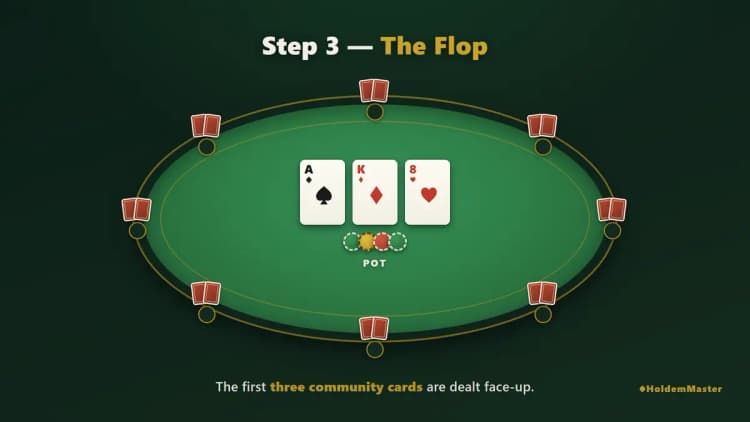
After that, the dealer reveals five shared cards in the middle of the table:
| Stage | Cards revealed | What happens |
|---|---|---|
| Preflop | 0 community cards | Players act using only their 2 hole cards |
| Flop | 3 community cards | First shared cards appear |
| Turn | 1 more card | Fourth community card appears |
| River | 1 final card | Fifth community card appears |
| Showdown | No new cards | Remaining players compare best 5-card hands |
You do not need to use both of your hole cards. You can use two, one, or even zero hole cards if the board itself makes the best hand — a skill called reading the board.
For example:
| Your cards | Board | Your best hand |
|---|---|---|
| A♠ K♠ | A♦ 7♣ 7♥ 2♠ 9♣ | Two pair, aces and sevens |
| 8♠ 8♦ | K♣ 8♥ 4♠ 4♦ J♣ | Full house, eights full of fours |
| 2♣ 3♦ | A♠ K♠ Q♠ J♠ 10♠ | Royal flush on the board |
How to Play Texas Hold'em — Beginner Flow Summary
This article gives you the beginner version of the flow so you can sit down without freezing. If you want a deeper street-by-street walkthrough with one full hand, betting order, and examples, read  Texas Hold'em order of play next.
| Order | Stage | What beginners should remember |
|---|---|---|
| 1 | Dealer button | Sets blinds and action order |
| 2 | Small blind / big blind | Forced bets before cards are dealt |
| 3 | Two hole cards | Private cards only you can see |
| 4 | Preflop | Action starts left of the big blind |
| 5 | Flop, turn, river | Community cards come 3, then 1, then 1 |
| 6 | Showdown | Remaining players compare the best 5-card hand |
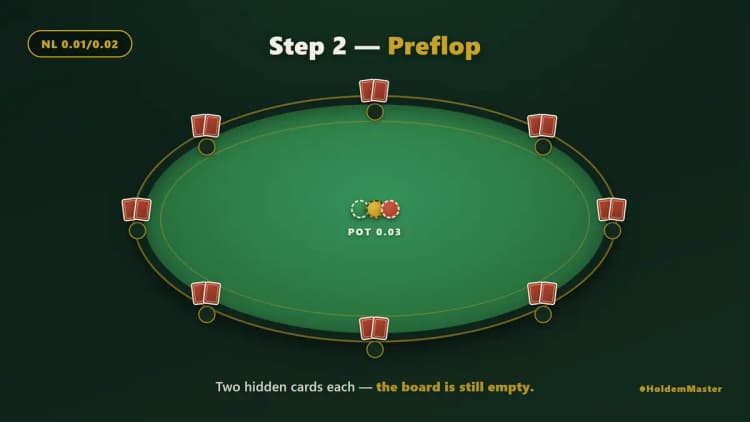
For the detailed version, continue with Texas Hold'em order of play from blinds to showdown.
How Many Players Can Play Texas Hold'em?
Texas Hold'em works with anywhere from 2 to 10 players at one table. You do not need a full table to start — you just need at least two people.
| Players | What it's called | Beginner notes |
|---|---|---|
| 2 | Heads-up | Fast and aggressive; blinds are reversed (see below) |
| 3–6 | Short-handed (6-max) | Most common online; more hands are playable |
| 7–10 | Full ring (9-max) | Classic home/casino game; play tighter, more folding |
When only two players are left (or you start with two), that is called heads-up. The rules are the same with one twist: the button posts the small blind and acts first before the flop, but the big blind acts first on the flop, turn, and river. That reversal keeps the game fair when one player would otherwise always act last.
The number of players also shifts your strategy — the more opponents, the more likely someone has a strong hand, so you fold weaker holdings. If you are deciding between a casual ring game and a competitive format, see cash game vs tournament.
Who Goes First in Texas Hold'em?
This is one of the most common beginner questions because the answer changes after the flop.
| Round | First player to act | Why |
|---|---|---|
| Preflop | Player left of the big blind | The blinds already posted forced bets |
| Flop | First active player left of the button | Button acts last after the flop |
| Turn | First active player left of the button | Same postflop order |
| River | First active player left of the button | Same postflop order |
Before the flop, look left of the big blind. After the flop, look left of the button.
That is why the button is such a powerful position. The button usually acts last on the flop, turn, and river, which means they get to see what everyone else does first. For a full breakdown of every seat name — UTG to button, 6-max vs 9-max, and what opening range each spot allows — see the poker positions guide.
What Chips Do You Start With in Texas Hold'em?
In a casino, the chip values are already defined. In a home game, you choose the chip setup yourself.
For beginners, keep the numbers simple. You do not need five different chip colors. Three or four colors are enough.
| Home game type | Suggested starting stack | Example blinds |
|---|---|---|
| Very casual learning game | 100 chips | 1 / 2 |
| Standard home cash game feel | 200 chips | 1 / 2 or 2 / 4 |
| Longer tournament-style night | 1,000 to 2,000 chips | 10 / 20 |
| Chip color | Value | Chips per player | Total value |
|---|---|---|---|
| White | 1 | 20 | 20 |
| Red | 5 | 16 | 80 |
| Blue | 25 | 4 | 100 |
| Total | 40 chips | 200 |
With 200 chips and 1/2 blinds, every player starts with 100 big blinds. That gives beginners enough room to fold, call, raise, and see flops without going broke too quickly.
How Much Money Do You Start With in Texas Hold'em?
The answer depends on whether you are playing for real money or just practicing.
If you are learning, use play chips first. The goal is to understand the order of the game, not to create pressure.
If you are playing a small home cash game, choose a buy-in that everyone is comfortable losing. A common beginner structure is:
| Blind level | Beginner buy-in | Notes |
|---|---|---|
| $0.01 / $0.02 | $2 to $5 | Best for learning with real stakes |
| $0.05 / $0.10 | $10 to $20 | Still small, but decisions feel real |
| $0.10 / $0.25 | $25 to $50 | Better after players know the rules |
Note that a tournament buy-in works differently from a cash game: you pay one fixed entry, get a set stack of non-cashable chips, and play until one player has them all. If you are unsure which you want, read cash game vs tournament first.
For online practice, use free tables until you can explain the action order without thinking. Then move up slowly.
No-Limit, Limit, or Pot-Limit? Which Texas Hold'em Are You Playing?
When people say "Texas Hold'em," they almost always mean No-Limit Hold'em (NLHE) — the format used in the WSOP Main Event and nearly every home game. The dealing, blinds, and hand rankings are identical across all three formats. The only thing that changes is how much you are allowed to bet.
| Format | How much can you bet? | Where you'll see it |
|---|---|---|
| No-Limit (NLHE) | Any amount from the big blind up to all your chips ("all-in") | Default game — home games, most casinos, WSOP |
| Fixed-Limit | Only fixed increments (a set small bet, then a double bet on turn/river) | Older casino tables; fewer big swings |
| Pot-Limit | Up to the current size of the pot | Rare for Hold'em; standard for Omaha (PLO) |
How to Deal Texas Hold'em
You do not have to deal perfectly like a casino dealer, but you should follow a clean order.
Here is the beginner-friendly dealing sequence:
1. Shuffle the deck. 2. Place the dealer button. 3. Small blind and big blind post their chips. 4. Deal one card at a time clockwise, starting left of the button. 5. Deal a second card to each player the same way. 6. Run the preflop betting round. 7. Burn one card, then deal the flop. 8. Burn one card, then deal the turn. 9. Burn one card, then deal the river. 10. At showdown, compare the best five-card hands.
The burn card is the top card placed face down before the flop, turn, and river. It helps protect the deck and is standard in live poker.
In a casual home game, the most important thing is consistency. Announce the street, keep the board clear, and do not rush action while someone is deciding.
Position in Texas Hold'em — Why Where You Sit Changes Everything
Position means when you act in each betting round. Acting later means you have seen what other players do first — and that information is worth more than most beginners realize.
| Seat | Name | Preflop order (9-max) | Key point |
|---|---|---|---|
| Early position | UTG (Under the Gun) | 1st | Most players still to act — play tightest |
| Middle | MP / HJ | 4th–5th | Moderate range, still cautious |
| One right of BTN | CO (Cutoff) | 6th | Second-best seat — widen range |
| Last post-flop | BTN (Button) | 7th pre; last post | Best seat — acts last every postflop street |
| Left of dealer | SB (Small Blind) | 8th pre, 1st post | Worst seat — acts first every postflop street |
| Two left of dealer | BB (Big Blind) | Last pre (9th), 2nd post | Has option to raise preflop; out of position postflop |
Texas Hold'em Strategy for Beginners
Once the rules make sense, your first strategy should be boring and solid.
Most beginners lose chips because they play too many hands, chase weak draws, or call just because they are curious. Your first goal is not to bluff everyone. Your first goal is to stop donating chips.
| Beginner rule | Why it works |
|---|---|
| Play fewer weak hands | Bad starting hands create hard decisions |
| Raise strong hands | Strong hands should build bigger pots |
| Fold more from early position | Too many players act after you |
| Respect big river bets | Beginners under-bluff many river spots |
| Do not chase every draw | A draw needs the right price to continue |
Good beginner starting hands include:
Beginner Starting Hand Chart — 4 Tiers
| Tier | Hands | When to play |
|---|---|---|
| 🟥 Premium — always raise | AA, KK, QQ, JJ, AKs, AKo | Every position, every stack |
| 🟧 Strong — usually raise | TT, 99, AQs, AQo, AJs, KQs | Most positions; tighter from UTG |
| 🟦 Playable — position matters | 88, 77, ATs, AJo, KJs, QJs, JTs | Prefer late position (CO, BTN) |
| ⬜ Fold by default | Everything else as a beginner | Especially from early position |
For a full 169-hand chart organized by position (UTG to button), see the Texas Hold'em starting hands chart by position. And before you can use starting hands correctly, you need to know your betting actions — check, call, raise, fold.
Pot Odds — The One Math Concept That Saves Beginners Money
You do not need to be a math expert. You just need to understand one question before calling a bet: is the price I'm paying worth the chance I have to win?
How pot odds work (one example)
Imagine the pot is $100 and your opponent bets $20. To stay in the hand, you must call $20. Before your call the pot is $120 — after it, $140.
Your pot odds are $120 to $20, or 6 to 1. That means you need to win at least 1 in 7 times (about 14%) for this call to be profitable.
The Rule of 2 and 4 — instant probability shortcut
When you have a drawing hand (e.g. four cards to a flush), count your outs — the cards that will complete your hand.
| Situation | Formula | Example (9 flush outs) |
|---|---|---|
| On the flop, seeing both remaining cards with no further bet (e.g. all-in) | Outs × 4 | 9 × 4 = ~36% chance |
| On the turn (1 card to come) | Outs × 2 | 9 × 2 = ~18% chance |
⚠ The ×4 rule only holds if you will not have to pay another bet before the river — in practice, almost only when you are all-in. If you call a bet on the flop and must decide again on the turn, count one card: 9 outs are then 9 ÷ 47 = ~19%.
If your percentage chance of winning is higher than the percentage the pot odds require, the call is profitable — use the number that matches your price: for a single call on the flop that is the one-card figure (9 ÷ 47 = ~19%), not the ×4 number. If it is lower, fold.
This is the single most important math concept for beginners. Master it and you will automatically avoid half of the expensive mistakes new players make.
Printable Texas Hold'em Rules Cheat Sheet
This is the quick version to keep beside the table. You can copy it into your notes, print the page, or use the shared English PDF before a home game.
| Topic | Beginner answer |
|---|---|
| Cards per player | 2 private hole cards |
| Community cards | 5 shared board cards |
| Best hand | Best 5-card poker hand |
| Betting rounds | Preflop, flop, turn, river |
| Forced bets | Small blind and big blind |
| First preflop action | Left of the big blind |
| First postflop action | First active player left of the button |
| Button advantage | Usually acts last after the flop |
| Winning without showdown | Everyone else folds |
| Winning at showdown | Best 5-card hand wins |
| Rank | Hand | Approximate frequency |
|---|---|---|
| 1 | Royal flush | 0.003% — may go years without seeing one |
| 2 | Straight flush | 0.03% — extremely rare |
| 3 | Four of a kind | 0.17% — rare; bet it hard |
| 4 | Full house | 2.6% — strong and common enough to expect |
| 5 | Flush | 3.0% — solid winner most boards |
| 6 | Straight | 4.6% — vulnerable to flushes/full houses |
| 7 | Three of a kind | 4.8% — good hand, but board matters |
| 8 | Two pair | 23.5% — most common "strong" hand |
| 9 | One pair | 43.8% — the most frequent hand at showdown |
| 10 | High card | 17.4% — weakest hand at showdown; usually wins only when everyone else missed too |
Common Beginner Mistakes
After years of hosting home games, I see the same five mistakes at almost every beginner table — and none of them are about strategy. They come from not yet trusting the rules.
Mistake 1: Thinking you must use both hole cards
You can use both, one, or none of your hole cards. The best five-card hand wins.
Mistake 2: Forgetting that action order changes
Preflop starts left of the big blind. After the flop, action starts left of the button. The first home game I dealt, two players kept acting out of turn on every flop — we set a physical dealer button on the table, and the confusion disappeared within one orbit.
Mistake 3: Calling because "it might come"
Draws need the right price. If the pot is small and the bet is huge, chasing a weak draw is usually expensive.
Mistake 4: Playing any ace
A♣4♦ looks exciting to a beginner — I've watched more new players lose chips with a weak ace than with almost any other hand — but weak aces often make second-best one-pair hands. Big aces like AK and AQ are much stronger.
Mistake 5: Ignoring position
Hands are easier to play when you act later. If you are first to act, you need stronger hands because everyone else still has information advantage.

FAQ
Final Takeaway
Texas Hold'em is easier to learn when you separate rules from strategy.
First, learn the flow: blinds, two hole cards, five community cards, four betting rounds, and best five-card hand. Then learn position, starting hands, and basic pot decisions.
For your next step, review Texas Hold'em hand rankings, practice with the starting hand chart, and use the poker odds calculator when you want to understand why a call is profitable or not.