You called the river bet. Now both of you are staring at each other, waiting for the other to flip first.
Nobody moves.
The dealer looks back and forth. Other players at the table sigh.
This exact standoff happens at almost every live table — because most beginners never learned who is actually supposed to show first. This guide covers every showdown situation: standard hands, checked-through rivers, all-ins, and why slow rolling will get you glared at for the rest of the session.
Who Has to Show Cards First at Showdown?
The rule depends on how the final betting round ended (for the full street-by-street sequence that leads here, see  the order of play).
| Final street action | Who shows first |
|---|---|
| Someone bet or raised on the river | The last player to bet or raise shows first |
| Everyone checked the river | First active player left of the dealer button shows first |
| All-in on earlier street (no river betting) | Tournament: every hand tabled without delay once all betting is complete (TDA Rule 16). Cash: the all-in player turns over first — with a side pot, the side-pot players show first (Live Action Rule 149) |
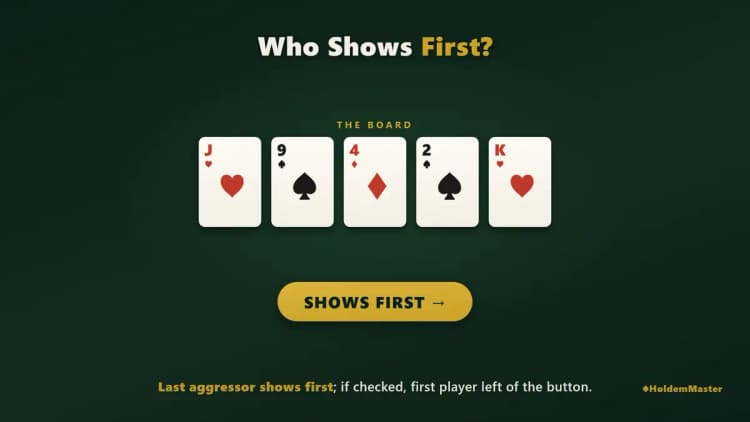
The key phrase is "last aggressor." If you bet the river and got called, you show first — not the caller. The caller gets to see your hand before deciding whether to show or muck theirs.
Can You Muck Without Showing at Showdown?
Yes — if you lost.
Once the last aggressor shows their hand, the other players can either:
- •Show their hand if they think they win
- •Muck face-down if they see they've lost — no need to reveal your cards. That only holds while nobody was all-in: in a tournament, once a player is all-in, TDA Rule 16 requires every hand in the pot to be tabled, and nobody may muck (cash games follow house rules, and most let the caller muck)
Practical rule: as the last aggressor you turn your cards over — even on a bluff that got called. Mucking face-down is the caller's option, taken after seeing the bettor's hand. Muck fast as the bettor and you lose twice: the caller can demand your hand anyway, and because cards speak, plenty of pots have been thrown away by players whose ace-high was actually ahead.
Showdown Order When Everyone Checked the River
If nobody bet on the river (everyone checked), the showdown starts from the first active player left of the dealer button and proceeds clockwise.
Example: Button, small blind, and big blind see the river. SB checks, BB checks, Button checks. Showdown starts from the SB (first active player left of the button). SB can show or muck. Then BB. Then the button last.
In this case, the button shows last — which is actually an advantage. The button can see whether anyone beats them before deciding whether to flip.
All-In Showdown Rules — Does the All-In Player Show First?
In a tournament, when a player goes all-in and there's no more betting possible, all remaining cards are run out with all hands shown face-up (TDA Rule 16). This protects the integrity of the hand — no player should be able to muck strategically in an all-in situation. Cash games run on house rules, and the WSOP Live Action rules put it the other way round: if betting ended before the river, the player who pushed all-in is responsible for turning over first, and when there is a side pot, the players contesting it show before anyone who is all-in for only the main pot (Live Action Rule 149).
| All-in scenario | Showdown rule |
|---|---|
| Player goes all-in on an earlier street, others call, no more betting possible | Tournament: every hand tabled without delay once all betting is complete. Cash: the all-in player turns over first — with a side pot, the side-pot players show first (Live Action Rule 149) |
| All-in bet on the river gets called | The all-in bettor shows first as last aggressor — and in a tournament nobody may muck here: under TDA Rule 16 the caller must table too |
| Multiple all-ins creating multiple side pots | Each pot resolved separately; all involved hands shown |
One nuance: if there is a side pot (other players still have chips and keep betting), the side pot is awarded first and then the main pot. That is the payout order. In a tournament it has nothing to do with when cards come up — the all-in player's hand is already face-up the moment no further betting is possible; the TDA illustration to Rule 16 says it outright: do not wait for the side pot to be divided before turning up the all-in. In a cash game under the WSOP Live Action rules the show order follows the pots instead: the side-pot players show first, then the player who is all-in for only the main pot (Rule 149).
For how side pots are built and paid when players are all-in, see all-in rules and side pots; for chopped pots, see split pot and chop rules.
What Is the "Cards Speak" Rule?
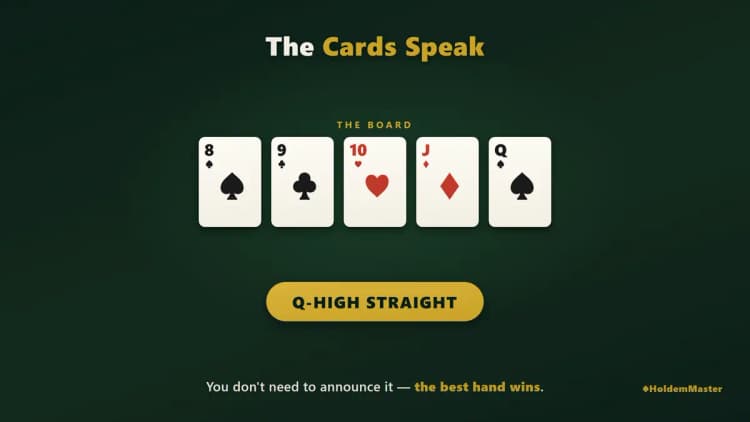
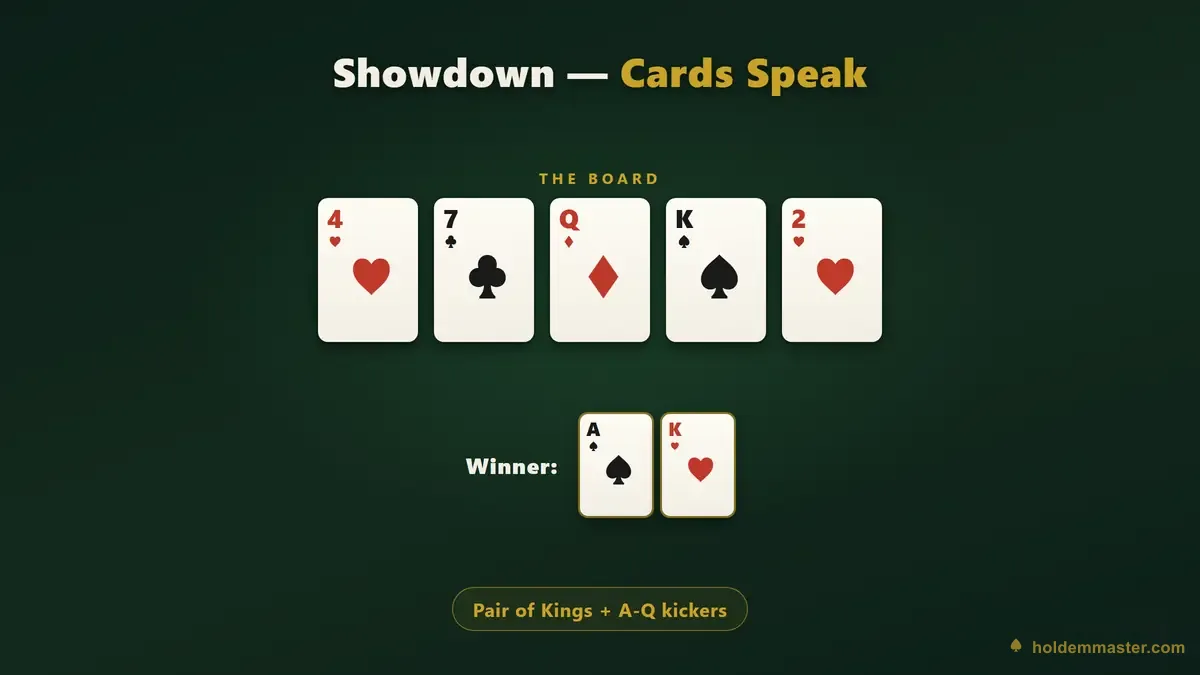
"Cards speak" means the best hand wins regardless of what players say.
If a player misreads their hand and says "I have a pair," but they actually have a straight — the straight wins. The dealer reads the cards and awards the pot to the best hand shown.
This works both ways. If you think you lost and muck without showing, but your hand would have been the winner — the pot is gone. Your hand is dead once the dealer has pushed it into the muck, or once it can no longer be identified and retrieved — cards laid face-down are not automatically dead (TDA Rule 14). Never rely on that, though. Always let the dealer read your hand before mucking if you're not 100% sure you lost.
Real situation: you hold J♥ 10♥ on a board of Q♥ 9♥ 8♥ 2♣ 5♦. You have a queen-high straight flush (Q-J-10-9-8 of hearts). Opponent shows K♣ Q♦ (one pair of queens). You win by a mile. Don't muck just because you see their queen.
What Is Slow Rolling in Poker?
Slow rolling is deliberately taking a long time to show a very strong hand when you know you've won.
You have the nuts. The opponent shows a strong hand. You pause, pretend to think, peek at your cards slowly, make everyone wait — then flip the winner. Technically legal. Universally disliked.
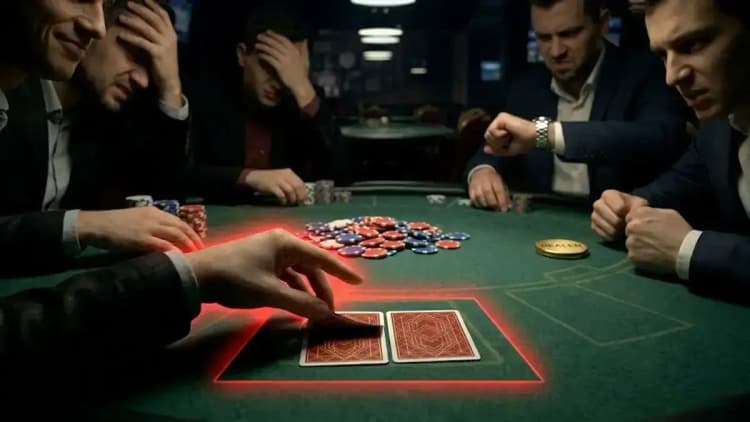
Slow rolling is the fastest way to create enemies at a poker table. It's interpreted as deliberately rubbing in a win. The unwritten rule: if you have the best possible hand, flip it immediately. There is no strategic benefit to slow rolling. The only outcome is tension.
Contrast this with tanking — legitimately taking time to make a difficult decision. That's accepted, even respected. Slow rolling the nuts is different.
Do You Have to Show Your Hole Cards If You Win Without Showdown?
No. If everyone folds before showdown, you win the pot without showing a single card.
You can show if you want — some players show bluffs to tilt opponents or show strong hands to build a tight image. But you are never obligated to show your cards when you win by everyone else folding.
This is one reason poker is interesting. The best hand doesn't always win — the last person standing does.
Showdown Etiquette — What Beginners Get Wrong
Nothing sours a table faster than a showdown handled wrong. Most of it isn't the rules — it's habits nobody taught the new player. Here are the four I end up correcting most often.
Mistake 1: Waiting for the caller to show first
You bet the river. Someone calls you. You freeze and wait for them to show. That's backwards. You show first — you were the last aggressor. Waiting looks like slow rolling even when it isn't — I've watched a friendly game go cold for a full orbit because one player kept letting the caller sweat before turning over the winner.
Mistake 2: Mucking before the dealer reads the hand
You're pretty sure you lost. You slide your cards face-down toward the muck. Dealer pulls them in. Turns out you had the winner. Hand is dead — pot gone. Never muck until you're certain. Let the dealer read both hands.
Mistake 3: Demanding to see every called hand
In most cardrooms you can ask the dealer to expose a mucked hand — but only a hand that was called and reached showdown. A folded hand is dead once it is in the muck, and only a hand that is still clearly identifiable may be retrieved (WSOP Tournament Rule 109). The request rule exists to guard against collusion, not to satisfy curiosity, and abusing it is considered rude. Use it sparingly.
Mistake 4: Not knowing you can show early
At showdown — once all betting is complete — there's no rule against flipping your hand before it's officially your turn. While the hand is still live and any action is pending, the opposite applies: exposing cards costs you a penalty under WSOP Tournament Rule 117 (the Live Action rulebook numbers its clauses differently). If you have the nuts or a very strong hand, show immediately. Other players appreciate it. It speeds up the game. And it's the opposite of slow rolling.