
My first live cash game, I was seated in what I'd later learn was UTG. I looked down at J♥ J♠ and raised. The hijack called. The cutoff called. The button called. The big blind 3-bet. I had no idea what to do — I called and bled chips across three streets.
Three hands later I was on the button with the same J♥ J♠. I raised. Everyone folded. I won $14 without ever seeing a flop.
Same hand. Completely different result. The only thing that changed was my seat — and that night I realized I didn't actually know what the seats were called, let alone what they meant. If you're still learning how a full hand flows from deal to showdown, start with the Texas Hold'em rules guide; this article is the seat map that guide assumes you know.
✦ Quick answer
Poker positions are the named seats measured from the dealer button — UTG, lojack, hijack, cutoff, button, small blind, big blind — and they move one seat clockwise every hand as the button moves. Preflop, UTG acts first and the big blind acts last. Postflop, the small blind acts first and the button acts last.
What Are the Positions at a Poker Table? (Full Seat Map)
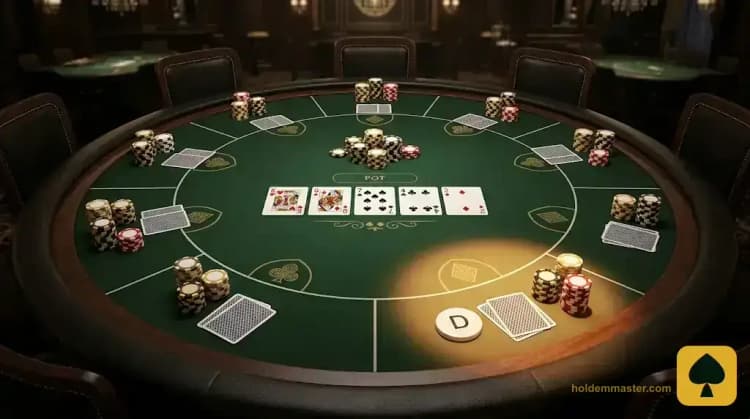
A position is not a chair — it's a name for where you sit relative to the dealer button, and it determines when you act on every street. Because the button moves one seat clockwise after every hand, every player at the table wears a different name every single hand.
Here is the full 9-max positions chart — every seat name, its abbreviation, its zone, and exactly when it acts before and after the flop:
| Seat | Abbr | Zone | Preflop | Postflop |
|---|---|---|---|---|
| Under the Gun | UTG | Early | 1st (first) | 3rd |
| Under the Gun +1 | UTG+1 | Early | 2nd | 4th |
| Under the Gun +2 | UTG+2 | Early | 3rd | 5th |
| Lojack | LJ | Middle | 4th | 6th |
| Hijack | HJ | Middle | 5th | 7th |
| Cutoff | CO | Late | 6th | 8th |
| Button | BTN | Late | 7th | Last |
| Small Blind | SB | Blind | 8th | 1st |
| Big Blind | BB | Blind | 9th (last) | 2nd |
Live table note: the button is a physical disc that moves one seat clockwise each hand. "UTG" is whoever sits three seats left of the button at that moment — not a fixed chair.
Poker Position Names & Abbreviations: UTG, LJ, HJ, CO, BTN, SB, BB
Every position name you'll hear at a table or read in a strategy article, decoded:
| Abbr | Full name | Group | What it refers to |
|---|---|---|---|
| UTG | Under the Gun | Early (EP) | First to act preflop, directly left of the big blind |
| UTG+1 / UTG+2 | Under the Gun plus one / two | Early (EP) | The next seats clockwise from UTG |
| LJ | Lojack | Middle (MP) | Three seats to the right of the button |
| HJ | Hijack | Middle (MP) | Two seats to the right of the button |
| CO | Cutoff | Late (LP) | One seat to the right of the button |
| BTN | Button (Dealer) | Late (LP) | The seat with the dealer disc — last to act postflop |
| SB | Small Blind | Blinds | First seat left of the button; posts the small forced bet |
| BB | Big Blind | Blinds | Second seat left of the button; posts the full forced bet |
Knowing the names is step one. What to actually do from each of them — ranges, steals, in-position versus out-of-position play — is a strategy question, and it lives in the position strategy guide.
Poker Seat Numbers vs Positions — Seat 1 Is Not a Position
This trips up almost every first-time live player: when the floor calls "Table 12, Seat 5", that number has nothing to do with poker positions.
In most card rooms, physical seats are numbered from the dealer's immediate left — Seat 1 is conventionally the first chair to the dealer's left, counting clockwise around to Seat 9 or 10 at the dealer's right. Those numbers are bolted to the chairs. Staff use them for logistics: seating new players, delivering chips, calling time.
Positions are the opposite — they rotate one seat clockwise every single hand with the button. Seat 5 might be the button this hand, the cutoff the next, and the hijack the hand after that.
So "what is Seat 1 in poker?" has a boring answer — it's a chair — and that's exactly the point. A seat number is an address; a position is a job, and the job gets reassigned every hand.
What Is UTG in Poker?
UTG stands for "Under the Gun" — the seat immediately to the left of the big blind, and the first player to act preflop. The name evokes the pressure of the spot: you must commit chips before seeing what a single opponent does, as if acting at gunpoint.
In a full 9-handed game there are actually three "under the gun" seats — UTG, UTG+1, and UTG+2 — counted clockwise from the big blind. Only the first one acts truly blind; the +1 and +2 seats at least see one or two decisions first.
That's the definition. How to play UTG — why it demands the tightest range at the table, and why raise-or-fold is the standard line there — is covered in the position strategy guide.
The Hijack and Lojack — and Why They're Called That
The hijack (HJ) is the seat two to the right of the button. The lojack (LJ) is one further, three to the right of the button. Together they make up middle position in a modern 9-max game.
The names have no documented official origin — poker slang rarely does — but the commonly told story goes like this:
- •Hijack: the cutoff and button are the classic blind-stealing seats. When the player one seat earlier raises first, they "hijack" the steal the late seats were waiting to make — so the seat itself picked up the name.
- •Lojack: came later, as a playful riff on "hijack" — the seat one step "lower" in the pecking order. Most tellings also hear an echo of the LoJack anti-theft brand: a hijack, one notch down.
The Cutoff and the Button (Dealer Position)
The cutoff (CO) is the seat one to the right of the button — the last position before the dealer. Two origin stories circulate: one says the seat "cuts off" the button's chance to steal the blinds by raising first; an older one says that in self-dealt home games, the player to the dealer's right cut the deck after the shuffle. Either way, the name stuck, and the cutoff is universally counted as late position.
The button (BTN) — also called the dealer position — is the seat marked by the physical dealer disc. In casino games a professional dealer handles the cards, so the button simply marks who would be dealing, which is what anchors the betting order: the button acts last on every postflop street, and everything else at the table is named by its distance from that disc.
That guaranteed last action is why the button is considered the most profitable seat in poker — the full argument, with the numbers behind it, is in the position strategy guide.
The Blinds: SB and BB Seats
The two seats left of the button are positions and forced bets at the same time:
- •Small blind (SB): the first seat to the button's left. Posts a forced bet — usually half the big blind — before cards are dealt.
- •Big blind (BB): the next seat clockwise. Posts the full forced bet that sets the price of entering the hand.
Why the blinds exist, how much they cost per orbit, and how to defend them is its own topic — the small blind and big blind guide covers the forced-bet mechanics and math in full.
Who Acts First in Poker — Preflop vs Postflop (Do the Blinds Go First?)
The single most-asked question about positions, answered in one table:
| Street | First to act | Last to act |
|---|---|---|
| Preflop | UTG — first seat left of the big blind | Big blind — may check or raise |
| Flop / Turn / River | Small blind — or the first still-active seat to the button's left | Button — or the closest active seat before it |
And between the two blinds: the small blind acts before the big blind on every street, preflop and postflop alike — with one exception, heads-up, covered below.
One neighbor question worth a line: at showdown, the default is that the last player who bet or raised shows first (if the river checks through, the first active seat left of the button shows) — the full etiquette is in the showdown rules guide. For the complete street-by-street sequence of a hand, see the order of play.
Poker Positions by Player Count: Heads-Up to 10-Handed (6-Max vs Full Ring)
The position names don't change with table size — they peel off from early position first as players are removed. The button, blinds, cutoff, and hijack survive the longest; the UTG+1 and higher seats exist only at full-ring tables. Here's the map from 2 players to 10, listed in preflop acting order:
| Players | Preflop acting order (first → last) |
|---|---|
| 2 (heads-up) | BTN (posts the small blind) → BB |
| 3 | BTN → SB → BB |
| 4 | CO (the "UTG" seat here) → BTN → SB → BB |
| 5 | HJ (the "UTG" seat here) → CO → BTN → SB → BB |
| 6 (6-max) | UTG (also called LJ) → HJ → CO → BTN → SB → BB |
| 9 (full ring) | UTG → UTG+1 → UTG+2 → LJ → HJ → CO → BTN → SB → BB |
| 10 | UTG → UTG+1 → UTG+2 → UTG+3 → LJ → HJ → CO → BTN → SB → BB |
6-max vs full ring is purely subtraction: the three extra seats (UTG+1, UTG+2, and one middle seat) don't exist, so 6-max runs UTG → HJ → CO → BTN → SB → BB. The practical consequence is not that a seat plays "later" — a cutoff has the same three players behind it either way. It's that with the early seats gone, you sit in the blinds and in late position far more often, and fewer players open in front of you — 6-max UTG faces five opponents, not eight — which is why ranges widen across the board in short-handed games. The seat-by-seat numbers live in the position strategy guide, and the exact hands that fill each range are mapped in the starting hands chart.
Naming caveat: some sites and rooms label the first 6-max seat "LJ" or "MP" instead of UTG, and 10-handed middle seats sometimes appear as "MP1/MP2". Labels vary; the acting order never does.
FAQ
The Takeaways
1. Positions are names, not chairs. Every seat is named by its distance from the dealer button, and every name moves one seat clockwise each hand. 2. The chart in one line: UTG → UTG+1 → UTG+2 → LJ → HJ → CO → BTN → SB → BB. Preflop starts at UTG and ends at the big blind; postflop starts at the small blind and ends at the button. 3. Seat numbers ≠ positions. Seat 1 is conventionally the dealer's immediate left and never moves; positions rotate every hand. One is an address, the other is a job. 4. Table size subtracts from the front. 6-max drops the early seats; heads-up fuses the button with the small blind — first to act preflop, last to act postflop.
Once the names are second nature, the real edge comes from what you do with them —  how to play each position, from opening ranges to in-position versus out-of-position play, is the next read. From there, the starting hands chart maps exact hands to exact seats, and the hand rankings guide settles what actually wins at showdown.