Everyone who sits down to their first game of Texas Hold'em asks the same thing: "Wait — whose turn is it, and when do I put money in?" You know you get cards. What you don't know is when to bet, when more cards come out, and how the winner is actually decided.
This is the order-of-play guide: blinds, preflop, flop, turn, river, showdown, and who acts first at each point. If you are completely new and want the broader beginner package — rules, chips, hand rankings, first strategy, and a printable PDF — start with  Texas Hold'em rules for beginners. Then come back here for the detailed hand flow.
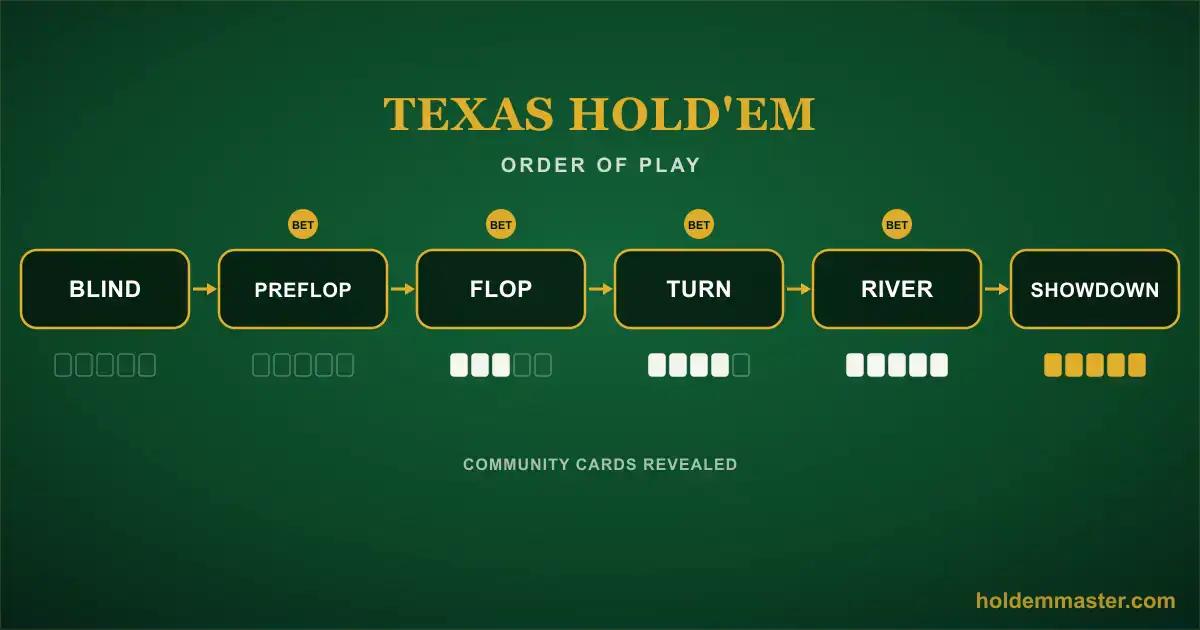
One hand in 15 seconds
Post the blinds (forced bets) → deal two hole cards to each player → preflop betting → reveal three flop cards → bet → add the turn card → bet → reveal the final river card → bet → surviving players show down → best five-card hand wins.
What Is Texas Hold'em?
Texas Hold'em is the most widely played poker game in the world. From the WSOP Main Event to a casual home game, when people say "poker," they almost always mean Hold'em.
The core rule is simple: you make your best five-card hand out of your two private hole cards plus five shared community cards. Luck deals the cards, but understanding the order of play — and making the right decision at each stage — is what separates winners from everyone else.
Before the Deal: The Button and the Blinds
Before any cards come out, two things set the table: the dealer button and the blinds.
The dealer button (the "button," marked D) is a round disc that marks who is "on the deal" for that hand. Even with a house dealer, the button decides the betting order, and it moves one seat clockwise after every hand.
The blinds are forced bets posted before the cards are dealt. Without them, everyone could just check and fold for free; the blinds put money in the middle and give players a reason to compete. (New to them? See exactly how the small and big blind work.)
| Blind | Position | Example |
|---|---|---|
| Small Blind (SB) | First seat left of the button | 1,000 |
| Big Blind (BB) | Second seat left of the button | 2,000 |
The blinds aren't just an entry fee — they're the starting point of position and strategy.
Stage 1 — Preflop: The First Decision Sets the Tone
Once the blinds are posted, the dealer gives each player two hole cards face down. Only you can see them, and preflop betting begins.
Action starts to the left of the big blind and moves clockwise. On your turn you choose one of these:
- •Fold — give up the hand and muck your cards. You lose nothing more, but you win nothing.
- •Call — match the current bet (preflop, that's the big blind).
- •Raise — bet more than the big blind to put pressure on opponents.
- •3-bet — a raise over someone else's raise. A strong-hand signal.
Solid starting hands for beginners
- •Premium: A♠A♥ (pocket aces), K♠K♥, Q♠Q♥, J♠J♥
- •Strong: A♠K♥ ("Big Slick"), A♠Q♥, 10♠10♥, 9♠9♥
- •Situational: A♠J♥, 8♠8♥, K♠Q♥, K♠J♥
Stage 2 — The Flop: Three Community Cards
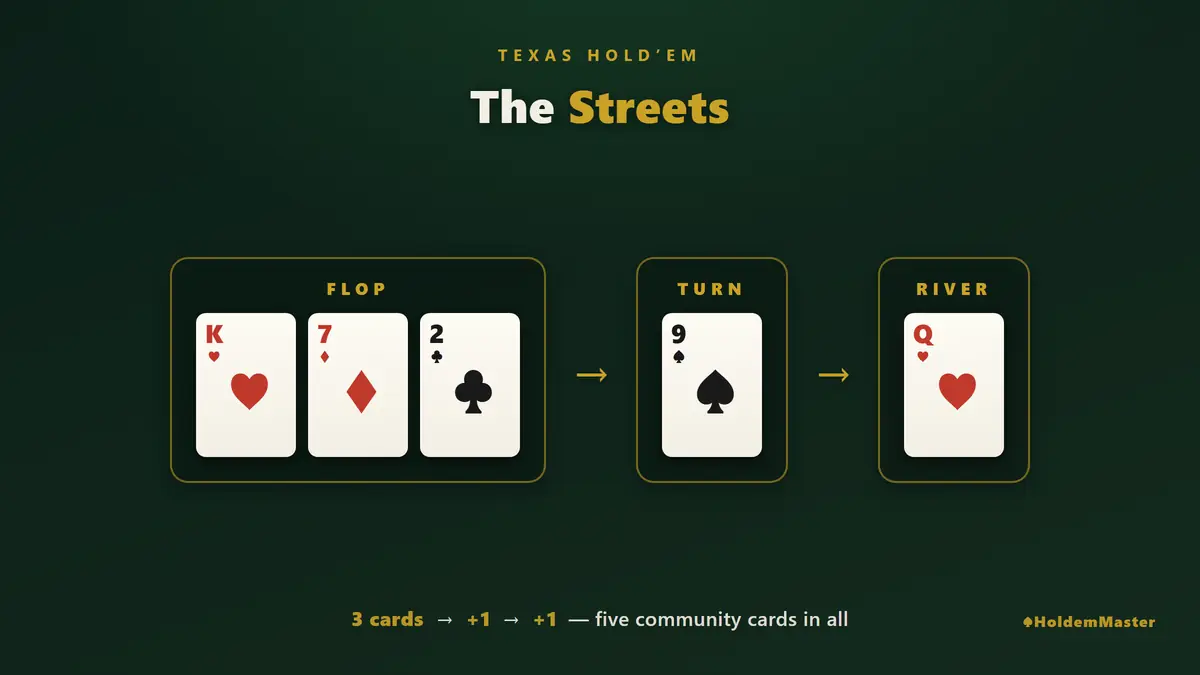
When preflop betting ends, the dealer reveals three community cards in the middle of the table. This is the flop.
Now you can read a real five-card hand: your two hole cards plus the three on the board. Look at two things at once:
- •What you have now — a pair, two pair, or nothing yet.
- •What you can still make — a flush or straight draw that could complete on later streets.
The flop also unlocks a new option: the check. If no one has bet yet, you can check to pass the action without putting in chips. But if an opponent bets after you check, you'll have to call, raise, or fold.
Stage 3 — The Turn: The Picture Sharpens
After the flop betting round, one more community card is dealt — the turn (also called fourth street). There are now four cards on the board.
The turn is a strategically heavy street:
- •Did your straight or flush draw complete?
- •What do your opponent's preflop and flop actions say about their range?
- •Is this hand worth taking all the way to the river?
Stage 4 — The River: The Last Card, the Last Decision
After the turn betting round, the fifth and final community card is revealed — the river (also called fifth street). All five community cards are now out, and there is no new information left to come.
Classic river mistakes:
- •Calling to the bitter end with a weak hand — the "well, I've come this far" trap.
- •Checking a strong hand passively — handing your opponent a free showdown.
- •Trying a sudden river bluff — if you were passive on every earlier street, a big river bet rarely tells a believable story.
Stage 5 — Showdown: Best Five Cards Wins
If two or more players are still in after the river betting, the hand goes to showdown.
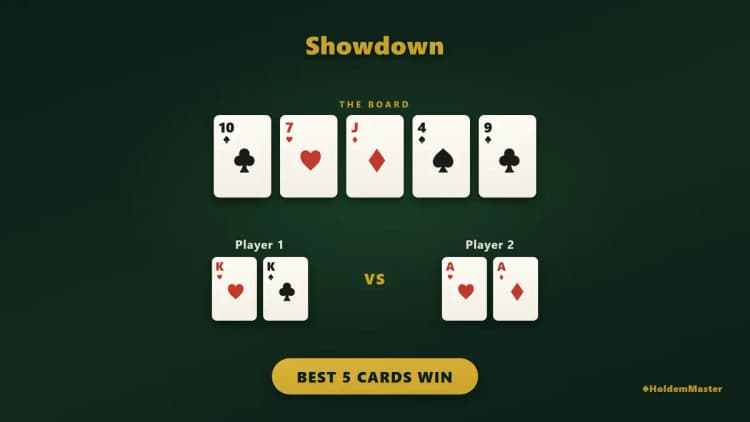
Showdown rules:
- •Each player makes their best five-card hand from their two hole cards and the five community cards.
- •You don't have to use both hole cards — you can use one, or even play the board (zero) if that's your best five.
- •The player who made the last aggressive action (bet or raise) shows first; if the river was checked through, the first active player to the left of the button shows first.
- •A losing player may simply muck (fold without showing) — except in a tournament all-in: once a player is all-in and betting is complete, every hand is turned face up (TDA Rule 16 · WSOP Tournament Rule 70).
- •Equal hands split the pot ("chop") evenly.
Who Bets First in Texas Hold'em?
Two seats own the word "first," and which one is on duty depends on whether the flop is out. Before the flop it is UTG — "under the gun," immediately left of the big blind — precisely because the blinds already have money in and get to act last. Once the flop lands that privilege is spent, so the action restarts at the first live player left of the button, and the button closes every street from there.
"Whose turn is it?" therefore has a different answer before and after the flop — and that single shift is the engine behind position strategy.
| Street | First to act | Last to act |
|---|---|---|
| Preflop | Player left of the big blind ("UTG") | Big blind |
| Flop | Small blind (or first live player left of the button) | Button |
| Turn | Same as the flop | Button |
| River | Same as the flop | Button |
The memory trick: before the flop, look left of the big blind; after the flop, look left of the button. The button acts last on every postflop street, which is exactly why it's the most profitable seat — see poker positions: UTG to button.
Heads-up (2 players) is the exception: the button posts the small blind and acts first preflop, but last on the flop, turn, and river. That is the order used in the full-hand walkthrough below.
The Whole Order at a Glance
| Stage | What happens | Community cards | Betting? |
|---|---|---|---|
| Blinds | SB and BB post forced bets | 0 | Forced |
| Preflop | Two hole cards dealt → bet | 0 | ✅ |
| Flop | Three community cards revealed | 3 | ✅ |
| Turn | One more community card | 4 | ✅ |
| River | Final community card | 5 | ✅ |
| Showdown | Best five cards compared → winner | 5 | — |
⚡ A one-line memory hook for each street
- •Preflop = start (decide on your two cards alone)
- •Flop = change (three cards open up the possibilities)
- •Turn = decision (your last real chance to plan the river)
- •River = conclusion (all cards out, final bet)
- •Showdown = result (best five cards takes it)
Follow One Full Hand, Step by Step
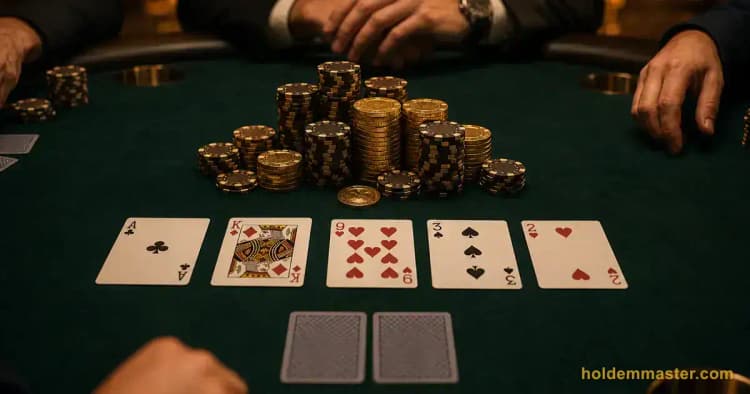
Reading about streets is abstract. Let's run a single heads-up hand from the first card to the last with real cards and chip amounts.
Setup: Heads-up. Blinds SB 1,000 / BB 2,000.
- •Player A (you): A♠ K♥ (ace-king offsuit)
- •Player B (opponent): 9♦ 9♣ (pocket nines)
Preflop
A raises to 6,000 with Big Slick. B calls with pocket nines. Pot: 12,000
Flop: K♦ 9♠ 3♥
- •A: top pair, top kicker (a pair of kings). Looks strong.
- •B: three nines — a set. Already a monster.
Turn: 2♣
- •A: no change, still top pair.
- •B: still a set, no need to improve.
River: A♥
- •B: checks.
- •A: the ace pairs up — now two pair, aces and kings. Feeling great, bets 30,000.
- •B: the set still crushes two pair. Check-raises to 70,000.
- •A: convinced two pair is good, calls.
Showdown
- •A: A♠ K♥ + A♥ K♦ 9♠ → two pair (aces and kings)
- •B: 9♦ 9♣ + 9♠ K♦ A♥ → three of a kind (nines)
The lesson: when the river paired A's hand to two pair, it felt like the winner — but B had a set from the flop the entire time. Reading the whole board, not just your own improvement, is the heart of Hold'em.
The 7 Moves You Can Make, Fully Explained

Here is every action available at the table — the part beginners mix up most.
| Action | What it does | When it's available |
|---|---|---|
| Fold | Give up the hand, muck your cards | Any street — in turn |
| Check | Pass the action with no bet | Only when there's no bet to you |
| Call | Match the current bet | When there's a bet to you |
| Bet | Make the first wager of a round | When no one has bet yet |
| Raise | Increase over the current bet | When there's a bet to you |
| Re-raise (3-bet) | Raise over a raise | When there's a raise to you |
| All-in | Push all your chips in | Any street — in turn, as a bet or raise |
Important: preflop you can't check — unless your own post is already the live bet. The big blind is a live bet, so everyone else must call, raise, or fold. The big blind may check if no one has raised — and so may a player who posted a live straddle, since that post is their opening bet and they act last preflop (WSOP Live Action Rules 159 · 165); for everyone else, checking begins on the flop.
For a deeper decision guide on when to use each move — with a check-call-raise-fold decision table — see betting actions explained.
The 10 Poker Hand Rankings You Must Know
To win at showdown, you need to instantly know which hand beats which. This is the hand ranking order.
| Rank | Hand | Example | Frequency |
|---|---|---|---|
| 1 | Royal Flush | A♠ K♠ Q♠ J♠ 10♠ | Extremely rare |
| 2 | Straight Flush | 5♥ 6♥ 7♥ 8♥ 9♥ | Very rare |
| 3 | Four of a Kind | A♠ A♥ A♦ A♣ K♠ | Rare |
| 4 | Full House | K♠ K♥ K♦ A♠ A♥ | Uncommon |
| 5 | Flush | A♠ K♠ 8♠ 5♠ 2♠ | Uncommon |
| 6 | Straight | 5♥ 6♠ 7♦ 8♣ 9♥ | Occasional |
| 7 | Three of a Kind | Q♠ Q♥ Q♦ 5♠ 7♥ | Occasional |
| 8 | Two Pair | J♠ J♥ 8♦ 8♣ A♠ | Common |
| 9 | One Pair | K♠ K♥ 7♦ 4♣ 2♠ | Very common |
| 10 | High Card | A♠ Q♥ 8♦ 5♣ 2♠ | Common — but rarer than two pair |
Want the full breakdown — including how kickers and ties decide a winner? See the complete guide to poker hand rankings.
5 Mistakes Every Beginner Must Avoid
You can memorize the order of play and still bleed chips if you make these. I've watched each one cost a beginner the pot in real time — usually more than once in a single session.
1. Playing almost every hand
"Let's just see a flop" is a long-term loser — it's the single most common leak I see at a new player's first table. Strong players play only 15–25% of hands and fold the rest without hesitation. If you're calling preflop with any two cards, you're paying to lose.
2. Ignoring position
The closer you are to the button, the better — acting last lets you see what everyone else does before you decide. Play tight in early position and more aggressively in late position. For the full seat map and opening ranges per position, see poker positions explained: UTG to button.
3. Chasing draws blindly
A flush or straight draw doesn't mean an automatic call. You have to weigh pot odds — the price of the call against the size of the pot. If the pot — with your opponent's bet already in it — is 100,000 and you must call 50,000, your draw needs to complete at least about 33% of the time to be worth it.
4. Bluffing the river with a weak hand out of nowhere
If you checked passively the whole way and then shove the river, opponents see through it instantly. A bluff needs a consistent story from the first street.
5. Misreading your hand at showdown
A classic beginner error: thinking "I've got two pair!" when you actually have one pair. I've had players proudly turn over what they were sure was a straight, only to find the cards weren't connected — the table goes quiet, and the pot slides the other way. Practice picking the best five cards out of your two hole cards and the five board cards until it's automatic.
How to Start Playing Today
Once the order of play clicks, it's time to actually play.
- •Practice with play money — most poker apps and sites offer free games. Put this guide to work in a real flow.
- •Re-read this article two or three times — the sequence has to be second nature so you never freeze at the table.
- •Make a hand-ranking cheat sheet — write the ten hands on paper and keep it where you'll see it.
- •Start at the lowest stakes — the cheaper your mistakes, the faster you learn.

FAQ
The 3 Things to Remember
1. The order: blinds → preflop → flop (3) → turn (1) → river (1) → showdown, with four betting rounds. 2. The reads: on every street, judge both what you have now and what you can still make — and watch the whole board, not just your own hand. 3. The discipline: fold most hands preflop, respect position, and only bet big when your story makes sense.
Learn the sequence cold, drill it with free games, and you'll never again freeze wondering whose turn it is. You're ready to sit down.