
You're short-stacked. You shove. The player behind calls. A third player re-raises. The dealer starts separating chips into two piles.
You have no idea what's happening.
I've been at that table. The first time I went all-in at a live cash game, I didn't know whether I could still win anything, whether the other player could re-raise, or even which pile of chips was mine. Nobody explained it.
This guide covers every situation: main pots, side pots, re-raise eligibility, and showdown order. No more freezing when the dealer starts counting stacks. (If the basic betting flow is still fuzzy, the  beginner's rules guide covers it first.)
What Does "All-In" Mean in Texas Hold'em?
Going all-in means betting every chip you have in front of you. Once you commit, you cannot add more chips — and you cannot be forced to fold.
The foundation is the table stakes rule: you can only bet the chips you had on the table at the start of the hand. You cannot reach into your pocket for extra money, borrow from a friend, or add a watch or car keys — that's movie poker.
| Term | Meaning |
|---|---|
| Push / Shove / Jam | Slang for going all-in |
| Table stakes | You can only bet what you had at hand start |
| Double up | Win an all-in and double your stack |
| Main pot | The pot everyone — including the all-in player — can win |
| Side pot | Chips only bigger stacks can win; the player who went all-in for less is excluded |
Once you're all-in, you are guaranteed to see all remaining community cards. Nobody can bluff you off the hand. Your cards stay live through the river.
How to Declare All-In
Two valid ways:

Never push a single oversized chip forward silently — facing a bet, the dealer counts it as a call (with no bet pending, as just that chip's value), never your full stack. Always declare "all-in" out loud, or move your entire stack at once.
How Do Side Pots Work in Poker? (Why the All-In Player Gets Capped)
The all-in player can only win their own bet plus a matching amount from each other player still in the pot. Any chips bet beyond that form a side pot that belongs exclusively to the players who funded it.
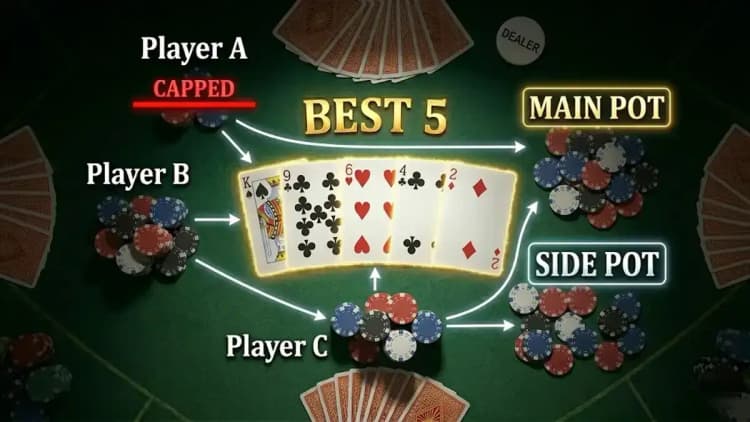
3-Player Example (Standard)
| Player | Stack | Action |
|---|---|---|
| Player A | 100 chips | All-in |
| Player B | 300 chips | Calls 100, then bets 50 more |
| Player C | 300 chips | Calls 100, then calls 50 |
Side pot: 50 × 2 = 100 chips (only B and C eligible)
Player A can win the 300-chip main pot at showdown. But even if A has the best hand overall, A cannot touch the 100-chip side pot. B or C will win it.
4-Player Multi-Stack Example
This is where it gets complicated — and where most beginners get lost.
| Player | Stack | Goes all-in for |
|---|---|---|
| A | 100 | 100 |
| B | 200 | 200 |
| C | 500 | 500 |
| D | 500 | calls all |
| Pot | Amount | Eligible players |
|---|---|---|
| Main pot | 100 × 4 = 400 | A, B, C, D |
| Side pot 1 | 100 × 3 = 300 | B, C, D (A is capped) |
| Side pot 2 | 300 × 2 = 600 | C, D (A and B capped) |
| Total | 1,300 | — |
The rule: each side pot is built by taking the difference up to the next-smallest stack × the number of players who match it. Work from smallest stack to largest.
Does Going All-In Reopen the Betting? — The Rule Most Players Get Wrong
This is the single most disputed all-in rule at live tables — I've watched two players argue about it for five minutes while the whole table waited. Both were wrong.
The rule: If a player goes all-in for less than a full raise, that all-in does NOT reopen the betting for players who have already acted in that round.
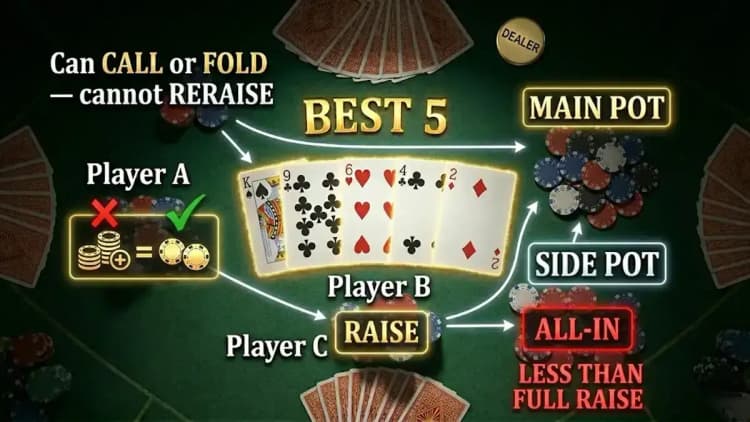
Example:
Blinds $1/$2. Four players see the flop.
1. Player A bets $10. 2. Player B goes all-in for $14 (only $4 more than A's $10 bet — not a full raise, which would need at least $20).
What happens to Player A, and to Player C who hasn't acted yet?
- •Player A already acted (bet $10) and now faces only an incomplete raise. Because B's all-in of $14 is less than a full raise, the action does NOT reopen for Player A. A can only call or fold — they cannot re-raise.
- •Player C has not yet acted — Player C can still raise normally.
| All-in amount | Full raise? | Reopens betting? |
|---|---|---|
| Less than a full raise | No | No — players who already acted can only call or fold |
| Full raise or more | Yes | Yes — all players can re-raise again |
Why does this exist? It protects players from being forced into larger raises by partial all-ins. A full raise signals real aggression — a short-stack all-in for scraps doesn't.
Advanced Case: What If Multiple Players Go All-In Short?
This is the version that trips up even regulars. Multiple short all-ins can add up to a full raise — and if their combined increments reach the threshold, betting reopens for a player who already acted. The test is run player by player, not once for the table: it reopens only for a player who, when the action returns to them, is facing at least a full raise above what they have already put in (TDA Rule 47).
This is the official TDA "re-opening the bet" rule, and most card rooms follow it.
Example (Blinds $1/$2, on the flop):
1. Player A bets $10. 2. Player B goes all-in for $14 (+$4 increment — not a full raise alone) 3. Player C goes all-in for $21 (+$7 increment — not a full raise alone)
Combined increments: $4 + $7 = $11 — that meets the $10 minimum raise threshold.
Result: betting REOPENS for Player A. A put in $10 and now faces $21 — $11 more, at least a full raise — so A can fold, call, or re-raise, even though neither B nor C individually made a full raise. A player who had called B's $14 in between would face only $7 more when it came back around, and for them nothing reopens: call or fold.
| B's all-in | C's all-in | Combined increment | Reopens for A? |
|---|---|---|---|
| $14 (+$4) | $18 (+$4) | $8 — below $10 | ❌ No |
| $14 (+$4) | $21 (+$7) | $11 — meets $10 | ✅ Yes |
| $15 (+$5) | $24 (+$9) | $14 — meets $10 | ✅ Yes |
The minimum raise threshold is always the last full valid bet or raise — not any cumulative total.
Quick Decision Guide — Does This All-In Reopen Betting?
| Situation | Reopens for players who already acted? |
|---|---|
| Single all-in < full raise | ❌ No — call or fold only |
| Single all-in ≥ full raise | ✅ Yes — all can re-raise |
| Multiple short all-ins, combined < full raise | ❌ No |
| Multiple short all-ins, combined ≥ full raise | ✅ Yes — for each player who now faces at least a full raise above their own last action |
| Player who has NOT yet acted | ✅ Always can raise (regardless) |
All-In Showdown Rules
When all betting is complete and a player is all-in, here is what happens at showdown:
1. Cards are turned face-up. In tournaments, all hands involved in the all-in are typically tabled once betting is complete. In cash games it depends on when the betting ended: if it ended before the river, the player who pushed all-in turns over first (WSOP Live Action Rule 149); if the river was bet, the standard last-aggressor showdown rule applies. 2. Side pots are awarded first. The dealer resolves the most recently created side pot first, then works backward to the main pot. 3. Cards speak. The best hand wins each pot they're eligible for — regardless of what players say they have. 4. Multiple winners are possible. Player A can win the main pot. Player B can win the side pot. Neither takes everything just because they won "their" pot.
One player can win the main pot but lose the side pot. Both outcomes are valid.
Special case: If one side pot has only one player left (everyone else folded), that player wins those chips back immediately — no showdown needed for that pot.
What Happens If You Go All-In Wrong? — 5 Mistakes to Avoid
After enough all-in pots, you learn the chaos almost always comes from five specific misunderstandings — not the math, but who is eligible for which pot.