One board earlier the big blind bet its entire range on  A♦K♠2♥ and split the sizing almost down the middle — 57.8% small, 42.2% large.
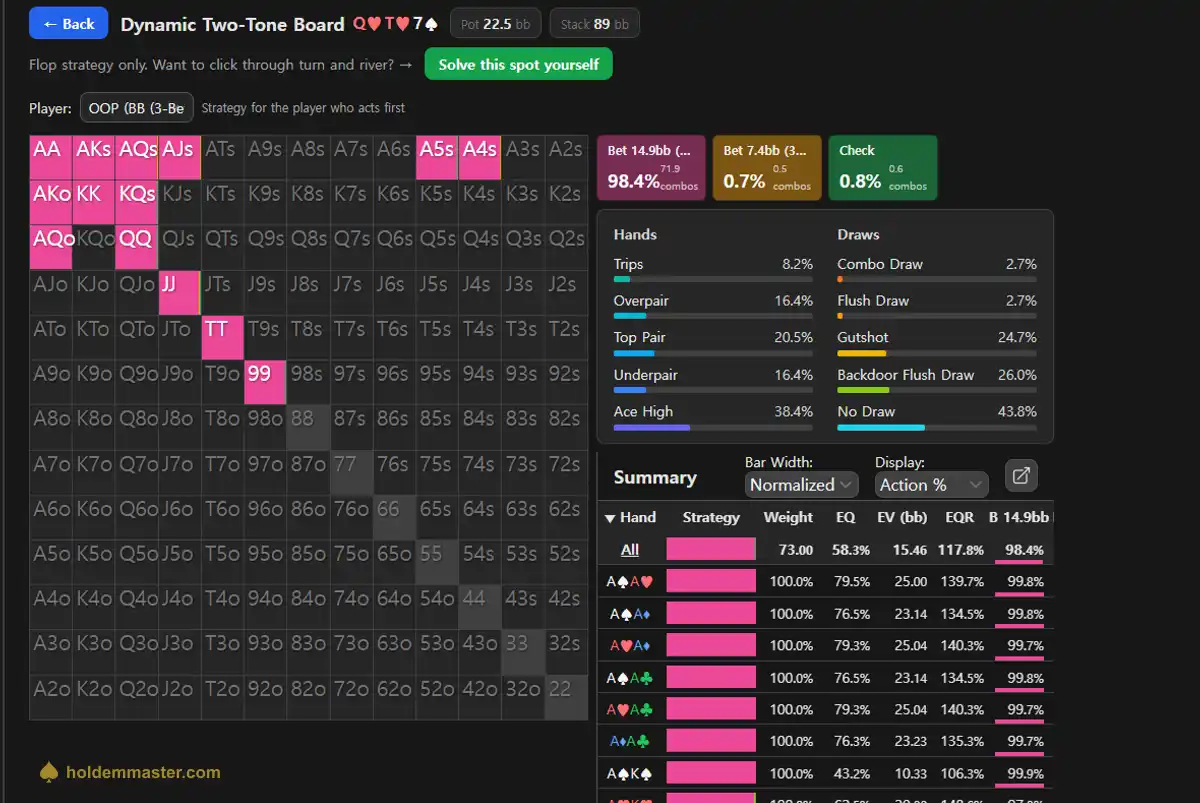
This flop is Q♥ T♥ 7♠. Two hearts, and only the jack missing between the queen and the ten. Far more draws, and the split disappears: two thirds of the pot takes 98.4%, and the small size takes 0.7%.
"Bet big on wet boards" is advice everybody has heard. What nobody mentions is how extreme it gets. Every number below comes from HoldemMaster's free GTO solver.
✦ Quick answer
The big blind bets 14.9bb, two thirds of the pot, 98.4% of the time. The small size at 0.7% and the check at 0.8% are effectively zero, not a strategy you can act on. The reason is the price. A third of the pot asks the caller for about 19.8% equity, which the button's four flush-draw combos clear easily. Two thirds asks for about 28.5%, and counted one card at a time, only two of the button's 40 draw combos still clear it — the twelve-out combo draws that sailed past the small size no longer get there on the next card alone. On A-K-2 the sizing split instead because 63 combos were all a pair or better — a range with its bottom cut off, and no draws to charge.
What conditions produced these numbers?
Same three-bet pot as the previous board — only the flop changed. The big blind three-bet to 11bb, the button called, and the two of them see Q♥T♥7♠ with 22.5bb in the middle and 89bb behind. Those two figures are the whole difference between this series' single-raised pots and its three-bet pots.
| Setting | Value |
|---|---|
| Preflop | BTN opens → BB three-bets to 11bb → BTN calls |
| OOP · IP | OOP = BB (the three-bettor) · IP = BTN (the caller) |
| Flop | Q♥ T♥ 7♠ — two hearts, so two-tone |
| Pot · stack | Pot 22.5bb · effective stack 89bb (SPR 4.0) |
| Bet sizes offered | About a third (7.4bb) and two thirds (14.9bb) of the pot |
| Rake | Not modeled |
| Checked | 2026-08-20 |
Does the range really use only one size?
Effectively, no — it uses one. 71.9 of the 73 combos take the two-thirds size, while the small bet and the check divide 1.1 combos between them. Both sizes were open in the tree and the solver declined one of them, so this is a choice rather than a restriction.
| Big blind's first action | Frequency | Combos |
|---|---|---|
| Bet 14.9bb (66% pot) | 98.4% | 71.9 |
| Check | 0.8% | 0.6 |
| Bet 7.4bb (33% pot) | 0.7% | 0.5 |
Put the two three-bet pots side by side and they look like different games.
Both rows are three-bet pots at SPR 4.0 running the same 14-hand three-bet range.
| Flop | A third | Two thirds | Check |
|---|---|---|---|
| A♦K♠2♥ dry rainbow | 57.8% | 42.2% | 0.0% |
| Q♥T♥7♠ two-tone, connected | 0.7% | 98.4% | 0.8% |
Why does a wet board want one big size?
Because poker bet sizing is set by what the opponent can afford to call with, not by how strong your own hand is. Count the draws the button can hold, price each of them against the two sizes in the tree, and the choice makes itself. On a dry board that count is close to zero, which is why the small size survives there instead.
| Draw | BB (three-bettor) | BTN (caller) |
|---|---|---|
| Combo draw | 2.7% | 3.0% |
| Flush draw | 2.7% | — |
| Open-ended straight draw | — | 4.5% |
| Gutshot | 24.7% | 22.6% |
| Backdoor flush | 26.0% | 27.1% |
| No draw | 43.8% | 42.9% |
🪶 Backdoor flushes are excluded on purpose. It takes two running cards of one suit (hearts for a hand holding one heart, spades for one holding two spades beside the 7♠), and that lands only (10 ÷ 47) × (9 ÷ 46) = about 4.2% of the time — not something a bet size can charge for. And the draw table is a separate axis from the made-hand table — an overpair with one heart lands in the backdoor row too. On the  dry king-high flop the same row read 72.2% "no draw" for the big blind and 77.7% for the button. Different planet.
Bet a third of the pot, 7.4bb, and the caller needs 7.4 ÷ (22.5 + 7.4 + 7.4) = about 19.8% to continue. Here is what that price buys, measured one card at a time.
| Draw the button can hold | Combos | Outs | Next card | vs 1/3 (19.8%) | vs 2/3 (28.5%) |
|---|---|---|---|---|---|
| Flush plus open-ender — K♥J♥, 9♥8♥ | 2 | 15 | 15 ÷ 47 = 31.9% | ✅ | ✅ |
| Flush plus gutshot — A♥K♥, A♥J♥ | 2 | 12 | 12 ÷ 47 = 25.5% | ✅ | ❌ |
| Open-ended straight — K-J and 9-8 in the other suits | 6 | 8 | 8 ÷ 47 = 17.0% | ❌ | ❌ |
| Gutshot | 30 | 4 | 4 ÷ 47 = 8.5% | ❌ | ❌ |
⚠ "Prices out" here means the next-card arithmetic only. Against the big blind's whole range with both cards to come, 30 of those 38 combos still hold more than 28.5% equity — the A-K gutshots sit at 37.6%–42.9% because their overcards count too. What the large size does to most draws is charge them, not fold them.
⚠ The column above prices one card. A draw that needs both is a different question — and it pays twice. Seeing both cards instead of one takes the fifteen-out draw to about 54.1% and the twelve-out draw to about 45.0%; the eight-out straight draw reaches 31.5% and even a gutshot gets to 16.5%. The caller also has position, a stack of 74.1bb behind, and the option to raise. The big size puts a price on all of it.
One step further, though: the caller cannot simply fold everything either. Facing 14.9bb into 22.5bb, denying a pure bluff its profit takes 22.5 ÷ (22.5 + 14.9) = 60.2% of the range — the minimum defense frequency. The button's genuinely made hands add up to only 33.9% (6.8 trips, 20.3 top pair, 6.8 second pair).
🪶 Filling 60.2% does not need the draws at all, though — 33.9% made plus 36.1% underpairs is already 70.0%. Even if all 38 priced-out draw combos fold, 71.4% of the range remains, comfortably clear. What the big size really does, then, is less "chase the draws away" and more make the middle of the button's range pay badly to stay — those underpairs put the money in under the queen (and under both broadway cards, except JJ) with every draw on the board.
🪶 Do not compress this into "a flush draw calls anyway." A bare flush draw is nine outs, 9 ÷ 47 = 19.1%, which does not even clear the small size's 19.8% — and this button range holds zero bare flush draws (the dash in the comparison table). It has exactly four two-heart hands, and every one of them carries a straight draw as well — two a gutshot, two an open-ender — which is why all four sit in the combo-draw row instead. That a bare flush draw reaches about 35.0% by the river is true, and beside the point here.
For a broader look at how to count outs and price draws, see drawing odds and pot odds.
Your hand does not choose the size. What your opponent can afford to call does.
 Q♠J♦T♠ it checks 99.9%. Standing advice like "bet big on wet boards, and polarize" in the c-bet guide is written for the raiser's seat, not the caller's. The three-bet is what swaps them. Here the big blind is the one holding the range that connects, so it is the one betting — with everything. Texture alone never settles this; read the preflop action first.
What is geometric bet sizing?
Geometric sizing means picking one pot fraction and repeating it every street so the last bet lands exactly on all-in. With a 22.5bb pot and 89bb behind, the final pot after three bets and three calls has to be 22.5 + 2 × 89 = 200.5bb, so the pot must grow by 200.5 ÷ 22.5 = 8.91 times across three streets. That works out to about 54% of the pot, three times.
The size the solver actually offers here is bigger than that, and it still fits:
- •Flop 14.9bb → called, the pot is 52.3bb and 74.1bb is behind
- •Turn 34.5bb → called, 39.6bb is behind
- •River 39.6bb all in
And far fewer hands can plan that line than fire the first bet. 98.4% bets the flop; on strength alone the candidates for all three streets are the sets and overpairs, 6 + 12 = 18 combos, while the ace-high combos at the bottom are buying one street and looking again. ⚠ That is read off the categories, not solved: with no turn or river node here, this screen cannot confirm that the 18 go all the way, nor place the 15 top-pair combos on either side. Top pair is exactly where the decision is, so settle your own plan before you bet.
This is what an SPR of 4.0 actually means. The number to watch is not the money behind, it is the count of bets remaining. Betting 14.9bb drops the turn SPR to 74.1 ÷ 52.3 = 1.4, at which point the next bet is a stack decision whether you meant it to be or not.
And it is why the big size is not only about this street. The by-the-river draw equities are all "if I get to see both cards" numbers, and at two thirds the caller has to pay twice more to see them. Starting small is what would have waived that cost.
Why do hands with no pair bet here?
Because 38.4% of the big blind's range is ace-high, and most of that is drawing to a straight. Of the 73 combos, 28 are ace-high, and all 18 gutshots sit inside those 28. A hand with no pair is not the same as a hand with no equity: four outs to Broadway, two overcards, and whatever folds the bet wins outright.
| The 28 ace-high combos | Combos | What they are |
|---|---|---|
| AK | 16 | One jack makes A-K-Q-J-T. 15 are gutshots; A♥K♥ adds the flush and becomes a combo draw |
| AJs | 4 | Same A-K-Q-J-T, but it needs a king. 3 are gutshots; A♥J♥ is a combo draw |
| A5s · A4s | 8 | A♥5♥ and A♥4♥ are the two bare flush draws |
JJ and 99 are the opposite case. Neither is drawing to anything. Jacks plus the board's queen and ten still need two more cards — a king and a nine, an ace and a king, or a nine and an eight — to make a straight. They have a pair, which reads as strength, but the hand that can turn the whole thing around with one card is A-K.
What does the button actually have?
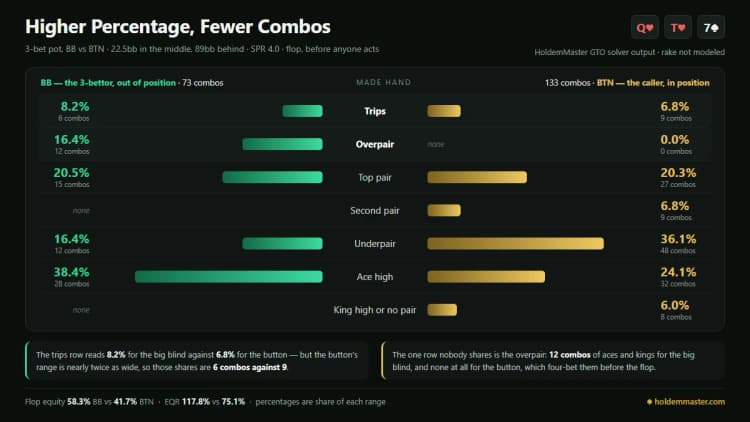
More than a third of it — 36.1% — is an underpair, so it walks into a board with two broadway cards holding a pair below the queen — below both broadway cards for every underpair except JJ, which sits between them. The rest splits into hands that connected with the queen, hands drawing at the hearts, and a small tail of nothing. One row in the table below does not mean what it appears to mean, and it is worth finding before reading on.
| Category | BB (three-bettor) | BTN (caller) |
|---|---|---|
| Trips (a set) | 8.2% | 6.8% |
| Overpair | 16.4% | — |
| Top pair (a queen) | 20.5% | 20.3% |
| Second pair (a ten) | — | 6.8% |
| Underpair | 16.4% | 36.1% |
| Ace high | 38.4% | 24.1% |
| King high or no pair | — | 6.0% |
The overpair row is a genuine monopoly: 16.4% for the big blind, nothing for the button, because this example's calling range holds no pocket aces or kings at all. (Aces and kings themselves are all over it — 32 combos of A-K and A-J sit in the ace-high row.) That is a preflop setting written into the tree, not something the solver derived — real solves sometimes keep a few back to protect the top of the calling range.
The trips row is not a monopoly, despite the bigger percentage. 8.2% of 73 combos is 6; 6.8% of 133 combos is 9. The button has more sets here, not fewer. A smaller share of a wider range can still be the bigger count, and 133 against 73 is wide enough to flip it. (The panel labels this row Trips. On a flop with no pair on it, a pocket pair matching a board card is a set — the distinction is worked through in the paired-board spot.)
Second pair belongs to the button alone for a structural reason: the big blind's three-bet range contains no hand with a single ten in it. Pocket tens are in there, but those flop a set and move up a row.
Top pair is 20.5% against 20.3%. The difference between these ranges is above and below it, never at it.
Why is the EQR 117.8% when equity is 58.3%?
The big blind realizes 1.18 times its share of the pot while out of position. That is higher than the 109.6% on A-K-2 — and it does not mean this is the better spot. The big blind's actual EV fell, from 16.99bb there to 15.46bb here.
| BB (OOP) | BTN (IP) | |
|---|---|---|
| Equity | 58.3% | 41.7% |
| EV (bb) | 15.46 | 7.04 |
| Equity realization | 117.8% | 75.1% |
The equity gap here is narrower than on A-K-2, where it ran 68.9% against 31.1%, and yet the realization figure is higher. Part of that is the denominator shrinking. Equity realization measures against your own share, so as equity approaches 50% the same edge shows up as a bigger multiple. ⚠ The larger part, though, is real: measured as EV above raw share, A-K-2 came to 16.99 − 22.5 × 68.9% = about 1.49bb and this board to 15.46 − 22.5 × 58.3% = about 2.34bb, so the excess itself grew too. What did shrink is the big blind's share of the pot: 16.99 ÷ 22.5 = 75.5% on A-K-2 against 15.46 ÷ 22.5 = 68.7% here — a higher EQR and "taking more of the pot" are different claims.
The button's 75.1% is not independent evidence of anything either — the two EVs sum to the pot, so one side clearing 100% forces the other below it. What the number rests on is the overpair monopoly, and what it buys is the ability to charge the button's middling hands a bad price. Why position is normally worth money is covered in position play.
What changes at the table?
Everything below assumes heads-up, three-bet pot, SPR 4. Add a cold-caller or shorten the stacks and "bet the whole range" stops being true.
- •Pick the size from the board before you look at your hand. Choosing by hand strength means big when strong and small when weak, which is readable. The solver puts 98.4% through one size here.
- •In a three-bet pot on a board with two draw types, reach for the large size first. A third of the pot announces "19.8% is enough to continue," and all four of the button's flush-draw combos clear that with room to spare (a bare nine-out flush draw would not — 9 ÷ 47 = 19.1% — but only the big blind holds those here). ⚠ Do not file that away as "draws mean bet big," though — this article quotes its own counterexample. The 8-5-2 board, where 78.3% of the range has no draw at all, also fires the large size 97.8% of the time, and there the reason is a polarized range rather than draws. Read draw density and range shape together. (In a single-raised pot the same texture is a different question — see the single-raised-pot note earlier.)
- •A-K is not a check on this flop. With a queen and a ten out there it is a gutshot to Broadway — ⚠ but that is not why it bets: on the 8-5-2 low board quoted above, where nothing attaches to it, A-K still goes into the large size 95.9%–97.9% of the time (97.8%–99.9% here). So "does it have a draw" alone does not settle what A-K does. The rule to carry is not "A-K bets" or "A-K checks" but "look at the shape of your whole range on this board first."
- •★This is a flop answer, not a plan. Betting 14.9bb takes the turn SPR to 1.4, so the next bet is effectively the stack. Decide before you bet whether this hand is going there. A heart on the turn cuts both ways — the button's four combo draws get there, but so do your own four, and every one of yours holds the A♥ — which also means that when you are the one holding it, two of the button's four cannot exist. What it does to a non-heart ace-high is subtler: the jack you were drawing to is not gone, it is contaminated, because a J♥ completes somebody's flush. One size cannot cover all three cases.
- •★Decide the raise response in advance. Betting almost the whole range means almost the whole range gets raised, and at SPR 4 a raise is a question about the stack. Sets and overpairs go with it. Ace-high without two hearts — 24 of those 28 combos — is the clearest fold, since a bare gutshot is four outs. The four heart hands are the continuing candidates, and A♥K♥ and A♥J♥ are the strongest of them because they carry the gutshot too. Top pair is the real decision, and a flop-only solve does not answer it.
- •★From the button's seat, plan where the middle pairs stop. 36.1% of the calling range is an underpair here. ⚠ Do not read the MDF of 60.2% as a calling quota, though — it is derived by treating the bet as a pure bluff with no equity, and 45.1% of the big blind's betting range is already made (8.2 trips, 16.4 overpairs, 20.5 top pair), so whether the true optimal defense sits above or below it is a question this solve does not answer. The turn is where those pairs go — a second big bet folds most of them out, and calling the flop without having decided that is how stacks leak. (The turn node is not in this solve, so that is judgment, not a figure.)
Check it yourself
Open the free GTO solver and go to Study Spots → Dynamic Two-Tone Board → [⚡ View results].
Watch the action strip first: Bet 14.9bb (66% pot) · 98.4% · 71.9 combos, with the other two options both under one percent. Then switch the Player selector to IP (BTN) and look at what is missing from the panel — the button has no Overpair row and no Flush Draw row at all. A category at zero is simply not drawn, and those two absences are most of this article.
Then open the GTO Trainer in the sidebar. It deals a hand from the real range weights and grades your action by EV lost. Free, no install, no account.
A useful contrast is the ace-high board from the previous spot. A♦K♠2♥ is a rainbow, so no flush draw exists on it for anybody, and the big blind's whole range there is a pair or better. Here the "no draw" row reads only 43.8%. ⚠ The other 56.2% is not all live, mind — 26.0 points of it is a backdoor, needing two running cards of one suit (hearts, or spades for the two-spade holdings) and completing about 4.2% of the time. Real draws come to 30.1%. That one line is not the full explanation, though — the  8-5-2 flop later in this series has 78.3% "no draw" and still fires the large size 97.8% of the time. Draw density and range shape both have a vote.
Review your own hand from this spot — This spot is a 3-bet pot: BTN opens, BB 3-bets and BTN calls. If you have played the same situation, open the solver's Hand review ↗, set the situation (3-bet pot, Opening seat BTN, 3-betting seat BB) and Your seat, pick Your 2 cards and the 3 flop cards, then enter the actions in the order they were actually played, including your opponent's. Hand review then shows whether that choice is rated Best play, Acceptable or Review this play. Hand review uses the app's preflop charts (online 6-max cash, 100bb), and its larger flop bet is 75% of the pot rather than 66%, so its numbers can differ from the example above, and it may not suit pub games or tournaments.