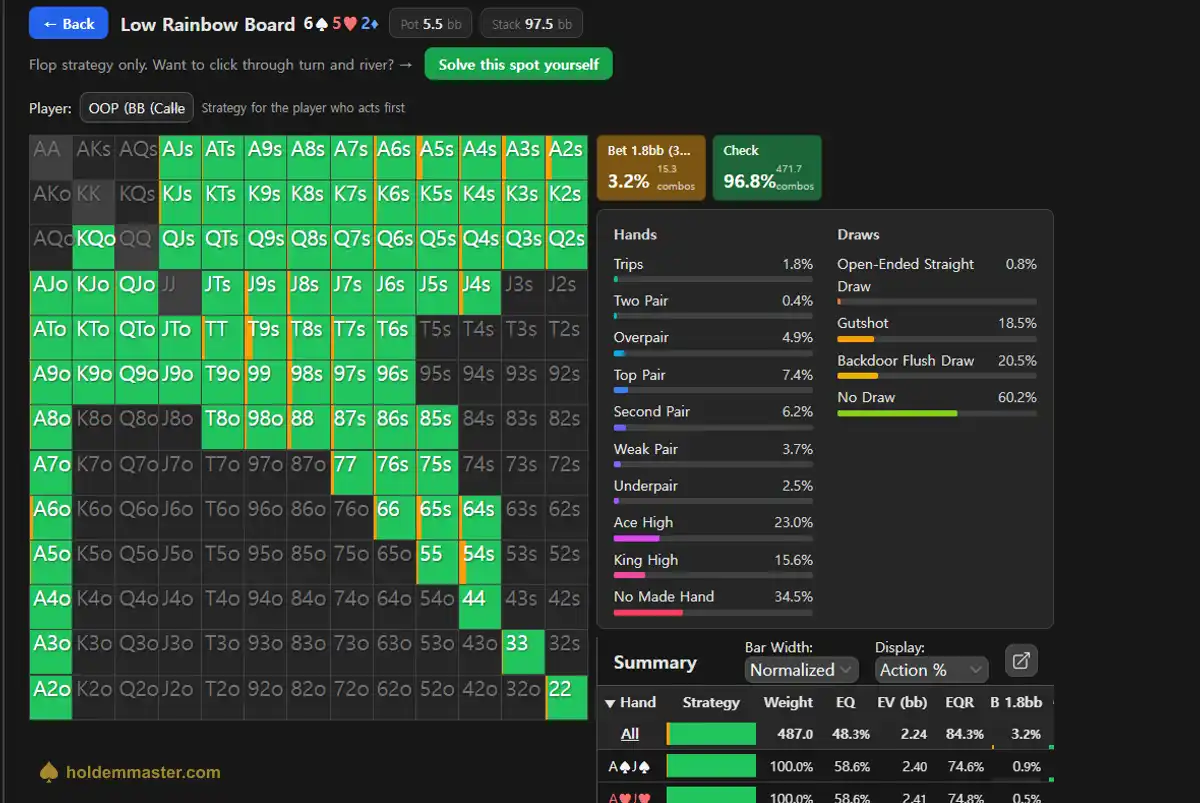
The flop is 6♠ 5♥ 2♦. Three low cards, three different suits — so no flush draw, and a flush would need both remaining cards.
It looks like the kind of board the big blind should attack. The big blind's equity here is 48.3% — the second highest of the seven spots in this series where it defends, ahead of the  ace-high flop's 45.1% and the king-high flop's 46.3%.
It leads 3.2% of the time.
The reason is one hand. Exactly one holding makes a straight on 6-5-2, and neither player has it. Every figure below comes from HoldemMaster's free GTO solver.
✦ Quick answer
Check, then take your shot on the raise. Equity is not what buys you the right to bet first — a top-end edge is, and this board gives neither side one. Once the button bets, the big blind gets to be the aggressor: it check-raises with every set it holds and fills the rest of that raise with straight draws — the group it holds more of than the button, and the one it actually spends here.
What conditions produced these numbers?
The button opens to 2.5bb, the big blind calls, everyone else folds. Two players, a 5.5bb pot, 97.5bb behind. One difference from the earlier spots in this series: there is only one bet size.
| Setting | Value |
|---|---|
| Preflop | BTN opens 2.5bb · BB calls · everyone else folds |
| Ranges | Approximations of standard 100bb online play |
| Flop | 6♠ 5♥ 2♦ (rainbow — three different suits) |
| Pot · stack | Pot 5.5bb · effective stack 97.5bb (SPR about 17.7) |
| Bet size | Roughly 33% of pot — one size only |
| Rake | Not modeled |
| Checked | 2026-08-20 |
The single bet size matters when you read the screen. Earlier spots offered 33% and 75%; this one was solved with 33% alone, so there is no "Bet 4.1bb" row anywhere in the output. Nothing is missing — the option was never in the tree.
How often does the big blind check on 6-5-2?
96.8%. Of 487 combos, 15.3 go out as a bet and 471.7 check.
| Big blind's first action | Frequency | Combos |
|---|---|---|
| Check | 96.8% | 471.7 |
| Bet 1.8bb (33% pot) | 3.2% | 15.3 |
Why does the big blind lead 3.2% here but 23.7% on 9-8-7?
Because equity and the right to bet first are different things. Line the seven spots up and the ranking scrambles completely.
| Flop | Post | BB equity | BB lead |
|---|---|---|---|
| Q♠J♦T♠ broadway (two-tone) | ③ | 46.7% | 0.1% |
| K♠8♦3♣ dry | ② | 46.3% | 0.2% |
| A♥7♦2♣ dry | ① | 45.1% | 1.9% |
| 6♣6♦3♥ paired | ⑥ | 47.2% | 3.0% |
| 6♠5♥2♦ low rainbow | ⑦ | 48.3% | 3.2% |
| Q♠9♠2♠ monotone | ⑤ | 47.7% | 11.2% |
| 9♥8♥7♣ connected | ④ | 48.5% | 23.7% |
Now put ⑦ next to ④. The equity gap is 0.2 percentage points. The lead gap is 3.2% against 23.7%.
The difference is straights. On  9-8-7 the big blind arrives with 24 combos of made straight — J-T, T-6 suited and 6-5 suited. On 6-5-2 the only hand that completes one is 4-3, filling 2-3-4-5-6. To build the straight at the other end you would need 7, 8 and 9 — three cards, and you only hold two.
And 4-3 is in neither range. The solver's category panel has no "Straight" row at all, and 43s and 43o are grayed out in both matrices — the hand never arrives in this spot in either form.
One hand makes a straight on this board, and neither player was ever dealt it.
How do the two ranges differ on 6-5-2?
The big blind wins the pairs and loses everything above them. It holds more top pair, more second pair and more weak pairs than the button; sets and two pair are dead level; and its overpairs run at barely half the button's. Nearly three quarters of both ranges has no pair at all — which is what makes this an overcard fight rather than a value fight, and why the hand that wins it is usually still being drawn to.
| Category | BB (OOP) | BTN (IP) |
|---|---|---|
| Trips | 1.8% | 1.8% |
| Two pair | 0.4% | 0.4% |
| Overpair | 4.9% | 9.5% |
| Top pair (a six) | 7.4% | 5.4% |
| Second pair (a five) | 6.2% | 4.2% |
| Weak pair | 3.7% | 2.4% |
| Underpair | 2.5% | 2.4% |
| Ace high | 23.0% | 28.6% |
| King high | 15.6% | 14.3% |
| No made hand | 34.5% | 31.0% |
Two rows explain the whole spot:
- •The "Trips" row is 1.8% for both players. 🪶 That is the app's label, quoted as the panel shows it — 6-5-2 carries no pair, so what the row actually holds is a set (trips means one card in your hand matching a pair on the board). Only 66, 55 and 22 make it, and each is exactly 3 combos because one of each rank sits on the board. Nine combos each. The best hand on this flop is split down the middle.
- •Overpairs run 4.9% against 9.5% — almost double. An overpair here is any pocket pair above a six, so 77 through AA. The big blind three-bets JJ and better before the flop, which leaves it 77 through TT, and nothing else. The button keeps the whole top of that list.
Why is the equity 48.3% but the EQR only 84.3%?
Because equity is what you own and EQR is what you collect.
| BB (OOP) | BTN (IP) | |
|---|---|---|
| Equity | 48.3% | 51.7% |
| EV (bb) | 2.24 | 3.26 |
| Equity realization | 84.3% | 114.7% |
The number to compare it against is the ace-high flop, where the big blind had 45.1% equity and realized 84.0%. Three points more equity here, and it keeps virtually the same fraction of it. Meanwhile the big blind realized 93.2% on 9-8-7 — because on that flop it held straights, so it could bet even out of position.
Position is worth more than three points of equity when your range has no top-end edge. That is the whole gap.
When should you check-raise on this flop?
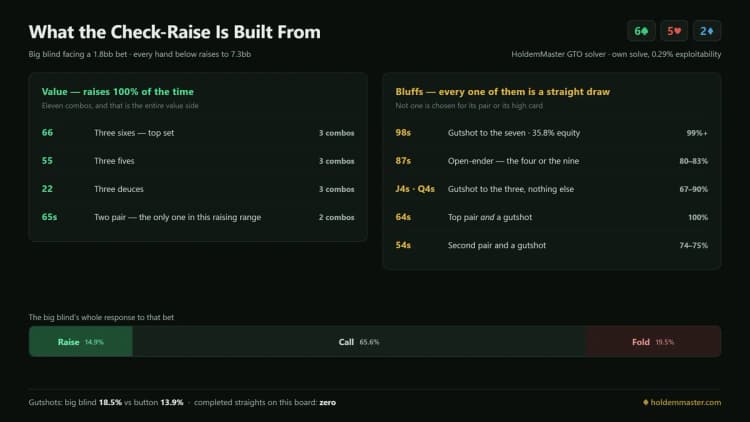
When the button bets, and often. Facing a 1.8bb bet the big blind raises 14.9% of the time.
First, what the button does when the action is checked to it:
| Button, after the check | Frequency | Combos |
|---|---|---|
| Bet 1.8bb (33% pot) | 63.0% | 316.5 |
| Check back | 37.0% | 186.5 |
| Big blind, facing 1.8bb | Frequency | Combos |
|---|---|---|
| Raise to 7.3bb | 14.9% | 69.7 |
| Call | 65.6% | 314.6 |
| Fold | 19.5% | 93.2 |
Two things worth noticing.
The raise is 60% of the pot, not a pot-sized raise. It is easy to get this backwards. Raising to 7.3bb does match what is already in the middle — 5.5 + 1.8 = 7.3 — but a pot-sized raise means raising the pot after your call: 5.5 + 1.8 + 1.8 = 9.1, which would put you at 10.9bb. What 7.3 actually is: (7.3 − 1.8) ÷ 9.1 = 60% of the pot, matching the 60% raise size in the tree, and a shade over four times the bet (7.3 ÷ 1.8 = 4.06).
The big blind folds only 19.5%, which means it continues 80.5% of the time. Against a 1.8bb bet into 5.5bb, the break-even defense figure is 5.5 ÷ (5.5 + 1.8) = 75.3% — the share you have to keep so a pure bluff cannot print money. The solver goes past it, because a board this low and this dry gives almost every hand something to hang on to.
Which hands make up the check-raise?
Every set, both two pairs, and after that almost nothing but straight draws.
We read all 487 rows of the per-hand table rather than the first screen of it. Sorted by raise frequency, the top of that list splits unusually cleanly.
| Hand | What it is | Raises |
|---|---|---|
| 66 · 55 · 22 | Three of a kind — all nine combos | 100% |
| 65s | Two pair — only 6♦5♦ and 6♣5♣ exist, since the 6♠ and 5♥ are on the board | 100% |
| 64s | Top pair and a gutshot | 100% — two of its three combos |
| 98s | Gutshot to the seven — equity 35.8% | 99%+ |
| 87s | Open-ended, the four or the nine — equity 46.2% | 80–83% |
| J4s · Q4s | Gutshot to the three and nothing else | 67–90% |
| 54s | Second pair and a gutshot | 74–75% |
- •98s holds 5-6-8-9 and needs the 7.
- •87s holds 5-6-7-8 and takes the 4 or the 9 — the only open-ender in this range. ⚠ Not the only one the board allows: 74 makes 4-5-6-7 and waits on the 3 or the 8, a textbook open-ender, and 84 is a double gutshot with eight outs of its own (the threes and sevens). The 0.8% in the draw table means this solver's ranges have no 74 suited, not that the board has one open-ender.
- •J4s, Q4s, 54s and 64s all hold 2-4-5-6 and need the 3.
Those seven rows are the top of the sorted list, and they account for roughly 30 of the 69.7 combos that raise. The rest of the raise comes from the same range at lower frequencies — worth knowing before you conclude that nothing else ever raises here.
And look at how little of it is value. Sets and two pair together are 2.2% of the range — 2.2% × 487 ≈ 11 combos — out of the 69.7 that raise. Even counting the two hands that pair the board as well, fewer than one raising combo in four is a made hand. That is why the raise still works when it gets called: most of the range that put the money in can still improve.
And straight draws are what the solver chooses to spend that edge on.
| Draw | BB | BTN |
|---|---|---|
| Open-ended | 0.8% | 0.8% |
| Gutshot | 18.5% | 13.9% |
| Backdoor flush | 20.5% | 18.5% |
| No draw | 60.2% | 66.8% |
Is 6-5-2 a wet board or a dry one?
Dry at the top, wet in the middle. A wet board is one that hands out draws — cards that connect for straights or flushes, so hands that are behind still have a way to win. A dry board gives out almost none. On 6-5-2 the distinction cuts both ways at once, which is why the label alone tells you nothing here.
There is no flush draw, and — as covered above — no completed straight sits in either range. In that sense the board is bone dry: the ceiling is a set, and both players get there equally often.
But 19.3% of the big blind's range holds a straight draw (0.8% open-ended plus 18.5% gutshots), and another 20.5% picks up a backdoor flush. Only 60.2% has neither. So plenty of hands have a reason to keep going even with nothing made.
That combination — a low ceiling and a wide floor — is what produces the numbers above. Nobody can bet a monster because nobody has one, and nobody folds much because almost everybody has an out. A board like Q♠9♠2♠ is the opposite: a high ceiling that both players are afraid the other has already reached. What you can bet follows the ceiling, not the floor — the same principle the continuation bet guide works through on other textures.
What changes at the table?
- •Stop leading low rainbow boards just because you "hit something." Equity of 48.3% is not a reason. On 6-5-2 the entire range leads 3.2%, and the hands doing it are barely committed to it. The lead here is a single size, a third of the pot, so the button only needs 19.8% to call — and its ace-highs and king-highs, 42.9% of the range between them, come in above that bar. You do not fold them out, and what does call has hands that beat you mixed in.
- •Check-raise with your sets, all of them. All nine set combos raise 100% of the time. Slow-playing a set here — when the button has just as many — throws away the one big pot you were going to win.
- •Pick your bluffs by draw, not by high card. The raising range is built from gutshots. An ace-high with no draw — A-J, A-9 — belongs in the calling range, the 65.6%, not the raise. (A-K never reaches this spot: the big blind's defending range tops out at A-J.)
- •Do not over-fold to a small bet. Against 1.8bb into 5.5bb the solver keeps 80.5% of its range, above the 75.3% break-even figure. Folding your king-high and weak pairs to one small bet is the single most exploitable habit on a board like this.
Check it yourself
Open the free GTO solver, then go to Study Spots → Low Rainbow Board → [⚡ View results].
The thing to look for is what is not there: scroll the category panel and find the missing "Straight" row. Then open the matrix and look at the 43s and 43o cells — grayed out for both players. That absence is the entire article.
To reach the check-raise numbers you have to go one step further, because the study spot is flop-only. Hit Solve this spot yourself, keep the tree it loads, and run it. When it finishes, click Check and then Bet on the top strip.
Then open the GTO Trainer in the sidebar: it deals you a hand using the actual range weights and shows how many big blinds your action costs. Free, nothing to install, no account.
Review your own hand from this spot — This spot is a BTN open, BB call pot. If you have played the same situation, open the solver's Hand review ↗, set the situation (Open · Call, BTN and BB) and Your seat, pick Your 2 cards and the 3 flop cards, then enter the actions in the order they were actually played, including your opponent's. Hand review then shows whether that choice is rated Best play, Acceptable or Review this play. Hand review uses the app's preflop charts (online 6-max cash, 100bb), so its numbers can differ from the example above, and it may not suit pub games or tournaments.