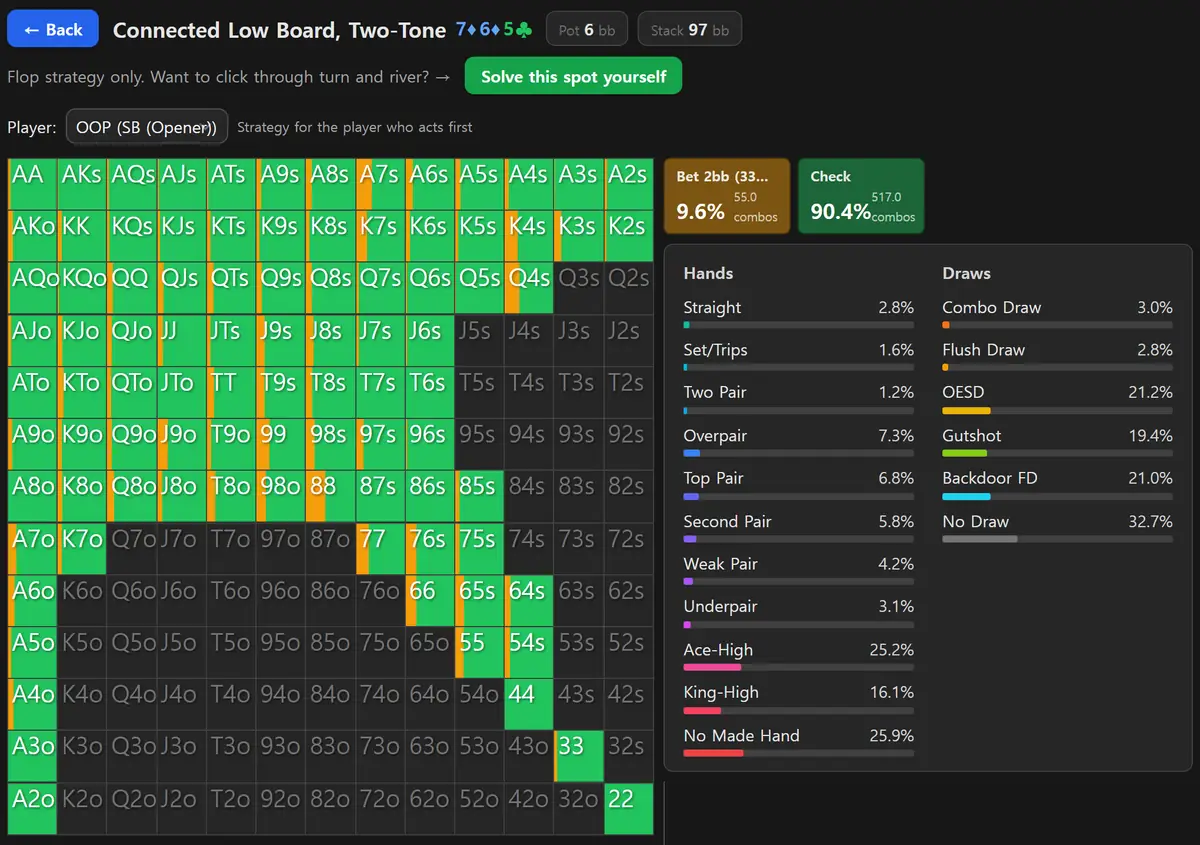
In the previous spot the small blind bet 67.4% with no position. The reason was that the preflop aggressor is also first to act in that seat, so the range edge and the action order land on the same player.
So should the small blind simply always bet blind versus blind? This spot is the answer.
The pot is the same 6bb, the effective stack the same 97bb, and the only bet size in the tree is still a third of the pot. Both ranges are the same as the previous spot too. The only thing that changed is three board cards. And the small blind's bet collapses to 9.6%. Every number below comes from the HoldemMaster GTO solver.
✦ Quick answer
On the 7-6-5 connected board blind versus blind, the small blind's first action is bet 9.6%, check 90.4%. Pot, stack, SPR, bet size and both ranges are identical to the previous spot (K♥T♦6♠) — only the board changed, and the bet fell from 67.4% to 9.6%. The opener's range edge is an edge in high cards, and on a board of 5, 6 and 7 that edge is gone entirely. Equity actually flips to 49.6% against 50.4%, and the small blind's equity realization drops from 103.1% to 85.3%.
What conditions produced these numbers?
They are identical to the previous spot. Since the whole point here is "same conditions, different result," it is worth nailing down what is the same and what is not.
| Item | This spot ⑫ | Previous spot ⑪ | Same? |
|---|---|---|---|
| Preflop | SB opens 3bb → BB calls | SB opens 3bb → BB calls | same |
| OOP (acts first) | SB — the opener | SB — the opener | same |
| Pot | 6bb | 6bb | same |
| Effective stack | 97bb | 97bb | same |
| SPR | 16.2 | 16.2 | same |
| Bet size | One size, about a third of the pot | One size, about a third of the pot | same |
| SB range | 572 combos | 538 combos | same range (only board blockers differ) |
| Flop | 7♦ 6♦ 5♣ | K♥ T♦ 6♠ | different |
| Rake | Not modeled | Not modeled | — |
| Checked | 2026-08-08 (study spot result) | 2026-08-08 | — |
The combo counts differ — 572 against 538 — not because the ranges differ but because cards on the board delete the combos that would have used them. A board of K, T and 6 removes more from a range thick with broadway cards.
The display is in big blinds — bets read as "Bet 2bb (33% pot)", and EV reads as "EV (bb)".
How often does the small blind bet here?
9.6% bet, 90.4% check. Of 572 combos only 55 go into the bet; the other 517 check.
| The small blind's first action | Frequency | Combos |
|---|---|---|
| Bet 2bb (33% pot) | 9.6% | 55.0 |
| Check | 90.4% | 517.0 |
| Spot | Who is out of position | OOP bet frequency |
|---|---|---|
| A♥7♦2♣ · K♠8♦3♣ · Q♠J♦T♠ (①②③) | BB caller | 0.1%–1.9% |
| 6♣6♦3♥ · 6♠5♥2♦ (⑥⑦) | BB caller | 3.0%–3.2% |
| 7♦6♦5♣ blind vs blind (⑫) | SB opener | 9.6% |
| Q♠9♠2♠ monotone (⑤) | BB caller | 11.2% |
| 9♥8♥7♣ connected (④) | BB caller | 23.7% |
| K♥T♦6♠ blind vs blind (⑪) | SB opener | 67.4% |
| A♠A♥6♦ blind vs blind (⑬) | SB opener | 80.1% |
| A♦K♠2♥ · Q♥T♥7♠ · 8♦5♣2♠ (⑧⑨⑩) | BB three-bettor | 98–100% |
Why does 67.4% become 9.6% when nothing else changed?
Because the opener's edge is an edge in high cards. The small blind could open to 3bb because its range is thick with aces, kings and queens and heavy in broadway combinations — and not one of those cards touches 5, 6 or 7.
The previous board was the opposite. The top card was a king, and king combinations are far more numerous on the opener's side. Put the same range on a low connected board and that structure inverts.
| K♥T♦6♠ (⑪) | 7♦6♦5♣ (⑫) | |
|---|---|---|
| Top board card | K — the opener's card | 7 — the caller's card |
| SB equity | 55.3% | 49.6% |
| SB EQR | 103.1% | 85.3% |
| SB bet frequency | 67.4% | 9.6% |
The range edge is won preflop, but whether it gets realized is decided by three cards on the flop.
The previous article ended by saying "on boards that fit the caller the check comes back even from this seat." This is that case, and the number the solver puts on it is 9.6%.
Why does this board favor the big blind?
Because the big blind's calling range adds hands the small blind never opens that hit 7-6-5 — T7o, 97o, 87o, 76o, 74s and 43s among them — on top of the straights, sets and two pair both ranges hold. The top five rows below are the classes that actually hit this board, and apart from overpairs the small blind does not lead a single one.
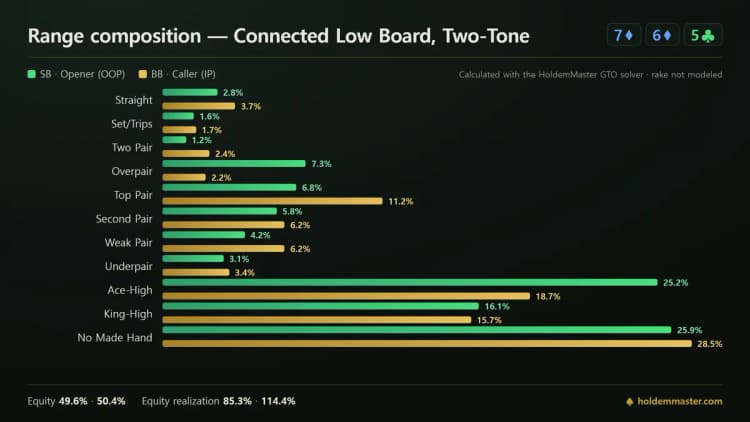
| Class | SB (OOP · opener) | BB (IP · caller) |
|---|---|---|
| Straight | 2.8% (16 combos) | 3.7% (20 combos) |
| Set/trips | 1.6% (9 combos) | 1.7% (9 combos) |
| Two pair | 1.2% (7 combos) | 2.4% (13 combos) |
| Overpair | 7.3% (42 combos) | 2.2% (12 combos) |
| Top pair (7) | 6.8% (39 combos) | 11.2% (60 combos) |
| Second pair (6) | 5.8% | 6.2% |
| Weak pair | 4.2% | 6.2% |
| Underpair | 3.1% | 3.4% |
| Ace-high | 25.2% | 18.7% |
| King-high | 16.1% | 15.7% |
| No made hand | 25.9% | 28.5% |
- •Top pair is 39 combos against 60. Half again as many sevens for the big blind. The small blind's opening range is built without offsuit hands like T-7, 9-7 and 8-7, while the big blind — already in for 1bb — adds just 2bb and keeps every one of them.
- •Straights are 16 combos against 20. Both hold 9-8 (making 9-8-7-6-5), but the big blind also has 4-3 suited for 7-6-5-4-3. The small blind's opening range has no 4-3 suited.
- •Two pair is 7 combos against 13. All six combos of offsuit 7-6 belong to the big blind alone.
The one class the small blind leads is overpairs, 42 combos (7.3%) against the big blind's 12 (2.2%) — everything from T-T up gets three-bet against a small-blind open, so only 8-8 and 9-9 remain in the calling range.
The trouble is that an overpair is not a strong hand on this board. The hands already beating it in the opponent's range come to 9 sets + 13 two pairs + 20 straights = 42 combos. The 60 combos of top pair currently losing to it can turn into two pair or trips by the river, and the draws run thicker on the big blind's side as well.
| Draw | SB | BB |
|---|---|---|
| Combo draw | 3.0% | 3.7% |
| Flush draw | 2.8% | 2.6% |
| Open-ended straight draw | 21.2% | 24.9% |
| Gutshot | 19.4% | 23.8% |
| Backdoor flush draw | 21.0% | 15.5% |
| No draw | 32.7% | 29.4% |
🪶 The small blind leads exactly two cells: flush draws 2.8% to 2.6%, and backdoor flushes 21.0% to 15.5%. The first is a 0.2-point gap, effectively a tie; the second needs runner-runner cards of the same suit and completes only about 4.2% of the time. All six rows have to be added to reach 100%, so do not stop reading this table at "no draw."
The opener is behind on equity — how?
Because ace-high and king-high are worth almost nothing on this board. 41.3% of the small blind's range is ace-high or king-high (25.2 + 16.1), and above 5-6-7 those combinations are simply high cards.
| Item | SB (OOP) | BB (IP) |
|---|---|---|
| Equity | 49.6% | 50.4% |
| EV (bb) | 2.54 | 3.46 |
| EQR (equity realization) | 85.3% | 114.4% |
Equity is nearly even at 49.6 to 50.4, yet realization splits wide at 85.3% against 114.4%. That gap is what position is worth. In the previous spot the range edge more than covered it and the small blind realized 103.1%; here there is no edge left to cover it with.
Rank the out-of-position EQR of six selected spots from low to high and this one sits among the callers. (The true bottom of the whole series is ③ at 77.9%, ② at 80.7% and ⑥ at 83.7%, all caller seats; the table below is an excerpt with that tail cut off.)
| Spot | Who is out of position | OOP equity | OOP EQR |
|---|---|---|---|
| A♥7♦2♣ dry (①) | caller | 45.1% | 84.0% |
| 6♠5♥2♦ low (⑦) | caller | 48.3% | 84.3% |
| 7♦6♦5♣ blind vs blind (⑫) | opener | 49.6% | 85.3% |
| 9♥8♥7♣ connected (④) | caller | 48.5% | 93.2% |
| K♥T♦6♠ blind vs blind (⑪) | opener | 55.3% | 103.1% |
| 8♦5♣2♠ 3-bet pot (⑩) | three-bettor | 58.6% | 106.9% |
So which hands make up the 9.6% that bets?
Not one block — a thin layer smeared across the whole range. Nowhere in the matrix is a cell fully orange; most carry a narrow orange stripe. Even A-A and K-K are mostly green.
Three kinds of cell carry a visibly thicker stripe. (The frequencies below are combo averages for each hand class, counted by reading the live per-hand table all the way down on 2026-08-21.)
- •8-8 — betting 39.5%, the most frequent class in the range. On 7-6-5 an eight-eight is an overpair and an open-ender at the same time (8-7-6-5 completes with a four or a nine). Value and draw in one hand, so there are two reasons to bet. Measured equity runs 73.4%–75.2% and EQR 133%–138%.
- •A-7 suited and K-7 suited — top pair with a seven. They get picked not for strength but because thin value comes with an ace or king blocker (holding the ace or king removes several of the opponent's ace-high or king-high combos). Top pair on this board actually trails, 39 combos to 60.
- •K-4 suited and Q-4 suited — a suited four. Add a four to 7-6-5 and you hold 4-5-6-7, an open-ender completing on a three or an eight. By class average that is Q-4s at 30.9% and K-4s at 27.1%, but as individual combos Q♠4♠ and Q♥4♥ hit 54.7%, the highest in the entire spot.
 ⑪ K-T-6 and on
  the A-A-6 board later in the series, where the same small blind bets 67.4% and 80.1%. What produced 9.6% is not the stack; it is three board cards.
What changes at the table?
- •Do not turn "it's blind versus blind, so bet" into a rule. The 67.4% of the previous spot and the 9.6% here were split by the board, not the seat. Even if you opened from the small blind, once the flop runs low and connected — 5, 6, 7, 8 — the initiative in that hand has already crossed the table.
- •Do not treat an overpair as a reason to build a big pot. The small blind's 42 combos of overpairs are three and a half times the big blind's, but on a board where the opponent holds 42 combos that already beat them, this is not a hand for two or three barrels. That is not an argument against a single small bet — the point is not to treat it as a stack-off hand. ⚠ Nor does it mean "fold the moment a raise comes." The opponent's range holds 24.9% open-enders, 23.8% gutshots and 3.7% combo draws, so a flop raise cannot be all value, and auto-folding an overpair to a draw-heavy opponent's raise is itself an exploitable habit. Declining to stack off and folding are different things. And the bet-then-raise node is not in this solve, so no frequency comes out of it. This series keeps reaching the same conclusion, that
 a connected board shaves the preflop aggressor's edge.
 - •Do not mistake ace-high for strength. A quarter of the small blind's range is ace-high, and on this board most of it can only pair up (A4 and A8 pick up open-enders, and the A♦x♦ hands a flush draw). The opponent's draws, when they hit, are mostly straights — what differs is not the chance of improving but what the improvement is worth. The 49.6% equity figure is the result.
- •Decide in advance what you do after checking. Having passed 90.4% into a check, what you call and what you
 check-raise against the opponent's bet is the next real problem. ⚠ That answer is not in this calculation — the study spot solves only the first action on the flop, so the nodes after a check (the big blind's betting frequency, the small blind's check-raise) simply do not exist. If you want a spot where a check-raise was actually solved, the low-rainbow board is the only one in the series with re-solved frequencies — though the seat is different (there the big blind is the caller facing a button).
Check it yourself
Every figure here comes up if you open the GTO solver and hit Study Spots → "Connected Low Board, Two-Tone" → [⚡ View results]. To play the same spot as a problem instead, open the GTO Trainer from the sidebar — it deals you a random hand, and once you pick an action it shows the mixed frequency and the EV loss (bb) of your choice. Your history is kept on this device by default; signing in with a HoldemMaster account syncs your Study Spots and Daily Challenge history across devices.
Click back and forth with "King-High with a Ten", the previous spot. The player labels read "OOP (SB (Opener))" on both, the pot and stack are identical — and the matrix flips colour completely. It is the shortest demonstration in this series of what a board actually does. Free, no install, no account.
Review your own hand from this spot — This spot is an SB open, BB call pot (blind vs blind). If you have played the same situation, open the solver's Hand review ↗, set the situation (Open · Call, SB and BB) and Your seat, pick Your 2 cards and the 3 flop cards, then enter the actions in the order they were actually played, including your opponent's. Hand review then shows whether that choice is rated Best play, Acceptable or Review this play. Hand review uses the app's preflop charts (online 6-max cash, 100bb), so its numbers can differ from the example above, and it may not suit pub games or tournaments.