In the seven spots before this one, the big blind's answer was almost always to check. Even on the  9-8-7 flop, where leading mattered most, it only bet 23.7% of the time. Everywhere else it checked between 88.8% and 99.9%.
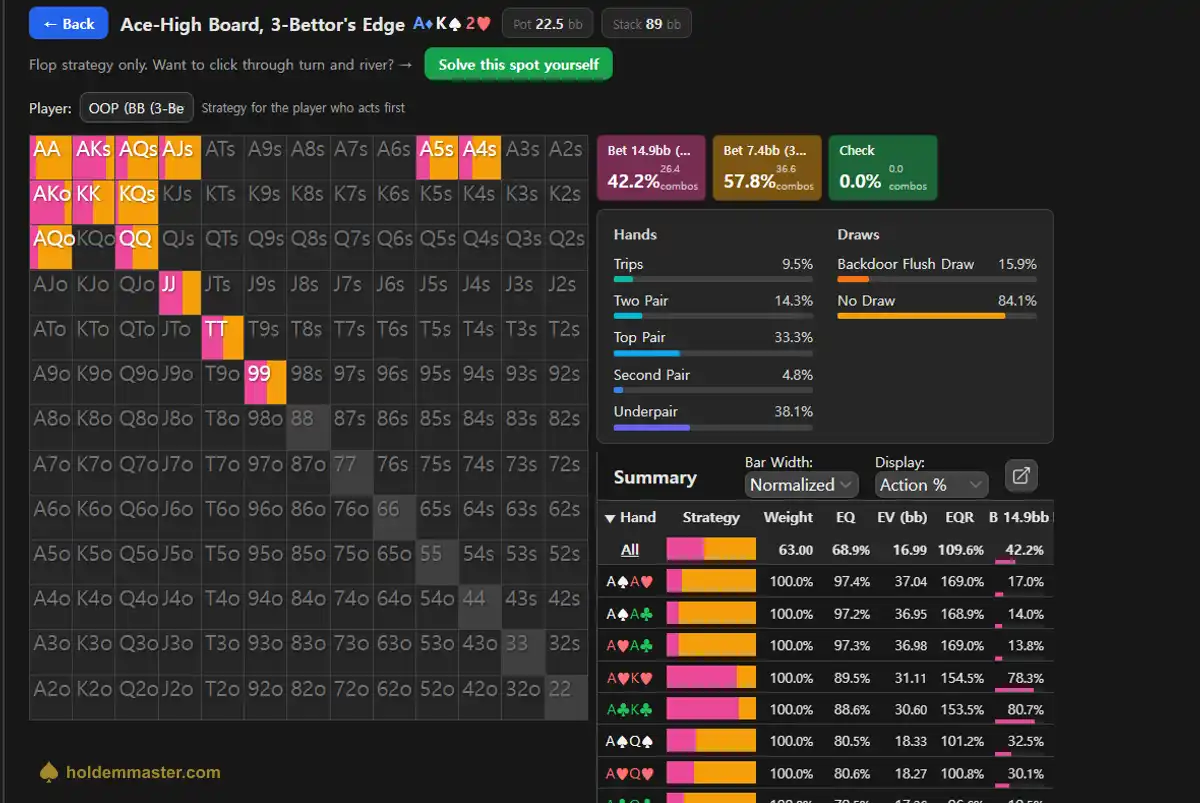
Here it does the opposite: the big blind bets its entire range — all 63 combos, each at least 99.9% of the time.
What changed is mainly the preflop action: the big blind three-bet instead of calling, so the pot is 22.5bb instead of 5.5bb. (⚠ The board moved too — spot ① was A♥7♦2♣, this is A♦K♠2♥ — so this is not a controlled comparison with preflop as the only variable.) That difference flips the entire flop on its head. Every figure below comes from HoldemMaster's free GTO solver.
✦ Quick answer
The big blind bets its entire range. The small size (7.4bb, 33% of the pot) is used 57.8% of the time and the large one (14.9bb, 66%) 42.2%. It is not because every hand is strong — 38.1% of the range is a pocket pair below the king. It is because the button four-bet its pocket aces and kings away before the flop, so the top of this board belongs to one player, and with an SPR of 4.0 there is no later street worth saving a check for.
What conditions produced these numbers?
★The conditions are different from the first seven spots. The pot, the stack and the roles all changed, so the table comes first.
| Setting | This spot (3-bet pot) | ①–⑦ (single-raised pot) |
|---|---|---|
| Preflop | BTN opens → BB three-bets to 11bb → BTN calls | BTN opens 2.5bb → BB calls |
| OOP (acts first) | BB — the three-bettor | BB — the caller |
| IP | BTN — the caller | BTN — the opener |
| Pot | 22.5bb | 5.5bb |
| Effective stack | 89bb | 97.5bb |
| SPR | 4.0 | 17.7 |
| Bet sizes | Roughly 1/3 and 2/3 of pot | Roughly 33% and 75% (⑦ had one size) |
| Rake | Not modeled | Not modeled |
| Checked | 2026-08-20 | ①–④ 2026-08-19 · ⑤–⑦ 2026-08-20 |
Is the check frequency really 0%?
0.0% on screen. The raw output does hold a residue — 41 of the 63 combos carry a sliver of checking, the largest K♥K♦ at 0.09%, together less than a hundredth of a combo. That is solver noise, not a strategy, so read it as zero. Betting splits between two sizes instead: 57.8% takes the small one at 7.4bb and 42.2% the large one at 14.9bb. Across the seven single-raised pots before this, the big blind's default was the opposite in every single one.
| Big blind's first action | Frequency | Combos |
|---|---|---|
| Bet 7.4bb (33% pot) | 57.8% | 36.6 |
| Bet 14.9bb (66% pot) | 42.2% | 26.4 |
| Check | 0.0% | 0.0 |
A 0.0% does not mean checking is forbidden. It means every combo's checking EV came out below its betting EV in this tree, with these ranges.
In the earlier spots the losing action still kept a scrap — 0.2%, 0.1%. Here the check does not even get that.
Why doesn't a single combo check?
Because the big blind owns the top of this board outright. Three hands make a set on A-K-2, and it holds two of the three. When the player who has to act first also holds the best hand far more often, there is nothing a check protects that a bet does not protect better. The category table shows how far that runs.
| Category | BB (OOP) | Combos | BTN (IP) | Combos |
|---|---|---|---|---|
| Set | 9.5% | 6 | 2.3% | 3 |
| Two pair | 14.3% | 9 | 6.9% | 9 |
| Top pair (an ace) | 33.3% | 21 | 20.8% | 27 |
| Second pair (a king) | 4.8% | 3 | 11.5% | 15 |
| Underpair | 38.1% | 24 | 46.2% | 60 |
| No made hand | 0.0% | 0 | 12.3% | 16 |
Look at the top row. Three hands make a set on A-K-2 — AA, KK and 22 — and the button holds only the last one. (The solver's panel labels that row Trips. On a board with no pair on it, a pocket pair matching a board card is a set — the distinction is laid out in the  paired-board spot.) The button four-bets its pocket aces and kings before the flop, so its set count is three combos against the big blind's six.
That is the whole spot. When your opponent almost cannot have the best hand, you can bet with the parts of your range that are not strong at all — and 38.1% of this range is a pocket pair below the king.
"No made hand: 0.0%" is not the reason, though it is easy to think so. The same three-bet range on a low board tells you otherwise: on the  8-5-2 flop later in this series, 48.2% of the big blind's range is ace-high with no pair at all — and it still checks only 2.0%. Going from 0% air to 48% air moves the check by two points. What makes a check appear is not how much air you hold; it is whether the board turns against the three-bettor.
 ace-high flop in a single-raised pot. There the big blind was the capped one — no AA, AK or AQ, because it would have three-bet them — and it checked 98.2%. Same ace-high texture, opposite seats: the player who three-bet is the player who keeps the top.
What is SPR in poker?
SPR is short for stack-to-pot ratio: the effective stack divided by the pot at the start of the flop. Here it is 89 ÷ 22.5 = 4.0, so the stack behind is only four times what is already in the middle. That is the number that makes a flop decision into a decision about the whole stack, because there is no longer enough room to put the question off.
| Situation | Pot | Effective stack | SPR |
|---|---|---|---|
| Single-raised pot (①–⑦) | 5.5bb | 97.5bb | 17.7 |
| Three-bet pot (this one) | 22.5bb | 89bb | 4.0 |
- •Flop 14.9bb → called, the pot is 52.3bb and 74.1bb remains
- •Turn 34.5bb → called, 39.6bb remains
- •River 39.6bb all in
Run the same three bets in a single-raised pot and you have spent 3.67 + 8.56 + 19.96 = 32.2bb, a third of the stack. That is the real difference between SPR 17.7 and SPR 4.0 — not the money, the number of decisions you still get to make. And when there is no later street to defer to, a check has nothing left to buy.
Why is the smaller size used more often?
Because of the shape of the range, not the depth of the stack. All 63 combos here are a pair or better, so the bottom of the range is gone entirely and it never splits into "nuts or nothing." With no air to pair up with the large size, the whole range gets pushed toward the small one — which is why 57.8% of it goes out at a third of the pot. ("Condensed" is the usual label for a range with no bottom and no top; it does not fit here, because this range owns the top of the board outright — both top sets, AA and KK, all six combos.)
A-K-2 rainbow gives almost nothing to draw to, so there is no need to charge a draw either. Between the two, the range shape is what does the work.
⚠ "Shallow stacks mean small bets" is not it. Two later spots in this series sit at exactly the same SPR of 4.0 and fire the large size almost always — Q-T-7 at 98.4% and 8-5-2 at 97.8% — for two different reasons. Q-T-7 is a wet board, so a big bet is what puts a price on the draws. 8-5-2 is dry like this one, but its range splits into overpairs and ace-high with almost nothing between, and a polarized shape bets big. Same stack depth, opposite sizing, and neither reason is the depth.
And the large size is not "the strong hands' share" either. Count the combos that can get a whole stack in — sets, two pair and top pair — and you get 6 + 9 + 21 = 36 combos, 57.1%, which is more than the 42.2% that bets large.
The giveaway is that the combo counts are not whole numbers: 26.4 large and 36.6 small. If whole categories were assigned to one size, both counts would be integers. The same hand is mixing between the two sizes, and 42.2% means "42.2% of the range" — not "a particular tier." Making the size unreadable is the point.
What does the button actually have?
Nearly half of its calling range — 46.2% — is a pocket pair with neither an ace nor a king in it — so it walks straight into a board that has both.
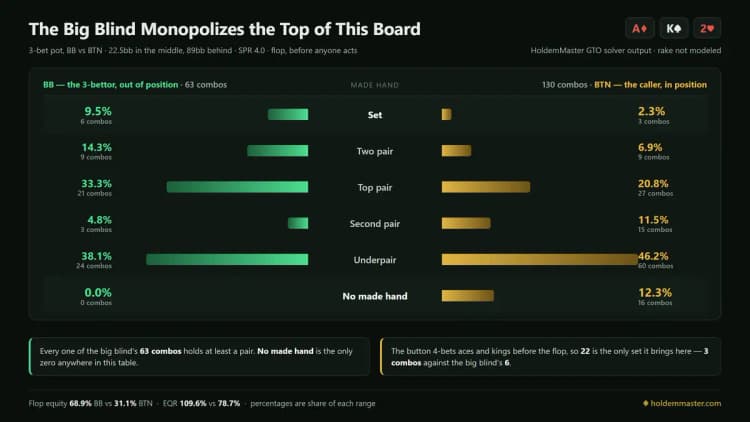
Underpairs are 46.2%, or 60 combos: QQ down to 33, ten pairs at six combos each. They cannot call two barrels on this texture.
One caveat worth naming: those 130 combos are the calling range this solve was given — a preflop setting written into the tree, not a defense the solver worked out. Real opponents fold middle pocket pairs and call with A-Q, A-J and K-Q instead. Against that player the 46.2% is not there — so look at what your opponent actually called with before you take these numbers into a live game.
How does the button respond to a third-pot c-bet?
It is a hard spot to call all the way down. The button's underpairs are blocked by both the ace and the king, and at an SPR of 4.0 there is not much distance left before the stack is gone.
⚠ Which bet is the all-in depends on the size. At two-thirds it is 14.9 → 34.5 → 39.6, exactly three. At the 7.4bb (one-third) bet this section is about, three bets come to 7.4 + 12.3 + 20.4 = 40.1bb, only 45% of the stack. And the turn node does not exist in this solve — the study spot stops at the flop's first action, so everything from here is read off the range composition.
Facing 7.4bb into 22.5bb, denying a pure bluff any profit takes about 22.5 ÷ (22.5 + 7.4) = 75.3% of the range — the minimum defense frequency. But the button's hands that actually connected with A-K-2 add up to only 20.8 + 11.5 + 6.9 + 2.3 = 41.5%. 🪶 Note that the 2.3% of sets is 22 — it paired the deuce, not the ace or the king. Counting only the hands that paired an ace or a king gives 39.2%.
⚠ In this spot, though, the premise behind MDF stands on weak ground. MDF is the frequency that makes a pure bluff with zero equity indifferent — and the big blind's betting range contains 0.0% no-made-hand, not one combo. A range with no unpaired hand in it leaves little of the pure bluffing MDF assumes, so the lean is toward folding more, not less. ⚠ Two qualifications keep that honest: ① "0% no-made-hand" is not "0% bluffs" — a weak underpair in the betting range can be doing the work of a bluff or a protection bet; ② the button's response node is not in this solve, so the actual optimal defense frequency cannot be confirmed here. So do not read the 41.5% as "therefore continue with middle pocket pairs." Whether the small size even prices those 60 combos in is doubtful: against the big blind's whole range only QQ and JJ hold more than the 19.8% it asks for, while 99 down to 33 sit at 7.6%–9.2%. Either way, the reason for the size is the shape of the range from the previous section; this is a side effect.
Why is the EQR 109.6% when the big blind is out of position?
Because a big enough range advantage outweighs position. This is the first spot in the series where the out-of-position player realizes more than its equity — 68.9% against 31.1% is a different order of gap from the single-raised pots, where the out-of-position player ran 45.1% to 48.5% against 51.5% to 54.9%.
| BB (OOP) | BTN (IP) | |
|---|---|---|
| Equity | 68.9% | 31.1% |
| EV (bb) | 16.99 | 5.51 |
| Equity realization | 109.6% | 78.7% |
Position magnifies an edge. It does not manufacture one.
The button's 78.7% is not separate evidence of that — it is the same fact seen from the other side, since the two EVs add up to the pot, so one player's realization going above 100% forces the other's below it. What is worth looking at is the size of the gap. Across ①–⑦ the out-of-position player realized between 77.9% and 93.2%; here it clears 100%, because everything the button folds lands in the big blind's stack. Why position is usually worth money is covered in position play.
What changes at the table?
- •Stop deciding whether to c-bet a three-bet pot — but only heads-up. On an ace-high dry board where the three-bettor holds the top, the whole range bets, and the only question is the size. If a cold-caller comes along and three players see the flop, "bet everything" stops being true; drop the underpairs first for every extra player.
- •Count your SPR before the flop comes. A bigger pot means fewer bets left, not less money. SPR 4 is the band where three big bets finish the stack — there is no fourth. Count the bets you have left, then pick the size.
- •★Betting the whole range is not the same as stacking off with the whole range. 38.1% of what bets here is a pocket pair below the king. Even inside that group it splits: QQ beats more than half of the button's calling range and is a hand to check the turn with, while TT and 99 are the first to go when a raise comes.
- •★Top pair splits by kicker. Those 21 combos include A5s and A4s — hands three-bet as blockers, with the worst kicker there is. The range that calls off 89bb is narrow — 22 and A-K at its core, with a strong top pair like A-Q attached depending on the opponent. A-4 beats none of it. The sets (AA, KK) beat all of it. A-K sits in between: it chops with the button's A-K and loses to 22, so "SPR 4, so it all goes in" holds unconditionally only for AA and KK — whether A-K belongs there depends on how wide the opponent calls.
- •★If the flop gets raised, the hand is over right there. At SPR 4 a raise commits the rest of the stack. It is not a call-and-see-the-turn spot: decide to jam or fold right there — sets go in, low underpairs and weak-kicker top pairs lean toward folding. ⚠ That is a policy drawn from the SPR and the hand classes, not a solver output: this example has no node for facing a raise, so the exact jam/call/fold boundaries cannot be confirmed. Two pair (A-K) depends on how wide the raise is: against a raising range of sets and A-K it is never ahead.
- •Do not carry "check 0%" to every three-bet pot. What changes it is the board more than the range: the same three-bet range on 8-5-2 checks 2.0%, and on a board that runs against the three-bettor a check appears for real. "An ace and a king together" is what produced this zero in this example — not a condition every three-bet pot has to meet. How to build the three-bet range in the first place is in 3-bet strategy.
Check it yourself
Open the free GTO solver, then go to Study Spots → Ace-High Board, 3-Bettor's Edge → [⚡ View results].
Check the header first: Pot 22.5bb · Stack 89bb. Seeing those instead of the 5.5bb and 97.5bb of the earlier spots is this whole article in a single glance. Then look for the row that is not there: the Hands panel lists only five categories for the big blind, and the missing one is "No made hand". Above it, in the action strip, the check chip reads 0.0% / 0.0 combos.
Then open the GTO Trainer in the sidebar: it deals you a hand using the actual range weights and shows how many big blinds your action costs. Free, nothing to install, no account.
Review your own hand from this spot — This spot is a 3-bet pot: BTN opens, BB 3-bets and BTN calls. If you have played the same situation, open the solver's Hand review ↗, set the situation (3-bet pot, Opening seat BTN, 3-betting seat BB) and Your seat, pick Your 2 cards and the 3 flop cards, then enter the actions in the order they were actually played, including your opponent's. Hand review then shows whether that choice is rated Best play, Acceptable or Review this play. Hand review uses the app's preflop charts (online 6-max cash, 100bb), and its larger flop bet is 75% of the pot rather than 66%, so its numbers can differ from the example above, and it may not suit pub games or tournaments.
 Q-T-7 spot