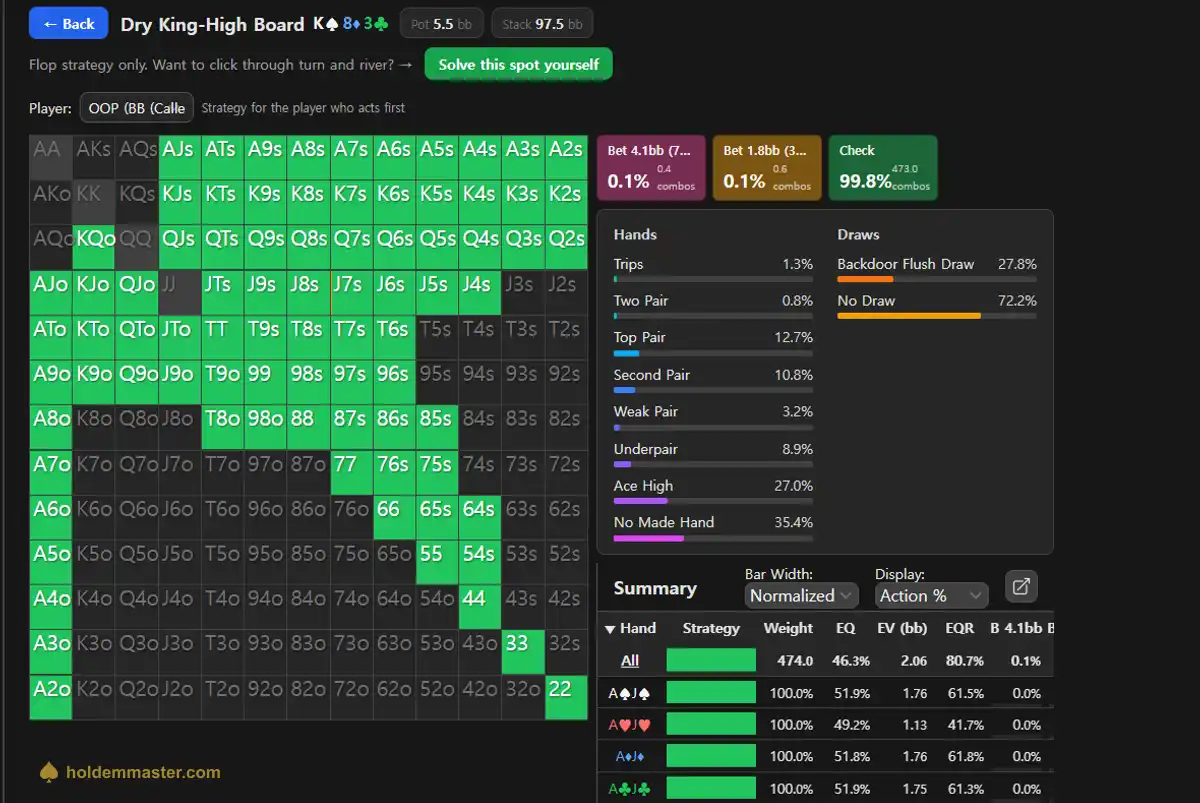
The flop comes K♠ 8♦ 3♣, rainbow. You hold K9 in the big blind — top pair. You already learned to check the ace-high version. Surely a king is different?
It is. It checks harder. The big blind checks 99.8% here, more completely than the 98.2% on  the ace-high flop. Both bet sizes together take 0.2% — one combo out of 474.
Every figure below came from HoldemMaster's free GTO solver, read off the study-spot output on 2026-08-19.
✦ Quick answer
Check everything, and expect to defend wide afterwards. One combo out of 474 leads, so treat leading as unavailable here. Two things make this check purer than the ace-high version: the big blind has no overpair on this board — AA three-bets preflop — and equity realization splits 80.7% against 116.7% even though equity is nearly even.
What conditions produced these numbers?
The button opens to 2.5bb, the big blind calls, everyone else folds — two players, a 5.5bb pot, 97.5bb behind. Ranges are the standard 100bb online approximations, the flop is K♠ 8♦ 3♣ with three different suits, and the solver has two bet sizes available, roughly a third and three-quarters of the pot. Rake is not modeled.
| Setting | Value |
|---|---|
| Preflop | BTN opens 2.5bb · BB calls · everyone else folds |
| Ranges | Approximations of standard 100bb online play |
| Flop | K♠ 8♦ 3♣, rainbow (all three suits different) |
| Pot · stack | Pot 5.5bb · effective stack 97.5bb |
| Bet sizes | Roughly 33% and 75% of pot |
| Rake | Not modeled |
| Checked | 2026-08-19, study spot output |
How often does the big blind check on K-8-3?
99.8%. The remaining 0.2% is split between the two bet sizes.
| Big blind's first action | Frequency | Combos |
|---|---|---|
| Check | 99.8% | 473.0 |
| Bet 1.8bb (33% pot) | 0.1% | 0.6 |
| Bet 4.1bb (75% pot) | 0.1% | 0.4 |
Why is this check even purer than on an ace-high flop?
Because the big blind holds no overpair here, and the ace-high flop has no overpair to hold. On K-8-3 the only pocket pair above the board is AA — and the big blind three-bets AA preflop, so it never arrives. Overpairs: 0.0% for the big blind, 1.3% for the button.
On A-7-2 that column does not exist for anybody: nothing is above an ace. So both ranges are missing the same thing, and their ceilings look alike. On a king-high board, the ceiling belongs to one player.
Sets say the same thing. The pocket pairs that flop a set here are KK, 88 and 33, and the big blind has only 88 and 33.
| Pocket pair that flops a set | BB | BTN |
|---|---|---|
| KK | ❌ (three-bets preflop) | ✅ |
| 88 · 33 | ✅ | ✅ |
| Share of range | 1.3% | 1.9% |
How do the two ranges differ?
The strong categories sit with the button, the weak ones with the big blind. Side by side the gap is obvious.
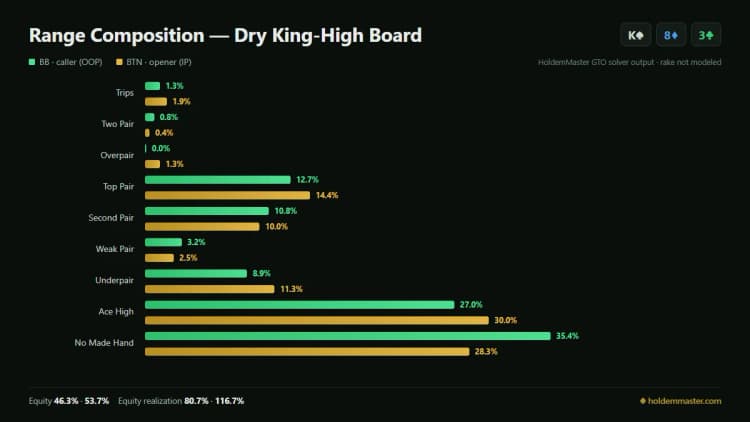
| Category | BB (OOP) | BTN (IP) |
|---|---|---|
| Trips — here always a set | 1.3% | 1.9% |
| Two pair | 0.8% | 0.4% |
| Overpair | 0.0% | 1.3% |
| Top pair (K) | 12.7% | 14.4% |
| Second pair (8) | 10.8% | 10.0% |
| Weak pair | 3.2% | 2.5% |
| Underpair | 8.9% | 11.3% |
| Ace high | 27.0% | 30.0% |
| No made hand | 35.4% | 28.3% |
Why is almost a third of both ranges ace high?
It happens on any board without an ace. Ace high is 27.0% of the big blind's range and 30.0% of the button's, close to a third each. On A-7-2 that group does not exist, because every ace is instantly top pair. So the contrast is not "king-high against everything else" but "boards with an ace against boards without one" — on the 8-5-2 flop later in this series, solved with a three-betting range, ace-high climbs to 48.2%.
That group is what makes this flop interesting. AQ and AJ have no pair, yet they beat every hand in the opponent's "no made hand" column, so they have showdown value. On the button, they are not automatic c-bets: part of the time they check back and take the free showdown.
The big blind's best ace-high here is AJ — its AQ three-bets preflop — and that AJ is worth less than it would be on the button, because getting to showdown without position is harder. Similar cards, different value by seat — which is exactly what the next section measures.
Why is EQR 81 against 117 when equity is 46 against 54?
Equity is your share of the pot if all the cards were dealt out, with ties counted as half; equity realization is how much of that you actually collect. They are not the same number.
| Metric | BB (OOP) | BTN (IP) |
|---|---|---|
| Equity | 46.3% | 53.7% |
| EV (bb) | 2.06 | 3.44 |
| Equity realization (EQR) | 80.7% | 116.7% |
The ace-high flop was 84.0% against 113.1%. Same dry texture, wider gap on the king board. Not because this board is quieter, though — the two widest EQR gaps in this series belong to boards drenched in draws: the  Q-J-T two-tone flop at 41.5 points and the Q-T-7 three-bet pot at 42.7. What opens the gap here is one column at the top — on A-7-2 neither player has an overpair, while on K-8-3 the button has 1.3% and the big blind has none. Why the seat itself is worth so much is covered in
  playing position.
Are there really no draws here?
No draws at all. K, 8 and 3 are three different suits and too far apart to connect, so there is no flush draw and no open-ended straight draw for either player — and no gutshot either. A flop straight draw needs two board cards inside one five-card run, since you only hold two, and K to 8 is five ranks apart, as is 8 to 3. No run holds two of them.
| Draw | BB | BTN |
|---|---|---|
| Backdoor flush (needs two more of a suit) | 27.8% | 22.3% |
| No draw | 72.2% | 77.7% |
Should you always c-bet a king-high flop?
Close to it at a small size, but "always" is the wrong word for one group of hands. The big blind has 35.4% with no made hand — the third of the range most likely to fold, though not all of it can: against a third-pot bet a balanced defense keeps about 75% of the range (MDF), so some of those hands still continue. (The big blind's response is not in this solve.) And 72.2% of the whole range has no draw — note the denominator: that figure counts the entire range, top pair (12.7%), second pair (10.8%) and sets included, so it is not a subset of the no-made-hand block. It means the picture is unlikely to change on later streets. Betting about a third of the pot with most of your range is the standard.
The common advice is that ace-high hands with showdown value should check back. On this board that is half right. At a small size, AQ and AJ mix in bets often enough — they fold out hands like QJ, JT and T9 that hold live cards but no pair, and an ace on a later street gives them the best pair on the board. But they also cost little by checking, so this is where much of the check-back range comes from. Neither "always bet" nor "always check back" is correct; the frequency is the answer.
What changes at the table?
- •Having called a raise heads-up on a dry king-high flop, leading is not a candidate. Even with a king. The range-check logic from the ace-high flop applies more strongly here, not less. The condition is the shape of your range, not the shape of the board, though — where the top of your range is thicker than theirs, the big blind does lead. The counterexample is the
 9-8-7 flop, where the big blind leads 23.7% of the time.
 - •Checking is not check-folding. Facing the small c-bet, the big blind continues wide — every king, the eights, the underpairs, ace-high with a backdoor. Top pair is a call; the natural check-raise candidates are 88, 33 and the two pairs (this solve does not cover the response to the c-bet).
- •On the button, do not give AQ and AJ one fixed treatment. Betting small and checking back are both defensible; adjust the mix based on whether this opponent actually folds overcards.
- •Do not read the check as weakness — against a balanced opponent. That checking range still holds the sets (88, 33) and 12.7% top pair. At low stakes the reverse is often true, because many players simply lead their strong hands, so keep value betting and treat the check-raise as an occasional cost.

Check it yourself
Open the free GTO solver, go to Study Spots → Dry King-High Board → [⚡ View results], and this screen appears with no waiting. Then switch the player selector to IP (BTN) — the range-composition table above is read straight off that panel, and comparing the two sides is the fastest way to see why one of them cannot bet.
To drill the spot instead of reading it, open the GTO Trainer in the sidebar: it deals you a hand from the real range weights, you pick an action, and it shows how many big blinds that choice costs. Free, nothing to install, no account.
Review your own hand from this spot — This spot is a BTN open, BB call pot. If you have played the same situation, open the solver's Hand review ↗, set the situation (Open · Call, BTN and BB) and Your seat, pick Your 2 cards and the 3 flop cards, then enter the actions in the order they were actually played, including your opponent's. Hand review then shows whether that choice is rated Best play, Acceptable or Review this play. Hand review uses the app's preflop charts (online 6-max cash, 100bb), so its numbers can differ from the example above, and it may not suit pub games or tournaments.