Across the seven single-raised pots earlier in this series one rule kept repeating. Whoever acts first checks. The highest the out-of-position player ever bet was on the  9-8-7 connected board at 23.7%, and the other six topped out at 11.2%. The only exception was a three-bet pot.
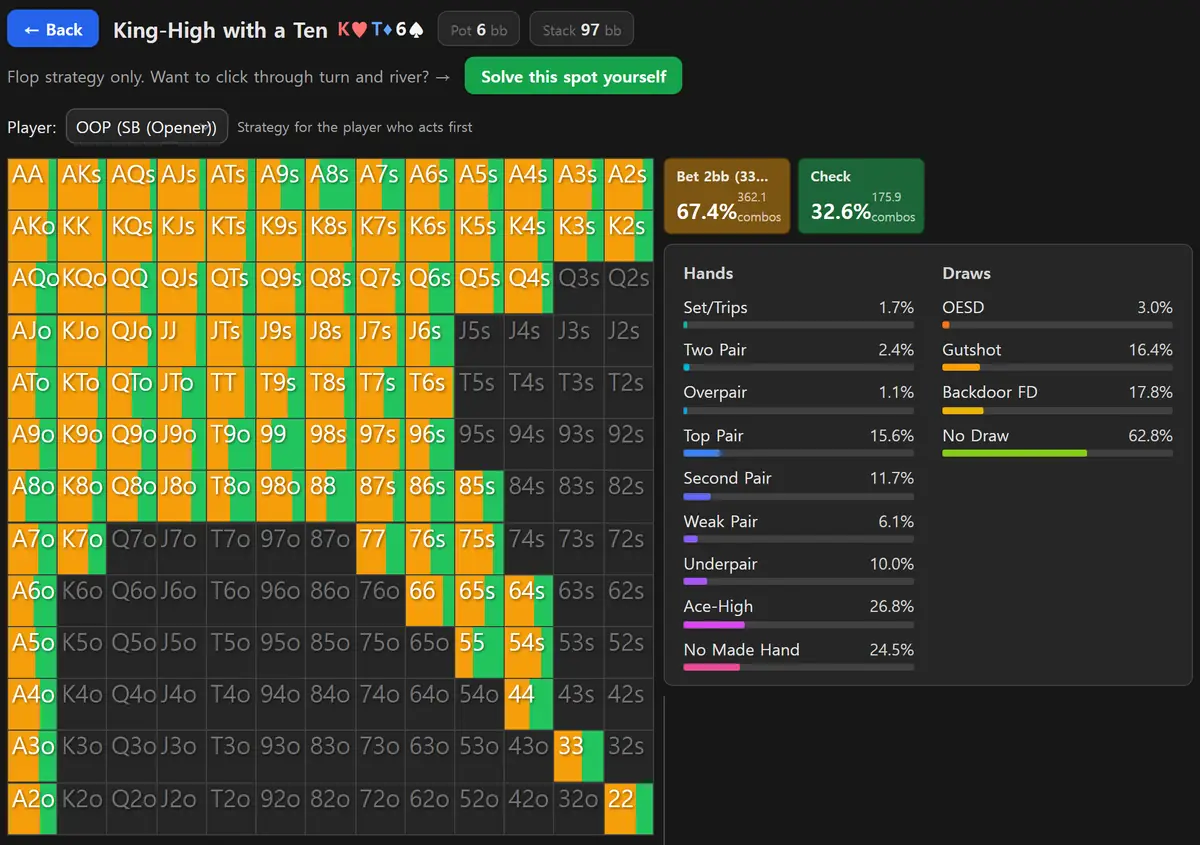
This is not a three-bet pot. It is an ordinary hand: the small blind opens to 3bb, the big blind calls. And the player who acts first bets 67.4%.
What changed? The pot is small at 6bb and the stacks are 97bb deep. What changed is who acts first, and which range the board favors — both at once. Every number below comes from the HoldemMaster GTO solver.
✦ Quick answer
On K-T-6 blind vs blind the small blind's first action is bet 67.4%, check 32.6%. That is the reverse of the 0.1%–23.7% seen in spots ① through ⑦, and two things are different, not one: the out-of-position player here is the raiser rather than the caller, and the board is a king with a broadway kicker. The seat alone does not explain it — the same small-blind raiser bets only 9.6% on a 7-6-5 board later in this series. Here the two line up, so the preflop aggressor is also first to act and holds the range edge and the action order together. The result is an out-of-position equity realization of 103.1% — the first time in a single-raised pot that it clears 100%.
What conditions produced these numbers?
★The setup has changed again. Pot, stack and roles are all different from the earlier spots, so the table comes first.
| Item | This spot (blind vs blind) | ①–⑦ (BTN vs BB) | ⑧–⑩ (3-bet pot) |
|---|---|---|---|
| Preflop | SB opens 3bb → BB calls | BTN opens 2.5bb → BB calls | BB 3-bets to 11bb → BTN calls |
| OOP (acts first) | SB — the opener | BB — the caller | BB — the three-bettor |
| IP | BB — the caller | BTN — the opener | BTN — the caller |
| Pot | 6bb | 5.5bb | 22.5bb |
| Effective stack | 97bb | 97.5bb | 89bb |
| SPR | 16.2 | 17.7 | 4.0 |
| Bet sizes | About a third of the pot, one size only | About a third and three quarters (⑦ has one) | About a third and two thirds |
| Rake | Not modeled | Not modeled | Not modeled |
| Checked | 2026-08-08 (study spot result) | ①–④ 2026-08-19 · ⑤–⑦ 2026-08-20 | ⑧⑨ 2026-08-20 · ⑩ 2026-08-08 |
The display is in big blinds — bets read as "Bet 2bb (33% pot)", with the amount and the pot fraction together, and EV reads as "EV (bb)".
How often does the small blind actually bet?
67.4% bet, 32.6% check. Of 538 combos, 362.1 go into the bet.
| The small blind's first action | Frequency | Combos |
|---|---|---|
| Bet 2bb (33% pot) | 67.4% | 362.1 |
| Check | 32.6% | 175.9 |
| Spot | Who is out of position | OOP bet frequency |
|---|---|---|
| A♥7♦2♣ · K♠8♦3♣ · Q♠J♦T♠ (①②③) | BB caller | 0.1%–1.9% |
| 6♣6♦3♥ · 6♠5♥2♦ (⑥⑦) | BB caller | 3.0%–3.2% |
| 7♦6♦5♣ blind vs blind (⑫) | SB opener | 9.6% |
| Q♠9♠2♠ monotone (⑤) | BB caller | 11.2% |
| 9♥8♥7♣ connected (④) | BB caller | 23.7% |
| K♥T♦6♠ blind vs blind (⑪) | SB opener | 67.4% |
| A♠A♥6♦ blind vs blind (⑬) | SB opener | 80.1% |
| A♦K♠2♥ · Q♥T♥7♠ · 8♦5♣2♠ (⑧⑨⑩) | BB three-bettor | 98–100% |
Why does the out-of-position player lead here?
Because this is the seat where the preflop aggressor also acts first on the flop. ⚠ In this series every majority lead comes from that seat, but the seat guarantees nothing, and a caller can still lead some of the time (23.7% at ④). The same structure produces 9.6%  at ⑫ and 80.1%
  at ⑬. The seat opens the door; the board decides how far you walk through it.
In an ordinary hand these two come apart. When the button opens and the big blind calls, the aggressor is the button but the first to act is the big blind. That is what builds the check-then-c-bet structure, and it is what ① through ⑦ all looked like.
Blind versus blind, the two collapse into one. The small blind raised, and the small blind is first on the flop. The range edge and the action order land on the same player.
| Preflop aggressor | First to act on the flop | OOP bet | |
|---|---|---|---|
| BTN vs BB (①–⑦) | BTN | BB | split → 0.1%–23.7% |
| SB vs BB (⑪ K-T-6) | SB | SB | together → 67.4% |
| SB vs BB (⑫ 7-6-5) | SB | SB | together, and yet → 9.6% |
Equity puts a number on that edge. SB 55.3% against BB 44.7%. In ① through ⑦ the out-of-position player sat at 45.1%–48.5%, always short of half — the opposite direction.
Being out of position does not decide whether you bet first — how your range meets this particular board does most of the work.
Lacking position is the same for the big blind in ①–⑦ and the small blind here. What splits them is the relationship between range and board — ⚠ and you cannot reduce that to "range" alone. On the 7-6-5 board the range is literally identical and the check runs to 90.4%.
Why 67% here when a three-bet pot is 100%?
Because the big blind's defending range is wide. That is where this spot parts from the 100% bet in a three-bet pot.
The two ranges here are almost the same size: 538 combos for the SB, 525 for the BB. That many hands came along instead of folding. The small blind only raised to 3bb, so the big blind — already in for 1bb — had to add just 2bb, and the price was good enough to defend wide.
Against a wide range you cannot bet everything on the chance they fold. So 32.6% stays back as a check.
The checking hands have jobs of their own. Hands too weak to bet and hands that check to induce a bet both live there. If the opponent reads that check as weakness and fires, a  check-raise is waiting.
How do the two ranges differ?
The strong classes sit with the small blind; the unmade hands sit with the big blind.
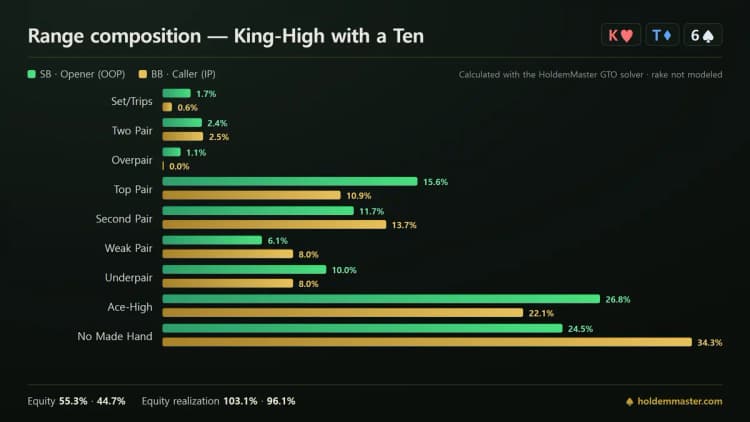
| Class | SB (OOP · opener) | BB (IP · caller) |
|---|---|---|
| Set/trips | 1.7% | 0.6% |
| Two pair | 2.4% | 2.5% |
| Overpair (AA) | 1.1% | 0.0% |
| Top pair (K) | 15.6% | 10.9% |
| Second pair (T) | 11.7% | 13.7% |
| Weak pair | 6.1% | 8.0% |
| Underpair | 10.0% | 8.0% |
| Ace-high | 26.8% | 22.1% |
| No made hand | 24.5% | 34.3% |
⚠ Do not read "unmade" as "has nothing," though. The solver counts draws on a separate axis — the four rows below are mutually exclusive and each column sums to 100%.
| Draw | SB (OOP) | BB (IP) |
|---|---|---|
| Open-ended straight draw | 3.0% | 2.3% |
| Gutshot | 16.4% | 16.0% |
| Backdoor flush draw | 17.8% | 21.1% |
| No draw | 62.8% | 60.6% |
The 3.0% open-ender works out to 0.030 × 538 = about 16 combos, and on this board exactly one hand makes an open-ender: Q-J (K-Q-J-T, needing an ace or a nine — eight outs). Sixteen is precisely the number of Q-J combos. The gutshot row is thicker because A-Q, A-J, Q-9, J-9, 9-8 and 8-7 all land in it.
Still, when a third of the opponent's range has not even paired and your own top end is heavier, betting small and wide is the standard.
Sets point the same way. Three pocket pairs make a set on this board — K-K, T-T and 6-6 — and the small blind holds all three, nine combos (1.7%), while the big blind is left with 6-6 alone, three combos (0.6%). The big blind three-bets K-K and T-T against a small-blind open rather than calling. Overpairs belong to the small blind for the same reason: A-A, six combos.
Why is equity realization 103.1% without position?
Because the range edge barely outweighs the positional one. Put this spot's numbers on the whole series and the answer shows.
| Item | SB (OOP) | BB (IP) |
|---|---|---|
| Equity | 55.3% | 44.7% |
| EV (bb) | 3.42 | 2.58 |
| EQR (equity realization) | 103.1% | 96.1% |
Pick seven spots from the series and rank them by EQR:
| Spot | Who is out of position | OOP equity | OOP EQR |
|---|---|---|---|
| A♥7♦2♣ dry (①) | caller | 45.1% | 84.0% |
| 6♠5♥2♦ low (⑦) | caller | 48.3% | 84.3% |
| 9♥8♥7♣ connected (④) | caller | 48.5% | 93.2% |
| K♥T♦6♠ blind vs blind (⑪) | opener | 55.3% | 103.1% |
| 8♦5♣2♠ 3-bet pot (⑩) | three-bettor | 58.6% | 106.9% |
| A♦K♠2♥ 3-bet pot (⑧) | three-bettor | 68.9% | 109.6% |
| Q♥T♥7♠ 3-bet pot (⑨) | three-bettor | 58.3% | 117.8% |
⚠ Nor does a higher EQR mean a bigger edge. Read the ranking as it stands — the biggest range edge in the table, ⑧ at 68.9% equity, lands on 109.6%, below ⑨'s 117.8% at 58.3% equity — ten points less. EQR is EV ÷ (equity × pot), so equity is the denominator: the lower it is, the larger the ratio for the same EV. It is true that one open-raise of edge stops at 103.1%; the reason is not "it could have reached 117.8%."
The big blind's 96.1% is the other face of the same story. Position, and still short of its share. Why position usually pays, and when it is not enough, is in  why position matters.
What changes at the table?
- •Blind versus blind, do not default to "no position, so check." If you opened from the small blind, the preflop range edge is yours, and the solver bets 67.4% on this board. But you still read the board — a king with a broadway kicker suits the opener, and on boards that fit the caller the check comes back even from this seat. The 7♦6♦5♣ connected board is exactly that: the same small blind bets only 9.6%.
- •The size is a third of the pot. With the big blind defending 525 combos, small and wide is right. ⚠ Do not turn that into "betting big is worse" — this study spot only had the 33% size in the tree. With no larger size solved, "what if I had bet big" is a question this calculation cannot answer. The A-A-6 spot later in the series does have 75% open alongside it.
- •★At SPR 16.2, decide in advance what a raise means. Betting 67.4% of your range means facing raises often, and with sixteen pots left behind you this is not a stack-off spot for top pair. That is the reverse of a three-bet pot at SPR 4.0, where "raise" meant "the stack is going in." Here calling and seeing a turn covers far more of your range, and outside nine set combos and two pair (K-T, K-6, T-6) there is little reason to commit. 🪶 Note that A-A is below two pair — not because the king on the board "pins" it, but because an overpair is still one pair in the hand rankings, and one pair loses to two pair. The class table lists the categories in that order, set → two pair → overpair (the 1.7% · 2.4% · 1.1% beside them are range shares, not a strength ranking). ⚠ The node after a raise is not in this solve, so this is judgment drawn from the SPR, not a solver number.
- •Defending the big blind, remember what three-betting K-K and T-T costs you. The result is exactly the structure on this board: the big blind's only set is 6-6. The calling range thins out by that much.
- •Do not read the 32.6% of checks as weakness. Check-raising hands are mixed in. The general standards in
 c-bet strategy are worth double-checking in this seat.
Check it yourself
Every figure here comes up if you open the GTO solver and hit Study Spots → "King-High with a Ten" → [⚡ View results]. To play the same spot as a problem instead, open the GTO Trainer from the sidebar — it deals you a random hand, and once you pick an action it shows the mixed frequency and the EV loss (bb) of your choice. Your history is kept on this device by default; signing in with a HoldemMaster account syncs your Study Spots and Daily Challenge history across devices.
Look at the player labels across the top first: "OOP (SB (Opener))". Once you see that it differs from the earlier spots' "OOP (BB (Caller))", what this article means by "the role changed" lands immediately. Free, no install, no account.
Review your own hand from this spot — This spot is an SB open, BB call pot (blind vs blind). If you have played the same situation, open the solver's Hand review ↗, set the situation (Open · Call, SB and BB) and Your seat, pick Your 2 cards and the 3 flop cards, then enter the actions in the order they were actually played, including your opponent's. Hand review then shows whether that choice is rated Best play, Acceptable or Review this play. Hand review uses the app's preflop charts (online 6-max cash, 100bb), so its numbers can differ from the example above, and it may not suit pub games or tournaments.