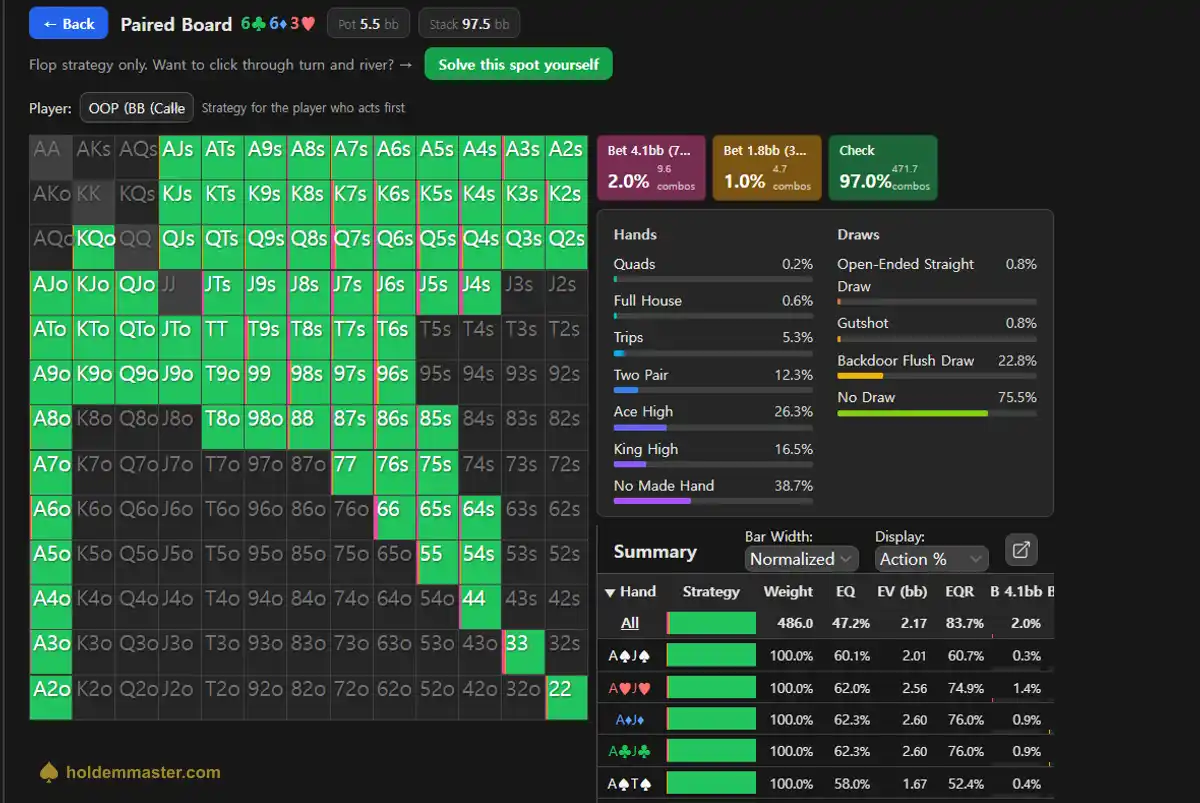
The flop is 6♣ 6♦ 3♥ — low cards, and a pair among them. It looks like a board nobody hit.
Hold TT there and your equity is 76.0%. The same TT is around 54–57% against AK preflop, so this flop is better for it than the usual flip. Hold A9 and you have nothing — but four-fifths of your opponent's range has nothing more than the board's pair either, so folding it right away throws away the pot.
A board nobody hit is really a contest over whose high cards are better. The ace-high and king-high flops were fights over who connected; this one is a fight between two ranges that mostly did not. Every solver figure below comes from HoldemMaster's free GTO solver; probabilities such as the 17.2% chance of a paired flop are plain combinatorics.
✦ Quick answer
Check almost everything, and do not fold just because you missed the board. Holding a six is not a reason to lead — leading only folds out what you already beat, so the sixes stay in the checking range, and the big blind checks 97.0% here. The hands that genuinely gain on this flop are the pocket pairs above a six, and ace-high should not be an automatic fold against a single small bet — exactly how wide the optimal defense goes is not something this study spot shows.
What conditions produced these numbers?
The button opens to 2.5bb, the big blind calls, and everyone else folds — two players, a 5.5bb pot, 97.5bb behind, standard 100bb online ranges, two available bet sizes at roughly a third and three-quarters of the pot, and no rake modeled. Change the ranges or the sizing and the frequencies move with them.
| Setting | Value |
|---|---|
| Preflop | BTN opens 2.5bb · BB calls · everyone else folds |
| Ranges | Approximations of standard 100bb online play |
| Flop | 6♣ 6♦ 3♥ (paired board, three different suits) |
| Pot · stack | Pot 5.5bb · effective stack 97.5bb |
| Bet sizes | Roughly 33% and 75% of pot |
| Rake | Not modeled |
| Checked | 2026-08-20, study spot output |
Trips vs a set — on a paired board it’s trips
A set is a pocket pair that matches one board card; trips is one card in your hand matching a pair on the board. They are the same ranking — three of a kind, filed together in the hand rankings — but they play completely differently.
On every unpaired flop in this series, three of a kind means a set (the one other paired board, A♠A♥6♦, comes later in the blind-battle group): on A-7-2 the big blind needed 77 or 22 in hand. Here the board brings its own pair, so any single six makes trips, and only 66 in the pocket makes quads.
| Your hand on 6♣6♦3♥ | You have |
|---|---|
| A6, K6s, 96s … any one six | Trips — three sixes |
| 66 | Quads |
| 33 | Full house — threes full of sixes |
| TT, 99, 88, 77 … | Two pair — your pair plus the board's sixes |
How does the big blind play a low paired flop?
Check 97.0%. On 6♣6♦3♥ the big blind leads only 3.0% of the time in total — 2.0% for 4.1bb and 1.0% for 1.8bb — and hands the initiative straight back to the player who opened. What is worth a second look is which of the two sizes it picks when it does bet, because this is the one flop in the series where the answer flips.
| Big blind's first action | Frequency | Combos |
|---|---|---|
| Check | 97.0% | 471.7 |
| Bet 4.1bb (75% pot) | 2.0% | 9.6 |
| Bet 1.8bb (33% pot) | 1.0% | 4.7 |
 the 9-8-7 donk-bet spot, 8.0% against 3.2% on the monotone flop. Here it inverts, and the per-hand table below shows why.
Why check when you hold more trips?
Because trips is only 5.3% of the range. The other 94.7% is mostly the board’s own pair of sixes plus a high card — and on that axis the button is ahead.
First, the count. With 6♣ and 6♦ on the board, only 6♠ and 6♥ remain — so every suited 6x hand is two combos, and A6 offsuit is six. The whole category runs through just two cards.
| 6x hand | BB (calling range) | BTN (opening range) |
|---|---|---|
| A6 (suited + offsuit) | ✅ 8 combos | ✅ 8 combos |
| K6s · Q6s | ✅ 4 combos | ✅ 4 combos |
| J6s · T6s · 96s | ✅ 6 combos | ❌ outside the opening range |
| 86s · 76s · 65s · 64s | ✅ 8 combos | ✅ 8 combos |
| Total | 26 combos = 5.3% | 20 combos = 4.0% |
Now widen the view and the picture flips.
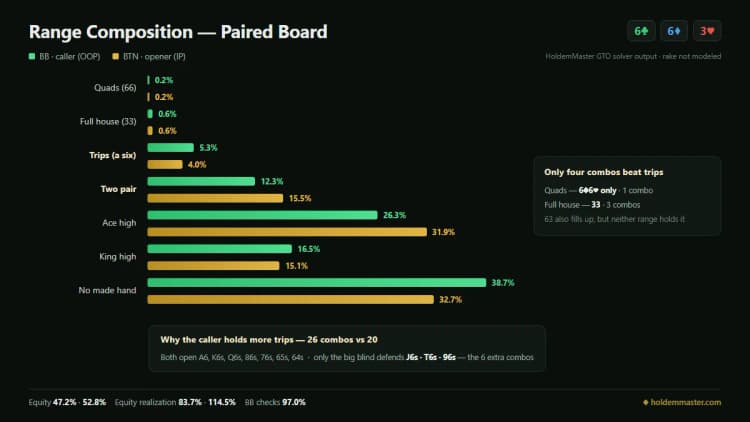
| Category | BB (OOP) | BTN (IP) |
|---|---|---|
| Quads (66) | 0.2% | 0.2% |
| Full house (33) | 0.6% | 0.6% |
| Trips (a six) | 5.3% | 4.0% |
| Two pair | 12.3% | 15.5% |
| Ace high | 26.3% | 31.9% |
| King high | 16.5% | 15.1% |
| No made hand | 38.7% | 32.7% |
Leading into that fails from both ends: with a six you fold out only the hands you already beat, and with everything else you advertise a range that cannot stand a raise. So the sixes stay in the checking range instead.
Equity is 47 against 53 — so why is EQR 84 against 115?
Because the board hits both ranges the same way, but the two players do not collect the same way. On 6-6-3 almost everybody holds the board's pair of sixes and nothing else, which keeps raw equity close. What each side actually banks is not close at all.
| Big blind (OOP) | Button (IP) | |
|---|---|---|
| Equity | 47.2% | 52.8% |
| EV (bb) | 2.17 | 3.33 |
| EQR (equity realization) | 83.7% | 114.5% |
The 30.8-point gap is almost exactly the 29.1 points of the  dry ace-high board. A paired board plays like a dry one — four ranges out of five are the same pair of sixes with a different high card, so the hand runs quietly, and the player who acts last gets to see which high card showed up before choosing. That advantage is the whole gap.
How strong are pocket pairs on 6-6-3?
Almost every pocket pair is two pair here. TT makes T-T-6-6-3. The two that break the pattern are the ones matching the board: 66 is quads, 33 is a full house.
| Hand | Equity | EV (bb) | EQR | Check |
|---|---|---|---|---|
| TT | 76.0% | 6.66 | 159.4% | 97.7% |
| 99 | 72.6% | 5.68 | 142.4% | 96.1% |
| 88 | 69.9% | 4.96 | 128.9% | 94.8% |
| 77 | 68.5% | 4.63 | 123.0% | 94.7% |
| 55 | 63.7% | 3.82 | 108.9% | 93.8% |
| 44 | 61.8% | 3.42 | 100.5% | 93.9% |
| 22 | 50.4% | 1.83 | 66.0% | 95.8% |
TT at 76.0% is the top of the big blind's range once you set aside the sixes, 33 and 66 — because JJ and better three-bet preflop and never see this flop.
But the bottom drops out. 44 realizes exactly its equity share — EQR 100.5% — and still makes 3.42bb against the range's 2.17bb average, so it is not a marginal hand. 22 is the one that breaks: 50.4% equity, EQR 66.0%, 1.83bb.
The dividing line is the three, not the six. 55 and 44 both sit below the six and still realize their full share. A deuce is under both board ranks, so it loses to 33, to every hand holding a three, and a second three on the turn or river counterfeits it into playing the board — on 6-6-3-3-K, 22 is just the board's two pair (only a deuce on the other street saves it). The rule that actually holds is not "small pairs are fine on low boards" but "any pair above the three is fine — the deuces are the only ones that break."
One more group counts as two pair, and it is easy to miss: any hand with a three. A3 plays as sixes and threes with an ace — which beats 22 and loses to every pair above the three.
How many quads and full houses are actually out there?
One combo of quads, three combos of a full house. You can count both by hand.
- •Quads (66) — with 6♣ and 6♦ on the board, the only remaining combination is 6♠6♥. 0.2% of 486 combos is 1.0 — and the per-hand table has exactly one row.
- •Full house (33) — with 3♥ on the board, that leaves 3♠3♦ · 3♠3♣ · 3♦3♣. 0.6% × 486 = 2.9.
Those four combos explain why paired boards feel dangerous. Open the per-hand table and read the EQR column: 6♠6♥ realizes 359.7% of its equity share (19.78bb of EV), and the three 33s run 309.8%, 309.8% and 309.5% — three to four times their share of the pot. Rare — but when one of them hits, the stacks go in.
Why is the big bet more common than the small one?
Because trips and quads pick the large size when they bet at all. Hand by hand:
| Hand | Bet 4.1bb (75% pot) | Bet 1.8bb (33% pot) | Check |
|---|---|---|---|
| K♠6♠ | 7.8% | 0.3% | 92.0% |
| Q♥6♥ | 7.9% | 0.7% | 91.5% |
| J♥6♥ | 9.0% | 3.3% | 87.7% |
| 6♠6♥ (quads) | 9.6% | 0.0% | 90.4% |
| T♠T♥ (two pair) | 0.8% | 1.7% | 97.5% |
It comes down to what the opponent can call with. A six is close to unbeatable here, so the point is to build a pot — and since most sixes are checking anyway, the few that do bet have every reason to go big. Two pair is behind every six and all three 33s, so it has no interest in a big pot. The class that wants a big pot refuses the small size; the class that only wants a call refuses the large one.
⚠ Do not read this as "the better the kicker, the bigger the bet" — the table runs the other way. Large-bet frequency goes K♠6♠ 7.8% < Q♥6♥ 7.9% < J♥6♥ 9.0%: the weakest kicker bets most. Trips blockers do not explain it either. Whichever six you hold removes the button's trips of its own suit — K♠6♠, Q♥6♥ and J♥6♥ each leave the button exactly 10 of its 20 — and the kicker removes nothing more, because the button opens K6 and Q6 only suited and your six has already taken that suit. The table shows the calculated mix; it does not isolate the cause of a gap this small.
And the sixes do not account for most of the large bets. They are 26 of 486 combos and contribute about 1.2 of the roughly 9.6 large-bet combos — about one eighth (13.0%). Most of the rest comes from hands with no six at all.
The big blind leads only 3.0% of the time, so you will rarely run into this at the table. It is a clean demonstration of a principle, though: sizing is chosen by the range, not by the hand.
Should you fold ace-high to a continuation bet?
Far less often than it feels like you should. Only 18.4% of your range has anything beyond the board's pair, so folding everything else hands the pot away.
Facing a 1.8bb bet into 5.5bb, denying a pure bluff any profit means continuing roughly 5.5 ÷ (5.5 + 1.8) = 75.3% of the time. That estimate is called minimum defense frequency (MDF).
Add every ace-high (26.3%) and every king-high (16.5%) to that 18.4% and you are still only at 61.2%, short of 75.3%.
⚠ Do not jump from that to "so you must defend more." MDF treats the opponent's bet as a pure bluff with zero equity, but a flop bluff still has two streets to come, so it does have equity. And the out-of-position player realizes equity badly. ⚠ What this study spot cannot tell you is where the real optimum sits: it is solved through the flop's first action only, so the big blind's response to a bet is not in it, and whether the optimal defense lands above or below MDF cannot be read from this material.
What this arithmetic is good for, then, is not "hit 75%" but "do not fold on the strength of one high card." Plenty of the ace-highs and king-highs are still calls here, and folding all of them to one small c-bet is exactly the habit that gets exploited.
(On a paired board nobody is literally ace-high: you always hold the board's pair of sixes. "Ace-high" here means that pair with an ace as your best card.)
 pot odds, and 3-bet defense works the same formula preflop.
What changes at the table?
- •Do not undervalue middle pocket pairs on low paired boards. 77 through TT are 68–76% equity here, the top of the calling range. But the floor is real: 44 and 55 still beat the range average, while 22 keeps only two-thirds of what its equity is worth, because it pairs below both board ranks.
- •Flopping trips is not a reason to lead. The sixes lead 6.8% — more than any two-pair or high-card hand, less only than the 33 full houses (8.8%) and the single quads combo (9.6%) — and they still check nine times out of ten. Leading only folds out the hands you already beat; checking lets those hands put the money in themselves, and leaves you a check-raise or a call-down. ⚠ What this solve cannot tell you is how much more the check-raise line makes: the study spot solves the flop's first action only, so the button's c-bet frequency and any check-raise EV simply do not exist in it.
- •Do not fold ace-high to one small bet. 79.7% of the button’s range has nothing beyond the board’s pair either — ace-high 31.9%, king-high 15.1% and no made hand 32.7%.
- •Your kicker decides the hand. Only three combos beat trips outright — the three 33 full houses. (Quads is off the table: once you hold a six yourself, 6♠6♥ cannot exist, so the four combos counted in the full-house section become three from your seat.) And even that holds only when your kicker is an ace. The second kicker is fixed by the board's 3, so the single card beside your six is the whole hand: with 76s the button's A6, K6, Q6 and 86 all have you dominated. Trips with a weak kicker is a bluff-catcher, not a hand to build a pot with.
Check it yourself
Open the free GTO solver, then go to Study Spots → Paired Board → [⚡ View results].
What to look for is the single 6♠6♥ row in the per-hand table — the only quads this board allows, and at 359.7% the highest equity realization anywhere in this series (second is the button's 88 in the 3-bet pot on a low board at 346.0%; on the big blind's side the runner-up is 6♥6♣ on the  low rainbow flop at 318.9%). Compare it with the three 33 rows just below and you can see how few combos the very top of a paired board actually contains.
Then open the GTO Trainer in the sidebar: it deals you a hand using the actual range weights and shows how many big blinds your action costs. Free, nothing to install, no account.
Review your own hand from this spot — This spot is a BTN open, BB call pot. If you have played the same situation, open the solver's Hand review ↗, set the situation (Open · Call, BTN and BB) and Your seat, pick Your 2 cards and the 3 flop cards, then enter the actions in the order they were actually played, including your opponent's. Hand review then shows whether that choice is rated Best play, Acceptable or Review this play. Hand review uses the app's preflop charts (online 6-max cash, 100bb), so its numbers can differ from the example above, and it may not suit pub games or tournaments.