One of the first rules you learn in poker: check to the raiser. The player who attacked preflop gets to make the first bet on the flop.
The last three spots were that rule at its most obedient. On ace-high, king-high and  broadway flops, the big blind's lead was under 2% every time — on K-8-3 and Q-J-T it was 0.2% or less, effectively zero.
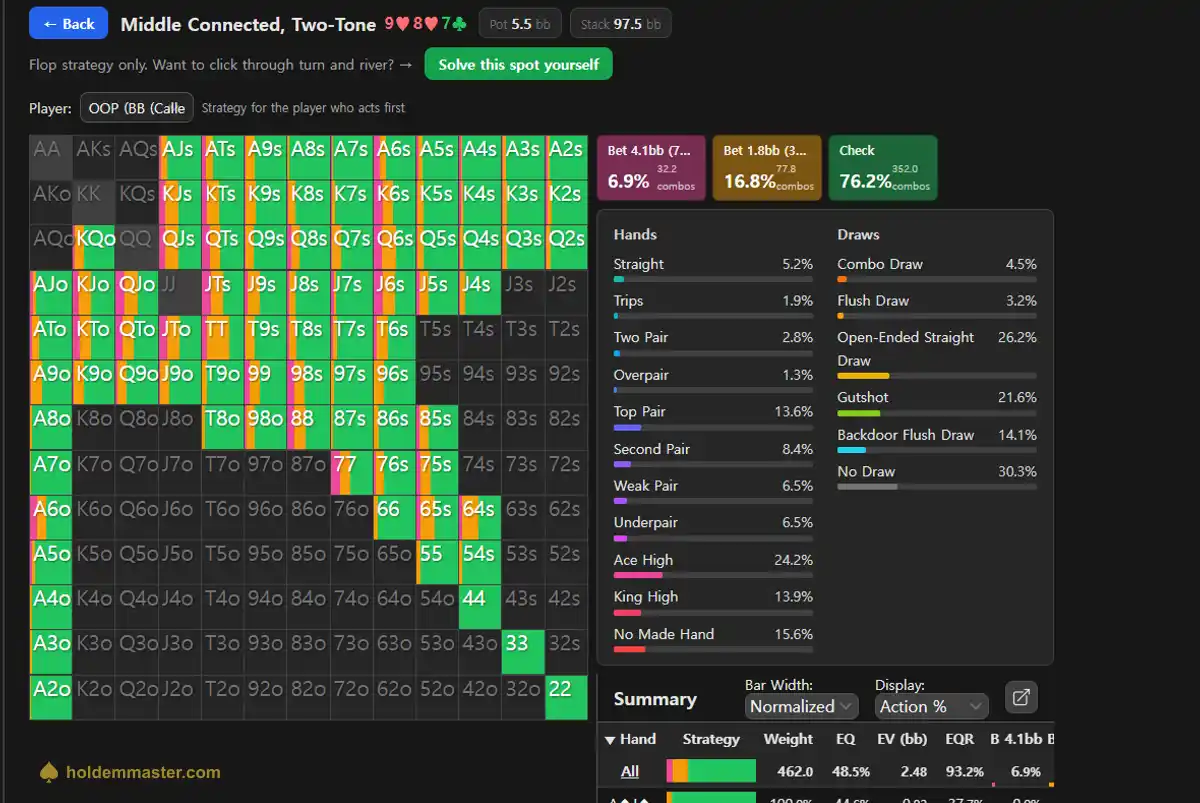
On 9♥ 8♥ 7♣ it is 23.7%. This is where the rule breaks.
A bet by the player who only called preflop is a donk bet — from donkey, which tells you how it has been regarded. Also called a lead. Solvers put it in the strategy on specific boards, and this is the clearest one in the study set.
Every figure below came from HoldemMaster's free GTO solver, read off the study-spot output on 2026-08-19.
✦ Quick answer
On 9♥8♥7♣ the big blind checks 76.2% and leads 23.7% across two sizes (both rounded). But range advantage has not changed hands — equity is still 48.5% against 51.5% in the button's favor. What changed is the size of the gap, and where the strong hands sit: the big blind's strength is in completed straights, the button's is in overpairs that this board threatens.
What conditions produced these numbers?
The button opens to 2.5bb, the big blind calls, everyone else folds — two players, a 5.5bb pot, 97.5bb behind. Ranges are the standard 100bb online approximations, the flop is 9♥ 8♥ 7♣ with two hearts, and the solver has two bet sizes available at roughly a third and three-quarters of the pot. Rake is not modeled, and the figures were read on 2026-08-19.
| Setting | Value |
|---|---|
| Preflop | BTN opens 2.5bb · BB calls · everyone else folds |
| Ranges | Approximations of standard 100bb online play |
| Flop | 9♥ 8♥ 7♣, two-tone (two hearts) |
| Pot · stack | Pot 5.5bb · effective stack 97.5bb |
| Bet sizes | Roughly 33% and 75% of pot |
| Rake | Not modeled |
| Checked | 2026-08-19, study spot output |
How often does the big blind donk bet on 9-8-7?
23.7%, and more than two-thirds of it goes in at the small size.
| Big blind's first action | Frequency | Combos |
|---|---|---|
| Check | 76.2% | 352.0 |
| Bet 1.8bb (33% pot) | 16.8% | 77.8 |
| Bet 4.1bb (75% pot) | 6.9% | 32.2 |
| Flop | BB leads |
|---|---|
| A-7-2 (dry) | 1.9% |
| K-8-3 (dry) | 0.2% |
| Q-J-T (connected, two-tone) | 0.1% |
| 9-8-7 (middle connected, two-tone) | 23.7% |
What changed compared with the first three flops?
For the first time the big blind is ahead in a top category. Completed straights are 5.2% against 4.2%.
Count the combinations and the reason shows up exactly. Three hands make a straight here: JT (J-T-9-8-7), T6 (T-9-8-7-6) and 65 (9-8-7-6-5).
| Straight hand | BB (calling range) | BTN (opening range) |
|---|---|---|
| JT | ✅ suited and offsuit (16 combos) | ✅ suited and offsuit (16 combos) |
| T6 | ✅ T6s (4 combos) | ❌ outside the opening range |
| 65 | ✅ 65s (4 combos) | ✅ 65s (4 combos) |
| Total | 24 combos = 5.2% | 20 combos = 4.2% |
It cuts the other way too. Overpairs belong to the button.
| Overpair (pocket pair above the 9) | BB | BTN |
|---|---|---|
| TT | ✅ 6 combos | ✅ 6 combos |
| JJ · QQ · KK · AA | ❌ all three-bet preflop | ✅ 24 combos |
| Total | 6 combos = 1.3% | 30 combos = 6.4% |
So does this flop favor the big blind?
No. Equity is still 48.5% against 51.5%. This is worth stating plainly, because it is the easiest wrong conclusion to draw: a lead appearing does not mean the range advantage moved.
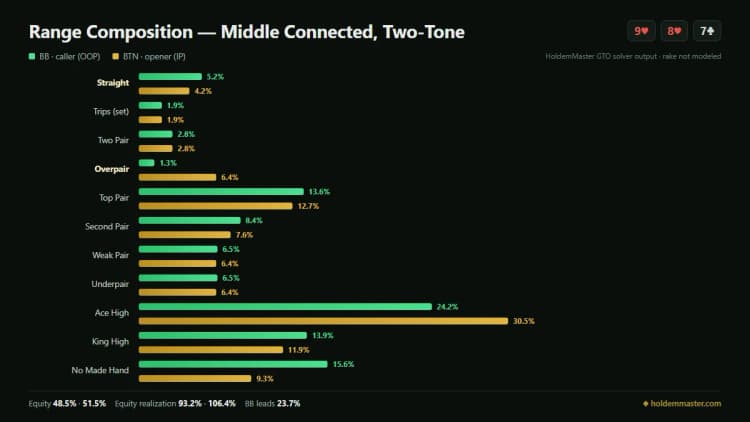
| Category | BB (OOP) | BTN (IP) |
|---|---|---|
| Straight | 5.2% | 4.2% |
| Set (trips) | 1.9% | 1.9% |
| Two pair | 2.8% | 2.8% |
| Overpair | 1.3% | 6.4% |
| Top pair (9) | 13.6% | 12.7% |
| Second pair (8) | 8.4% | 7.6% |
| Third pair or lower | 6.5% | 6.4% |
| Underpair | 6.5% | 6.4% |
| Ace high | 24.2% | 30.5% |
| King high | 13.9% | 11.9% |
| No made hand | 15.6% | 9.3% |
Only two rows favor the button: overpairs, 6.4% against 1.3%, and ace-high, 30.5% against 24.2%. Two pair is dead level at 2.8% and sets at 1.9%, and every other row belongs to the big blind.
The draws have to be read alongside it.
| Draw | BB (OOP) | BTN (IP) |
|---|---|---|
| Combo draw (straight + flush) | 4.5% | 3.6% |
| Flush draw | 3.2% | 2.3% |
| Open-ended straight draw | 26.2% | 23.7% |
| Gutshot | 21.6% | 20.6% |
| Backdoor flush | 14.1% | 17.6% |
| No draw | 30.3% | 32.2% |
The same holds after the money is counted. Equity realization still favors the button, just by less than anywhere else so far.
| Metric | BB (OOP) | BTN (IP) |
|---|---|---|
| Equity | 48.5% | 51.5% |
| EV (bb) | 2.48 | 3.02 |
| Equity realization (EQR) | 93.2% | 106.4% |
Two things changed to make that happen.
First, the gap narrowed. A 3.0 point equity difference is the smallest of the four flops so far — A-7-2 was 9.8 points, Q-J-T was 6.6.
Second, the button's strength sits in vulnerable places. The only two categories where it leads are overpairs (6.4%) and ace-high (30.5%) — and one of those is not strength at all. Most of that ace-high has no pair here — and where it does have a draw, so does the big blind, so the draws cancel rather than favor anyone. The overpairs are fragile for the reason in the next section. The big blind's edge, by contrast, is in hands that are already made.
A lead becomes correct not from average strength alone, but when you hold more of the strongest hands and your opponent cannot bet confidently. Both conditions look met here: the big blind has more straights (24 combos against 20, while the nut J-T is 16 for each), and with 30.5% of its range as ace-high the button would struggle to fire wide — a read from range composition, since the button's own betting node is not in this solve. That unclaimed space is what the lead takes.
Why are the button's overpairs vulnerable?
Because nearly half the cards still to come make the turn worse for them.
Say you hold QQ. Right now you are close to the best hand. Of the 47 unseen cards:
- •T, J, 6, 5 — 16 cards. Any of them completes a straight for a single card in your opponent's hand. A jack makes the board J-9-8-7, and anyone holding a ten already has J-T-9-8-7.
- •The remaining hearts that are not already counted — 7 cards. The flush gets there.
So an overpair here is a hand to charge the draws with now and shut down when raised — not one to build a huge pot with. The pot worth avoiding is the one that gets built after a bad turn, not the one you build on the flop.
Why is the small size two-thirds of the lead?
Because the lead is a claim about the whole range, not about one hand. Of the 23.7%, 16.8 points go in at a third of the pot and 6.9 at three-quarters.
A small bet says "my entire range likes this flop." If only the strong hands bet, the range splits into "bet = strong, check = weak" and your opponent reads it for free. Mixing straights, top pairs and draws into one small size keeps them indistinguishable.
The large size still exists for a reason. If every straight went into the small bet, the button could call everything without ever facing a big pot. Using two sizes is what leaves neither calling nor raising comfortable.
When should you not c-bet? The 9-8-7 exception
On this flop, as the preflop raiser — whether the big blind leads or checks. It is the clearest "when not to c-bet" board in the study set, and the reason is not the texture but what your own range looks like on it. How that judgment generalizes across board types is in  continuation bet strategy.
The reason is the range composition. Ace-high is 30.5% of the button's range, king-high 11.9%, no made hand 9.3% — 51.7% without a pair. ⚠ But "no pair" is not the reason on its own. Add the big blind's column the same way and you get 53.7% — the big blind has more of its range unpaired, by 2.0 points, and it is the one leading 23.7% of the time. What actually stops the button is what stayed behind in the checking range: 76.2% of the big blind's hands are still there, straights and 13.6% top pair among them, so betting wide runs into a check-raise. ⚠ Some of those 24 straight combos lead rather than check, so they are not all sitting in the checking range — and the check-raise frequency is not something this solve contains.
Missed offsuit high cards like AKo and AQo are standard check-backs: they hold showdown value, and when a raise comes you have nothing to continue with. The suited versions are a different hand — A♥K♥ and A♥Q♥ are nut flush draws here, and they bet.
What changes at the table?
- •Leads live on middle connected boards after a wide late-position open. The monotone board in the next spot has about 11% too, while ace-high and king-high dry flops are effectively zero. ⚠ The only middle connected board this series actually solves is 9-8-7, though, and the condition is not the texture alone but which range holds more of the strongest hands on it. The proof is inside the series: the
 6-5-2 flop is the same button-versus-big-blind single-raised pot and the big blind leads just 3.2% there, because the only hand that makes a straight is 4-3 and neither range holds it. Low and connected on its own does not produce a lead.
 - •You still check three-quarters of the time. When you do lead: small, and with more than your best hands — a range that only leads straights gets read immediately, so top pair and draws belong in the same size. Keep the total in view, though: the whole lead is 23.7%, 16.8 of it at the small size. Turned into "lead every draw," it becomes half the range and inverts the strategy. The other 76.2% checks.
- •On the button, resist the c-bet on this texture. More than half your range has no pair, and the overpairs want a controlled pot rather than a big one.
- •Against an opponent who c-bets far too often, checking can be worth more than leading — and check-raise, rather than only check-calling, with the straights and top pairs. Letting them bet your strong hands for you is worth more than taking the initiative, but only if you then charge for it.
- •Read it the other way too. Against a player who checks back wet boards, leading is worth more than the solver number suggests: checking there simply loses the street.
Check it yourself
Open the free GTO solver, go to Study Spots → Middle Connected, Two-Tone → [⚡ View results].
The best way to study this one is side by side with a dry board. Open "Dry King-High Board" first and look at a grid covered in a single green, then come back here and watch orange and pink appear among it. Same players, same ranges — three cards changed the strategy.
Then open the GTO Trainer in the sidebar and let it deal you the lead you just read about — it hands you a random hand from the real range weights and tells you in big blinds what choosing wrong cost. Free, nothing to install, no account.
Review your own hand from this spot — This spot is a BTN open, BB call pot. If you have played the same situation, open the solver's Hand review ↗, set the situation (Open · Call, BTN and BB) and Your seat, pick Your 2 cards and the 3 flop cards, then enter the actions in the order they were actually played, including your opponent's. Hand review then shows whether that choice is rated Best play, Acceptable or Review this play. Hand review uses the app's preflop charts (online 6-max cash, 100bb), so its numbers can differ from the example above, and it may not suit pub games or tournaments.