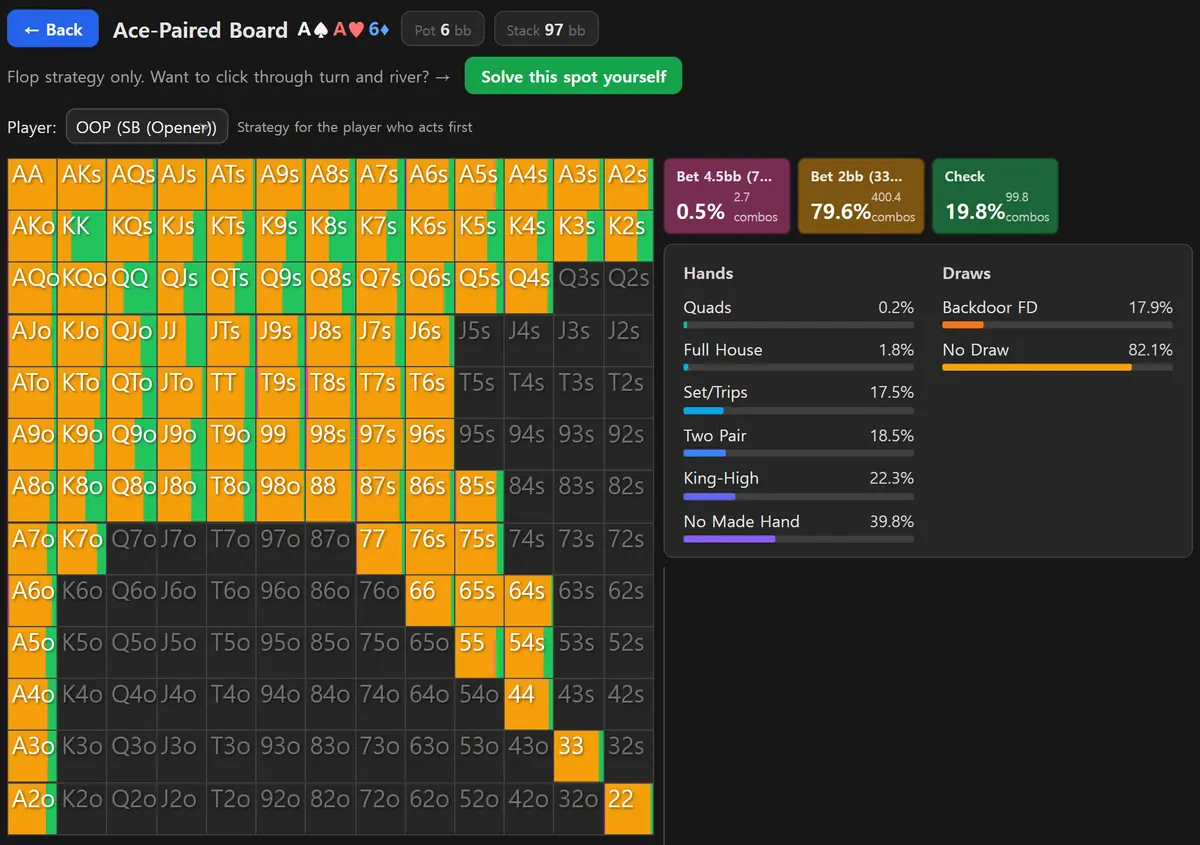
People will tell you bets do not go in on paired boards. On the  6-6-3 paired board earlier in this series the player acting first bet just 3.0%.
This is a paired board too. A♠ A♥ 6♦. And the small blind bets 80.1%.
The conditions are unchanged from the previous two spots — a 6bb pot, a 97bb effective stack, the small blind as the opener. One board ago, from that same seat,  it bet only 9.6%. This spot is the other end. Every number below comes from the HoldemMaster GTO solver.
✦ Quick answer
On the A-A-6 paired board the small blind's first action is bet 80.1%, check 19.8% (79.6% of it at a third of the pot). That is the reverse of the 3.0% on 6-6-3, and what split them is less that the board paired than which card paired and whose range it fits — the seats and ranges changed along with the board. Hands making trips with an ace run 88 combos to 66, and of those, A-K and A-Q — 16 combos — do not exist in the big blind's calling range at all. They were three-bet before the flop.
What conditions produced these numbers?
★Same as the previous two spots, except there are two bet sizes. Spots ⑪ and ⑫ had only a third of the pot; this one has three quarters open alongside it.
| Item | This spot ⑬ | ⑫ 7♦6♦5♣ | ⑪ K♥T♦6♠ |
|---|---|---|---|
| Preflop | SB opens 3bb → BB calls | same | same |
| OOP (acts first) | SB — the opener | same | same |
| Pot · effective stack | 6bb · 97bb | same | same |
| SPR | 16.2 | same | same |
| Bet sizes | Two: about 33% and 75% of the pot | One, 33% | One, 33% |
| SB range | 503 combos | 572 combos | 538 combos |
| Flop | A♠ A♥ 6♦ | 7♦ 6♦ 5♣ | K♥ T♦ 6♠ |
| Rake | Not modeled | Not modeled | Not modeled |
| Checked | 2026-08-08 (study spot result) | 2026-08-08 | 2026-08-08 |
The display is in big blinds — bets read as "Bet 4.5bb (75% pot)", and EV reads as "EV (bb)".
How often does the small blind bet here?
79.6% at the small size, 0.5% at the large one, and 19.8% checks. The bets add to 80.1%, and 403 of 503 combos go in.
| The small blind's first action | Frequency | Combos |
|---|---|---|
| Bet 4.5bb (75% pot) | 0.5% | 2.7 |
| Bet 2bb (33% pot) | 79.6% | 400.4 |
| Check | 19.8% | 99.8 |
| Spot | Who is out of position | OOP bet frequency |
|---|---|---|
| A♥7♦2♣ · K♠8♦3♣ · Q♠J♦T♠ (①②③) | BB caller | 0.1%–1.9% |
| 6♣6♦3♥ paired board (⑥) | BB caller | 3.0% |
| 6♠5♥2♦ low (⑦) | BB caller | 3.2% |
| 7♦6♦5♣ blind vs blind (⑫) | SB opener | 9.6% |
| Q♠9♠2♠ monotone (⑤) | BB caller | 11.2% |
| 9♥8♥7♣ connected (④) | BB caller | 23.7% |
| K♥T♦6♠ blind vs blind (⑪) | SB opener | 67.4% |
| A♠A♥6♦ paired board (⑬) | SB opener | 80.1% |
| A♦K♠2♥ · Q♥T♥7♠ · 8♦5♣2♠ (⑧⑨⑩) | BB three-bettor | 98–100% |
Two paired boards, 3.0% and 80.1% — what split them?
Not the number of trips but the rest of the range. The 6-6-3 spot is the decisive counterexample here, because there the player acting first held more trips and still bet 3.0%.
| 6♣6♦3♥ (⑥) | A♠A♥6♦ (⑬) | |
|---|---|---|
| Who acts first | BB — the caller | SB — the opener |
| Share of trips | BB 5.3% vs BTN 4.0% — the player acting first has more | SB 17.5% vs BB 13.1% — the player acting first has more |
| OOP equity | 47.2% | 56.2% |
| OOP EQR | 83.7% | 104.1% |
| OOP bet frequency | 3.0% | 80.1% |
Here the rest goes the small blind's way too. King-high is 22.3% against 18.2%, and hands that missed entirely run 39.8% against 51.5% — 11.7 points more for the opponent.
What sets the betting frequency is not how many combos your top class has. It is whether your whole range is better than theirs.
The ace is the card the preflop aggressor holds more of — in this spot 95 combos to 72, about 1.3 times as many. When that card lands twice on the flop, the top of the range and the rest of it tilt the same way, and that is when the betting frequency climbs to 80%.
Who holds more trips?
88 combos (17.5%) for the small blind, 66 (13.1%) for the big blind. But what is missing matters more than the count. (The solver labels this class "Set/Trips" — it is what the table calls trips.)
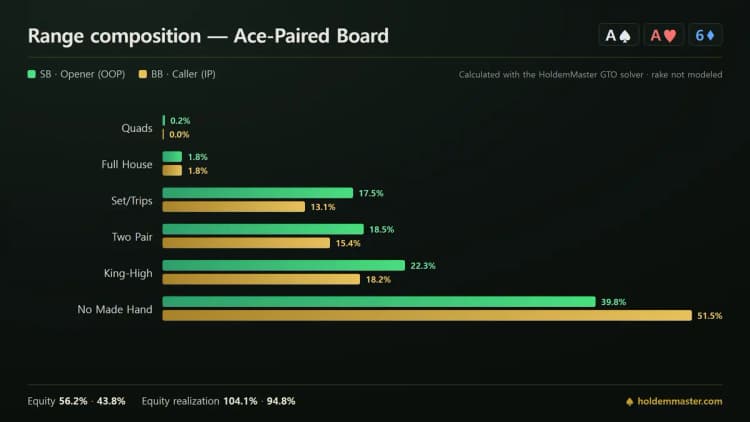
| Class | SB (OOP · opener) | BB (IP · caller) |
|---|---|---|
| Quads | 0.2% (1 combo) | 0.0% (0 combos) |
| Full house | 1.8% (9 combos) | 1.8% (9 combos) |
| Set/trips | 17.5% (88 combos) | 13.1% (66 combos) |
| Two pair | 18.5% (93 combos) | 15.4% (78 combos) |
| King-high | 22.3% (112 combos) | 18.2% (92 combos) |
| No made hand | 39.8% (200 combos) | 51.5% (260 combos) |
- •The big blind's trips contain no A-K and no A-Q. Those get three-bet against a 3bb small-blind open rather than called. The upper trips the small blind holds alone are 8 combos of A-K + 8 of A-Q + 6 of offsuit A-J = 22 combos. Same trips, and the kicker fight is already decided.
- •Quads belong to the small blind alone. With A♠ and A♥ on the board, the only aces left are A♦ and A♣, so A-A is exactly one combo. The big blind three-bets A-A and holds zero.
- •More than half of the big blind's range is nothing. 260 combos (51.5%) missed. That is the pool a bet presses on, not a fold rate: against a third of the pot, MDF says to keep about 75% of the range, so a balanced opponent folds nearer a quarter. (The big blind's response is not in this solve.)
Equity shows the result.
| Item | SB (OOP) | BB (IP) |
|---|---|---|
| Equity | 56.2% | 43.8% |
| EV (bb) | 3.51 | 2.49 |
| EQR (equity realization) | 104.1% | 94.8% |
Equity realization clears 100% with no position. It is the highest of the three blind-versus-blind spots — ⑪ at 103.1%, ⑫ at 85.3%, this one at 104.1%. It is the second of them to clear 100%, and the range edge being sharper here takes it a little past ⑪. (The three-bet pots also clear 100% out of position, at 106.9%–117.8% — that edge was built by three-betting.)
Why is the large size almost never used?
Because the edge is wide rather than deep. The three-quarter-pot bet gets 0.5%, just 2.7 combos. In practice there is only one size.
The three-bet pots were the opposite. On the  8-5-2 low board the big blind used two thirds of the pot 97.8% of the time, because that range split roughly in half into overpairs or ace-high — a polarized shape. A range pulled to the extremes calls for a big size.
This spot is not that. The small blind's range runs continuously — trips 17.5%, two pair 18.5%, king-high 22.3%, misses 39.8%. With that shape, pushing the whole range in at a small size is worth more: the opponent's 51.5% of misses is what a small bet presses on — a 2bb bluff into 6bb needs only 25% folds to break even — and the bet itself risks just 2bb now, though the 97bb behind can still come into play on the turn and river.
Which hands make up the 19.8% that checks?
Not one class held back whole, but a slice from each. Measured live on 2026-08-21, the pocket pairs check at K-K 72.4%, Q-Q 66.2%, J-J 42.0% and T-T 21.6% — so K-K and Q-Q lean check, but T-T is already betting 78%. The 99.8 checking combos cannot be summed up as "medium strength" either: misses are the largest group at about 44%, then king-high at about 27%, two pair about 17% and trips about 11%. The cells where green pools most thickly are offsuit queen- and jack-high hands like Q-9o, Q-Jo, Q-To and J-9o. The cells holding an ace, and 6-6, are mostly orange.
The reason lies in who calls you. K-K makes two pair with the board's aces, but there is little value to collect by betting it. ⚠ Do not translate that into "the worse hands fold and only better trips call" — this article's own table refutes it. The big blind's 78 combos of two pair are seven ranks of pocket pairs (42) plus six-x (36), all below K-K, and its 92 combos of king-high are below it too; facing a third-pot bet, those 170 combos (33.7% of the range) do not all fold. Meanwhile the trips and full houses that beat K-K come to 75 combos (14.9%) — fewer. The reason the value is thin is not that the weak hands all fold; it is that that wide slice will call but will not follow you into a big pot — two pair and king-high can tell they are behind K-K without much trouble, so the bigger you bet the more only trips remain. ⚠ For the record, another ace on the turn or river does not flip K-K — with A-A-A-6 on the board K-K becomes aces full of kings, and nothing in those 170 combos beats that card. Checking instead leaves room for the big blind's 260 missed combos to bluff, and then a call earns its keep — on the assumption that the opponent mixes in bluffs. ⚠ How often the big blind actually bluffs after a check is not in this calculation (the study spot ends at the first action on the flop); it is an interpretation drawn from range composition.
That pairs with the trips going almost entirely into the bet. The 88 combos holding an ace need value from the opponent's king-high and misses, so there is little reason to check. ⚠ "Entirely" is wrong, though — measured live on 2026-08-21, the 94 combos holding one ace (88 trips plus the 6 combos of A-6 that make a full house) check between 0.1% and 26.0%, averaging 12.3%, and not one combo checks exactly 0%. The mixing is steadiest where the ace is paired with a low card (A♣8♣ at 19.4%, A♣7♣ at 20.9%, and offsuit A-5 through A-2 averaging 20.1%).
What changes at the table?
- •Do not turn "paired board means check" into a rule. It is 3.0% on 6-6-3 and 80.1% on A-A-6. The test is not whether the board paired, and not how many combos of that rank you hold either — on 6-6-3 the big blind held sixes more heavily (5.3% against 4.0%) and still bet only 3.0%. The test is whether your range as a whole is better than theirs. The bet reached 80% here because the top and the rest tilted the same way.
- •With two aces out there, do not assume your ace is worthless. If the opponent three-bets A-K and A-Q, the kicker fight is already leaning your way. That does rest on them three-betting, though — against a table that only ever calls with A-K and A-Q the premise collapses, so with a weakly kicked trips hand, bet but stay out of a big raising war.
- •Small size, high frequency. When the range runs continuously, pushing wide at a third of the pot is better. The large size is the tool for a range split into strong and weak — though even within three-bet pots the reason differs on
 a board thick with draws, where a big bet is about holding the opponent at a bad price. Note also that 80.1% is a heads-up calculation — with more than one opponent still in, cut the bets from the missed hands sharply and narrow toward trips and two pair.
 - •Do not bet K-K and Q-Q "because they are strong." On this board they struggle to get called by anything worse. Checking to catch the opponent's bluffs is better. ⚠ That is a judgment drawn from range composition, not a value this series measured — the study spot shows only the frequency of the first action on the flop, and no node after a check is solved for this spot (the only check-then-bet node in the series is the re-solve on the low rainbow board). It also assumes the opponent mixes in bluffs — against someone who almost never does, a bet arriving after your check is usually an ace, and folding beats digging in.
Check it yourself
Every figure here comes up if you open the GTO solver and hit Study Spots → "Ace-Paired Board" → [⚡ View results]. To play the same spot as a problem instead, open the GTO Trainer from the sidebar — it deals you a random hand, and once you pick an action it shows the mixed frequency and the EV loss (bb) of your choice. Your history is kept on this device by default; signing in with a HoldemMaster account syncs your Study Spots and Daily Challenge history across devices.
Click back and forth with the 6-6-3 paired board. Both are paired boards and the matrices are opposite colours. Work through the study spots once and one conclusion is left: look first not at what board it is but at whose range this board attaches to. Free, no install, no account.
Review your own hand from this spot — This spot is an SB open, BB call pot (blind vs blind). If you have played the same situation, open the solver's Hand review ↗, set the situation (Open · Call, SB and BB) and Your seat, pick Your 2 cards and the 3 flop cards, then enter the actions in the order they were actually played, including your opponent's. Hand review then shows whether that choice is rated Best play, Acceptable or Review this play. Hand review uses the app's preflop charts (online 6-max cash, 100bb), so its numbers can differ from the example above, and it may not suit pub games or tournaments.