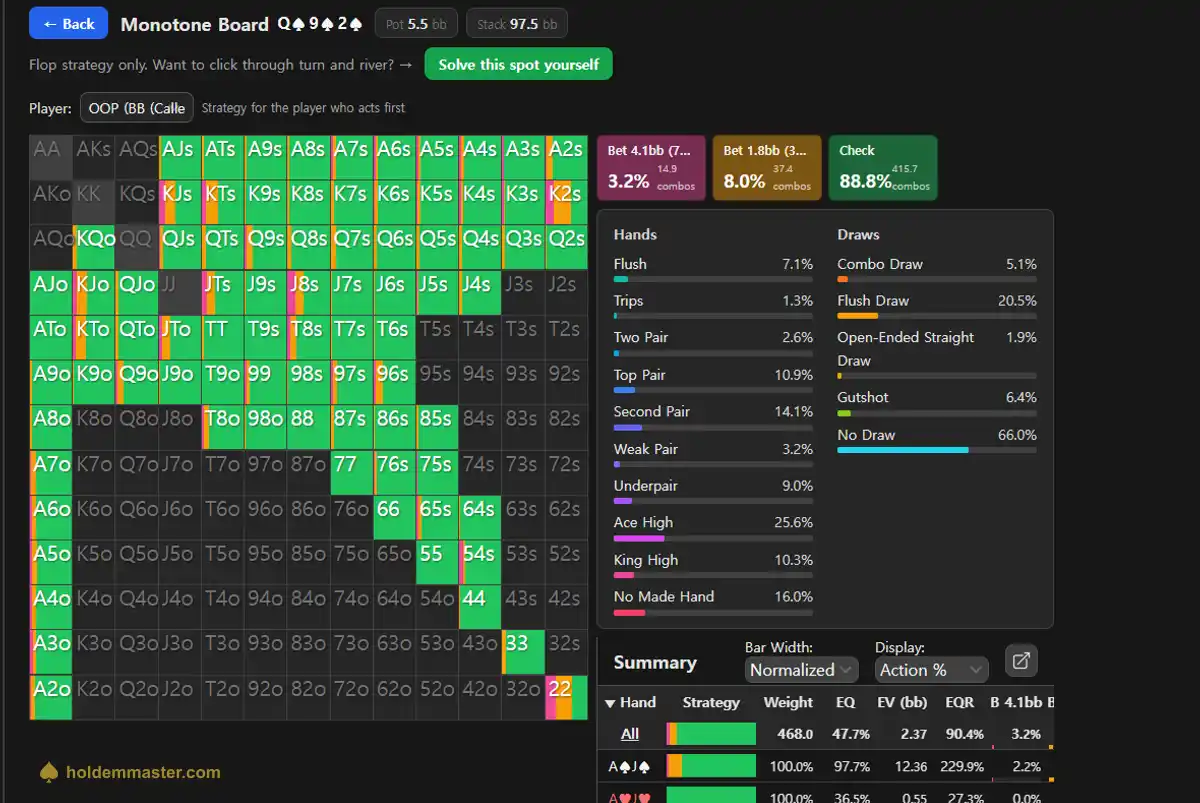
The flop is Q♠ 9♠ 2♠ — three cards, one suit. You look down at A♠J♠. That is the nut flush, already made, on the flop.
So how much do you bet? The instinct is to build the pot. The solver checks this hand 83.4% of the time.
A monotone flop is the texture that confuses people most, because made hands and air both behave differently than usual. Every figure below came from HoldemMaster's free GTO solver.
✦ Quick answer
Bet small or check, almost never big. On Q♠9♠2♠ the big blind checks 88.8%, bets a third of the pot 8.0%, and bets three-quarters just 3.2%. The nuts are locked to one hand type, so a made flush is already getting called by a small bet, and the bigger you bet without a flush, the more your callers narrow to flushes. That squeezes the large size out of the strategy for both players.
What is a monotone board in poker?
A flop where all three cards share the same suit — Q♠ 9♠ 2♠ here, so any two spades in a player's hand is already a made flush. It is the rarest of the common textures and the one that changes hand values the most, because a single suited card can be worth more than a pair.
| Setting | Value |
|---|---|
| Preflop | BTN opens 2.5bb · BB calls · everyone else folds |
| Ranges | Approximations of standard 100bb online play |
| Flop | Q♠ 9♠ 2♠, monotone (three spades) |
| Pot · stack | Pot 5.5bb · effective stack 97.5bb |
| Bet sizes | Roughly 33% and 75% of pot |
| Rake | Not modeled |
| Checked | 2026-08-20, study spot output |
How does the big blind play a monotone flop?
Check 88.8%, lead 11.2%. That is less leading than the  9-8-7 connected board at 23.7%, but far more than the dry flops, where it ran 1.9% on A-7-2 and 0.2% on K-8-3.
| Big blind's first action | Frequency | Combos |
|---|---|---|
| Check | 88.8% | 415.7 |
| Bet 1.8bb (33% pot) | 8.0% | 37.4 |
| Bet 4.1bb (75% pot) | 3.2% | 14.9 |
So neither side is served by the large size, and only one of them is served by the small one — which is why the whole strategy collapses toward "small, or check." This is not "the big bet got removed": it is the big blind betting less overall — and the reason shows up most clearly in how made flushes behave.
Why does the big bet disappear on a monotone flop?
Because the nuts are fixed. Q, 9 and 2 are not connected, so no straight flush is possible on this flop. The best hand is locked: whoever holds the A♠ with a second spade (the A♠ alone is only four to a flush). One card decides the top of both ranges.
Once that is true, large bets stop paying anyone.
One side is served by the small size; the other is served by neither. So the strategy collapses toward "small or check" for everyone. This is the clearest board in the series for the principle that sizing is decided by what your opponent can call with, not by how strong you are.
Why does the nut flush check?
Because almost nothing can call. Scroll the solver's per-hand table to the bottom and pull all eight combos of the nut flush — every A♠ hand the big blind can actually hold:
| Hand | Equity | Check | Bet 1.8bb | Bet 4.1bb | EQR |
|---|---|---|---|---|---|
| A♠J♠ | 97.7% | 83.4% | 14.3% | 2.2% | 229.9% |
| A♠T♠ | 97.7% | 84.2% | 14.5% | 1.2% | 232.3% |
| A♠8♠ | 97.7% | 79.1% | 17.4% | 3.5% | 232.6% |
| A♠7♠ | 97.6% | 56.0% | 20.6% | 23.4% | 231.3% |
| A♠6♠ | 97.6% | 60.2% | 22.0% | 17.9% | 232.6% |
| A♠5♠ | 97.6% | 64.1% | 20.2% | 15.7% | 233.6% |
| A♠4♠ | 97.6% | 52.7% | 24.1% | 23.2% | 237.3% |
| A♠3♠ | 97.6% | 79.7% | 0.0% | 20.3% | 240.6% |
Why only eight combos? Three of the ace-suited hands are impossible, because Q♠, 9♠ and 2♠ are already on the board. Of the nine that remain, A♠K♠ three-bets preflop and never arrives, leaving eight.
The reason for checking is not what you win now but what you win in total. Bet big and most of the one pairs and high cards fold; a hand with one spade may come along, but against a made nut flush it can never make a higher flush and needs runner-runner help, such as a full house, to win. Either way the money you were going to collect later stops. Check, and your opponent bets their own pair or bluffs into you — money you can keep collecting on the turn and river.
The numbers say it plainly: EQR 230%, more than twice the pot share. The pot is 5.5bb and A♠J♠ has an expected value of 12.36bb. What is still to come is worth more than what is already there.
Blockers show up in the same table. A♠J♠ and A♠T♠ check over 80%, while A♠7♠ through A♠4♠ drop to 52–64% and bet far more. Holding J♠ or T♠ blocks the non-nut flushes that carry those cards. ⚠ There is no such thing as a "jack-high flush" on this board — the Q♠ is already on it, so every made flush is at least queen-high and the second-best flush is king-high. What the J♠ or T♠ takes away is the kicker slot of those flushes (K♠J♠, J♠T♠ and the like). But blockers do not explain the split on their own. Count the button's 18 non-nut flushes: the J♠ and the T♠ each remove 4 of them, while the 7♠ removes 6, the 8♠ and 6♠ 5 each, the 5♠ 4 and the 4♠ only 2 — and A♠7♠, the biggest blocker of the lot, still bets 44.0% of the time, second only to A♠4♠ (47.3%), which blocks just 2. Only the 3♠ blocks none, and A♠3♠ checks 79.7%. For every nut-flush combo the three actions sit within 0.05bb of each other, so read the column as a mix between near-equal options, not as a blocker rule.
Are non-nut flushes played differently?
They check even more. The big blind's range holds 33 made-flush combos on this board; the 25 without the A♠ average 81.4% checking, against the nut's 69.9%.
| Hand | Equity | Check | EQR |
|---|---|---|---|
| A♠J♠ (nuts) | 97.7% | 83.4% | 229.9% |
| K♠J♠ | 94.0% | 91.8% | 197.0% |
| K♠8♠ | 93.6% | 76.3% | 193.0% |
| K♠6♠ | 93.6% | 61.0% | 193.7% |
Who holds more flushes here?
The big blind — 7.1% against 5.7%. But flush draws run the other way.
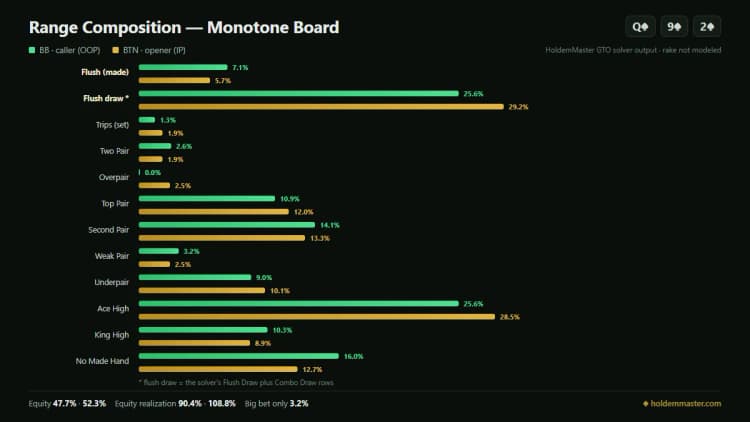
| Category | BB (OOP) | BTN (IP) |
|---|---|---|
| Made flush | 7.1% | 5.7% |
| Flush draw (one spade, incl. combo draws) | 25.6% | 29.2% |
| Top pair (Q) | 10.9% | 12.0% |
| Overpair (KK, AA) | 0.0% | 2.5% |
| Ace high | 25.6% | 28.5% |
The split comes from preflop. The big blind defends cheap suited junk — hands like J4s, J5s and 85s get called from the big blind, and the spade ones turn into flushes. The button never opens them.
What the button has instead is far more offsuit ace-x and king-x with one spade. Not made, but drawing — and this is where the A♠ becomes special. It can make the nut flush, and it also tells you your opponent cannot have one.
How does one spade change a hand's value?
The same top pair is a different hand depending on whether it holds a spade.
Take Q♥J♦ — top pair, no spade. Already behind against 12.0% of the button's full 474-combo range (flushes 5.7 + overpairs 2.5, plus sets and two pair), and behind on the kicker to AQ and KQ on top of that: the Q♠ is on the board and the Q♥ is in your hand, so two queens remain, making 8 combos of AQ and 8 of KQ — 16 of the 428 combos the button can still hold once your Q♥ and J♦ are out, about 3.7%. Counted the same way, everything already ahead of you comes to 68 of 428, roughly 15.9%. On top of that another 29.2% can pass it with one card (⚠ four of those 16 kicker combos hold a spade and are counted in that 29.2% as well, so do not simply add the two figures). That is not a hand for three streets of value; it is a hand that catches a bluff once.
Now take 9♥8♠ — middle pair with a spade. It can win now or improve later, which makes it flexible enough to bet or call.
One suit rewrites the whole ranking on this board.
Why is EQR 90 against 109 when equity is 48 against 52?
Because a board where pots stay small also shrinks the value of position.
| Metric | BB (OOP) | BTN (IP) |
|---|---|---|
| Equity | 47.7% | 52.3% |
| EV (bb) | 2.37 | 3.13 |
| Equity realization (EQR) | 90.4% | 108.8% |
The 18.4 point gap is the second-smallest of the seven single-raised pots, behind 9-8-7 at 13.2. ⚠ Across the series it is only fifth — the blind-versus-blind K-T-6 (7.0) and A-A-6 (9.3) and the 8-5-2 three-bet pot (16.6) are all tighter, and they are different seats. When large bets disappear, so do the difficult decisions — and position is worth exactly as much as the decisions still left to make.
What changes at the table?
- •On a monotone board the big bet is rare to begin with. In theory the big blind's large size falls to 3.2% here. ⚠ Do not run that straight into "so fold one pair to a big bet." The 3.2% is how often the big blind leads, and when you are the one facing a bet, the button's sizing frequencies are not in this solve at all. Look at the button's own column too: made flushes are 5.7% while one-spade draws are 29.2%, more than five times as many — reading a big bet as "flush" folds you out to semi-bluffs. The first thing to check when a big bet lands is whether your own hand holds the A♠.
- •Don't drive a small flush for three big streets. The solver checks non-nut flushes 81.4% of the time (nuts: 69.9%). Take value with small bets, and treat a large raise as the A♠ until proven otherwise.
- •Holding the A♠ promotes a hand to bluff candidate. A bluff made while knowing your opponent cannot hold the nut flush is a different bet from one made blind.
- •Against an opponent who never folds a pair, stop trapping. The 69.9% check assumes the other player bets when checked to; if they only call, bet your flushes and take the money.
Check it yourself
Open the free GTO solver, go to Study Spots → Monotone Board → [⚡ View results].
For this spot the per-hand table at the bottom is the whole lesson — scroll it to the end. You can read why A♠J♠ and A♠4♠ differ by 30 points of checking frequency, and how the same queen splits into two different hands depending on whether it comes with a spade.
Then open the GTO Trainer in the sidebar and let it deal you a flush on this board: picking an action and seeing the EV cost is faster than being convinced by a table. Free, nothing to install, no account.
Review your own hand from this spot — This spot is a BTN open, BB call pot. If you have played the same situation, open the solver's Hand review ↗, set the situation (Open · Call, BTN and BB) and Your seat, pick Your 2 cards and the 3 flop cards, then enter the actions in the order they were actually played, including your opponent's. Hand review then shows whether that choice is rated Best play, Acceptable or Review this play. Hand review uses the app's preflop charts (online 6-max cash, 100bb), so its numbers can differ from the example above, and it may not suit pub games or tournaments.