The flop comes 8♦ 5♣ 2♠. You three-bet before the flop, the board is as dry as it gets, and you are holding A-K. No pair, and nothing better than backdoor draws. This is where checking feels obvious.
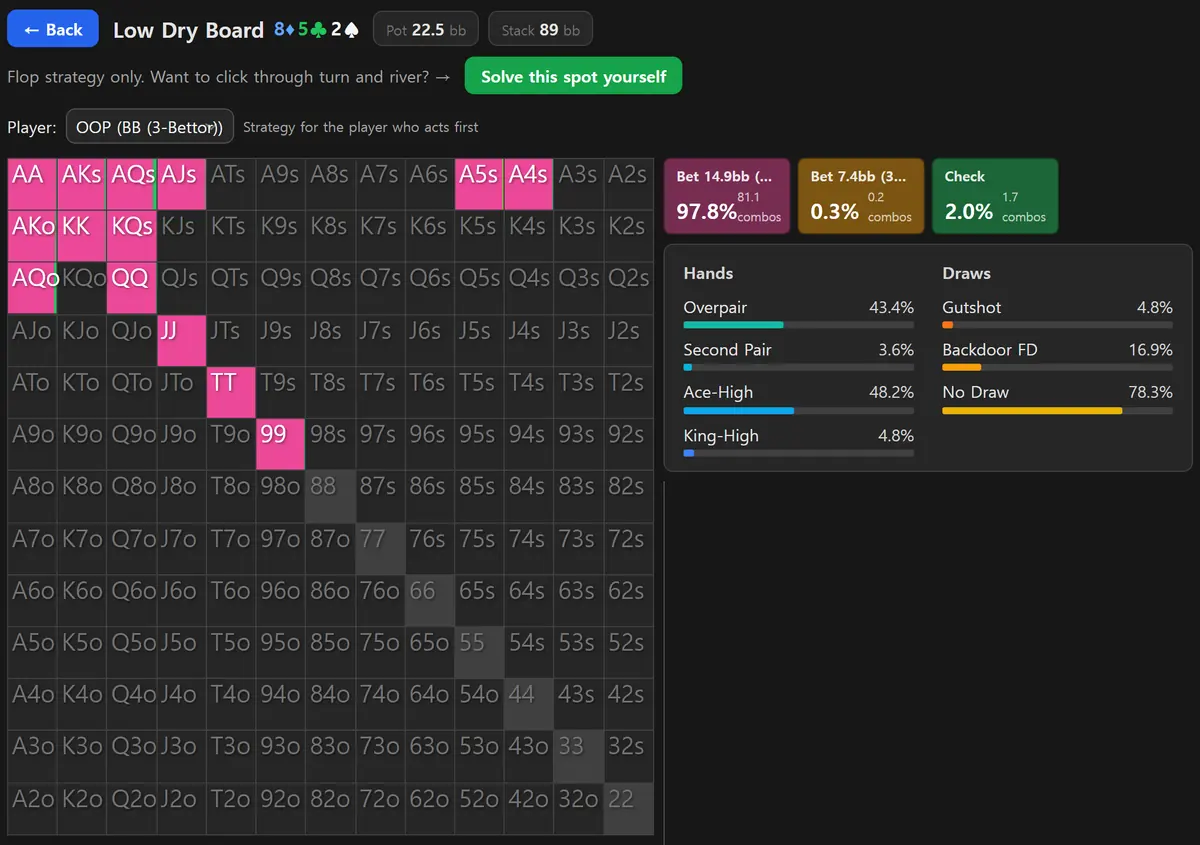
The solver does the opposite. It bets 14.9bb — two-thirds of the pot — 97.8% of the time. And this is not a statement about A-K. Of the big blind's 83 combos, the number that actually paired this board is three.
Why a range that hit nothing fires the big size is what the numbers below are for. All of them come from HoldemMaster's free GTO solver.
✦ Quick answer
On 8-5-2 in a three-bet pot the big blind bets two-thirds of the pot 97.8% of the time. Yet of its 83 combos only three — the A5s — paired the board, and 88, 55 and 22 are not in the range at all. The bet still goes in because the range splits into 36 combos of overpairs (43.4%) and 40 combos of ace-high (48.2%) with almost nothing between them. Very strong or nothing at all — when the middle is empty, the size goes up.
What conditions produced these numbers?
The same three-bet-pot setup as the  A-K-2 and
  Q-T-7 spots. Only the board changed.
| Item | Setting |
|---|---|
| Preflop | BTN opens → BB three-bets to 11bb → BTN calls |
| OOP · IP | OOP = big blind (three-bettor) · IP = button (caller) |
| Flop | 8♦ 5♣ 2♠ (three different suits) |
| Pot · stack | Pot 22.5bb · effective stack 89bb (SPR 4.0) |
| Bet sizes | About a third of the pot (7.4bb) and two-thirds (14.9bb) |
| Rake | Not modeled |
| Checked | 2026-08-08 (study spot result) |
How often does the three-bettor actually bet?
The large size, 97.8% of the time. Almost identical to the wet board in the previous spot (98.4%).
| The big blind's first action | Frequency | Combos |
|---|---|---|
| Bet 14.9bb (66% pot) | 97.8% | 81.1 |
| Check | 2.0% | 1.7 |
| Bet 7.4bb (33% pot) | 0.3% | 0.2 |
Did only three combos really pair this board?
Yes — three combos of A5s. Laying out all 83 combos:
| Category | Share | Combos | What it is |
|---|---|---|---|
| Overpair | 43.4% | 36 | AA · KK · QQ · JJ · TT · 99 |
| Ace-high | 48.2% | 40 | AK 16 · AQ 16 · AJs 4 · A4s 4 |
| Second pair (5) | 3.6% | 3 | A5s |
| King-high | 4.8% | 4 | KQs |
| Set/trips | 0% | 0 | 88, 55 and 22 are not in a three-betting range |
| Top pair (8) | 0% | 0 | Nothing in the range holds an eight |
There is exactly one gutshot too. The four combos of A4s are one card — a three — away from the A-2-3-4-5 wheel. The solver's draw panel splits into three mutually exclusive rows: gutshot 4.8% · backdoor flush 16.9% (14 combos) · no draw 78.3%. That is not "78.3% is whatever is left after the gutshot." All three have to be added to reach 100, and the backdoor 16.9% sits between them (it needs runner-runner suited cards, so it completes about 4.2% of the time).
Why bet big with a range that missed?
Because the range splits into "very strong" and "nothing," with an empty middle. When the middle is gone, the size goes up.
The 36 overpair combos take the entire top of the big blind's range. From AA or KK, the only hands beating you are the button's nine combos of a set. At the other end, the 40 ace-high combos beat almost nothing at showdown against the range that calls a big bet — though against all 144 of the button's combos the picture is different, since 58.3% of them missed this board too.
⚠ Do not treat the overpairs as one block, though. The button holds overpairs of its own — 16.7%, 24 combos of QQ, JJ, TT and 99 — so the big blind's 99 loses to 18 of them, TT to 12, JJ to 6. The ranking runs inside the "overpair" row as well.
| Range shape | Size |
|---|---|
| Strong, medium and weak spread evenly (a range bet) | Small — the medium hands need to get called |
| Strong or nothing (polarized) | Large — with no middle, there is nothing to protect |
⚠ That is not the same as "start small and you lose the path to getting it all in." You do not. Starting with 7.4bb: called, the pot is 37.3 with 81.6 behind; two-thirds of that on the turn is 24.6, leaving a pot of 86.5 and a stack of 57.0; the river shove of 57.0 is 65.9% of the pot. And the size is not chosen by stack depth anyway — the A-K-2 board sits at the same SPR of 4.0 and uses the small size 57.8% of the time. What produces the large size here is the polarized range, not the SPR.
And the 40 ace-high combos win as soon as the opponent folds. 58.3% of the button's range is ace-high, king-high or no made hand on this board. ⚠ "Missed" is not "folds," though — the node for how the button responds to a bet is not in this solve, so no fold frequency comes out of it, and the button's ace-highs run A-K down to A-T, which keeps some showdown value. When a bluff is actually profitable is covered in bluffing strategy.
Why are all the sets on the other side?
Because 88, 55 and 22 are not in a three-betting range, and they are in a calling range. This is the first spot in the series where the top of the board belongs entirely to the in-position player.
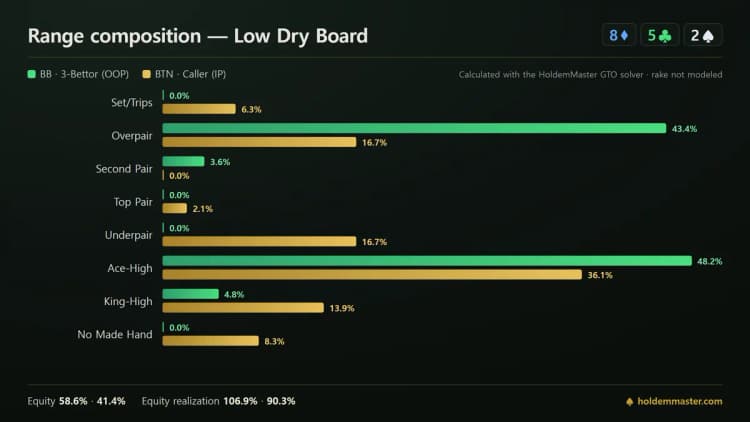
| Category | BB (three-bettor) | BTN (caller) |
|---|---|---|
| Set/trips | 0.0% | 6.3% (9 combos) |
| Overpair | 43.4% | 16.7% |
| Top pair (8) | 0.0% | 2.1% |
| Second pair (5) | 3.6% | — |
| Underpair | — | 16.7% |
| Ace-high | 48.2% | 36.1% |
| King-high · no made hand | 4.8% | 22.2% |
This shape matters at the table. All the sets are on the other side, and the big blind has nothing above them — so its overpairs are not the nuts here.
⚠ Do not turn that into "if a raise comes back, the overpair beats nothing." Two reasons. First, the node for responding to a raise is not in this solve — the study spot stops at the flop's first action. Second, it is not true anyway: to raise against a 97.8% range bet you need bluffs mixed with the value (nine combos of a set), and AA and KK beat everything in that raising range except those nine combos.
Why does the caller realize more equity here than in the last two spots?
The button's realization climbs to 90.3% in the same three-bet-pot structure. It was 78.7% and 75.1% in the previous two. ⚠ It is not that the button alone went up — the two EVs sum to the pot, so with the equities held fixed, one side's gain in realization is the other side's loss. Across different boards the equities move too, so that link is not automatic — but here it is what happened: the big blind came down from 117.8% to 106.9%. Here, at least, these are two sides of one fact.
| BB (OOP) | BTN (IP) | |
|---|---|---|
| Equity | 58.6% | 41.4% |
| EV (bb) | 14.09 | 8.41 |
| EQR | 106.9% | 90.3% |
| Three-bet pot, three boards | BB EQR | BTN EQR |
|---|---|---|
| A♦K♠2♥ dry (⑧) | 109.6% | 78.7% |
| Q♥T♥7♠ two-tone (⑨) | 117.8% | 75.1% |
| 8♦5♣2♠ low (⑩) | 106.9% | 90.3% |
A low board is where the three-bettor stays ahead but converts that edge into money least well. Its 58.6% equity is actually a shade above Q-T-7's 58.3%, while realization drops from 117.8% to 106.9%. ⚠ Do not read the 15.2-point move on the button's side (⑨ 75.1% → ⑩ 90.3%) as "what the opponent takes home" — EQR is the ratio of equity realized, not a share of the pot. By actual share, this button books 8.41 ÷ 22.5 = 37.4% against ⑨'s 7.04 ÷ 22.5 = 31.3% — a gap of 6.1 points.
What changes at the table?
- •Do not default to "I missed, so I check" on a low dry board. In a three-bet pot your opponent missed too — 58.3% of the button's range failed to make a pair here. ⚠ Do not convert that 58.3% into a folding share; the response node is not in this solve. The reason to bet is not "they fold" but "my range is polarized, so the large size earns its keep."
- •But do not treat an overpair as the nuts when a raise comes back. All nine set combos are on the other side, and the button also holds 24 combos of QQ through 99. Your 99 and TT are overpairs that lose to overpairs.
- •Against someone who rarely folds, cut the ace-high portion. The 97.8% figure rests on the fact that much of the opponent's range missed. ⚠ Again, "58.3% missed" is not "58.3% folds" — no fold frequency comes out of this solve, and the button's 36.1% of ace-high is the A-K, A-Q, A-J, A-T family with no weak aces in it. 🪶 Facing 14.9bb into 22.5bb the MDF is 60.2%, but that is a starting point, not a calling quota — MDF treats the bet as a pure bluff with zero equity, whereas the range betting here contains 36 combos of overpairs, so that assumption does not hold. Whether the true optimal defense sits below it is a question this solve does not answer. Against a calling station, firing ace-high twice and three times turns the whole bluff portion into losses; narrow to the overpairs for value instead.
- •From the button, small pocket pairs are worth more here than anywhere in this series. 88, 55 and 22 make sets, and 77, 66, 44 and 33 are all ahead of ace-high. That is the exact opposite of the A-K-2 spot, where the underpairs were helpless. How the three-betting range is built decides this, and that is in
 3-bet strategy.
 - •Count the SPR before you bet. At SPR 4, two-thirds-pot twice (14.9 → 34.5) plus a river shove of 39.6 empties 89bb precisely. Once you bet the flop, the rest of the stack is one or two more bets away, so decide before that first bet which turns and rivers you will keep firing on — the turn and river are not in this solve, and a runout or an opponent can still change the answer.
Check it yourself
Every figure here comes up if you open the GTO solver and hit Study Spots → "Low Dry Board" → [⚡ View results]. To play the same spot as a problem instead, open the GTO Trainer from the sidebar — it deals you a random hand, and once you pick an action it shows the mixed frequency and the EV loss (bb) of your choice. Your history is kept on this device by default; signing in with a HoldemMaster account syncs your Study Spots and Daily Challenge history across devices.
Look for the missing "Set/Trips" row in the hand panel. Then switch the player to IP (BTN) and it appears at 6.3%. That one line is the whole story of who holds the top of this board. Free, no install, no account.
Review your own hand from this spot — This spot is a 3-bet pot: BTN opens, BB 3-bets and BTN calls. If you have played the same situation, open the solver's Hand review ↗, set the situation (3-bet pot, Opening seat BTN, 3-betting seat BB) and Your seat, pick Your 2 cards and the 3 flop cards, then enter the actions in the order they were actually played, including your opponent's. Hand review then shows whether that choice is rated Best play, Acceptable or Review this play. Hand review uses the app's preflop charts (online 6-max cash, 100bb), and its larger flop bet is 75% of the pot rather than 66%, so its numbers can differ from the example above, and it may not suit pub games or tournaments.